I am an artist. All art is autobiographical. Creation is concentric – not linear. Invention is instantaneous. Design adjusts and polishes. Buildings grow out of each other. (Guedes 1982).
The Capital of Mozambique, since its independence from Portugal ratified in 1975, is called Maputo (from the name of the river which marks its Southern border and evoked in revolutionary slogans). Before then, it was known as Lourenço Marques, in honour of the Portuguese explorer and merchant who explored its bay in 1544, and became the capital in 1907. It is a testament to the outcome of a dual planning concept typical of several colonial cities: the informal settlements (caniços – huts) and the structured city (Xilunguíne – city of the white people) with a semi-annular circulation which separated them both geographically and ethnically. The former is still called ‘city of reeds’ and is inhabited by the poorer social groups, the latter is the ‘city of concrete’, or simply ‘the city’, where upper-middle classes live; the semi-annular artery – still very visible today – traced a well-defined demarcation line which was not untraversable (at least according to Pancho Guedes).
This paper is about the Laurentian city from 1950 to 1975, the economic, political, administrative and residential center of the former Portuguese colony of Mozambique. And it’s about the contribuition of an author (Pancho Guedes, 1925-2015), which makes the architecture-urban plan dialectic evident in relationship between the architecture and the city. The individual projects (architectures) of the author can be individually interpreted as epiphenomena of the city or as fragments of an otherwise modern authorial interpretation[1].
This production is equally connected to the genius loci as much as the genius temporis, and confirms both the duality and the identity of the city. «Creation is concentric – not linear. Invention is instantaneous. Design adjusts and polishes. Buildings grow out of each other» (Guedes 1982). Reference is made to the texts of A. Magalhães and I. Gonçalves: Moderno Tropical. Arquitectura em Angola e Moçambique 1948-1975 (2009), and of A. Faria Ferreira: Obras Públicas em Moçambique. Inventário da Produção Arquitectónica Executada entre 1933 e 1961 (2008) for a more comprehensive description of the importance of the Modern Movement in Mozambique, of the Ciam’s influence both in architecture and city planning before the independence, and of the relative autonomy with respect to the impositions of a português suave architecture (both nationalist and neo-traditionalist). It is also worth remembering Italian studies on the subject, from the most recent ones by F. Vanin (2013, 2008) to the previous ones by F. Accasti and G. Ferracuti (1987). In order to correctly recreate Laurentine trend, the rich volume by A. Lobato: Lourenço Marques, Xilunguíne published by Agência-Geral do Ultramar in Lisbon 1968 must be quoted. Although it is the Obras Públicas which add new information and detailed descriptions on emblematic buildings of this period, highlighting the work of the most active architects, the majority of whom were trained in Portugal (‘the African generation’[2]), with the exception of A. d’Alpoim Miranda Guedes, who had studied at the university of Martienssen, the Witwatersrand of Johannesburg. It is always Faria Ferreira who brings out the role of Lusitanian architects within the Portuguese department in charge of public works in Mozambique. The author outlines the role of Fernando Mesquita (1916-1990),who the introduction of modern principles of architecture within the institutions is owed to. The Lusitanian architect proposed, in fact, an architectural planning inextricably linked to the context, especially in relation to weather conditions, and promoted projects for schools in rural areas (which Lisbon was not particularly in favor of). Mesquita influenced generations of professionals and was also a mentor (and a supporter) of Guedes. Upon his return to the city and fresh on his studies (1945-1949) Mesquita encouraged him towards an informed independence from the stylistic drift of the Modern Movement which was already raging in town, justifying speculations and eclecticisms with a tropical taste[3].
In the 1950’s and 1960’s there was something restless and extraordinary in the beautiful city built by the Portuguese in less than 50 years and that was called Lourenço Marques [...] At the time, Mozambique was a closed and ideal world in which there was only good news, inaugurations and speeches from the Império (Empire). It was a world of rumours, secrets, gossip and an ever-growing web of informers and agents, but where, in spite of everything, anything seemed possible (Guedes 1998, p. 9).
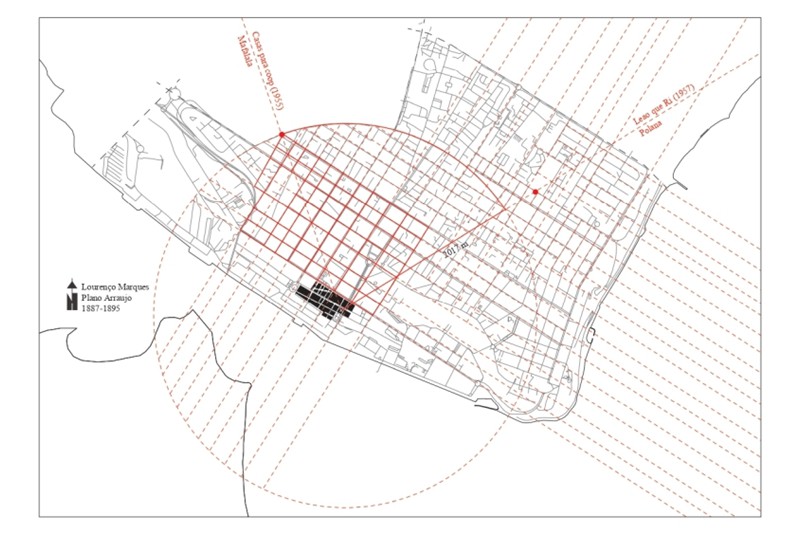
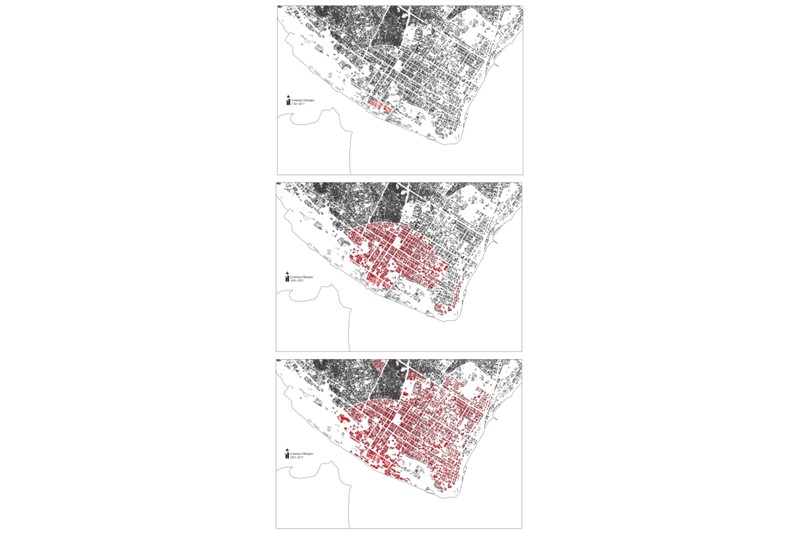
The ‘city of concrete’ of the Guedes years was still the one of the Plano Araújo (1887-1895), based on a Cartesian grid which tied the three most important and representative locations of the status quo at the time (the railway, the harbor and the hospital) and, with a clear mark, traced the border by means of a belt, linking the Governor’s palace to Ponta Vermella and to the train station. The ‘Regime Provisório’ picked up the legacy of the Araujo’s plan, and in 1909 defined the contours of the new capital. Its center has been situated at the crossroads between avenida Pinheiro Chagas and avenida Castilho and a 2017 meters radius that would trace an annular separation between the city of the settlers and that of the natives. The radial strategy, initially conceived as a defensive measure, had been preserved until the last Portuguese city plan (Azevedo Plan).
Despite an intense political strategies’ activity and accompanying economical deviations that impacted the capital of Mozambique, few and vague city-planning instruments have accompanied its growth and shape. In fact, the choice of a pattern characterized by long and wide tree-lined avenidas managed to compensate for both the expansion and the city design, fostering a polyphony of architectures which seemed to speak different languages but had a common grammar. After the Plano Araújo, the Aguiar Plan dates to 1952 and the zoning studies of the Polana and Pott areas date to the early 1960s, as well as those proposed by Mesquita. Mention should be made also of the Azevedo Plan (1965-1969), conceived to eliminate the urban discrimination in favor of neighbourhood unity (typical of informal settlements). The demographic growth (both within and outside the belt) and the political pressure (the start of the African colonies’ independence movements) together with cogent sanitary requests, convinced the central Salazarian government to undertake a serious reflection on the actual status of the ‘province’[4]. Azevedo changed the paradigm and, for the first time in Mozambiquan urban planning history, turned the attention to territorial scale. He recorded in 23 volumes almost one hundred chapters on as many topics and actions, both original and slavishly described. By reducing the written part to the strictly essential, a sizable number of urban planners and architects put a great effort in a vast number of designs and diagrams in order to make them universally comprehensible (in other words, not only by those knowledgeable in the trade, but also specifically accessible to the villages’ heads). It is still unknown whether Guedes and the urban planner-engineer in charge Mário de Azevedo ever cooperated on the subject, however for the first time a representative of the institutions included the villages and the multiple ethnic groups of Mozambique in a masterplan. If previous plans were only aimed at the city of the settlers[5], this last plan conveyed visibility and urban status to the informal/formalized caniços settlement, to Guedes’ sick city[6]. The Azevedo Plan would never be implemented: since the 1950s, communist and dissident cells found fertile ground on the very same palhotas (huts) of the informal city (caniço): Eduardo Mondlane’s (1920-1969) Frente de Libertação de Moçambique was born.
For complete disclosure and conclusion, it should be noted that independence did not manage to produce structural plans until the 2000s, thanks to the work of the Luso-Mozambiquan J. Forjas (2008). The newly-born People’s Republic of Mozambique, of Marxist-Leninist nature, prioritized a commendable literacy and sanitary hygiene campaign, which covered the whole country in a few years. At the same time, first President Samora Machel (1933-1986) invested a lot of effort in changing the appearance and stain of the informal city of the Laurentine capital re-naming it Maputo, and therefore confirming it as the Republic’s capital city. Formalizing the former Lourenço Marques capital, to many signified not unburdening themselves from the economical dynamics that had actually legitimized it[7]. The city is in fact located in the Southern-most part of the country: for many, the natural choice should have fallen on the more central, fertile and densely populated Nampula. With regards to this, Guedes referred to Maputo as a ‘schizophrenic city’[8] because of its insane duality between the caniços and the cidade de cimento, between natives and settlers, between indigenous Mozambiquans and Luso-Mozambiquans, but also due to the stretch of confirming it as the political capital, despite the benefits (political, pro-peace process) that Nampula would have definitely guaranteed. Machel’s policy, in reality, was exacerbating the toxic colonial-style dichotomy: by trying to change the appearance of informal settlements he was implicitly depriving them of value and identity. The expropriation policy of the ‘city of concrete’ in favor of the inhabitants of the caniços produced the opposite outcome: huts and shacks (palhotas melhoradas) were in fact immediately occupied by new internal migratory waves (rural population) while the city center’s buildings were being inhabited by former residents of the caniços. New residents but same divisive dynamics: the belt continued and continues to this day to mark the city. At the dawn of independence, the new residents of the former white people’s city didn’t know how to inhabit buildings that were so different from their shacks, and ended up vandalizing those quarters so desired yet so alien. Eventually preferring to relocate again beyond the annular belt, confirmed the alternative and suffering nature of those quarters. It has taken years to bring back a settling procedure, by adopting the very cautions and micro-interventions advocated by Azevedo. Before the end of the millennium, thanks also to the newly created Maputo Faculty of Architecture (1986), many of the expropriated buildings had found a ‘new balance’: the government, after implementing a ‘planned occupation’ with an ad-hoc committee (APIE: State Property Administration) selected and matched functions-buildings and inhabitants-residences through ‘merit’ and roles within the governance of the country and city criteria. This choice ratified the transition to today’s political-social context of certain construction projects and influenced the current real estate market.
The city, until the independence of the country, can be charted, therefore, as a semicircle within which a well-ordered set of lots are serviced by the same number of broad streets, perpendicular to the north-eastern coast, and of orthogonal avenidas. Within the grid there were luxurious gardens, governmental and institutional buildings. The years following the Second World War saw an important agreement between Portugal and the United Kingdom, that was asking to use the railways system to reach the mines and the harbor (which was also used by the Dutch), in exchange for customs duties and support in case of internal aggressions. The Salazarian dictatorship’s isolationism had brought a progressive impoverishment to the Country which had to surrender real estate investments in its Eastern African colony to private individuals. If during the 19th century Lourenço Marques had been the Eldorado of city planners and engineers (at the beginning it was a conglomerate of huts with a vast swamp separating it from the bay), during the 20th century the circumstances favored the architects. The ‘free’ lots of land identified by the urban plans were available for construction: commerce and naval companies, banks and services companies invested in the overseas colony and future province, which was acquiring the profile of an «African city with a continental atmosphere» (Vanin 2008, p. 137)[9].
In Mozambique, access to a private-style economy allowed for a certain amount of independence from the overseas motherland which also translated into architectural freedom, enriching the city with an unusual quantity and quality of new citizens. Quoting Guedes: for twenty years, there would be more customers than architects in Lourenço Marques (many of whom were trained in Portugal – these are the years of F. Távora and A. Siza). During the same period, in Europe, focus was directed to the post-war reconstruction and to the CIAM’s debates. If on one hand the non-participation to the international discussion (due to the dictatorship) had influenced the choice of certain Portuguese architects to emigrate, on the other hand the frantic work commitment (in Lourenço Marques, Nampula, Beira) left no time for internal debates nor for sharing ongoing experimentations. Experimentations concerning the geography of the Tropic of Capricorn (in terms of weather and techniques) and the varied provenance of customers, influenced the design of the buildings, especially in Maputo, where the vast majority of them are still present (Faria Fereira 2008).
It’s a known fact that the architectural production in an African colony is often the work of a limited group of professionals, who are culturally homogeneous (in this case, Lusitanian architects) operating in a relatively limited timeframe. It is also the result of the role assigned to the (extreme) weather conditions, of the (limited) amount of building materials and of the (basic) available techniques[10]. In order to understand the unusual range of architectural languages present in Lourenço Marques, in addition to these factors, it should be also taken into account the provenance of the clients (tastes and requests) who arrived in the city not only to invest but also to permanently settle and live. The absence of particularly restrictive urban planning instruments generated even a more favourable situation for so many diversified architectural designs to establish themselves in a self-regulating fashion. Within so many non-dogmatic architectural writings, Guedes’ work finds permanent placement and substance (Accasti 2002, pp. 105-112).
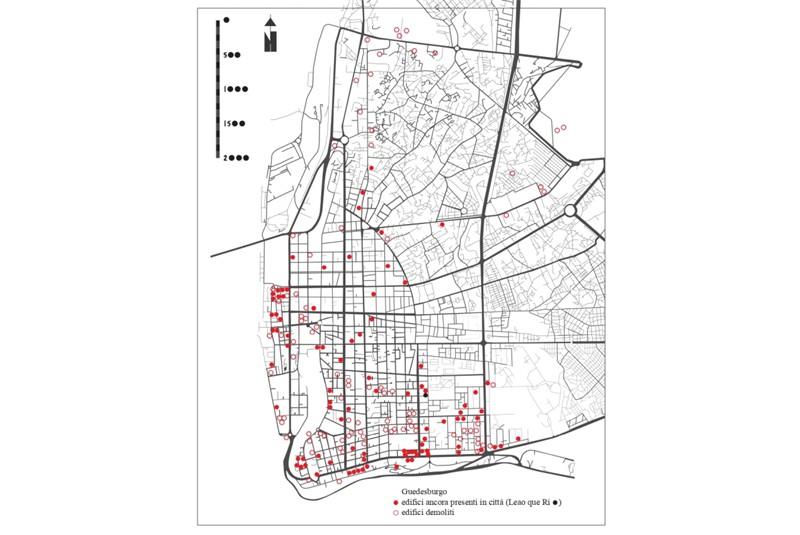
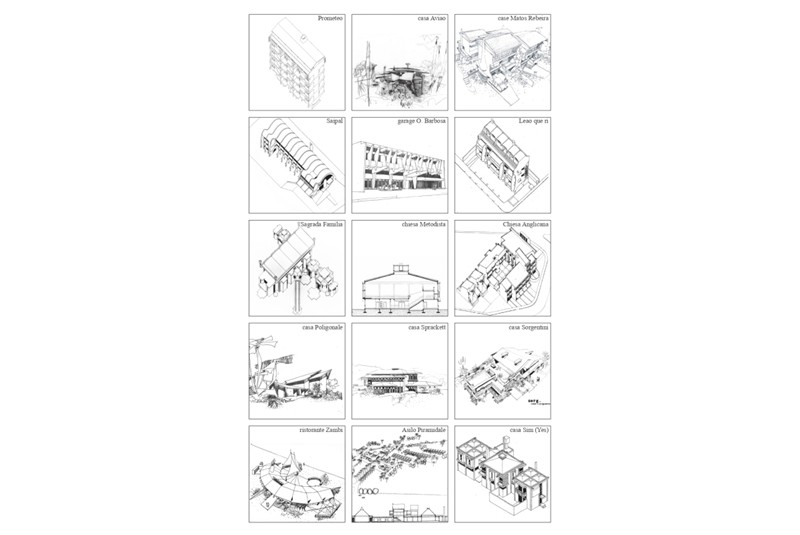
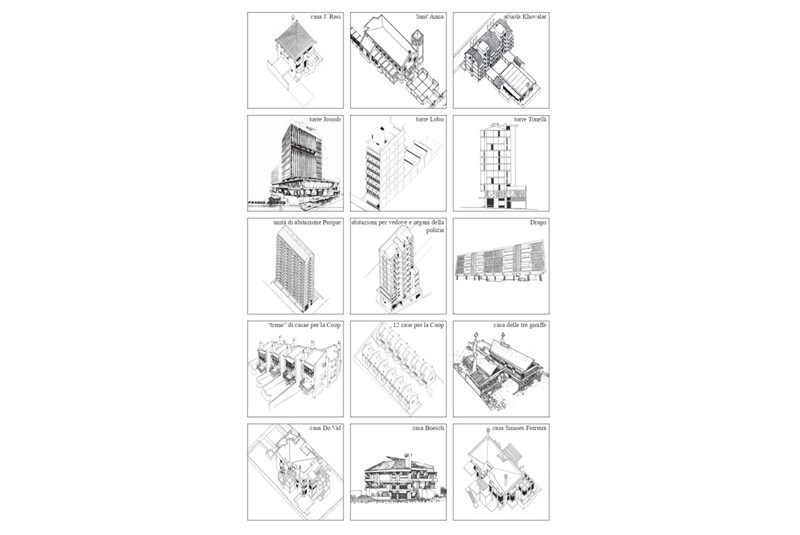
Guedes, after the experience at Mesquita’s, chose to join the practice of engineer Vitale Moffa[11], who will make the calculations for the first projects of the author, substantiating its plastic shapes. If on one hand the Portuguese mentor had steered the planning process of Amâncio Guedes towards an approach aimed at finding solutions for the environmental factors (temperature, ventilation, light and shade), on the other hand the Italian Moffa would put such approach in place through building techniques in an audacious synthesis of performance and expression. The peculiar plastic use of concrete provides Guedesian architectural designs with an eccentric character known as “stiloguedes”[12] and will give the city a vibrant tone and character. Out of the almost five hundred projects registered in Mozambique between 1950 and 1975, today in Maputo, some 112 have been traced and identified[13]. The office buildings and company headquarters have become ministries and institutions; banks, churches and certain schools have retained their original purpose; villas were ‘adopted’ by privates[14]; survived single-family houses, semidetached housing and the residential buildings Dragão and Prometeo are inhabited by today’s metropolitan middle classes. The Zambi restaurant was the best at the time of its construction (1954) and is still the most elegant location in town, together with the Polana hotel. The Coop (Cooperativa de construção de habitações) houses in the former ghetto-neighbourhood of Mafalala are inhabited by ‘intermediate’ population (for the major part people of mixed origins), as are several apartment buildings (Torre Parque and others located in outer zones which are closer to the belt). Like anywhere else in the world, the buildings inhabited by more frail social classes are managed by the government and are in various stages of neglect. Following the success of the retrospective Vitruvius Mozambicanus (Lisbon 2009) and the exhibition Pancho Guedes. A Aventura da Arquitectura, o desafio ao formalismo (Maputo 2010), the attitude of condemnation and oblivion towards this uncomfortable architect who notably animated the cultural life of Lourenço Marques by promoting a dignified independence from Portugal, seems to have steered towards a more favorable opinion. In 2010, five of Maputo’s buildings by Pancho Guedes came to the attention of the commission for the Pritzker Award (the former Saipal Bakery, the Leão que ri apartment building, Santos e Rocha offices building, Casa Avião, Casa Três girafas). At the same time, some works have been bound by national decree and a dozen entered the register of the ‘representative of national heritage’ works (Lage, Carrilho 2010). On the contrary, some buildings were demolished or are about to be demolished, in favor of real estate speculation.
The famous house for dr. Luz de Sousa (House of the Three giraffes, 1953), is also destined to this unfortunate fate, though being shortlisted by the Hyatt Foundation’s commission.
A challenge to formalism (o desafio ao formalism): the alien ingredient, for which the diversity of the Guedesian language is recognized, seems to be the author’s biography. Pancho Guedes in fact, was raised in Africa from the age of three and was educated at the post-Martienssen school (non-Eurocentric modernism), unlike his colleagues who were working at the same time in the city. They were coming from the Lusitanian school and because of the dictatorship destined to an orthodox architecture of nationalistic style (Português Suave) therefore bound to be ousted from the debate on the Modern, although its echo would nurture their forbidden fantasies. Although buildings characterized by organic geometries were deeply rooted in the architectural culture and training trends of the time, the Lusitanian architects who relocated to Mozambique experimented, for the most part, the so-called Tropical Modernism, adopting the practical British characteristics (Tropical architecture in the humid zone dating to 1956) and paying particular attention to Chandigarh, whose project was also joined by Fry e Drew in 1951. Guedes was getting his inspiration from Le Corbusier too: he was very interested on the corbusian subversive freedoms of figurative interpretations. Guedes was quite tepid towards the more (at the time) acclaimed projects, whose shapes to his opinion were not representative of the Swiss’ architect poetic. Not ordinary are the works by Amâncio d’Alpoim Miranda Guedes and extra-ordinary is the volume of projects completed, a peculiarity that did not escape Alison Smithson’s attention when in 1962, during the presentation of Guedes to Team X, renamed Lourenço Marques as ‘Guedesburg’ (Smithson 1991, p. 39).
It’s not just building, per se. It’s building worlds (Hejduk 1991)
Guedesburg is a thick grid of marks, traces, notes, images that inhabit, speak, describe, organize and interpret an artificial landscape that overlays a mix of shapes and objects of the growing African city. A language that is arbitrary, necessary (Ferreira 2013), recognizable in the multiple combinations and variations of morphemes: an itinerary that must be chased, from one object to the other, to tie together the threads of a narrative still imbued with pathos. The first guedesian known building to be built is from 1950 (Polygonal House, for the Barbosa family) that was followed, one year later, by the first apartment buildings (Dragão, Prometheus), the first office building (Jossub) and the family house Casa Avião (for the Leite Martins family). In one year, and before earning his license (translated in Lisbon in 1953), Pancho Guedes had started to populate the capital with objects that had designs never seen before, with coatings made of revisited pebbles or colourful murals of Dadaist style. Appearances that occupied the Laurentine grid’s lots of the Aguiar Plan, abiding to the applicable laws: 5-10 meters from the border opposite to the entrance, 14 meters in depth (or 17 meters if patios are present) with overhanging objects allowed for maximum 60 cm, and an height depending on the base of the building, following a 45-degree angle. Every architect, respecting those rules, was free to execute his project to his own preference. Vanin calls it Maputo città aperta [open city]: a sum of houses that was being rapidly built while exploring multiple directions.
After I arrived in Lourenço Marques I learnt that Otto Barbosa wanted to build a new house. I went to him and presented him with a batch of drawings for polygonal house, based somewhat on the floor plan of the Annie House that wright had built in California. The drawings were a success and in fifteen days the project was put out to tender (Guedes 2009, p.130).
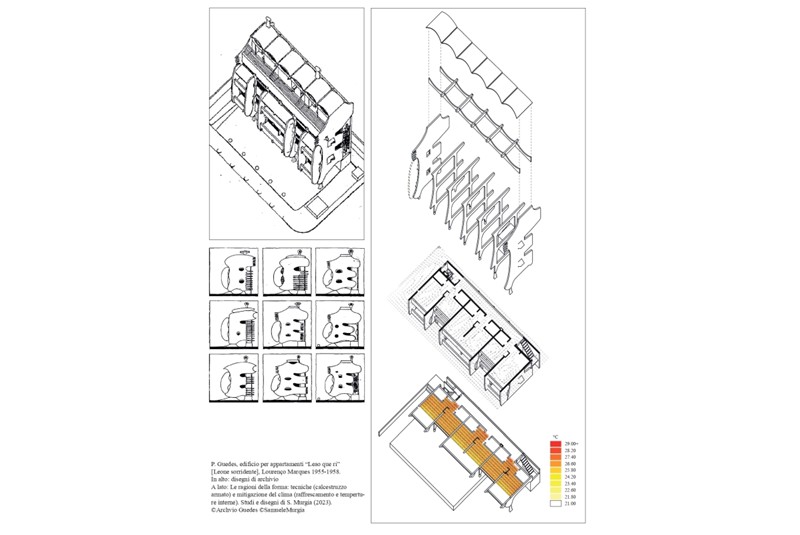
Among the several captions of the projects in the Vitruvius Mozambicanus of 2009 (the catalogue of the most complete Guedesian corpus available to date) it is not uncommon to find descriptions of building sites, with completion and design timeframes. There we learn that a project would enter the building site phase fifteen days after the client’s placet (to whom Guedes would submit three separate proposals), that it would take six months to realize a single-family residence and up to two years for a tower-like project. Guedes preferred to describe his work through thematic-focusing, grouping projects into families[15], but if one was to go through his projects chronologically, recurring names can be found: the director of Banco Totta after the bank’s headquarters will commission his single-family residence and then maybe also an investment (town houses for renting), same for the Barbosa (first the family house, then the garage) and for the Boesch (the company’s offices, the family residence, the daughter’s house, a hotel), the Simões, the Lopes da Silva, the Spence, the Tonelli families and others. Guedes built customer loyalty: the author’s style adapted to the function, the location, the scale, and at the same time would feed the client’s imagination. The language is recognizable, it’s meant to impress without flattery. Guedes is first of all his own customer, with his house in rua Navala n. 915 (twin houses, 1950) where he experiments unusual (unseen) and cheap shading systems (ceramic cylinders tightly arranged to fill the vast window openings) and through a double asymmetrical garden (one in front and one on the back) he allows cool and private spaces, moving many domestic activities in revisited ‘winter gardens’. The floor plans are instead academic in nature, traceable to the modernist teachings he had just learnt through his studies. But it is with the adjacent building that Guedes experiments his most daring language: the Leão que Ri apartment building (1958), the most iconic of Guedes’ body of work. Initially conceived for the family (one floor dedicated to living quarters and the atelier-workshop, four apartments to be rented out and the housekeepers quarters on the roof level), it was instead used to house the numerous community of Mozambiquans that inhabited his studio (the very same Malangatana and Honwana with their families, to name the most known ones, but also designers, artisans and workers etc.[16]). A classical pillar-beam system ensures the building’s stability, the floorplans are simple and the choice of a layout distribution that uses external walkway provides the apartments with a double view, which translates into the precious cross-ventilation (Murgia 2024). The Lion stands on six unevenly tall pillars, clearly defining the contour of a continuous partition on which the upper part of the supports would lean on leaving an horizontal ring through which the canopies of the Guedes residence’s trees garden can be seen. The pillars on the front side, shaped with a descending section (and whose bases sink into the ground highlighting the firmness of their hold) are at full length and craft a covered and shaded clearing on the façade (today the bays have been filled and are housing retail shops). If the plan layout is not innovative, the sections translate the author’s imagination within the environmental constraints and architectural limitations. The long sections interpret the role of the double-façade to safeguard the apartments from the heat and direct sun radiation in favor of internal comfort (Murgia 2024): walkways on one side and loggias on the other are enclosed by winding partitions that appear to be sliding off their respective support surfaces. The precious structural overhangs (allowing for fewer sections and a lower usage of iron) end with lines of whalebone-like elements that, pointing up to the sky are also ensuring the flexing momentum balance (Murgia 2024). Exotic wall-paintings frame the Lion’s neck whose head is protected by a light vaulted cover. The roof is a tray populated by volumes protected from the sun, of Corbusierian memory. The shorter sections are made of continuous brickwork and, by containing any potential deformation due to horizontal actions, they give shape to profiles that challenge the most grotesque formalism and highlight the presence of the Smiling Leão. Today, though being part of the ‘national monuments’ and being inhabited, is in a serious condition of neglect. The residential contracts are of a social nature and the maintenance should be guaranteed by the government, which however does not consider this a priority.
The Lion, ‘well-tamed’ by Guedes, continues to smile at us notwithstanding its apparently inevitable destiny as a ruin and as everlasting memory of the style it heralds:
family of buildings with spikes and fangs, with beams tearing into the spaces around them, made as if some parts are about to slip off and come crashing down, with convulsive walls and armoured lights (…) The plans of the Stiloguedes buildings are simple, quite straightforward and functional. It is the sections that are contorted, decorated and full of exaggerations. It is the sections and their reflections on the facades that are the architecture. They stretch the mysterious relationship between plan, section and facade and turn these works into strange apparition. (Guedes 2009, p. 79).
Guedes was also an architect of the Cooperativa de construção de habitações and by putting his signature on several low-cost semidetached houses, he broadened his audience of European admirers. Working pro bono he also made his mark in the caniços, therefore earning the natives’ respect. This was both unheard of as well as troublesome, confirming and hardening the hostility of the party scrutinizing officials (the PIDE, Portuguese Secret Services, which had a significant file on him). Guedes conquered the outskirts of the city with the Coop Houses (1955, 1956), the Methodist Wesleyan Church (1967), Santa Ana da Munhana (1966) and most of all with the Clandestine Asylum (1968, demolished).
The calculations are easily made and explain the author’s 500 projects. When in 1962, aged 37 and not even ten years after graduating, he joined the Team X, he presented himself with a selection of 25 completed projects[17]. In the span of 20 years the Mozambiquan countrysides were populated by ‘ultramarine Portuguese homes’ in search of a Portuguese-African style, and the capital would put in action a relevant modernist repertoire, in line with the emerging work of Drew-Frey and Königsberger but with most uncertain outcomes, as demonstrated by the Guedesian appearances.
If we accept Vattimo’s interpretation, that the identity is defined through the differences (Vattimo 1988), then the heterogeneity defines the identity of Lourenço Marques whose Guedesburg is a whisper.
Guedes’ fantastic and magical architecture arises from the incitement of a vast network of artists and thinkers that Guedes himself had supported, drawing from multiple contexts. In the Guedesian landscape, the Modern Movement of the South African declinations of Martienssen and the Brazilian of Costa and Niemeyer, the special experimentations of Gaudì, Wright, Kahn and Nervi, all coexist. The Guedesian landscape includes the activism of the “Black Morpheus” magazine and Ulli Beier, the African Art Congresses and Franck McEwen, CIAM and Team X, and lastly the new African artists he sponsored (from Bettina Lopes to Malangatana). During the 1950s, in an Apartheid Africa from Mozambique, Rhodesia and South Africa, Guedes understood the need of producing an authentic and primordial art, ‘art for authentic artists’, which would herald in a personal dimension, an authorial research centered on all formal dimensions, and on the possibility for architectural elements to carry and express emotions: «I claim for architects the rights and liberties that painters and poets have held for so long»[18]. Guedes tries to master the universal motifs of the primitive, blending them with his own heterogenous architectural culture. The author, from the magazine L’Architecture d’Aujourd’hui, argued that architecture should not be perceived as an intellectual experience, but rather as a feeling, as an emotion (Guedes 1962). Guedes was devoted to the research of such a quality «that had been lost among architects but was able to reach a spontaneous architecture capable of magical intensity» (Guedes 2007, p. 12). The unbiased need to discover an alternative modernity was the response to an internal call, but also to an Africa that was being born in the midst of contemporaneity, to a new world in ferment and of which traces still remain in Maputo to this day, the Guedesburg of the day. Guedes is witness to and operates in an era in which architecture was open to popular culture, in which architecture without architects and architecture of fantasy were accepted. But it is also the era of complexity and multiple solutions open either to continuity and to the Modern Movement crisis, which resulted from the equation between reason and emotion (Giedion 1941).
Notes
[1] For the Altro Moderno – Otherwise Modern, refer to the studies by L. Semerani. As Ana Tostões remembers: «alternative modernity was the answer to an inner appeal, but also to an Africa dawning to contemporaneity, to a new world which was in a state of ferment. Pancho witness and acts in a time when Architecture is open to popular culture, when architecture without architects and architecture of fantasy are accepted» (Tostões 2011, p. 20; italic is not of Tostões). ‘Visionary Architecture’ is the title of the renowned 1960 exhibition at MoMA.
[2] “The African generation”. J. Aires, F. Castro, J. Garizo do Carmo, C. Lopes, F. Mesquita, B. Ramahete, P. Sampaio, A. Soerio, J. Tinoco and others.
[3] «Pour certains, le mouvement moderne a rempli sa tâche, et l’architecture est entrée dans l’ère du raffinement et du classicisme. En réalité, le cancer des styles prolifère à nouveau, plus mortel et terrifiant que jamais.Mais pour nous autres, qui demeurons jour après jour dans notre totale solitude, nous savons que nous resterons toute notre vie des hors-la-loi, ou que nous nous trahirons.» (Guedes 1962, pp. 42-48).
[4] In 1951 Mozambique’s transition from the status of Colony (that is a country controlled by another country) to that of Province (1951), that is a non-subordinated part of the Portuguese territory. It must be noted that in 1949 Portugal became a member of NATO, with all the conditions thereof, among which guaranteeing peoples’ freedom of self-determination. The Portuguese assimilate and are assimilated. This condition is true for both Mozambique and South Africa. The Luso-Mozambiquans are a ‘new society’ settled in Mozambique and coming from Portugal. This deep-rooted belief made the natives even more hostile, as they considered the Portuguese on one hand as usurpers of their country with ensuing identity shift, and on the other made the 1975 expulsion even more painful. Even Guedes defined himself as an exile.
[5] With a surprising exception of the 1940s: the Munhuana-type neighborhood, an urban-planning for the city periphery.
[6] A cidade doente – The Sick City. Various Prescriptions for Curing Reeds Disease and the Handbook for the Self-Taught City Councillor is a manifesto where Pancho Guedes by highlighting the extreme lack of balance of Lourenço Marques, promoted initiatives for an urban redevelopment aimed at bringing the two souls of city closer to one another. This manifesto was censored, nevertheless it was published in 1963 on the daily paper «A Tribuna» edited by J. Reis (Vaz Milheiro 2007, pp. 30-33, 66-73). Guedes will expose himself again on the issues of the caniços with a paper published in 1971 by Pau Oliver in Shelter of Africa (pp. 200-209).
[7] Lourenço Marques-Maputo was born as an outpost to defend the colonial economic profits of the 1900s. Until 1887 the capital city was Ilha de Moçambique, in the central region of Nampula, waypoint for the routes that connected Portugal with India.
[8] Guedes calls it ‘schizophrenic city’ in the manifesto A cidade doente (cit.).
[9] Vanin reports a slogan from an illustrated pamphlet dated 1954 and published by the Portuguese Ministry of Tourism. The author makes an interesting reflection on the role of tourism (of its propaganda) in the creation of the Mozambican collective imagination (and myth).
[10] There was no iron and steel industry in Mozambique: iron for constructions and infrastructures was imported from South Africa. There was instead an important cement factory (the CCM - Companhia de cimento de Moçambique) to which Guedes and Moffa would turn to for experimentations of structural prefabrication. There were no training schools nor specialized workforce. All these circumstances favoured small inventions both from technical-structural and morphologic standpoints and led Guedes to train locals in order to have specialized teams of workers that Guedes employed in all his building sites, even beyond urban and national borders (Guedes 2009, p. 272).
[11] Vitale Moffa (Campobasso 1910 - an. year of death) arrived in Mozambique in 1942, surviving the Nova Scotia shipwreck. Besides his collaboration with Guedes, at present nothing else is known about him.
[12] «Stiloguedes is my own most idiosyncratic manner, my royal family as it were. It is a family of buildings with spikes and fangs, with beams tearing into the spaces around them, made as if some parts are about to slip off and come crashing down, with convulsive walls and armoured lights» (Guedes 2009, p. 79).
[13] During the exhibition ‘A Aventura da arquitectura, o desafio ao formalismo’ (Maputo, March-May 2010), Walter Tembe, a former student of Guedes mapped and identified 112 buildings by Amancio Guedes on behalf of the Camões Institute, which was sponsoring the exhibition. Meanwhile another half a dozen buildings have been ‘rediscovered’ (2023).
[14] Casa Salm (1965, where the Smithson were hosted in 1970), is currently the residence of the Italian ambassador, Casa Simões Ferreira (1968) is the residence of the ambassador of Finland and Casa Almiro do Vale (1966) is the residence of the ambassador of South Africa.
[15] Guedes groups and talks about his buildings as if they were members of families or books, using a terminology borrowed from De Architectura by Vitruvius. The Guedesian families make ‘formal islands of signs’ real, their features representing the very vision of the author and, in the same fashion, changing according to the situation. (Santiago 2007, p. 113).
[16] The Guedes family was anti-colonial and strived to let the entire population have some sort of rights through the only possible process at the time also known as Assimilation. The term assimilado referred to natives who had officially and entirely abandoned the customs and traditions of their origin, who could speak, read and write in Portuguese, were monogamist, had an occupation of some sort that was compatible with the ‘European civilization’ or that «had been acquired through lawful means, that allowed them to feed, maintain, buy clothes and provide themselves and their families with a proper abode». The Guedes family employed many people, some of whom were also offered accomodation, scholarships and opportunities to go abroad.
[17] In the same period Aldo Van Eyck, founder and member of the Team X, who was seven years older than Pancho Guedes, had ‘only’ worked on the projects for the three schools of Nagele (1955-56) and the orphanage of Amsterdam (1955-60). Van Eyck wasn’t particularly drawn to Guedes although he recognized his ability to grasp the many opportunities he encountered. «Whatever space and time mean, place and occasion mean more» he said in 1963 to the students of Wits who had organized a workshop and had invited Pancho Guedes, J. Beinartjenk and Peter Smithson to participate in it too. (van Eyck 1962, p. 20).
[18] Introduction statement to Guedes’ graduation thesis which he presented in Johannesburg in 1952.
Bibliography
ACCASTO G. (2002) – “Tropicalia. L’università del moderno e l’architettura gioiosa di Âmancio Guedes”. In: CUPELLONI L. (edited by), Mozambico: pensare, fare, insegnare l’architettura. Alinea editrice, Florence.
D’ALPOIM MIRANDA GUEDES A. (1962) – “Y aura-t-il une architecture?”. L’Architecture d’Aujourd’hui, 102, 42-48.
D’ALPOIM MIRANDA GUEDES A. (1963) – “A cidade doente - várias receitas para curar o mal do caniço e o manual do vogal semmestre”. A Tribuna, 6 may.
D’ALPOIM MIRANDA GUEDES A. (1971) – “The caniços of Mozambique”. In: OLIVER P., Shelter in Africa. Barrie & Jenkins, London.
D’ALPOIM MIRANDA GUEDES A. (1982) – Some reworking and a few recent adventures. Cape town university, May.
D’ALPOIM MIRANDA GUEDES A. (1989) – “Lembrança do pintor Malangatana Valente Ngwenya quando ainda jovem”. In: NAVARRO J., Malangatana Valente Ngwenya. Caminho, Lisbon.
D’ALPOIM MIRANDA GUEDES A. (2009) – Pancho Guedes. Vitruvius Mozambicanus. Museu Colecção Berardo ed., Lisbon.
FARIA FERREIRA A. (2008) – Obras Públicas em Moçambique. Inventário da Produção Arquitectónica Executada entre 1933 e 1961. Edições Universitárias Lusófonas, Lisbon.
FERRACUTI G. (1987) – Da Lourenço Marquez a Maputo. La riconversione della città coloniale tra ideologia e politiche urbane. F. Angeli, Milan.
FERREIR Z. (2013) – “Local and Global Modern Thinking. Designing with Climate in Mozambique: School Buildings Production”. Docomomo Journal, 48, 83-87.
GALLO A. e SEMERANI L. (2000) – L’altro Moderno. Gallimardi, Turin.
GIANI E. e BRKLJACIC M. (2020) – “El saber necesario. Reevaluando Didácticas del proyecto. Pancho Guedes y la otra modernidad”. AREA Agenda de Reflexión en Arquitectura, Diseño y Urbanismo [e-journal], 27(1).
GIANI E. (2022) – “Genius loci et temporis. Time capsules for recording memories”. In: AA.VV. Changing Cities V: Spatial, Design, Landscape, Heritage & Socio-economic Dimensions, pp. 377-386. Corfù, 20-25 june 2022.
GIEDION S. (1941) – Space Time and Architecture. The Growth of a new Tradition. Harvard University press, Massachusetts.
LAGE L. e CARRILHO J. (2010) – Inventario do património edificado da Cidade de Maputo. Catálogo de Edifícios e Conjuntos Urbanos propostos para classificação. Edições FAPF, Maputo.
LOBATO A. (1968) – Lourenço Marques Xilunguíne Biografia da cidade. Agência-Geral do Ultramar, Lisbon.
MAGALHAES A. e GONCALVES I. (2009) – Moderno Tropical. Arquitectura em Angola e Moçambique, 1948-1975. Tinta da China, Lisbon.
MORTON D. (2019) – Age of concrete: housing and the shape of aspiration in the capital of Mozambique. Ohio University Press, Athens (USA).
MURGIA S. (2024) – Oltre la forma. L’opera di Amâncio Guedes (1925-2015). Degree Thesis (rel: E. Giani), Venice.
SANTIAGO M. (2007) – Pancho Guedes. Metamorfoses Espaciais. Caleidoscopio, Casal de Cambra.
SHAPHIRO D. e HEJDUK J. (1991) – Conversation between David Shaphiro and John Hejduk. A+U, 244, 01.
SMITHSON A. (1991) – Team 10 Meetings, 1953-1984. Rizzoli Intl Pubns, New York.
TAVORA F. (1963) – “O encontro de Royamont”. Arquitetura. Revista Arte e Construção, 79 (luglio), 1.
TOSTOES A. (2011) – “Fantasy must be brought back into architecture”. RA: Revista de Arquitectura, 19, 20.
VAZ VAZ MILHEIRO (2007) – Pancho Guedes, Manifestos, ensaios, falas, publicações. Ordem dos Arquitectos, Lisbon.
VANIN A. (2008) – Maputo, città aperta. Indagini su una capitale africana. PhD Thesis in Urbanism (rel: B. Bruno, B. Secchi), Venice.
VANIN A. (2013) – Maputo, cidade aberta. investigação sobre uma capital africana. Fundaçao Serra Henriques, Lisbon.
VAN EYCK A. (1962) – “About place and occasion, the in-between realm and labyrinthian clarity”. In: For Us. Ciclostile della Wits, pp. 20-23.
VANIN A. (2013) – Pancho Guedes. Vitruvius Mozambicanus. DODO Iuav, Venice.
VATTIMO G. (1988) – Le Avventure della Differenza. Che cosa significa pensare dopo Nietzsche e Heidegger. Garzanti, Milan.