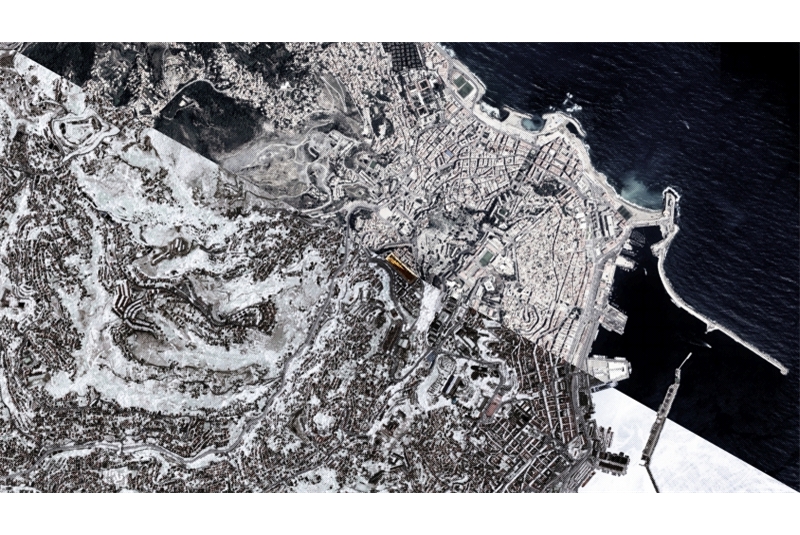
Climat de France (geographic coordinates: 36.78409840917006, 3.0470636861083786), originally situated in the Climat de France district, now Oued Koriche, refers to a public housing complex. It was intentionally named with geographical-political homonymy during the French colonization of Algeria to affirm France’s necessity, if not indispensability, in the political and daily choices of the country. Built during the years of the Algerian War of Independence (1954-1962)[1], it was conceived as a “civilizing” project to provide homes for the Muslim populations (then referred to as indigene in French) overcrowding the shantytowns of Algiers. Climat de France employed design strategies such as structural rigidity, serial repetition of elements in compositional syntax, the closed form of the “enclosure,” and an urban scale mismatch, assertively shaping the resolution of a space that accommodates living out of necessity, assigning civic tasks to architecture that surpass private ones.
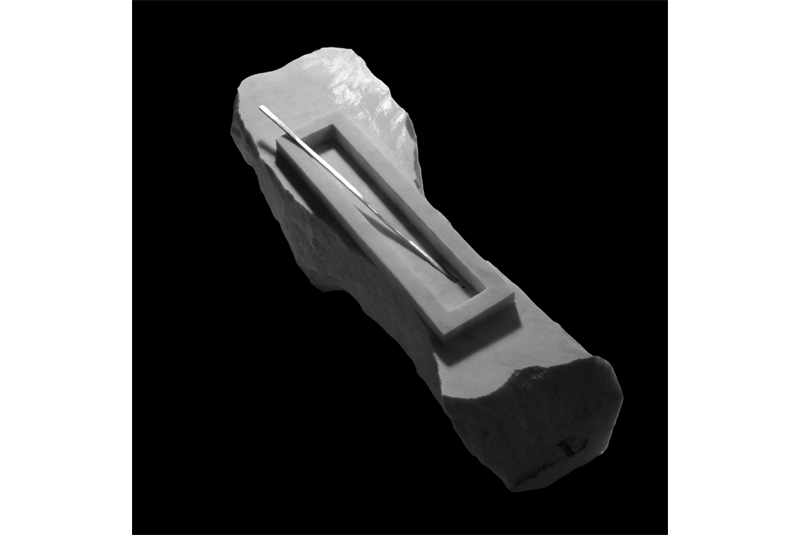
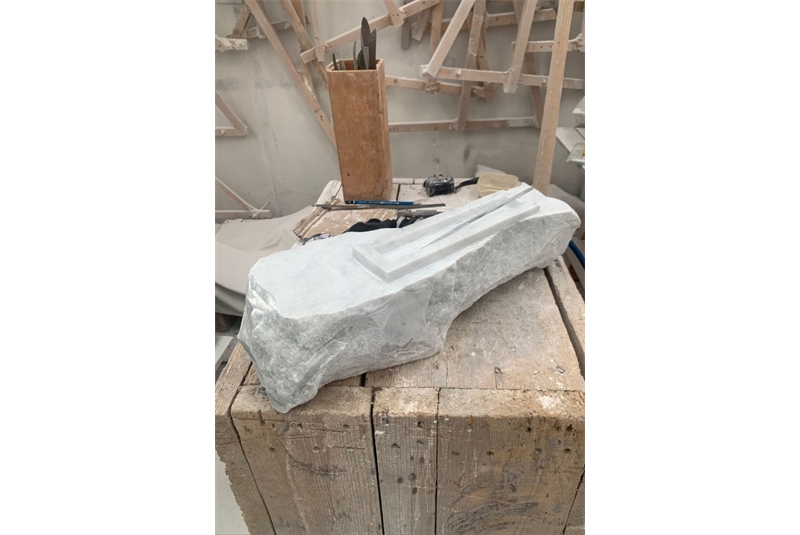
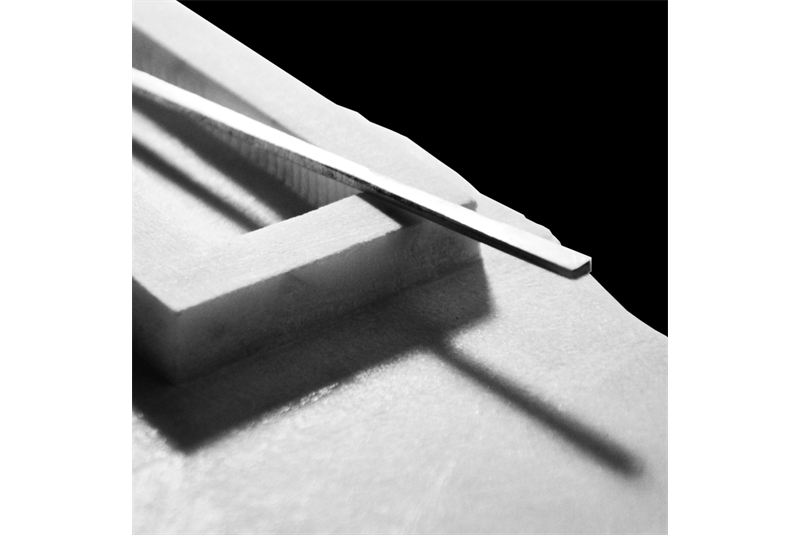
From these premises, the project of a memorial within the monument emerges, reflecting a desire to engage with the strategies outlined in the project. This paradoxical approach aims to reveal incongruities, limitations, and constraints within the symmetrical structure. An oblique and walkable blade rotated concerning the symmetry of the monument's enclosure (Fig. 1), cuts through the internal space of the “square of two hundred columns” (also known as meidan) like a great wound, allegorically attempting to represent the difficult and conflictual relationship between Algeria and the Muslim populations. The goal of the inhabited and traversable memorial is to exit the enclosure, use the square as both shade and conquer the horizon, both celestial and chthonic, in opposition to the static composition of the facade and thus the entire architecture of Climat de France.
The Existing: the Monument
Within the square of two hundred columns of Climat de France, the stone colonnade unfolds with a one-meter module, while the internal facade, made of red bricks and featuring openings, is structured on a sixty-centimeter module. The spans of both reconnect every three meters. From the square, the rhythm of the bricks triumphantly emerges above the stone colonnade. Pouillon has reactualized other ancient composition systems. This is not negligible, as it provides a free source of architectural and urban quality improvement (Sayen 2018, p. 31). As confirmed by Catherine Sayen’s words, the compositional tactics of the monument resurface, highlighting the architectural value of the enclosed space, including its contemporary relevance.
The square of two hundred columns, though conceived with private intentions, is the empty part of Climat de France that constructs both the project and the public part of the construction. Paradoxically, if one were to consider erasing the enormous project, it would result in the annulment of a secondary system of squares, accesses, spaces, and typological-morphological variations that anchor themselves to exist. It is the destiny of a public building to become a monument for these reasons, i.e., for the degree of relationship it imposes on the surrounding design relationships. Climat de France establishes another curious paradox, admitting, within its space of existence, a percentage of domestic everyday life that opposes, by nature, the monument:
The monument ‘Climat de France’ was born. It encompassed thirty hectares. What to think today of this composition? Is it a success or a failure? I could not say… Nevertheless, I am certain that this architecture was without contempt. Perhaps for the first time in modern times, we have installed human beings in a monument (Pouillon 1968, p. 207).
The internal space, the paysage intérieur (Pouillon 1968, p. 207), becomes the center of Pouillon’s reflection: the large square conceived as a space of interaction, two hundred thirty-three by thirty-eight meters, turns out to be dominated by the horizontal dimension, drastically restricting the inhabitant’s perceptual field, enclosing them within a highly regulated perimeter. The extremely precise geometric proportions, based on the numbers one, three, five, seven, establish, for the courtyard of Climat de France in a limited rectangle, as described by the author himself:
The composition of this monumental “meidan” of the humblest settlement in the world can be described by the numbers 1 to 9… 1 was the side of the columns and the height of the base. 2, the space in between the columns. 3, the dimension of the monolithic lintel. 4, the width of the portico. 5, that is multiplied by 8, the dimensions of the square. 6, that is multiplied by 40 (the dimension of the square) the length. 7, that is multiplied by 40, the overall length. 8, the height of the columns. 9, the height of the portico (Lucan 2003, p. 26).
Climat de France is also an architecture of numerology and therefore properly monumental: the two hundred columns contrast with the four thousand five hundred housing units[2], the two meters in height of each interior, and the fifteen thousand square meters of the square translating into overcrowded domesticity hidden within the “Ottoman”[3] fortress in Algiers. In the idea that the symbol-monument has civic functions, Climat de France goes beyond this univocal definition and admits public and domestic presence in the monument, downgrading its authority and simultaneously elevating its uses. According to Pouillon’s words, calling the residential area a monument, a fundamental countertendency emerges, undermining Climat de France’s main characteristics: the domesticity of the anti-monument.
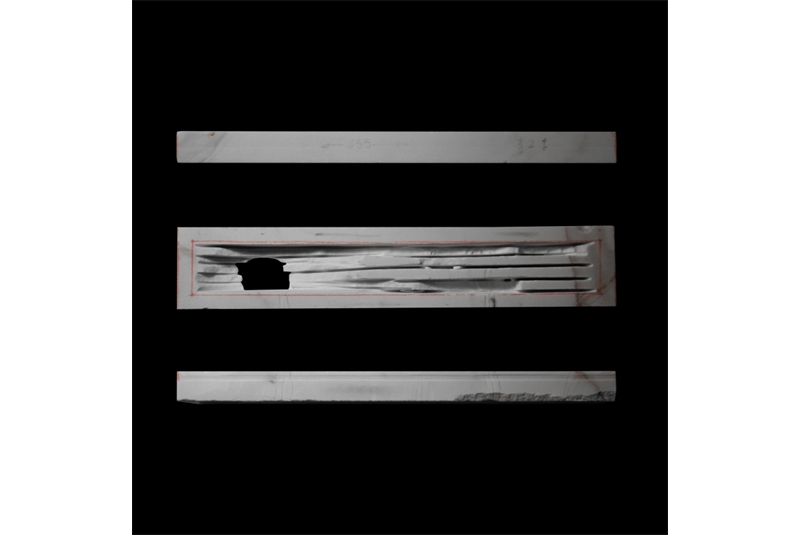
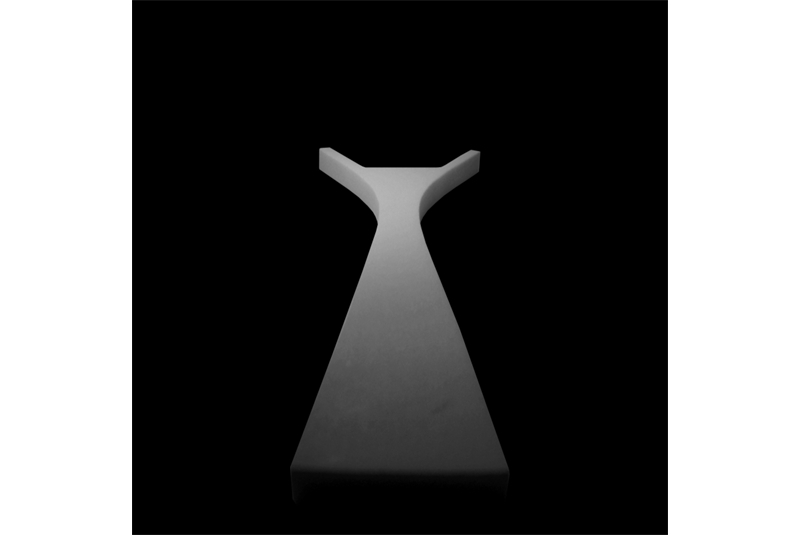
The hung white sheets, the parabolic antennas for television signal reception (almost one for each of the two hundred columns), the structure of a network determining the end of an ideal temporary football field set up inside the square, and the numerous cars contribute to the disruption of the solemnity of an inhabited monument. These internal paradoxes within the monument project have contributed to outlining the moves for the design of a memorial (Fig. 2) that insisted on the square and attempted to bring out, even in harmony with reality, the same short circuits.
To the Oblique: a Memorial
A few years ago, with this phenomenon not yet existing - author Claude Parent refers to the phenomenon of crowd migrations - the small closed worlds of the agora, the forum, and the public square were sufficient to contain the crowd. There was discipline in space. Currently, the crowd overflows. Its daily or seasonal deployment must not and cannot be obstructed. Channeling it is a temporary makeshift solution, absolutely unacceptable and insufficient under the pressure of popular dynamics (Parent 1978, p. 65).
Parent’s imaginative words contribute to building an imaginary reference for the “memorial” project. Consolidated urban spaces, such as the square, will need to exceed their capacities with the increasing population. Parent argues that the square, as a space that blocks rather than opens, becomes an obsolete urban configuration, even as a social model. Similar conditions have also affected the square of two hundred columns, currently used as a private storage space by the inhabitants, who do not use it as a square, probably also due to the absence of shade conditions. In 1970, Parent supported the idea of pedestrian circulation as the new main engine for inhabiting space, especially urban space. Extending circulation, and therefore urban exploration as well as living on facades[4], allows considering urban space as a territory completely controllable, where, with no other tools but one’s body, it would have been possible to go, know, and possibly live.
The most interesting consequence of this space contraction is to allow finding the CALM of the linear path of the pedestrian while still within possible travel times, less than half an hour. Speed is no longer the essential vector of our cities. Movement can be LIVED again and not JUST endured as a fate, as lost time (Parent 1978, p. 69).
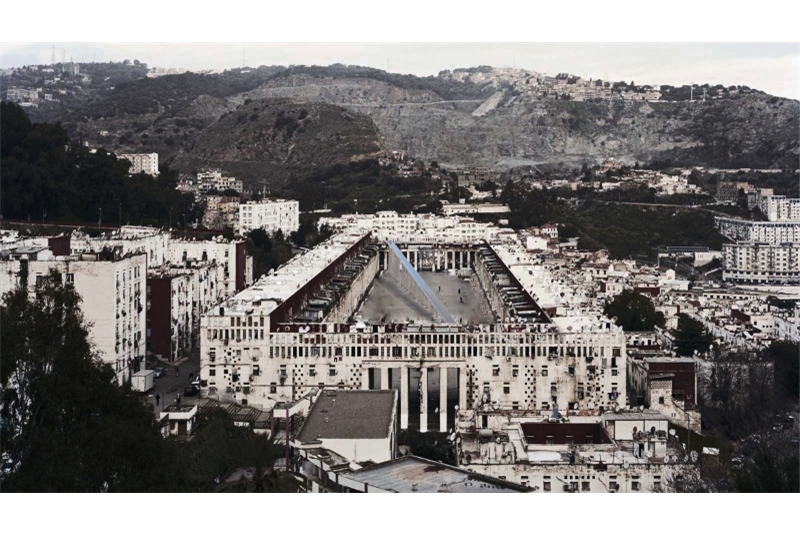
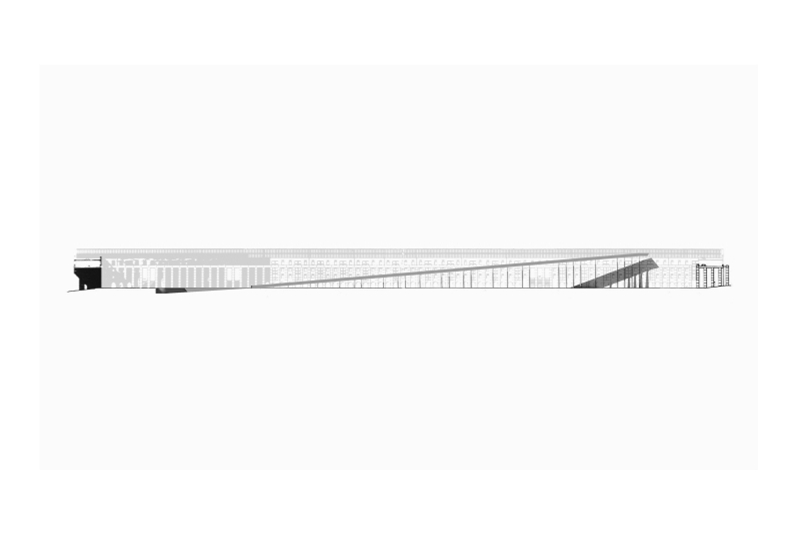
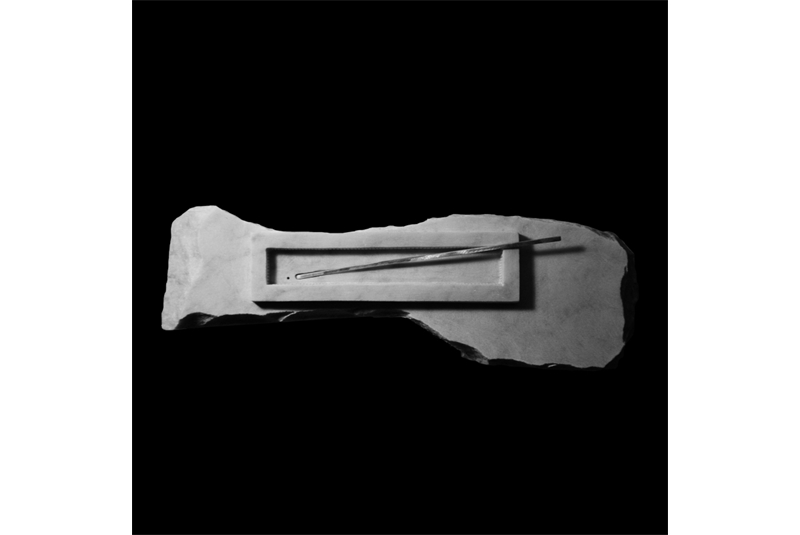
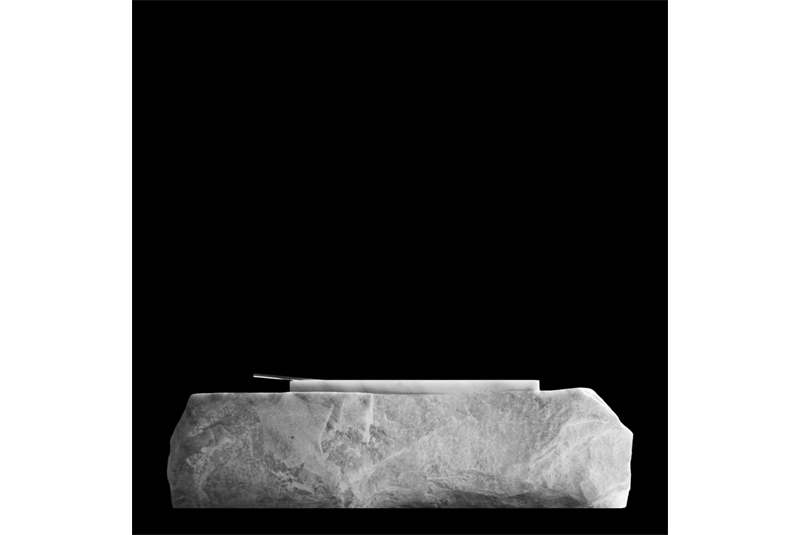
The memorial proposal embraces Parent’s considerations by identifying in the obliquity of the walking plane, in the exploratory use of the body, and in the reinterpretation of existing architecture as a “traversable” tool the key points of the reflection on the square of two hundred columns of Climat de France. An oblique plane, rotated fourteen degrees concerning the longitudinal symmetry axis, crosses the entire square’s length, reaching the summit level reached by the horizontal arm of the enclosure facing west. The oblique plane, besides extending along the entire length of the square, establishes a horizontal crossing of the ground at the southeast-facing angle, working the section with excavation, thus defining exploratory subterranean spatial coordinates (Fig. 3). From the roof plane, the oblique and rotated blade sharply contrasts with the monument's rigorous compositional articulation, almost touching the sacred enclosure. From above, the memorial reveals something of its antithetical compositional nature: a walkable pedestrian surface starts from the ground level of the square to reach the neighborhood’s summit level, while, conversely, also starting from ground level, a pedestrian path five times smaller than the above-ground one reaches the subterranean level and anchors to the sky through an oculus, which in plan becomes the ideal head of the silent cadavre exquise lying inside Climat de France. The reaching of the sky, its conquest, and the construction of alternative points to reach the blue become the project’s pretext for the composition of the walkway.
The plan, drawn on the repetition of a constantly tripartite module based on the number three, cuts through the internal space like a large wound, allegorically emphasizing both Algeria’s definitive independence from France and the contradictions and conflicting dynamics within the Algerian and Muslim community.
The above-ground walkway, consisting of a walkable and flared “C” –profile metal structure, is opacified and reflective: it continuously reflects life inside the building, the surrounding colonnade, and the sky. This structure is interrupted exclusively at the exit holes towards the outside, constantly reminding of the divisive function of the colonnade, which, contrary to its original purpose, effectively reduces to an impermeable wall. The ascent to the top is slow and obstacle-free, the slope is gentle, the path is gradual. Once the summit is reached, beyond Climat de France’s imposing walls, the view towards the outside is regained, rediscovering the relationship with the natural element, the external space. On the opposite side, however, the walkway intercepts the ground level, identifying a ground crossing and reaching a chthonic space, which, like the Nuragic well of Santa Cristina, unfolds a section that reflects through the water deposited at the bottom, the sky.
The memorial, fitting into a vast enclosure that excludes everything outside, through its obliqueness attempts to denounce the fall of such an obsessively precise and schematic system.
Sculptural Puntelli as Architectural Technique
The support system governing the walkway and enabling its existence are conceived from the use of sculptural props. The puntello[5], the idea of an autonomous part in marble made up of deliberately left excess material for support and masked (see the hand touching the knee in Myron's Discobolus or the drapery in Bernini’s David) or left exposed (as in Praxiteles’ Hermes with Dionysus), becomes the technical component allowing the walkway’s support. The props take on a Y-shaped form in elevation, through a broad support base that, in the central body of the prop, narrows almost to strangulation and widens again towards the top, accommodating the walkway’s silhouette inside. The rhythm of the puntelli in plan is dictated by the technical support needs, generating a curious case of random rhythmic alternation unrelated to Pouillon's design. The puntello, thus freed from the need to become a mask for something, reveals its technical component through architectural application. Sculptural supports, long ignored by sources as such or camouflaged even in the name, have often tended towards invisibility, to «rettificare l’immagine dell’opera» (Anguissola 2018, pp. 596). The puntello, supporting the walkway, ideally connects the ground with the inclined plane, making the square’s ground an integral part of the memorial. The adoption of the support as a visible and “shown” part of the memorial contributes to making the project “sculptural” and “sculpture” technical, exchanging the parts and roles that the fields have usually occupied over time.
*In memory of Alessandro Mosti “Indian”
Notes
[1] The cultural events that affected the independence of Algiers and the conflictual relationship with the Muslim populations and with the French regime were represented by the director Gillo Pontecorvo in The Battle of Algiers (1966).
[2] French journalist and anti-colonialist critic Albert-Paul Lentin provides an accurate description of the units: «deux pièces à plafond bas (2 m de haut), l’une de 2 x 3 m, l’autre de 3 x 3 m, une cuisine minuscule, un cabinet d'aisance, des fenêtres étroites» (Lentin 1963, pp. 146-147).
[3] The scale and relationships between the Algerian architecture built during the Ottoman domination became a design reference for Pouillon (Pouillon 1968, p. 205).
[4] Also note: «L’habitant, circulant sur la ville, sur les façades, non seulement n'est plus canalisé, mais bénéficie de connexions si directes qu’il peut choisir la voie piétonne sans être handicapé, car le temps de parcours diminue» (Parent 1978, p. 69).
[5] «Puntèllo.
Bastone o trave di legno da puntarsi, ossia mettersi a contrasto per
l’ÚNTA, cioè per ritto, onde serva di sostegno (v.
Puntare)» (Pianigiani 1907, voce puntello).
Also: «Puntello. Sbarra di legno o di metallo, opera
muraria e, in genere, elemento ad asse verticale, o anche
inclinato alquanto rispetto alla verticale, che, fissato a un
solido punto d’appoggio, serve come sostegno di
strutture (muri, armature di gallerie, scavi ecc.), soprattutto quando
esse si trovino in condizioni statiche incerte, usato anche in
nautica.» Enciclopedia Treccani online, consulted on 15/07/2023.
Bibliography
ANGUISSOLA A. (2018) – “I Limiti Del Marmo I Supporti Della Scultura Antica Nella Storia Della Critica”. Archeologia Classica, 69, 579-613.
AVERMAETE T. (2007) – “Climat de France: Fernand
Pouillon’s Re-invention of Modern Urbanism in Colonial Algiers”.
OASE Journal, 74, 118-138.
CARUSO A. e THOMAS H. (edited by) (2013) – The Stones of
Fernand Pouillon: An Alternative Modernism in French Architecture. ETH
Hönggerberg, Zurich.
DUBOR B.F. (edited by) (1987) – Fernand Pouillon. Architetto delle 200 colonne. Electa, Milan.
LENTIN A-P. (1963) – L’Algérie entre Deux Mondes. Le Dernier quart d’heure. Paris, 146-147.
LUCAN J. (2003) – Fernand Pouillon Architecte. Editions A. & J. Picard, Paris.
PARENT C. (1978) – Vivere “all’obliqua”, LEMBO F. (edited by). Calderini, Boulogne.
PIANIGIANI O. (1907) – Vocabolario etimologico della lingua italiana. Società editrice Dante Alighieri, Rome.
POUILLON F. (1964) – Les Pierres Sauvages. Èditions du Seuil, Paris.
POUILLON F. (1968) – Mémoires d’un Architecte. Èditions du Seuil, Paris.
SAYEN C. (2018) – Il mestiere dell’architetto, in PATRONO F., RUSSO M., SANSÒ C. (edited by), Fernand Pouillon Costruzione, Città, Paesaggio. Clean, Naples, pp. 28-31.