Introduction
The theme of migration, although central to the global geopolitical agenda, often comes to take on the character of a drama, painfully perceived by every citizen of our community. The Mediterranean – which due to its geographical location has always represented the crossroads of millenary cultures motivated by the foundation, exploration, or knowledge of the poleis on its shores – in contemporary times has become, despite itself, the scene of frequent landings and dramatic shipwrecks, a place of despair and collective tragedies, also fuelling social inequalities and political and cultural divergences on a global scale.
The underlying ambiguity, in the writer’s opinion, consists in all too often considering the migration phenomenon only in reference to the contingent issues it raises. In truth, migration is to be understood first and foremost as a determining element both for the essence of the European landscape as an “Archipelago” (Cacciari 1997) – womb of all our kósmoi, of all our worlds and shapes – as much as for the genetic constitution of the man who inhabits and travels the routes of this Archipelago. One only has to think, as recent studies claim (Bortolini et al. 2021), that the genetic heritage of contemporary Europeans was also formed by the migrations of peoples who crossed the continent during prehistory. Man is therefore first and foremost a migrant, constantly on the move and, like Ulysses, curious about the multiple and an investigator of the logos that unites the many.
The compositional choices that underlie the shape of the monument are, therefore, entirely derived from the conviction that the essence of human activity, which naturally includes architecture, is first and foremost an expression of the principle of the autonomy of reason (Rossi 1958), the translation of which to the field of architecture manifests itself in the application of a rational method in architectural creation and the affirmation of the ability to transmit, through this method, a certain teaching.
From this point of view, the particular theme of a monument in memory of the massacre of the 368 migrants that occurred close to the shores of Lampedusa on 3 October 2013, is re-signified in the more general idea of a monument to human reason, and thus to man himself, indistinct by race or origin.
The monument is therefore designed first and foremost to reveal itself as a distinct human work whose purpose is to welcome and celebrate man.
In this sense, taking up a theme dear to Enlightenment architecture and set out in depth in Hans Sedlmayr’s work (1948) – although with the reactionary spirit of the German Kulturkritk of which the Austrian historian is an authoritative exponent –, the proposal takes the form of a possible answer in formal terms to the theme of the architectural-figurative monument.
Hestia-Hermes: the idea of the monument
The original meaning of the term “monument” refers to memory-witnessing, the Latin root of monumèntum derives from the verb mònere, meaning “to make remember”. But remember what? If one thinks of the monumenta of our past, the answer is rather immediate. They bear witness to the highest creations of the spirit, in which it is possible to discern a meaning not only linked to Thymos – the emotional soul – inherent to the memory of an event, tragic or glorious, a hero or an eminent personage, but also to an ethical commitment, embodied in the need to educate future citizens on the shared values of civilised living, rooted in our culture but for this very reason still able to feed every man’s sense of belonging in the contemporary world as feeling of inclusion in a given context.
In the case of specific interest, the monument being proposed is to be described starting with the pair of gods Hestia-Hermes, investigated as complementary polarities capable of “fixing” the essential reason for the architectural composition. It is not a problem to put myth alongside human reason. In fact, as Cacciari argues:
L’Arcipelago è il luogo dove la parola come mythos certamente ha origine – ma per iniziare il proprio tramonto. Con il primo viaggio lungo le sue rotte questo tramonto ha inizio, poiché con esso comincia necessariamente l’interrogazione intorno a ciò che distingue, intorno all’elemento, alla forza, allo spirito che espone i molti al confronto – amicizia o inimicizia che sia (Cacciari 1997, p. 19).
Hestia, as pointed out by Jean-Pierre Vernant (1963), is the goddess of the hearth – of the home – a symbol of the “fixity” and immutability of space, while Hermes represents the messenger, the one who “moves” the domestic space, his place is on the threshold or more generally in all places where men gather publicly. The monument wants to assume the “maternal” characteristics of Hestia by associating with it the foundation of the Greek òikos (dwelling of life but also social and collective structure), capable of ensuring equality within the domestic group while also preserving the relationship with the “stranger” (xénos), integrating the guest into the domestic economy of the family space. However, the introduction of and contact with the other from oneself presupposes a change, a “mobility” of relations typical of Hermes since, as Károly Kerényi (1950) points out, «l’incontro e il ritrovamento sono una rivelazione essenziale di Hermes». Hestia – permanence – and Hermes – movement – become, as Vernant (1963, p. 200) argues: «i termini della relazione che oppone e insieme unisce, in una coppia di contrari legati da inseparabile “amicizia”, la dea che immobilizza lo spazio attorno a un centro fisso e il dio che lo rende indefinitamente mobile in tutte le parti», the archaic representation of space, capable of simultaneously “fixing” and “mobilising” it. The raison d’être of the monument thus resides in the definition of a “fixed centre”, guardian of the Hestia koinè – the common hearth – and capable of “mobilising” elements around it, symbolically alluding to the connection between individuals, who lose their status of singularity to qualify as equals, becoming collectivities. The people, therefore, gathered around the public hearth, represent in a broad sense a community, standing together around a “centre”, an omphalos, a stable point that builds the principle of man’s rootedness on earth, but it also becomes a general nomos in which the arrangement of the masses unfolds from a well-localised focal point. Sinking its roots into the deepest “collective memory”, paraphrasing the title of a well-known essay by Maurice Halbwachs (1950), the monument aspires to evoke these general conditions linked to the formation of a place, determining a collected space, which relates to a centre, which becomes the source of a “cosmic” order capable of dis-veiling the human reason that informs the compositional relations of the architectural work.
Excavation-extrusion: the composition of the monument
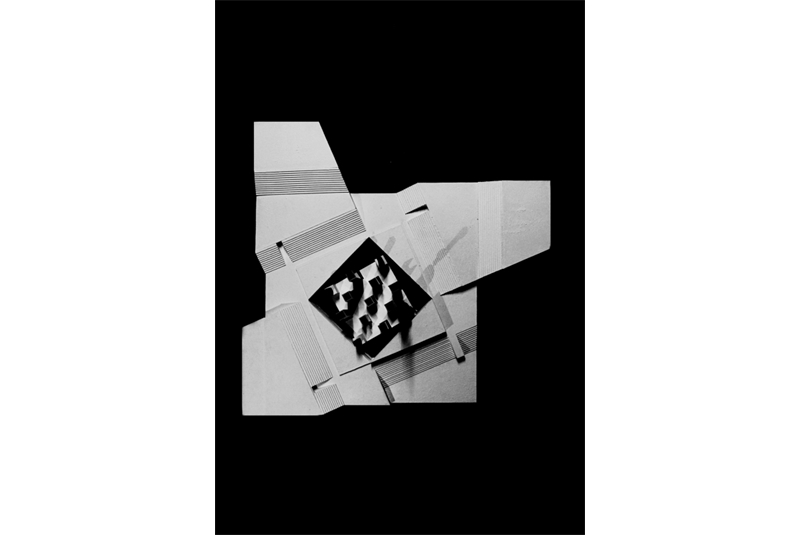
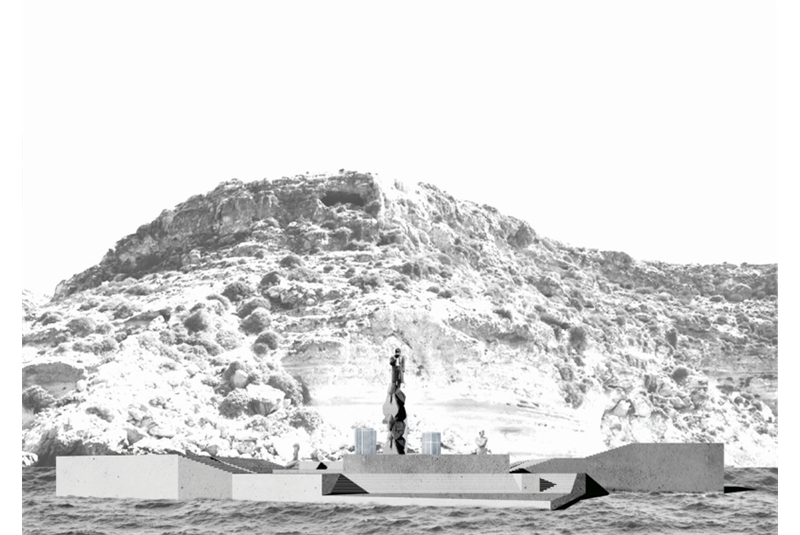
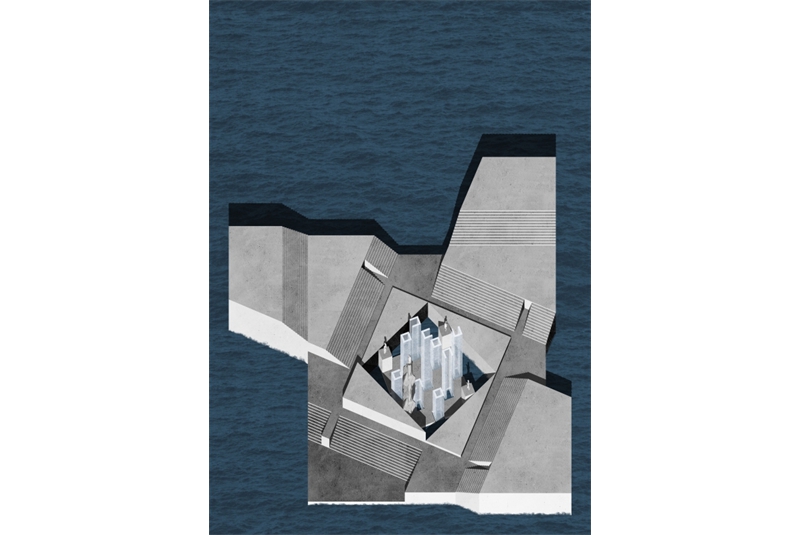
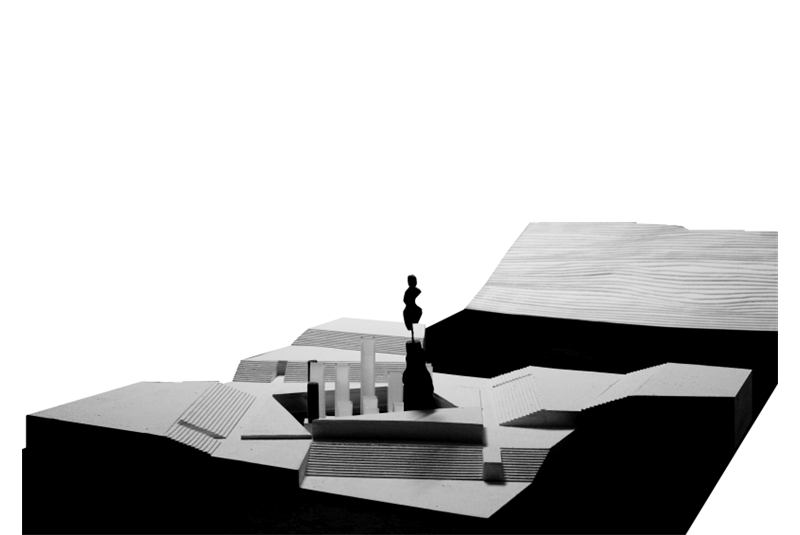
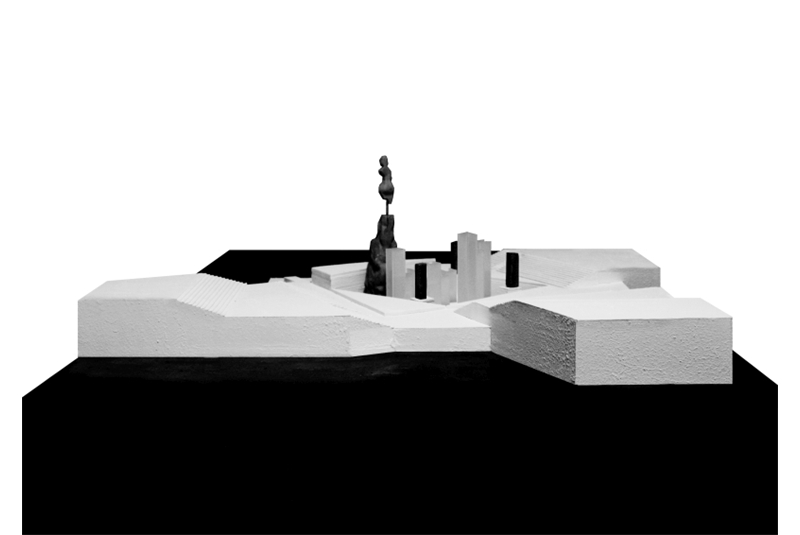
The monument is formally understood as a large massif that emerged from the Mediterranean.
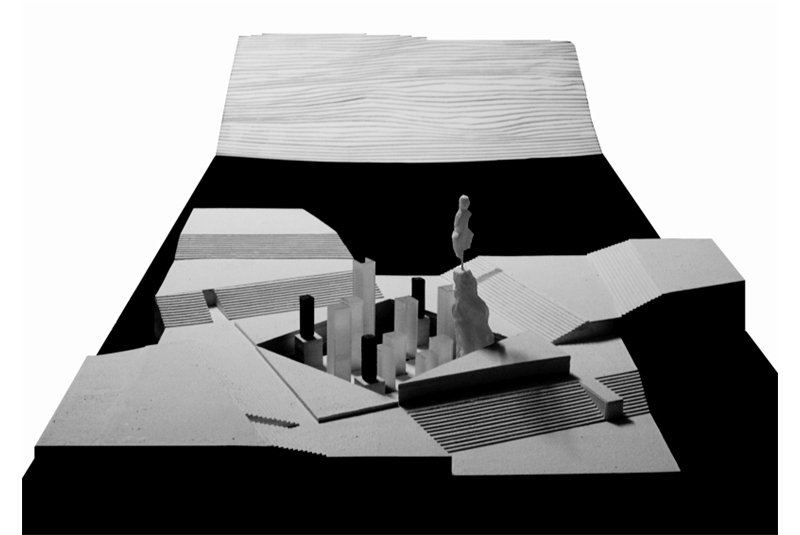
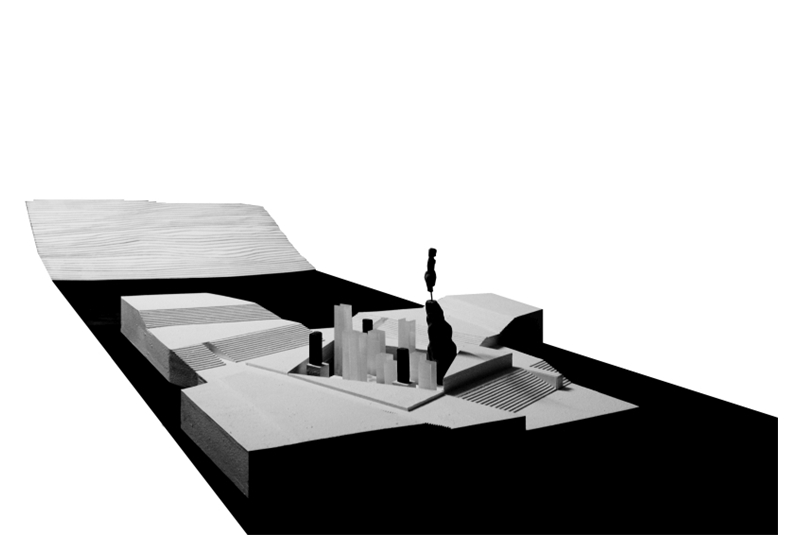
The compositional procedure assumes as a starting hypothesis the presence of the big intact artificial rock, a large pure prism on which two compositional operations are essentially carried out in order to make it inhabitable by man, excavation and extrusion. Starting from a shapeless original mass, the figure of the monument is revealed through a process of roughing typical of sculptural art, “taking off” – to use Michelangelo’s words – the superfluous so as to liberate from the intact and monolithic block a shape that already exists in potential, carrier the human ratio that produced it.
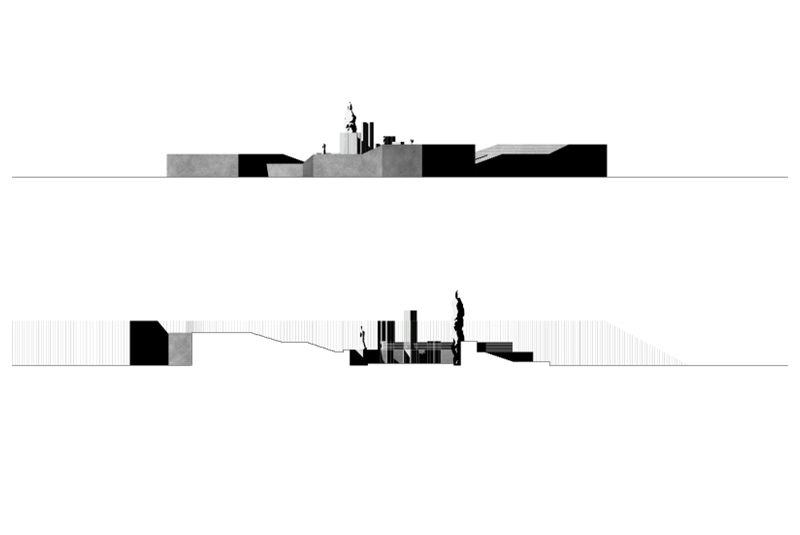
The joint action of excavation and extrusion reveals the plan of the monument, an iterated construction of the Pythagorean theorem whose syntax is governed by a pole of gravitation that offers itself as the effective centre of the plan, from which the “spiral” that regulates the development of the different volumes unfolds. The central space – obtained by subtraction of mass and “inhabited” by a group of four sculptures and a hypostyle of open-air columns – distributes a series of platforms, obtained by extrusion, that are arranged peripherally with respect to the central void.
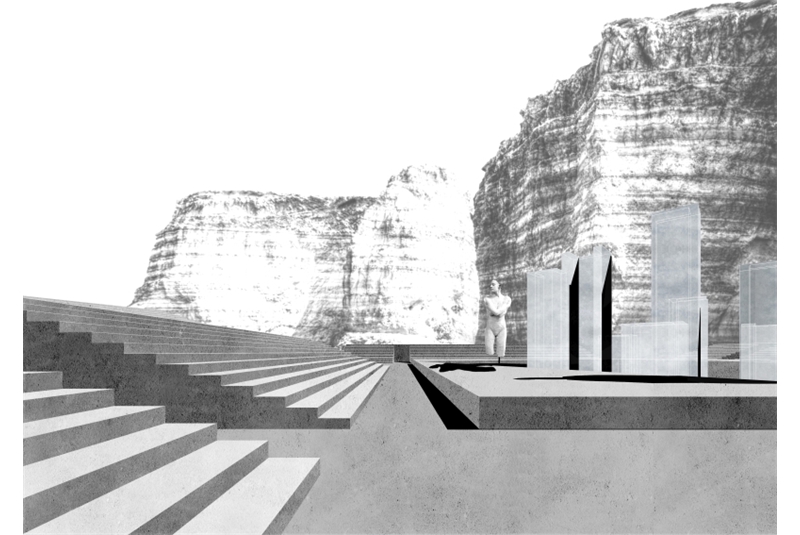
The sculptures, with their human features, represent the far more numerous victims of 3 October 2013. It is as if the monument, by making “space” in the sea, has made the bodies of those people re-emerge, in memory of those who, visiting the monument, recognise in those faces their fellow human beings. Paula, Vida and Ofrenda are the names of the three statues that inhabit – in a quincunx composition – the centre of the monument, works by sculptor Sergio Portela, son of architect César Portela.
The platforms, conformed by stereotomy, are not connected to each other but are only accessible from the central space, which is further identified by the syntactic order of the semi-transparent columns, as an expedient that aims to “multiply” countless times the contact between different peoples: inherent diversity between peers based on “ciascunità” – neologism proposed by James Hillman – of citizens in relation to a common sense of the world. The platform has a double significance: depending on where you look, it identifies the place to stop, sit, and observe - turning your gaze towards the centre of the monument - the power of human reason, expressed by the three triangular stages presided over by the three Portela statues. Or, climbing the steps and turning towards the Mediterranean, confirming the transience of human nature compared to the eternity of the mountains and the sea.
Evidently the centre assumes a fundamental syntactic role for the entire artefact, capable of determining an aggregation of architectural masses around it, but also capable of welcoming people who, as in a large open-air theatre, are arranged according to a precise configuration, which makes it possible to observe fragments of the surrounding landscape.
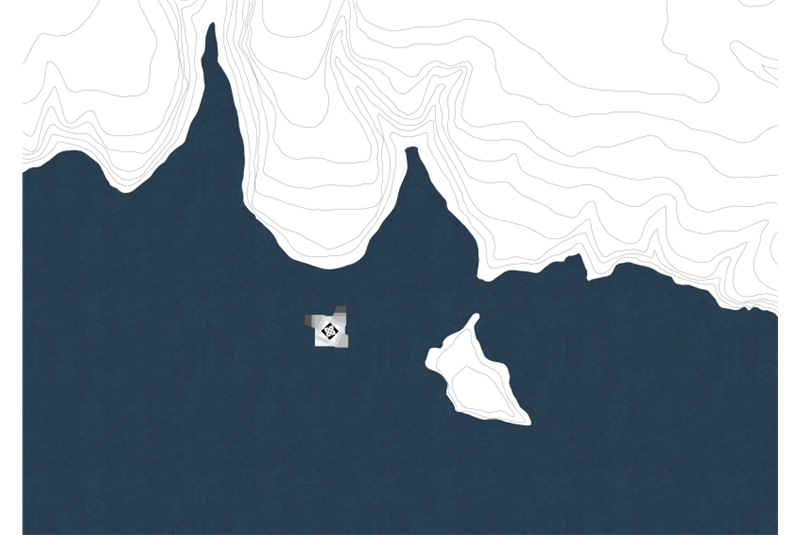
And it is precisely near the shores of Lampedusa, a place in the middle between Europe and Africa, that it was imagined placing the monument, a space to commemorate the tragic events of the migratory crossings but also capable of “making people think”, of imposing a reflection that aims to exorcise the death and anguish of living frequently attributed to this place.
The architecture of the monument, though isolated, reaches out towards the emergences of the site by means of a calibrated system of distant relations with which to “resonate” the morphology of the surrounding nature. The offshoots of the monument head towards the Isle of Rabbits to the east, the cliff punctuated by coves to the north, and the placid Mediterranean to the west, registering the different weights through the varying degrees of extrusion of its platforms. An artificial island that reveals its “second nature” by means of its pure form, distinct and isolated from its surroundings as a compact and elemental mass, and yet reaching out for contact with “first nature”. A contact that, however, does not take place except by geometric triangulations, seeking a landing on dry land that fails, leaving the immensity of nature with its silence and “inaccessibility” that give man a sense of his limitation.
The Monument as Theatre: conclusions
With respect to these considerations, the monument determines its theatrical character as an architecture that «looks far and is seen from afar». In fact, among the four sculptures that inhabit the monument, only one is unbalanced in its composition, rising higher than the others. This is the Monument to Capitán Nemo, another work by Portela which, in the logic of our design proposal, re-signifies itself as a tall vertical element of reference. Not only a real beacon to signal in the night the presence of the artificial island, but also a beacon of reason, a warning for the past and a hope for the future.
This is how one wants to elevate the monument to a symbol of equality, where the drama of the individual is averted in order to embrace the idea of plurality, reified in an effective social and cultural place where heterogeneous people come together: a device capable of making men interact with each other, confronting and clashing to claim their place in the world, actively participating in the development of civilisation, which thus aspires to become a community of Isoi.
Bibliography
BORTOLINI E. et al. (2021) – “Early Alpine occupation backdates westward human migration in Late Glacial Europe”. Current Biology, 31, 2484-2493.
CACCIARI M. (1997) – L’Arcipelago. Adelphi, Milano.
HALBWACHS M. (1950) – La mémoire collective. PUF, Paris. [It. Transl. Jedlowski P. (2001), La memoria collettiva. Unicopli, Milan].
KERÉNYI K. (1950) – Miti e misteri, Brelich A. (a cura di). Einaudi, Turin.
ROSSI A. (1958) – “Una critica che respingiamo”. Casabella-continuità, 219. Now in: Id., Scritti scelti sull’architettura e la città 1956-1972, Bonicalzi R. (a cura di). Clup, Milan 1975, 48-62.
SEDLMAYR H. (1948) – Verlust der Mitte. Otto Müller Verlag, Sazburg. [It. Transl. Guarducci M. (2011), Perdita del centro. Le arti figurative del diciannovesimo e ventesimo secolo come sintomo e simbolo di un’epoca. Borla, Rome].
VALERY P. (1957) – Inspirations Méditerranéennes, Gallimard, Paris. [It. Transl. Giaveri M. T. (2011), Ispirazioni mediterranee. Mesogea, Messina].
VERNANT J. P. (1962) – Les origines de la pensée grecque. Press Universitaires de France, Paris. [It. Transl. Condino F. (2011), Le origini del pensiero greco. Feltrinelli, Milan].
VERNANT J. P. (1963) – “Hestia-Hermès. Sur l’expression religieuse de l’espace et du mouvement chez les Greces”, L’Homme Revue Française d’Anthropologie, 3. [It. Transl. Romano M. e Bravo B. (1978), “Hestia-Hermes. Sull’espressione religiosa dello spazio e del movimento presso i Greci”. In: Id., Mito e pensiero presso i Greci. Einaudi, Turin].