The architecture of the memorial-monument
The memorial, as architecture, is the place of remembrance of the dead. Designed to be a tangible testimony of the Lampedusa tragedy, which on 3 October 2013 indelibly marked human history, the memorial, dedicated to the 368 victims of the shipwreck, including children, women, and men, commemorates and remembers.
Through the engraving of the earth’s crust, it keeps the memory of the tragedy alive for future generations as a warning and aims to preserve and honour the memory of the victims, transferring a profound and lasting significance into the permanence of the sign.[1]
Embodying memory through form, sign and symbol is an operation of architecture. This type of operation traces the meaning of the values of the memorial-monument back to the Ancient World,[2] in which the system of memorialization served to express through the body of architecture what the remains of the essence semantically transferred from the bodily figure to the architectural-monumental figure, whose purpose was to preserve the mortal remains.[3]
The tomb, originally made of earth and stone, corridors and central spaces, whose forms refer to an archaic origin made up of relations between Man, Earth and celestial vault, is, through the project for the island of Lampedusa, in line with the idea of a memorial-monument that everyone possesses.
The passage between life and death is expressed in the relationships of meaning that are defined and constructed within the very idea of the monument and, the formal expression of commemoration – past, present and future – is intertwined in the tragic epilogue of the migrants, defining through the physical space of the project the relationship of values between the sacred, historical and cultural.
The project idea for the island of Lampedusa is the topological space that constitutes memory through the analytical process and monument in the tectonic act, formally establishing a burial place for all the victims of the Mediterranean Sea.[4]
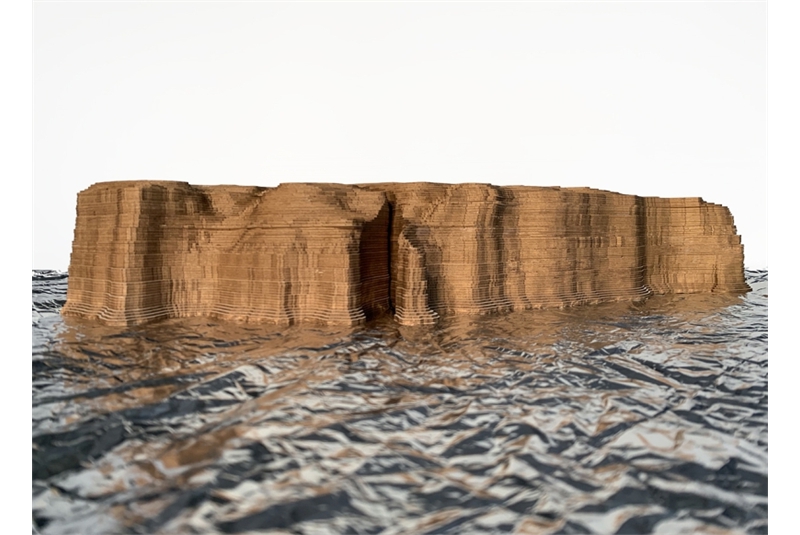
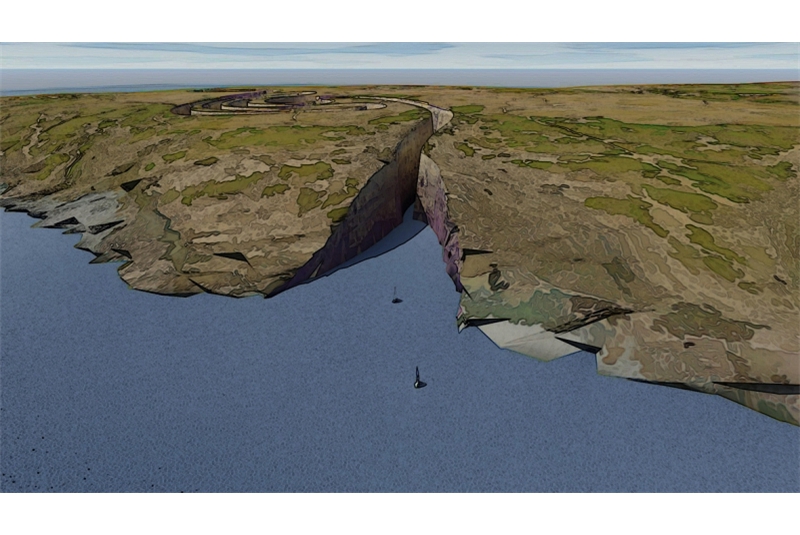
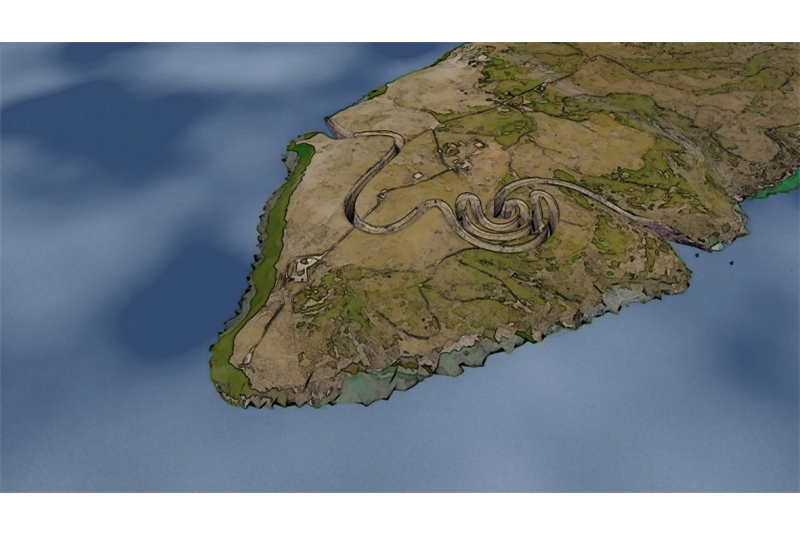
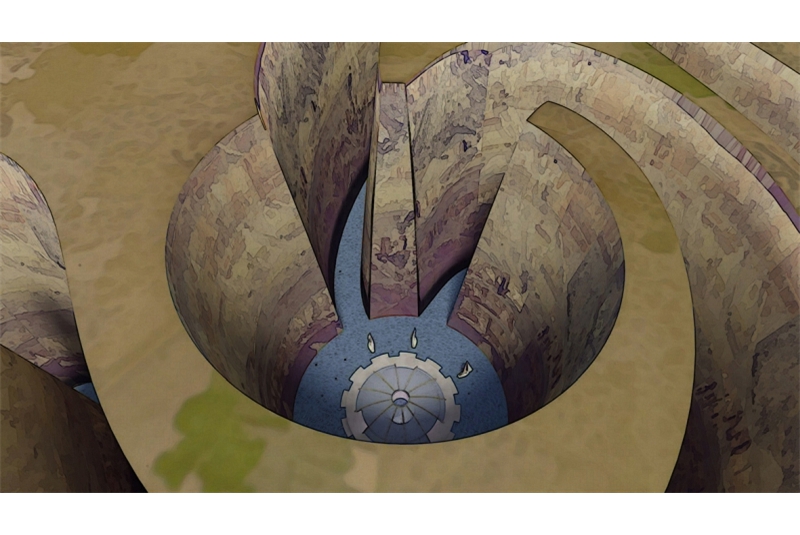
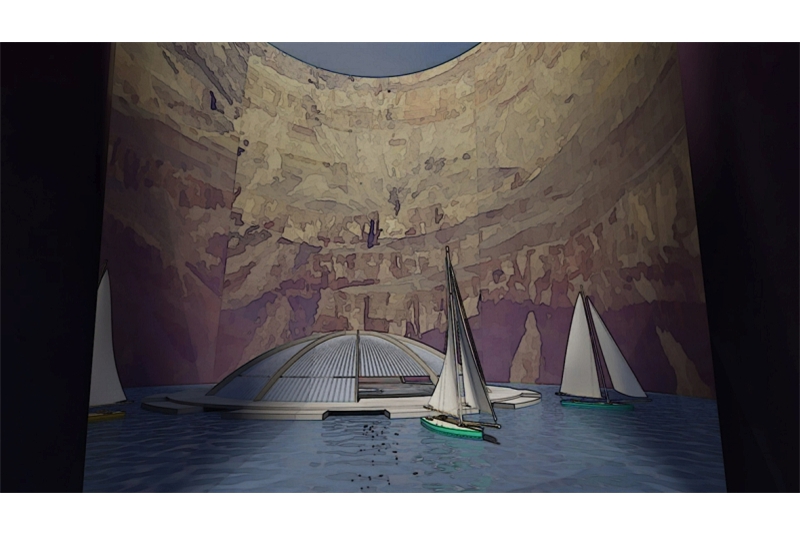
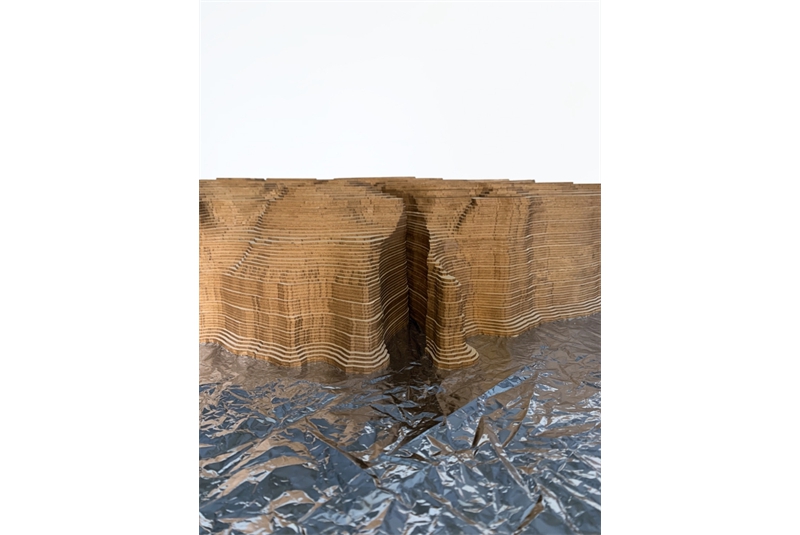
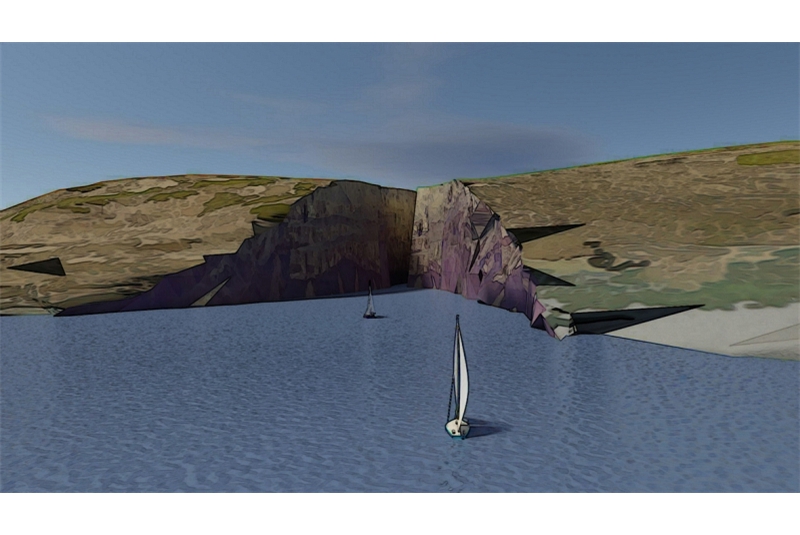
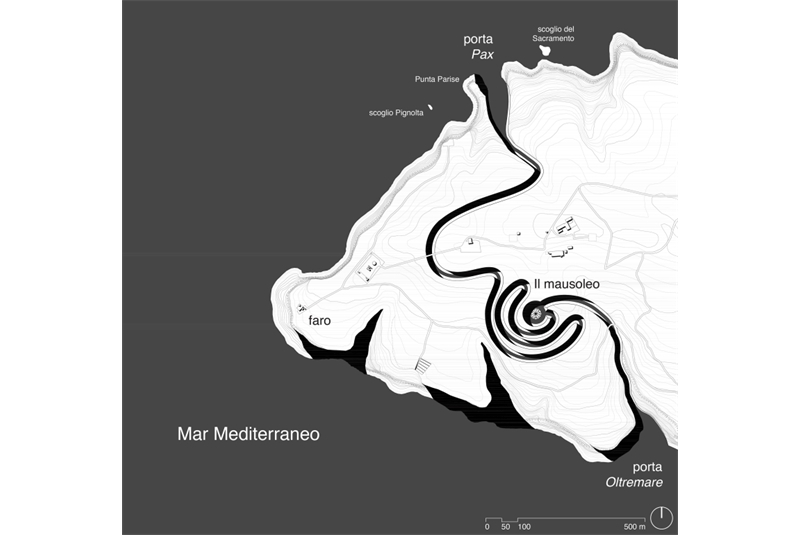
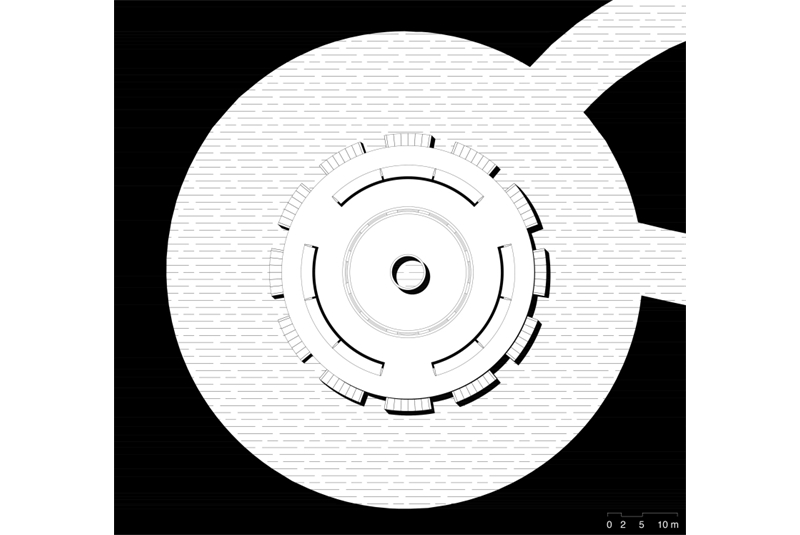
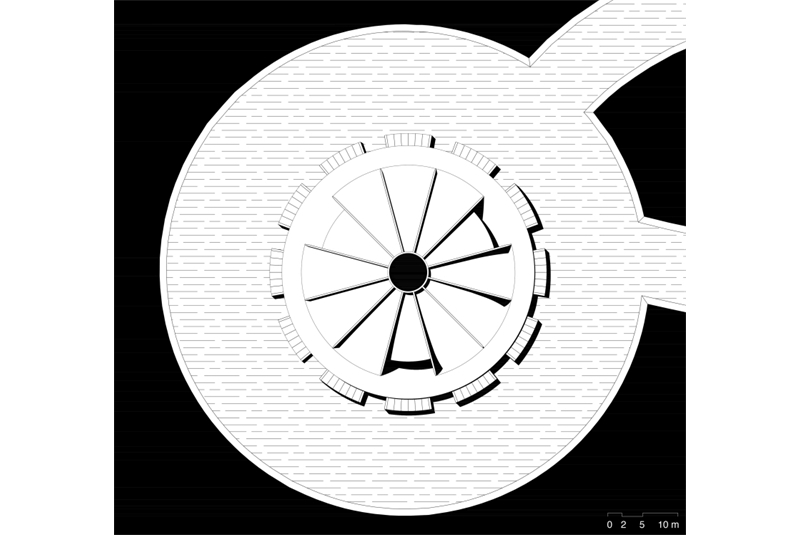
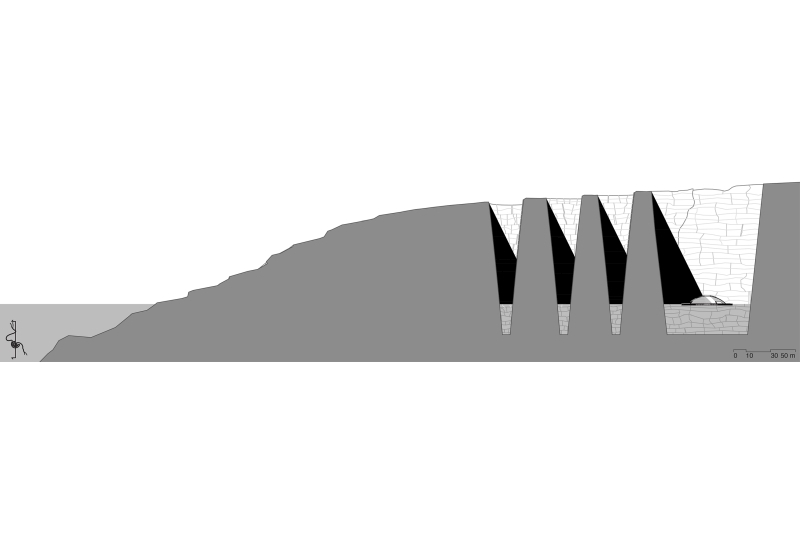
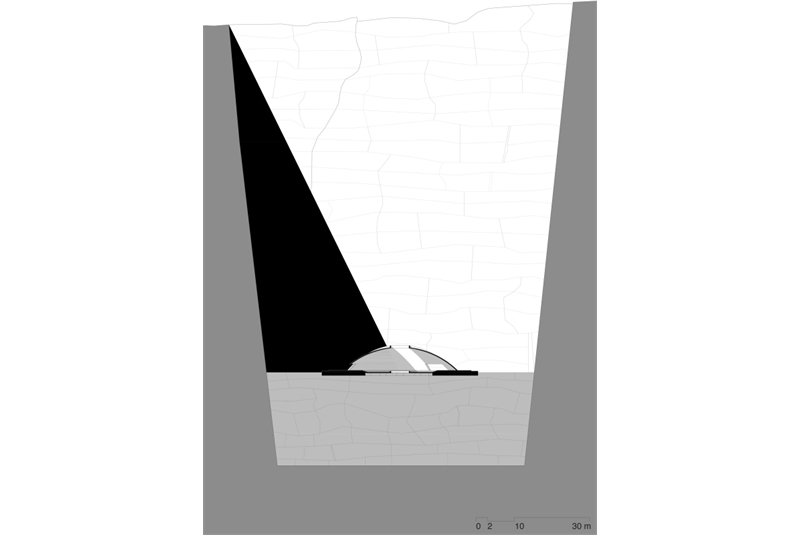
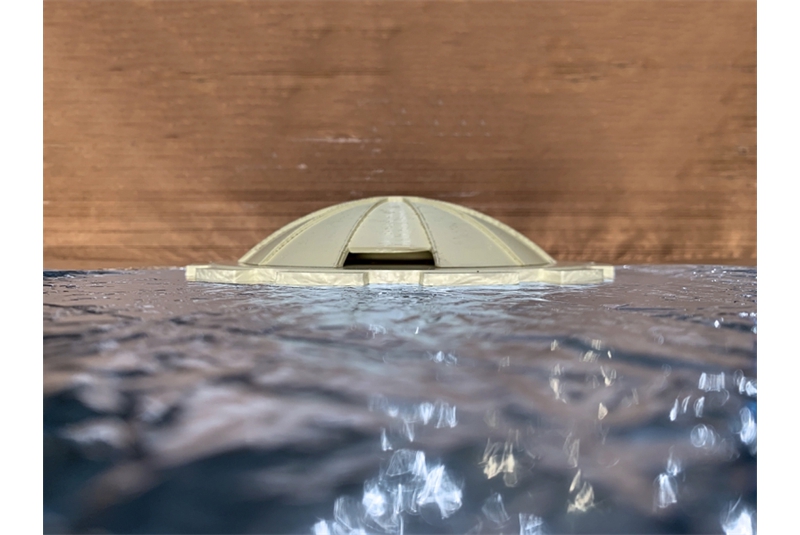
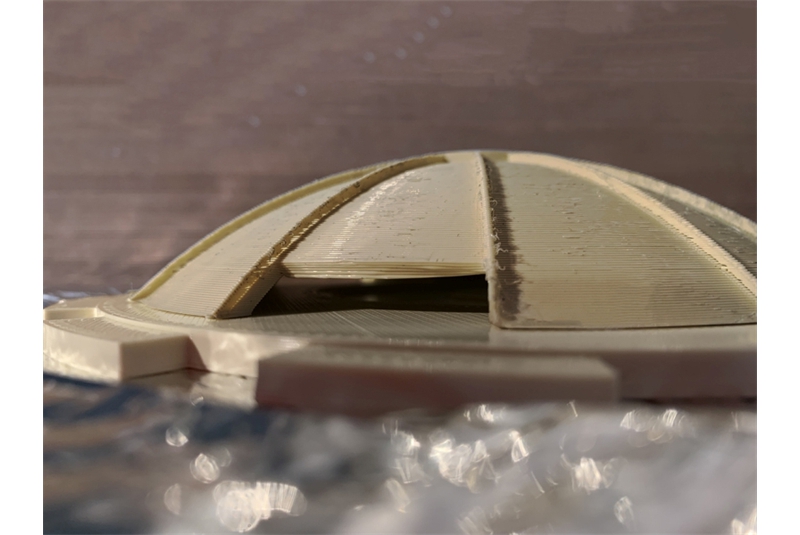
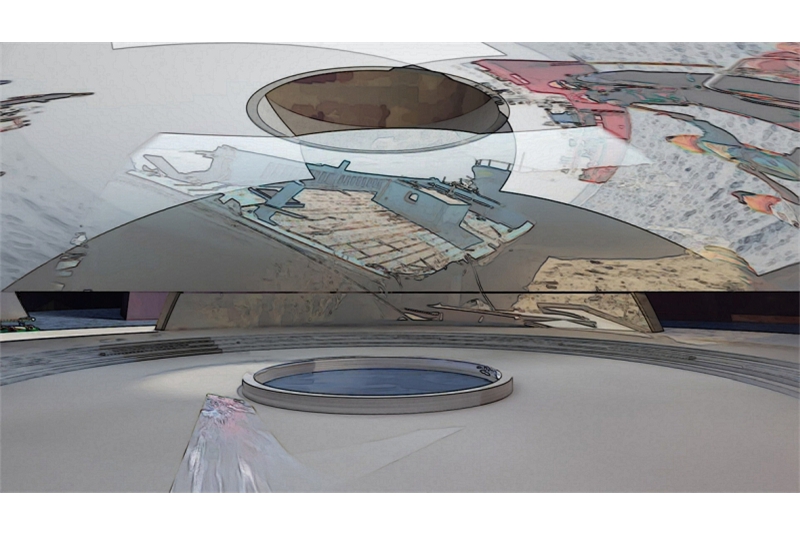
Through the process of memorialization,[5] the earth’s crust becomes a geographical reference and a place of pilgrimage. A light in the deep abyss of the Mediterranean Sea (Figg. 1-2-3).
Project description
The form of the memorial-monument is characterised by a curvilinear sign[6] that literally digs into the earth’s crust until it reaches sea level. The succession of meanders with which the marine journey within the earth’s surface is divided, hinders and slows down the path like the rivers of the underworld that obstruct the road that leads to the afterlife. [Figg. 4-5-6]
At the center of the route is the house of the dead and of memory: the mausoleum, the landing place, the raft (Figg. 7-8-9).
The waterway, which is entirely navigable, develops in a trench, inside a gorge carved into the Earth. The track is inscribed in an inverted trapezium in the shape of a canyon that runs from the Libyan coast overseas up the Mediterranean towards the Water Valley[7] (Fig. 10).
At the far end of this route, the Overseas entrance gate is located to the south and the Pax exit gate to the north; both are located at the natural inlets of the cliff and dialogue with the geographical features of the island of Lampedusa (Figg. 11-12).
The route refers to the labyrinth and its primordial meaning, to the intricate character of the series of meanders of which it is composed, in analogy with the impassable difficulties that the transited face in the dark of night in order to reach new destinies, to the meaning of life, made up of hardships and hope.
The southern gate is the gate of remembrance; it corresponds to the beginning of the route and represents the destination of the sea route that boats set sailed from the Libyan coast to reach the shore of the island of Lampedusa.
The pattern on the ground that cuts into the earth’s crust is an obligatory transit that can be followed in only one direction, which from the open-air sea enters the entrance gorge of the route in the middle of the night (Figg. 13-14).
The one-way transit to the opposite end of the island’s crust causes disquiet and disorientation. Here the human condition, the tragedy itself, becomes monumental, becomes experience when the problem of the figure description means death and remembrance. The mark on the ground, in carving the earth’s crust, structurally opens a wound in the earth. This wound is the internalisation of the human condition: tragedy.
The track, in addition to deliberately provoking a reaction in the broadest sense of the term, operates timelessly in a domain of anthropic and social transitions which, in addition to manifesting the fatigue and the impossibility of controlling destiny, needs to express the unspeakable in its journey: suffering, death, mourning and, at the same time, rebirth in the landing of new horizons (Fig. 15).
The mausoleum
The architecture of the mausoleum is composed of two elements: the raft and the dome. The first is floating and supports the weight of the second; terraced halfway towards the center with the space for mooring boats at the end of the circumference. The second is characterized by three openings.
The threshold that defines access to this space is lowered, forcing one to genuflect before entering below the hemisphere. The three thresholds are seven and twenty meters wide by one and a half metres high, and to these correspond the entrances to the mausoleum. This place is the house of memory (Figg. 16-17).
At the top of the hemisphere, corresponding to the zenith, there is the oculus which symmetrically communicates with the respective one of the raft. The oculus of the raft is the same size as that of the roof. Inside this place, ceremonial functions take place.
The mausoleum is a work that belongs to the community, in the same way as the navigable path that cuts through the earth’s crust.
From the center of the dome, the natural light that passes through the oculus of the hemisphere is reflected in the surface layer of water that resurfaces from the oculus of the raft, irradiating the perimeter surfaces of the mausoleum and reflecting the blue overseas from the center outwards.
The center of the mausoleum architecture has a very deep meaning. This place is designed for the purification of the community’s sins; the water flush with the oculus represents the bath of rebirth after the tragedy. The two overlapping architectural figures generate a beam of light five and forty meters wide (Fig. 18).
The mausoleum is a floating architecture that rises and falls according to the tide. The hemispherical structure is thirty-three meters wide and rests on a raft forty-five meters wide. The raft has three drops in altitude halfway before reaching the oculus. The building is set on corten steel alloy ribs fixed to the raft floor (Figg. 19-20).
The mausoleum is covered with 368 bush-hammered sheets of metal; each sheet of metal, if known, has the name of the person who passed through, victim of the tragedy, engraved by hand. The design of the surface covering of the house of the dead and of memory allows additional metal sheets to be added over time. Hoping that this type of operation will never happen, the memorial-monument is configured as an open work. The interior of the mausoleum is made of smooth light-coloured concrete.
Incision. Meaning of the transit
The choice to physically pierce the earth’s crust is an act of denunciation. The scar that crosses the island of Lampedusa from one end to the other, scratches, engraves, operates at the scale of the land, leaving an indelible mark visible from space.
Transit, composed of transĭtus, comes from transire, whose meaning is to pass, and is composed of trans which means beyond, through, and ire meaning to go. The memorial Transits. Overseas Abysses, specifies and identifies the need to go beyond, in sign and meaning.
To go beyond is the condition to which one is subjected in the experience of the memorial-monument; also leading the meaning back to the tragedy, to earthly and extracorporeal life, to the need to abandon oneself, to get lost in the labyrinth, ferried inside the earth, to Hades, in the oblivion of memories made of memory and architecture[8] (Figg. 21-22-23-24).
The physical, navigable passage retraces the tragedy, the sky dialogues with the water and the celestial vault reflects the light of the stars in the oculus and along the terrestrial incision. In the darkness of the night, the lights of the stars constitute the only orientation of the transients; their only hope is to entrust their existence to the unknown.
Abyss brings back the theme of waters; the narrative begins from the Mediterranean Sea, from the literal and literary depths that the unfathomability of suffering, reaches deep and dark regions; physical with death, restless with the drama of the tragedy that the survivors will carry in their memory for the rest of their existence.
Overseas brings the question of exodus to center of the discussion, the endless human drama of disorientation and the biblical journey, the last song of the chorus, the voice of emigration towards new routes.
Overseas raises the gaze on the theme of migrants, it represents the politics of the Western world looking beyond a border, a geographical and cultural distance, recognizing and identifying beyond the sea the borderline and the figure of diversity and, at the same time, the recognizable. The Overseas gate is a symbol; it cleaves the earth, engulfs migrants, opens a chasm along the cliff and constitutes the indissoluble scar of the world.
An imagined world. Technological features
The bewilderment one perceives as one traverses the architectural space of the excavation, seemingly with no way out, constitutes the great theme of migrants: the exodus of humankind, the transit, the flight into the unknown.
The navigable path leads to the en plein air temple of reminiscence, the house of the dead, the cherished place where memory, like Ariadne’s thread, leads the narrative and the destiny of mankind back to the interrupted point where every epilogue comes to a confrontation. In it, the stories of the people of the sea become fragments narrated by sounds and moving images that, as in a planisphere, bring the place of the landing back to the centre of the discourse, both in its etymological sense and in its extensive and transitive possibility of an archetypal figure in which the image of the voyage, the origin, the end, the emotion and the tragedy meet to set off again towards another unknown: the exit. Hence the idea of making advanced use of technology, in which the walls of the excavation, one hundred meters high, nine metres wide at water level and twenty-seven at ground level, lend themselves to projections of the world imagined by the art of video mapping. Immersive projections that during the transit through the canyon describe and transcribe on the surface of the water and along the walls of the earth’s crust, the history and memory of the men of the sea. Moving images of an imagined world, to make the transit experience even more engaging and immersive (Figg. 25-26-27).
The landing place becomes the Homeric symbolic element, Ulysses’ raft, and as such symbolizes the ability to adapt and the insatiable desire to return home. This place, obscured by sliding walls at the three thresholds, combined with performance art and 3D video mapping, is transformed into a multisensory artwork, in which architecture and technology transform the spectator’s experience.
The project combines figurativeness with an ethical commitment to social denunciation: the silent and disorienting path becomes a space for the memory of the living. As such, the work is configured not only as a place of passage and fruition for the entire community, but also as a deeply tangible fracture destined to constitute a significant legacy for future generations.
Notes
[1] The use of the terms permanence and sign is addressed to their geographical extension, to the territorial question, not necessarily definable through the anthropic condition. However, through the work of man, as in the case of the project for the memorial-monument, they constitute the possibility of establishing reasoning on form from terrestrial figures. This takes the form of a reworking of a subjugated object, the possibility of reading in the geographical features the plausible transfer of an archaeological knowledge. Geographical facts, together with those of Man, make themselves available to an analytical reading to define semantically and formally what lies above the memory of the underground, establishing the relationship between architecture and geography, text and figure, transferring meaning and memory to things. On the importance of sign and signification, see Carlo Sini (1985, 46-50).
[2] On the significance of monument values over time and how society perceives and evaluates monuments, see the work of Alois Riegl (2011, 11-29).
[3] The lemma memorisation belongs to the field of memory places. The meaning leads to the possibility of transferring a form of memory into the body of architecture, carrying the memory of a significant event through time. One form of memorisation is the construction of physical monuments and the creation of memorial sites, with the aim of honouring and remembering what has been, aiming to keep alive the collective memory of events or individuals that have had an impact on history. On the concept of memory and memorisation, see the three-volume work under the direction of Pierre Nora (1984-1992).
[4] The project formalises the place of memory through the modality of the narrative, in which the body of the text identifies, transfers and signifies in the body of the architecture and in the distributive characters the form of a mnemonic and figurative identity made of archetypes. The project for the island of Lampedusa constructs mnemonic processes by fragments starting from the figures of antiquity and leads through the system of circulation to a topology of memory. On memory and the topological question, see Frances A. Yates (1966).
[5] On memorisation as an action of transferring and configuring the sign function of the object of remembrance in the figure of the memorial-memorial, see the examples described and provided by Michela Bassanelli (2014, 2-7). For the definition and construction of the meaning of the sign function, see Louis Hjelmslev (1968, 52).
[6] The sign of the memorial – formalised in the distributive character – is the outcome of a «recognition that takes place when an object or event, produced by nature or human action [...] is understood by the recipient as the expression of a given content [...]». Moreover, in order to become connected between signifier and signified «the object must be seen as having been produced by display, replication or invention, and related by a given kind of ratio. Thus the act of recognition reconstitutes the object as IMPRINT, SYMPTOM or INDEX. To interpret the recognised object is to correlate it with a possible physical cause that functions as its content – it having been conventionally accepted that the physical cause acts as the sign’s in intentional producer» (Eco 1998, 289).
[7] The Water Valley is a small valley located along the south coast of the island. The layout for the island of Lampedusa, originates from the reading of the geographical features.
[8] Like the architecture of which a book is composed, the matter of cross-references to which the memorial monument for Lampedusa is subjected – on an architectural and territorial scale – is expressed between rhetorical and linguistic figures. This passage corresponds to the articulated composition of «lines of articulation or segmentarity, layers, territoriality; but also lines of flight, movements of deterritorialisation and destratification [...] a concatenation» as explained by Deleuze and Guattari (2003, 35), and «is itself only in connection with other concatenations, in relation to other bodies without organs» (Deleuze and Guattari 2003, 36).
Bibliography
BASSANELLI M. (2014) – “Forme della memoria: oltre il memoriale”. DAStU Working Papers, 2, febbraio, 2-7.
DELEUZE G. e GUATTARI F. (2003) – Mille piani. Capitalismo e schizofrenia. Trad. it. G. Passerone, Cooper & Castelvecchi, Roma (ed. orig.: (1980) – Mille plateaux. Capitalisme et schizophrénie, Les Éditions de Minuit, Paris).
ECO U. [1975] (1998) – Trattato di semiotica generale. Bompiani, Milan.
HJELMSLEV L.T. (1968) – Fondamenti di teoria del linguaggio. [It. Trans. G.C. Lepschy, Giulio Einaudi, Turin] (Orig. ed..: (1943) – Omkring sprogteoriens grundlaeggelse. Bianco Lunos Bogtrykkeri, Kobenhavn).
NELSON R.S. e OLIN M. (a cura di) (2003) – Monuments and Memory, Made and Unmade. University of Chicago Press, Chicago; London.
NORA P. (edited by) (1984-1992) – Les Lieux de Mémoire. Gallimard, Paris.
RIEGL A. (2011) – Il culto moderno dei monumenti. Il suo carattere e i suoi inizi. S. Scarrocchia (A cura di), trad. it. R. Trost e S. Scarrocchia, Abscondita, Milano (ed. orig.: (1903) – Der moderne Denkmalkultus. Sein Wesen und seine Entstehung. W. Braumüller, Wien-Leipzig).
ROSSI A. (1966) – L’Architettura della città. Marsilio, Padova.
ROSSI A. (1972) – “L’azzurro del cielo. Primo Classificato”. Controspazio, 10, ottobre, 4-9.
SEMERANI L. (2013) – Incontri e lezioni. Attrazione e contrasto tra le forme. Clean, Naples.
SINI C. (1985) – Il tempo e l’esperienza. UNICOPLI, Milan.
YATES F.A. (1966) – The Art of Memory. Routledge & Kegan Paul, London and New York.