Dico a ti,
chi del mestiero vole imparare,
bisogna danzare per fantasmata.
(Domenico da Piacenza, De la arte di ballare et danzare, 1425)
It is easy to get lost in the intricacies of definitions, in the anxiety of classification... We start with questioning what is meant by ruin and what by unfinished, and from there, we take but a moment to delve into the works of Walter Benjamin, Georg Simmel, Marc Augè, Didi-Huberman. Someone will inevitably refer to the visions of Piranesi, while others may go as far as Ruskin’s seven lamps. Those who enjoy intersecting architecture with other disciplines cannot ignore Michelangelo or Rodin. An interesting attempt to overcome this difficulty, this theoretical uncertainty, was proposed by Francesco Venezia (2011, p. 92) when, during a preliminary lecture to a didactic exercise, he argued that «the ‘unfinished’ is like ‘a broken shell: the revealed interior makes us discover a fascinating world’». From Venezia’s mystery of the unfinished, we arrive in medias res at the unfinished as a ‘choice of life’, which Attilio Stocchi (1999) defines as a fundamental component of Viganò’s poetics, a reference figure in the elaboration of this project. Stocchi continues:
the unfinished is a choice of life, apparently in opposition to the desire to define. It is an open value. It is the voice of the shadow that approaches vitality, feeling the abyss of a dark attraction exerted by the fear that reveals itself – perhaps as a counterpoint in a broad, extended stage... the unfinished represents freedom, the possibility that space and matter are not complete and the disillusion that there is a finite, a perfect completion. The result is an unfinished in space: fluid architecture, continuing, having a moment of arrest, marrying the air; and an unfinished in matter: raw, opaque matter, shaped by time (Stocchi 1999, p. 7, tba).
Similarly to Venezia, Viganò recognizes in the unfinished a condition to be exalted, to be sought and stimulated through the project, a trigger for a poetic reaction capable of revealing new fascinating worlds, reflecting simultaneously on space, time, and matter.
These initial thoughts on the theme of the unfinished have been projected onto the ‘Marchiondi’, whose non-finality is complicated by assuming the dual condition of incomplete and ruin, a condition that has produced in us a deep state of fascination. Is the mystery and ambiguity of this industrial archaeology invaded by spontaneous vegetation that continually hides and reveals itself not even more suggestive than the completed project? Is it possible to separate poetry from reality? Charm from the drama of abandonment? Indeed, can we not find poetry in the scarlet spiral staircases, once guiding children to their rooms but now reduced to vertebrae that heroically bear the weight of the entire structure? Are not the shattered windows on the facade, bathed in the glow of an orange sunset, a reflection of the rich tapestry of history woven through the threads of a project, a place, and countless adventures – in essence, the poetry of architecture?
The first preparatory drawings
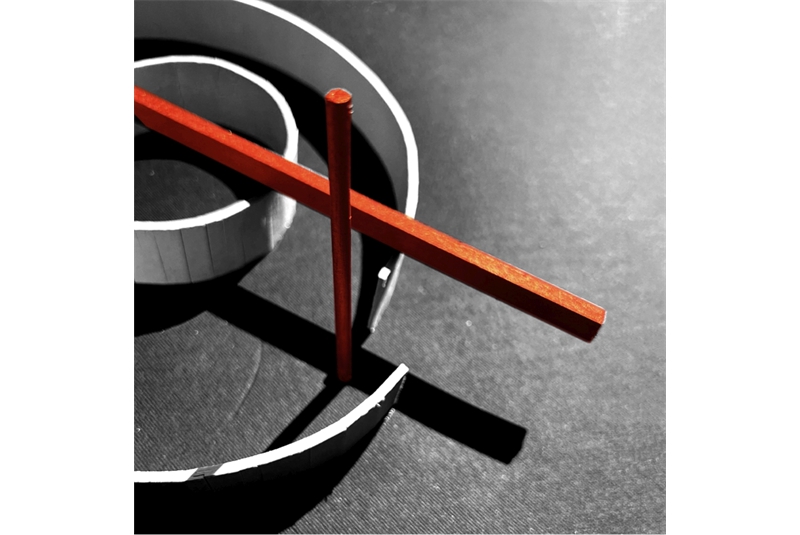
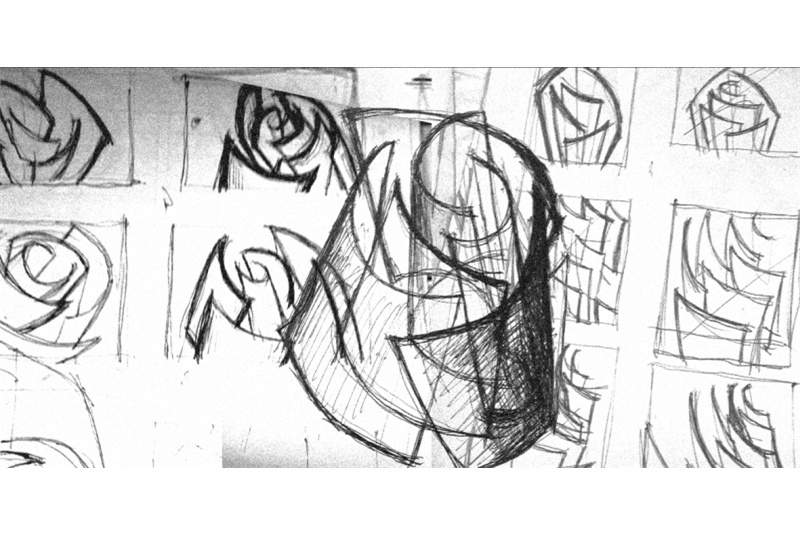
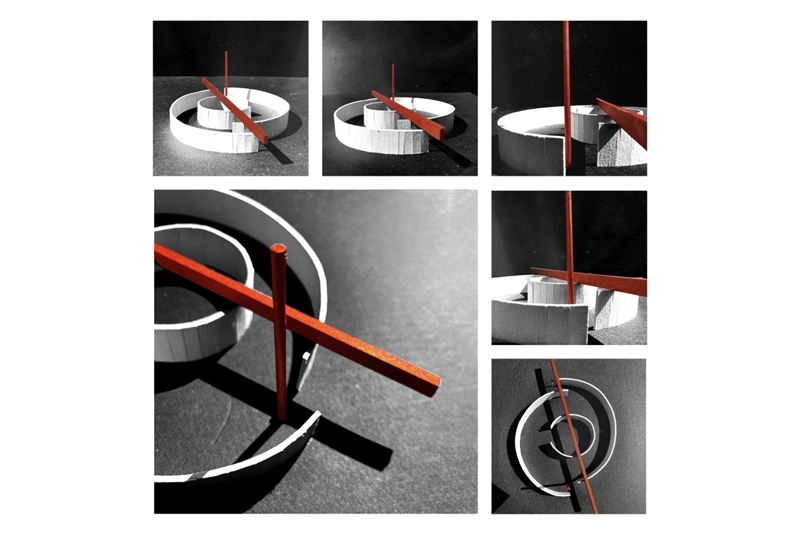
We chose to immerse ourselves in these initial enchantments, seeking a shared purpose and a common ground for the convergence of sculpture and architecture. As we delved into the sketches of Pinuccia Bernardoni, discovering overlooked preparatory studies that time had forgotten, they unexpectedly entered into a dialogue, specifically with those scarlet staircases that had captured our attention from the very outset. Consequently, we resolved to delve further into this interplay between the two elements, casting them as protagonists in a pièce [Fig. 1], akin to the text juxtaposed with an original composition, fostering novel avenues of exploration. These preliminary endeavors guided us towards a series of compositions [Fig. 2], characterized by delicate elements intricately folded like sheets of paper, featuring an ascending concentricity that seamlessly engaged with Viganò’s staircase element. These endeavors, as will be demonstrated, proved indispensable in the formal evolution of the project, serving as a pivotal moment to pay homage to the architectural element of the Milanese architect that had initially sparked our reflections.
The path, spatial suggestions
The analogical and emotional first approach, brought out, in addition to the mentioned formal considerations, some characteristics that would become constants in the subsequent phases of our work. Firstly, the definition of the unfinished as a field capable of refer to multiple interpretations, an act of awareness and self-awareness that leads the spectator, through their active participation, from a mere observer to an author themselves. The unfinished, again, as an ‘open value’ (Stocchi). From these considerations, it immediately seemed crucial that this path of individual interpretation and self-awareness should take on a truly physical dimension through the design of the monument-memorial not only as an enlarged sculpture on an architectural scale but as a place with a spatiality that can be experienced internally. In this regard, we advanced in refining the initial sketches, acknowledging that they already hinted at an internal permeability designed for circular movements, delineated by vertical elements capable of shaping both curvilinear and ascending spatial configurations, as well as disorienting and dizzying experiences. The crafting of space through the forces of gravity, energy, and material tension, along with the capacity to centralize space to elicit varied experiences for spectators, inevitably leads us to acknowledge Richard Serra as a distinct reference and an undisputed master. However, the influence extends to Constantin Brancusi as well, particularly his infinite columns, prompting contemplation on the potential interplay between sculpture and spatial experience through elements such as composition, form, and emptiness – an endeavor that has historically resonated with figures like Tatlin, Malevich, and El Lissitzky.
The Definition of form
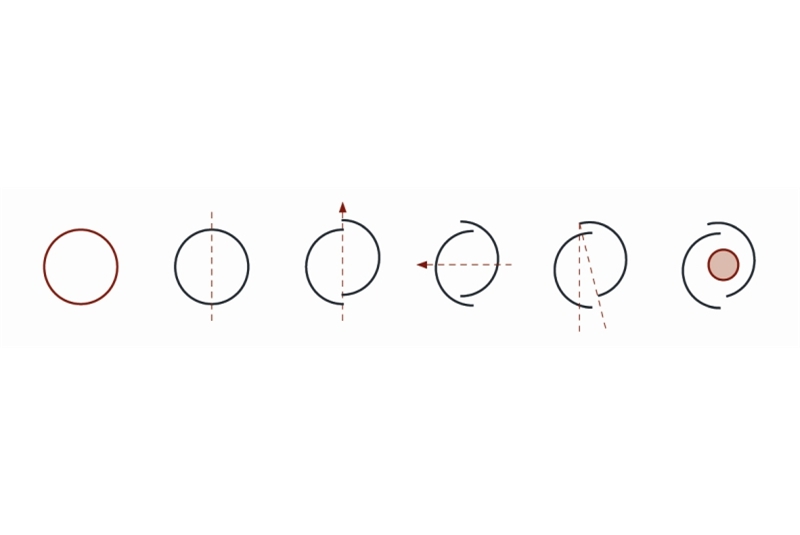
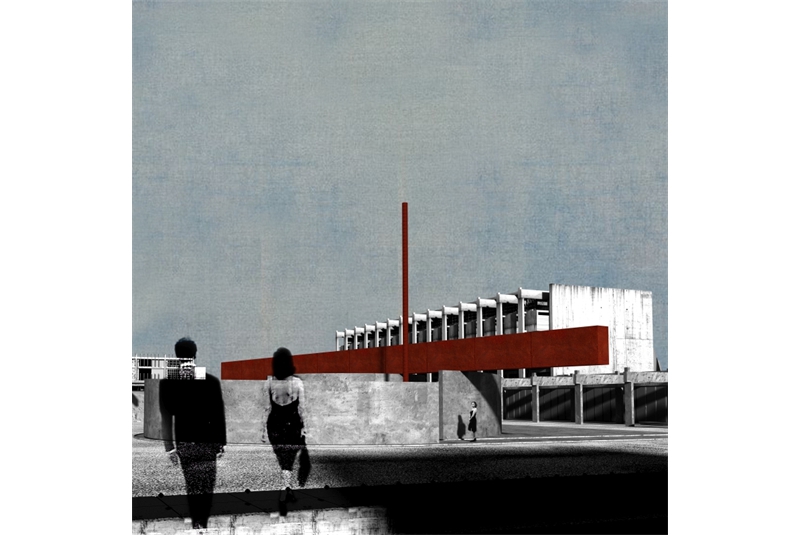
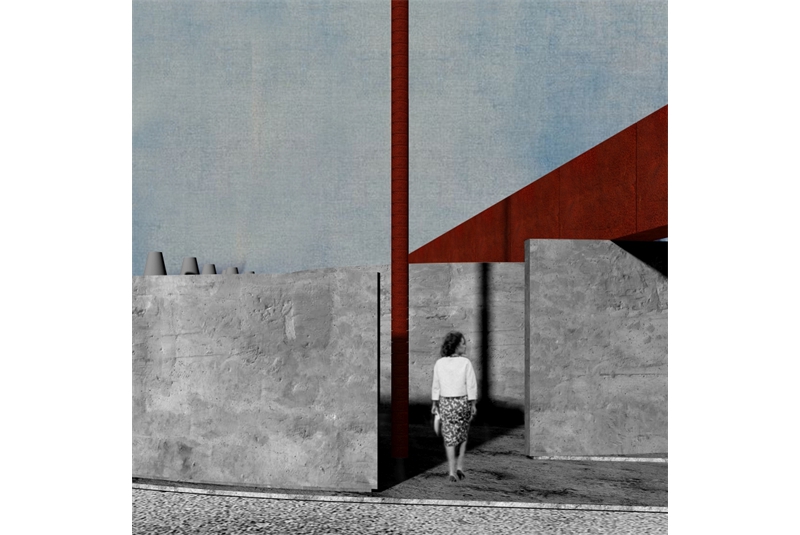
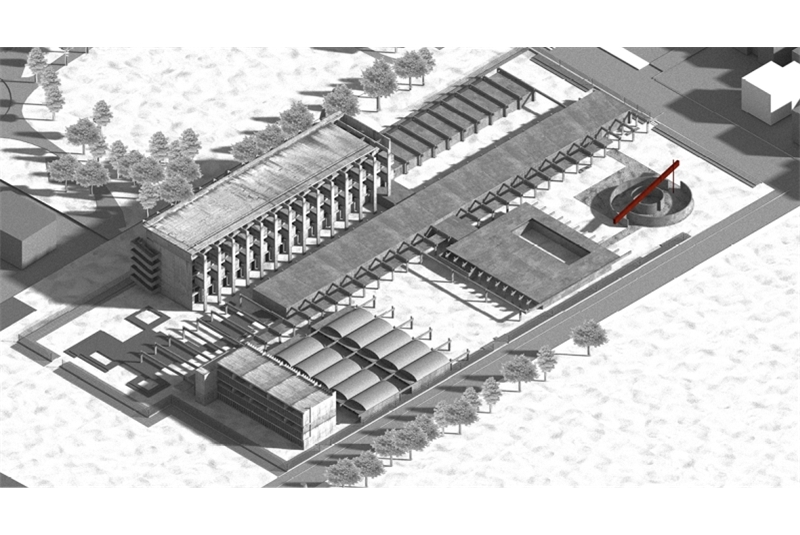
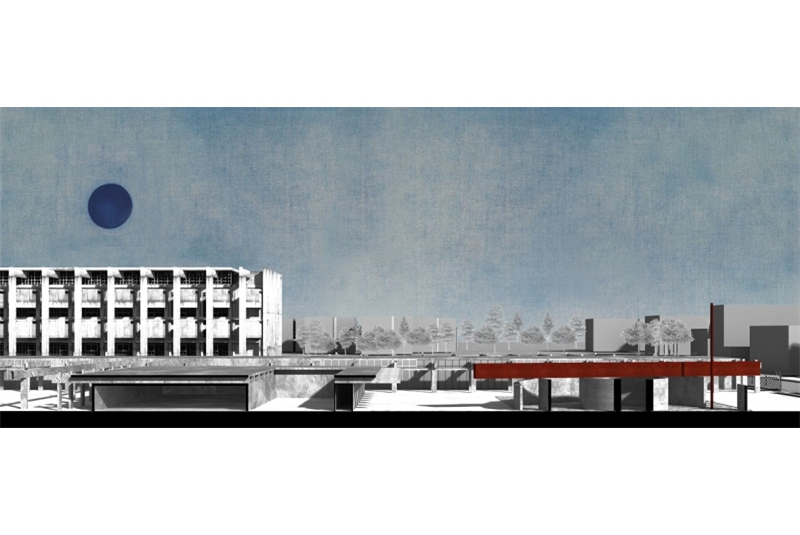
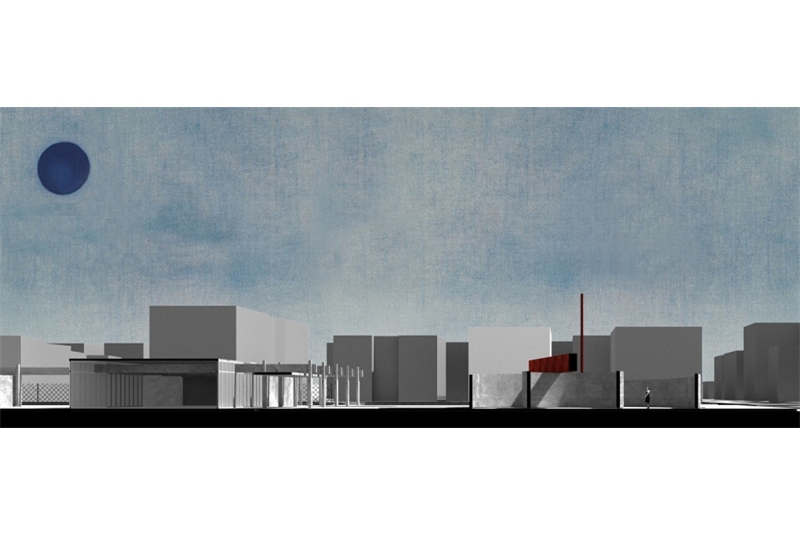
Proceeding with the description of the project’s genesis, the sketches found their natural definition in a planimetric drawing in which we rationalized the system of sails that, in the initial experiments, was assuming a metaphysical image too close to the world of plants and flowers. Similarly, we decided to stimulate the theme of the unfinished through the arbitrary alteration of the circle, a geometric figure that more than any other refers to completeness, the finished, unity, and perfection. The starting circumference [Fig. 3, a], with a diameter of 20 meters, is divided on the vertical axis into two semicircles [Fig. 3, b]. The one on the left remains fixed while the one on the right is subjected to a vertical translation of 2 meters [Fig. 3, c]. This gesture generates two interstices, one upper and one lower, which will become the entrances to the monument-memorial. Subsequently, the vertically translated semicircle undergoes a further displacement of 3 meters along the horizontal axis [Fig. 3, d] to approach its double, and a subsequent rotation of 15 degrees [Fig. 3, e], generating a triangular space, a perspective cone, as well as an opportunity to differentiate the two entrances described previously. From the plan, we move to the volume, the arches of the circumferences generated geometrically thicken, become concrete walls, a muscular exhibition whose excess needs to be limited through the smoothing of the profile that becomes ascending from the plane, the greater apex reaches a height of 3 meters, the lower one 2.4 meters. The two curvilinear sails, confronting each other, generate a tension that led us to insert an additional element in the central space that was created [Fig. 3, f], a curvilinear element, an inert body, a heart to be revealed, experienceable only by traversing the interior of the monument-memorial. One might think that the marked concentricity alludes to the theme of the labyrinth, to the one designed, for example, by BBPR and then painted by Saul Steinberg, but we wanted to distance ourselves from this misunderstanding immediately by introducing a strong, horizontal sign, constructivist memory. A steel beam rests obliquely on the curvilinear sails (at the higher elevation of 3 meters) along a diagonal axis of 15 degrees, the same angle responsible for the earlier rotation of one of the two semicircles. This element confronts the gravitational pull of the sails by balancing gracefully above them, revealing its vibratile essence. Moreover, this element, beyond enhancing the complexity of the internal spatial encounter, extending beyond mere vertical elements, serves as a conspicuous guide, marking the entrances to the monument-memorial like a red thread and dispelling any potential misconceptions of a labyrinth.
Materials
Discussions have touched upon form, composition, and space, yet material considerations have received less attention. Initial discussions foresaw the sails crafted from reinforced concrete, although early in the study, we explored alternative solutions involving steel. Some conceptualizations even delved into perforated sheet metal, and certain sketches explored the theme of opaque glass. Moreover, there were ventures into plastic materials with milky hues, as if conjuring a phantasmagoric image. Alternatives that, however, did not seem capable of returning that character of the unfinished later found in concrete, especially in its ability to be shaped by time, to assume a heroic and timeless character especially when left to itself, in ruin.
A raw material that becomes inevitable when faced with Vittoriano Viganò’s work, particularly within the context of the Marchiondi Spagliardi Institute. Reinforced concrete is accompanied by corten steel, a material displaying signs of oxidation as it shields itself from the corrosive impact of atmospheric agents, acquiring a rough surface and a burnt red hue. Red has always played a fundamental role in Vittoriano Viganò’s oeuvre, predominantly paired with black, as deemed a «necessary interlocutor» of black «to give it life and plasticity like a flame with soot» (Viganò in Stocchi 1999, tba). While not directly resorting to black, the selection of a red chroma for the beam element and the vertical element, to be discussed later, was motivated by the same desire to impart energy and vigor capable of engaging in a chromatic dialogue with the stark and cold cement.
Place
Finally, a consideration concerning the relationship with the
context. The interaction between the monument-memorial and the
‘Marchiondi’ has been examined from various perspectives:
figurative (such as the relationship between the initial sketches and
the spiral staircase), evocative (exploring the theme of the unfinished
between ruin and incompleteness), and material (concrete in
conversation with the red color). Yet, our attention was also drawn to
the selection of the physical location within the Institute to stage
the project. We chose to position the monument in a specific area of
the Marchiondi grounds, precisely in the strip of land along Via Noale
where the Church of the Institute was initially planned. This decision
was driven by the desire to reconcile Viganò’s original
design by engaging the unfinished incompleteness of
the project with that of our monument. This operation, beyond
addressing physical and mnemonic aspects, operates on a semantic level,
reinstating a space for reflection and sacredness, albeit secular, to
the original project. This intention is further underscored by the
introduction of a vertical element, a tubular Corten steel, which not
only marks the main entrance of the monument-memorial but also asserts
a verticality seemingly denied by the horizontal beam, harkening back
to the bell tower envisioned in the preliminary project.
Note about the Title
The concept of ‘fantasmata’ originates from a theoretical framework by Domenico da Piacenza, as documented in his treatise ‘De la arte di ballare et danzare’ (1441-1450). Among the six elements defining the art – measure, memory, agility, manner, and measure of the ground –Domenichino introduces ‘fantasmata’ a nuanced concept recently expounded upon by Giorgio Agamben (2007, p. 12) as a «sudden halt between two movements, designed to contract within its internal tension the measure and memory of the entire choreographic series» (tba). This ability to encapsulate the memory of a choreography in a solitary, suspended, and interrupted movement resonates with our project. Unfinished as it may be, it aspires to encapsulate in a singular spatial experience the memory of a place, encompassing its past, present, and future.
Bibliography
AA.VV. (1963) – “Concorso nazionale per il Monumento alla Resistenza a Cuneo. I dieci progetti ammessi al 2° grado”. L’architettura. Cronache e Storia, 90, 810- 823.
AGAMBEN G. (2007) – Ninfe. Bollati Boringhieri, Torino.
BERNARDONI P. (2008) – da 1 a 10. Aspasia, Bologna.
BERNARDONI P. (2021) – Scolpire geometrie. Danilo Montanari Editore, Bologna.
CANELLA GE. e MELLANO P. (edited by) (2019) – Il diritto alla tutela. Architettura d’autore del secondo Novecento. FrancoAngeli, Milan.
GRAF F. e TEDESCHI L. (edited by) (2009) – L’Istituto Marchiondi Spagliardi di Vittoriano Viganò. Mendrisio Academy Press, Mendrisio.
STOCCHI A. (1999) – Vittoriano Viganò. Etica brutalista. Universale di architettura, Testo & immagine, Turin.
VIGANÒ V. (1995) – “L’architettura dell’esperienza”. In Dialoghi di Architettura a cura di E. Faroldi, M. Pilar Vettori. Alinea, Florence.
VENEZIA F. (2011) – “Rovine e non finito”. In: Id, Che cosa è l’architettura. Lezioni, conferenze, un intervento. Electa, Milan.