Il tema
And immediately resumed
The journey
Like
After the shipwreck
A survivor
Sea dog (Ungaretti 1919).
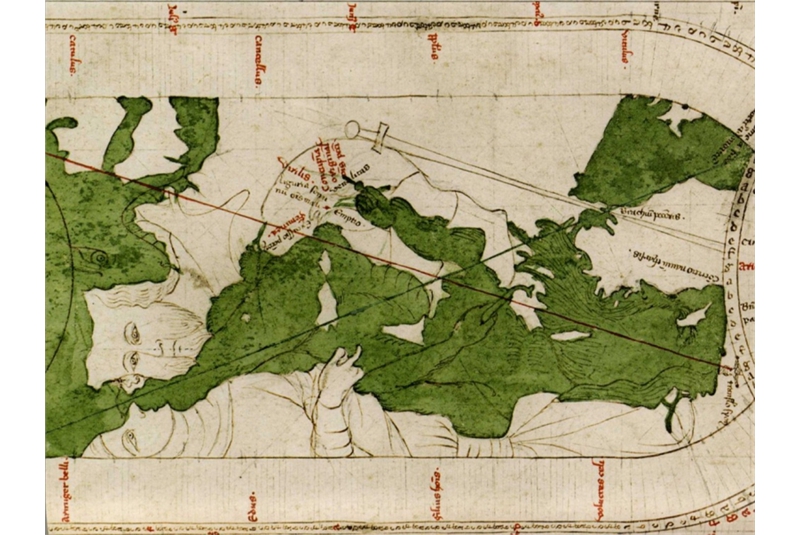
The proposed project is based on a historical-anthropological reflection on the Mediterranean, which has always been the theatre and metaboliser of conflicts and exchanges between different cultures. An example of this is the medieval cartography drawn by Opicino de Canistris, the subject of Carl Gustav Jung's latest studies (1943) (argued at the Eranos Conference on The Religions of the Sun in the Mediterranean), in which the Mediterranean is depicted as a demonic world, a dark “anti-world” opposed to the luminous world of the mainland (reminiscent of the Old Testament distinction between fresh and salt water, symbolising purity and impurity respectively). If therefore, in cartographies, Europe is represented as a male figure and Africa as a woman, the Mediterranean appears instead as a demonic figure with a “goat's beard”, carnally intermingling in the design with Europe and Africa. It is no coincidence that the culturally defined processes of mourning, in particular the institution of so-called “ritual mourning”, studied by intellectuals such as Ernesto de Martino and Mircea Eliade, also link the residual forms still present in southern Italy with the funeral mourning practised in the agricultural societies of the ancient Mediterranean.
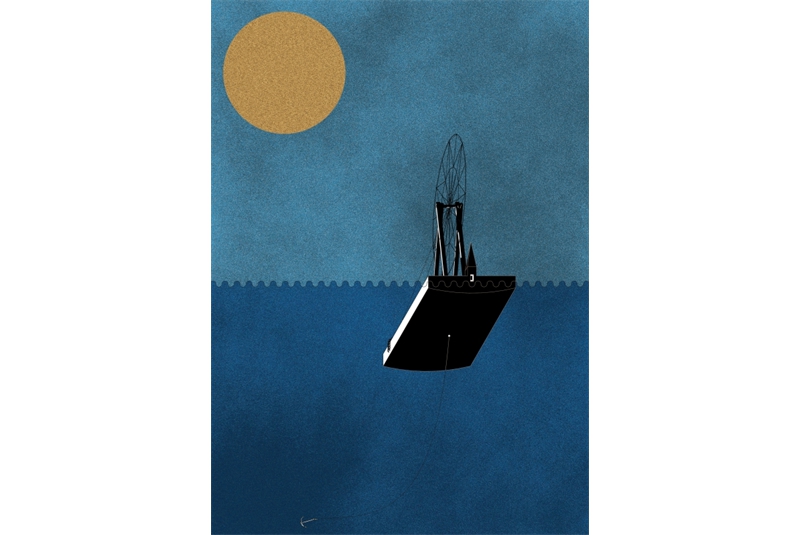
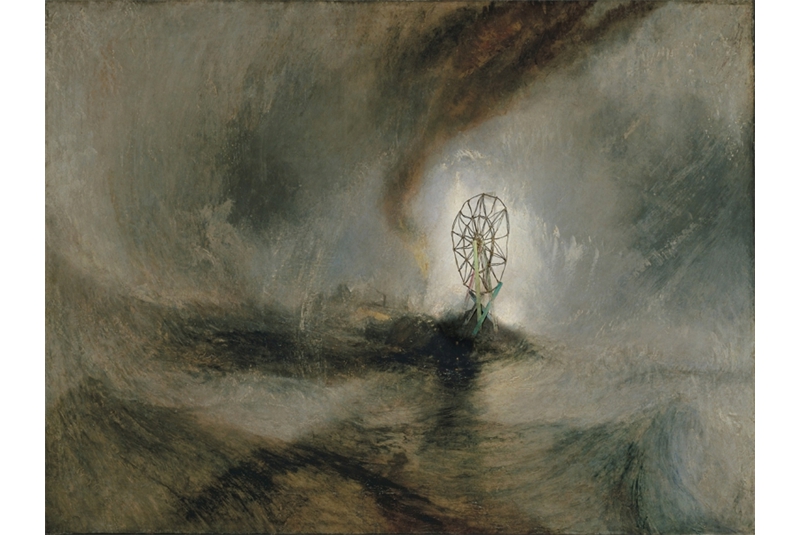
Hence the motto Fata Morgana[*] suggests the ambiguous and provocative nature of the project, which reworks certain folkloric rituals common to the basin, and all linked to the cult of the Sun (solar myths) as a metaphor for knowledge, illumination, revelation, reasoning on an idea of deception and illusion as a constant of a certain common disposition of those cultures to the impermanence of things, to a melancholic look on life. The monument, in fact, floating (anchored to cables) on the route that connects Lampedusa to Misurata (about 400 km), would never occupy the same position and, although visible from afar, could not really act as a point of orientation, thus assuming the “task” of a “rescue buoy”, abandoned to the pitching of the currents. It was not created as a “finished” or “eternal” monument, but stands as a formal idea (or archetypal scheme) available to the unexpected, to accidental encounter and even to ruin. The pieces of wood and sheet metal that compose it are in fact imagined to be recovered from the sea, and - in some cases - assembled according to contingencies, to compose a sort of “raft made of wrecks”.
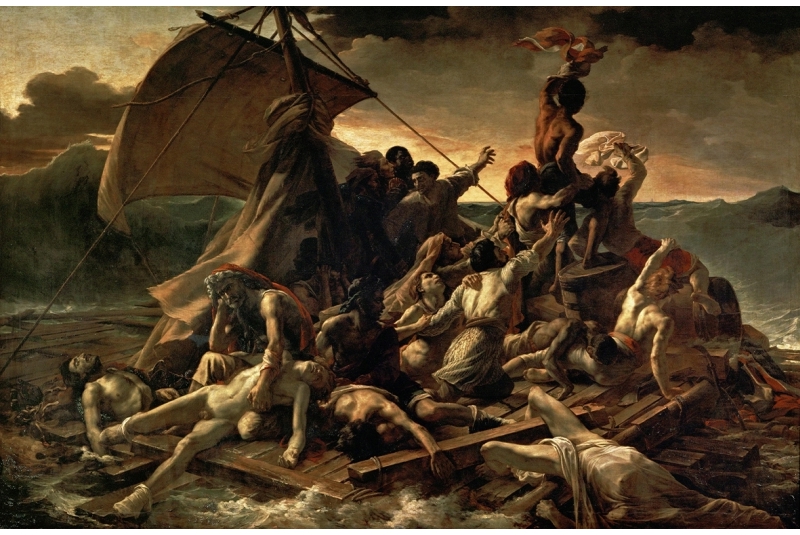
By its heterotopic nature, it is ascribed to an iconological-literary tradition that, from Apollonius Rhodius' Argonautics, to Sebastian Brant's Narrenshiff, to Gericault's Raft of the Medusa (see fig. 3), resists as a fragment of a contemporary epic, which, like the “ancient” ones, recounts the “impersonal” diaspora of populations torn apart by wars, famine and post-colonial stubbornness.
If in fact, as Roland Barthes (1972) argued in The Ancient Rhetoric, rhetoric was born out of property processes, when following the overthrow of a tyranny in Syracuse (which had carried out several expropriations) the old land rights had to be re-established: therefore it was necessary to convince, to be eloquent in order to “charm” popular juries. Today, even the sea seems to be subject to relations of ownership and rhetoric: no longer a treacherous expanse abandoned to the “anarchy” of wayfarers; but the site of a “tug-of-war” between states, peoples and solipsistic demagogies.
It may then come in handy to recall a section of Pier Paolo Pasolini's poetic and very lucid “prophecy” on Africa, which is the film Appunti per un'Orestiade africana:
The Orestiad summarises the history of Africa over the last hundred years: that is, the almost abrupt and divine transition from a 'savage' state to a civilised and democratic state: the series of kings who, in the atrocious secular stagnation of a tribal and prehistoric culture, dominated - in turn under the rule of black Furies - the African lands, has, as if suddenly, been broken: Reason has instituted democratic institutions almost motu proprio. It must be added that the really burning and topical problem, now, in the 1960s - the Years of the Third World and Negritude - is the 'transformation of the Furies into Maenads': and here the genius of Aeschylus has foreshadowed it all. All advanced people agree [...] that archaic civilisation - superficially called folklore - must not be forgotten, despised and betrayed. But it must be taken up within the new civilisation, integrating the latter, and making it specific, concrete, historical. The terrible and fantastic divinities of African prehistory must undergo the same process as the Erinyes: they must become Eumenides (Pasolini 1978; 1979, pp. 79-81).
Pasolini thus attempts to account for the “clash” between the “irrational” (represented by Africa) and the “rational” (by Europe) by using the myth of Orestes and Clytemnestra, representing the birth of the court, as the space of a violent and “magical” process of metamorphosis from the archaic world to modernity. Which turns out to be a hymn to mutual integration and enrichment. Similarly, the Fata Morgana project attempts to coordinate defined and perfectly rational compositional-figurative aspects with the randomness of the “fragment” as a metaphor for “migrating”. On the other hand, the wayfarer who embarks in search of a homeland, as splendidly described by Michel Foucault:
is a prisoner in the midst of the freest, the most open of roads: solidly chained to the infinite crossroads. He is the Passenger par excellence, the prisoner of the Passage. And one does not know the country to which he will land, just as, when he sets foot on land, one does not know which side he comes from. He has no truth or homeland except in this barren expanse between two lands that cannot belong to him (Foucault 2011, p.71).
Project report
Nay, thou wilt not boast, time, that I mute:
With new force thy founded pyramids
To me have nothing strange or novel;
They are but the spoils of past images.
The days are short to us, and we have a longing
Of that which by now ancient thou didst impose upon us,
And at our pleasure we love to bring them forth
Than to think that we have ever heard them heard (Shakespeare 1609).
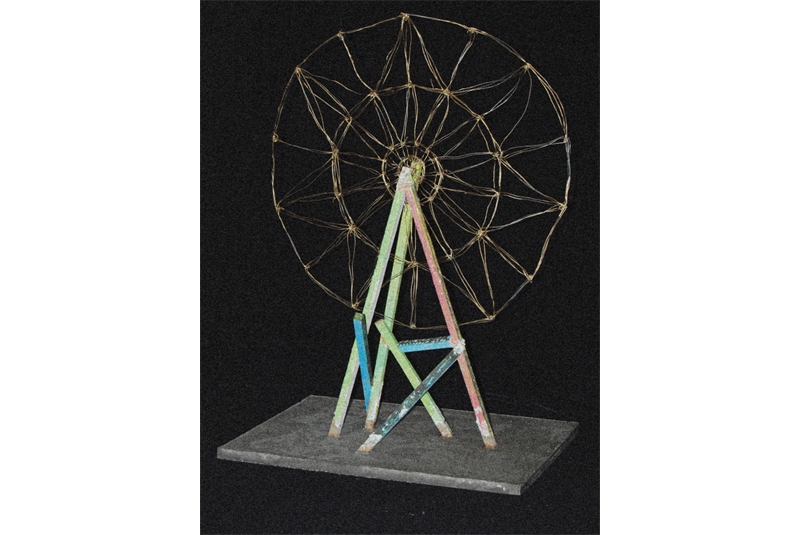
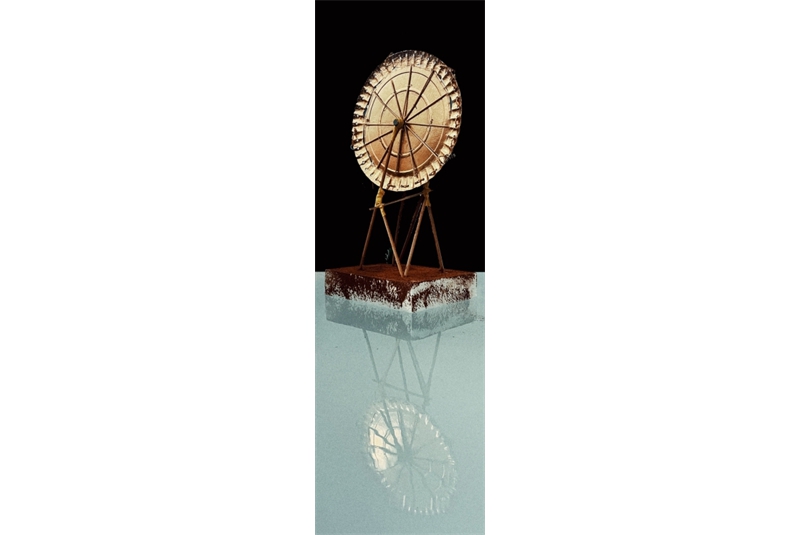
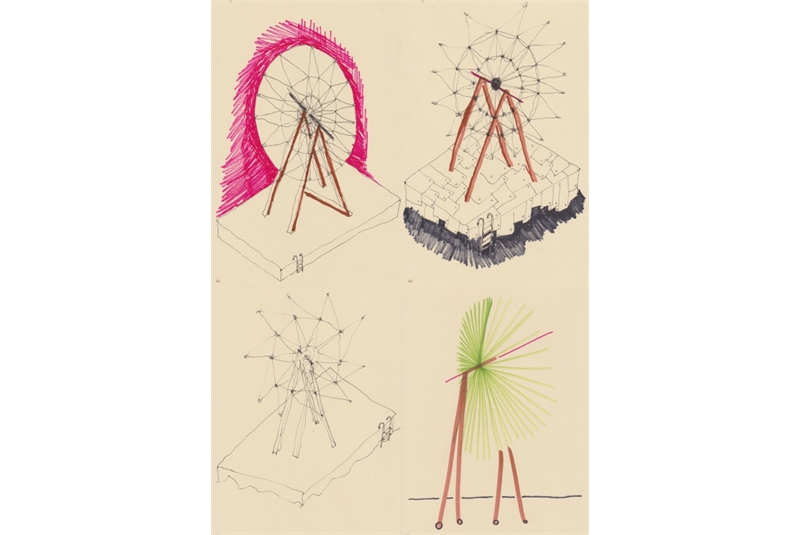
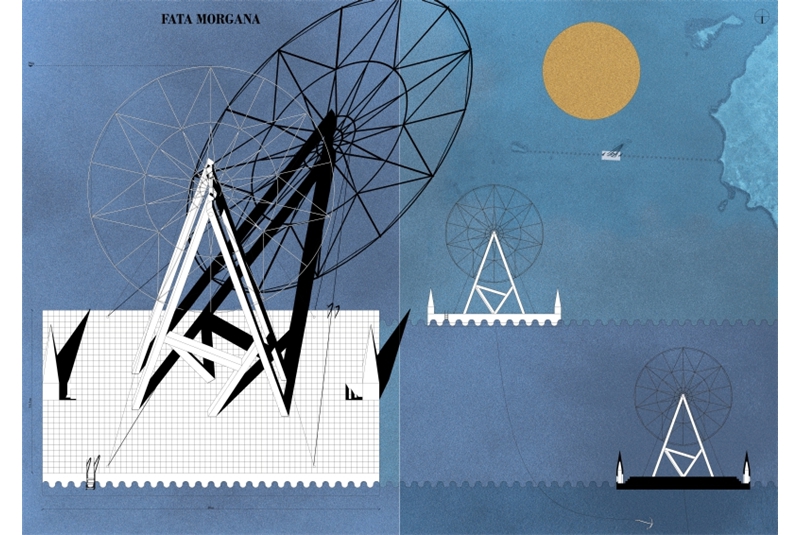
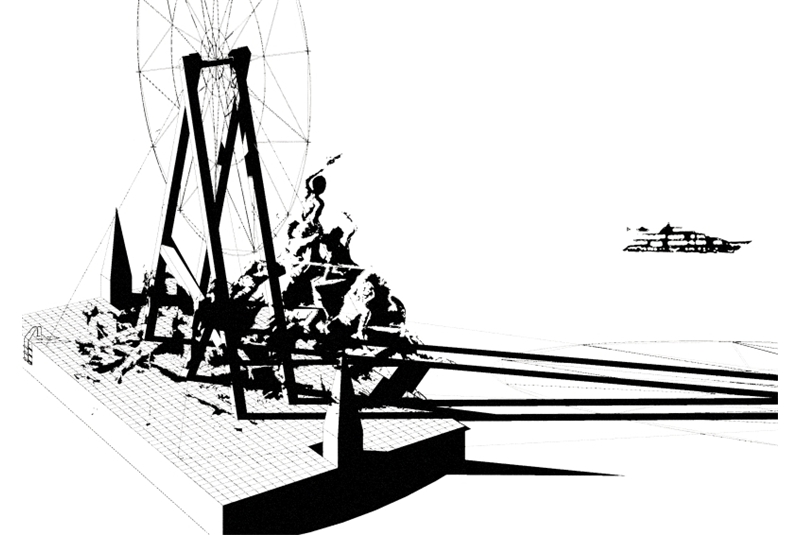
The project consists of a 30-metre long and 14.5-metre wide floating platform that serves as a pedestal for a 29-metre high and 11-metre radius wind wheel, supported by a timber trellis:
– The platform is formed by pieces of sheet metal (salvaged from wrecks) welded together, serves as a podium for the assembly of the pylon and is paved with ceramic tiles measuring 50x50 cm, useful to avoid excessive overheating of the walking surface during the day. It is a large watertight chamber for floating, 2 metres high, with a convex keel that reaches a depth of 2.85 metres. Access to the platform, which emerges 80 cm from the water's edge, is via two “pool ladders” positioned on its long sides. Two habitable “garitte” (also made of sheet metal), with a square base (1.5x1.5 m) and a pyramid-shaped roof, serve respectively as the raft's prow and stern, as well as “sighting” points, thanks to two rectangular oculi that look out to Africa on one side and Italy on the other. They are embedded in the 1.5-metre-deep platform, and reached via a three-step ladder. From a figurative point of view, the platform resembles a “barge”, while maintaining the typical “solemnity” of the Greek temple “podium”, embellished by the “Egyptian garitte”.
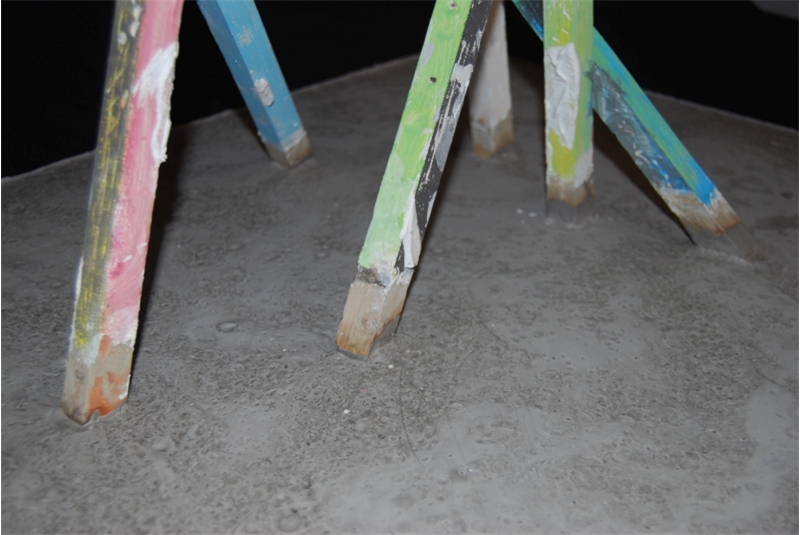
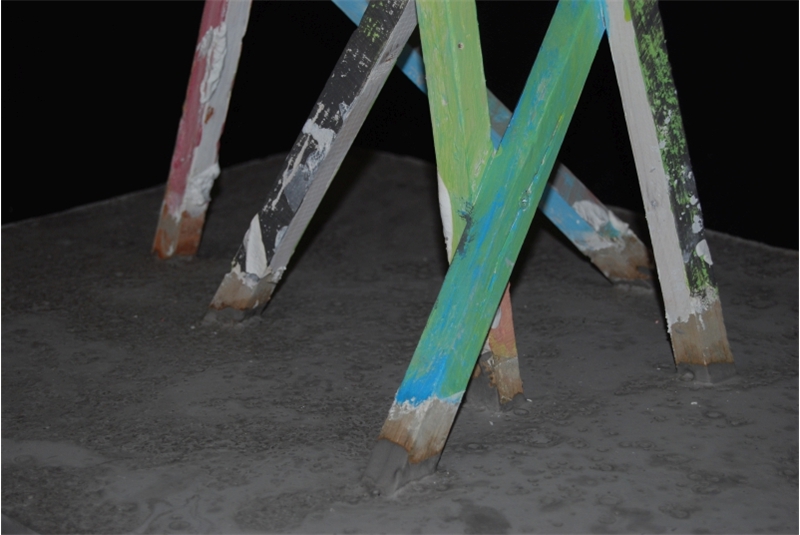
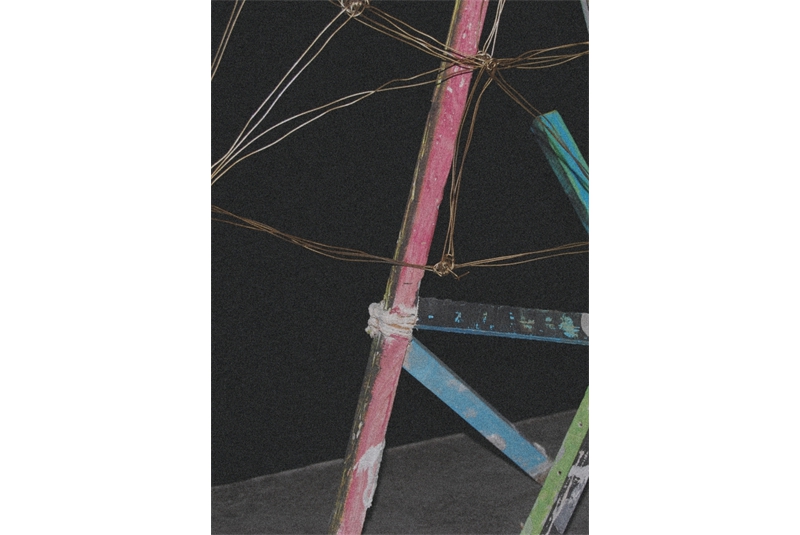
– The trellis consists of (salvaged) wooden poles with a square base (60x60 cm), bolted and painted. It reaches a maximum height of 18.5 metres (with poles of a maximum length of 20 metres) from the paved surface and is composed of two parallel triangular structures (2.60 m apart) that - similar to a swing - are connected by a central pivot to support the wind wheel.
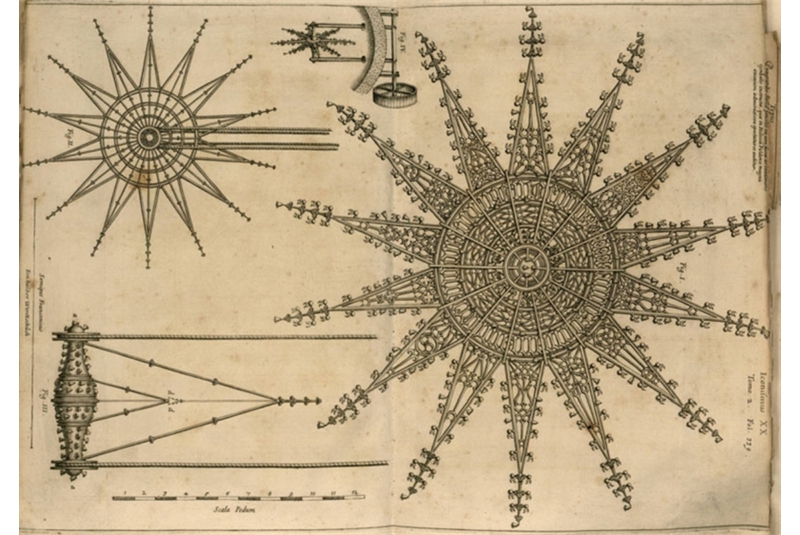
– The wind wheel is made of metal rods 3 cm in diameter, joined together and gilded to form three concentric rings (2, 4 and 5 metres apart) supported by 14 spokes, which draw and define, together with the bracing, a mesh of juxtaposed triangles. It is also stabilised by four tie rods anchored directly to the platform; and able to rotate freely around the pivot that supports it, depending on the winds and currents. From a figurative point of view, it freely reinterprets certain iconographies typical of the Mystery Processions and Patronal Feasts, with an internal decoration inspired by African sun masks, gaining great visibility by day through the reflection of the golden “filaments”, and by night thanks to a system of illuminations.
Conclusions
In the same way as Salvatore Bisogni's archipelago of clods, Fata Morgana, in the light of what has been said, intends to present itself as an "intermediate notion of architecture", as architecture's capacity to build places in open space, an "island of order", a "clod of the spirit" in which to take refuge (Bisogni 2011; Capozzi 2019). On the other hand, the word “place” metaphorically represents the “clearing circumscribed by the forest” (lichtung), the “domestic” light that is antinomically opposed to the inhospitable darkness (Heidegger 1927).
It is on this horizon of ideas that the confrontation between architect and sculptor has developed, in an attempt to build not so much a commemorative (and always "consolatory") "cenotaph", but to question the notion of "monument", to give rise to something immanent (and in a certain sense useful), to an island "of no-one", but habitable, in the middle of the sea. The walkway is in fact conceived as a point of landing-staying-anchor for the "wayfarers" of the Mediterranean.
In order to realise this "rescue buoy", an attempt was made (as already mentioned), not to start from a formal idea already given, but to go by trial and error, mistakes, second thoughts, making various models of "rafts" which were then disassembled and reassembled with the materials available.
The wheel would in fact be intended as an apotropaic sculpture and point of orientation/disorientation both visually and conceptually, capable of reacting differently to atmospheric events. A “clod of land” at sea capable, it is hoped, of evoking the continuously changing nature of time and the fragility of an image, of a shipwreck: «Because I know that time is always time / And place is always and only place / And what is actual is actual only for one time / And only for one place» (Elliot 1930).
[*] The title refers to the optical effect known as Fata Morgana, a form of mirage frequently observed in the Strait of Messina referring to the mythological figure of the same name, who induced false visions in sailors to lure them into her trap. The resulting deformation (due to the bending of light rays passing through layers of air at different temperatures) distorts objects to such an extent that they take on unrecognisable and fantastic shapes.