Anti-monument
When its construction was completed, Fernand Pouillon described the Climat de France in these terms, «I wanted men to have a kind of monument. Given that these were very small apartments, made for very poor people, I wanted the monumental spirit to enter their lives» (Utting et al. 2022). Born with the intention of rationalizing the Algerian suburbs, with notable monumental and architectural values, the Climat is now a monument for itself, with no relationship to the city and its urban context. It no longer has the values it once embodied, but ended up enclosing that banlieue it was intended to restore (Lagarde, Allik 2011).
The monumentality of the building has thus lost its monitum, its institutional symbolism linked to the values of modern architecture and French power in Algeria. It is no longer celebratory of the order and rationalization of Algiers' suburbs, nor is it a “warning” about the city’s colonial past.
The memorial at the Climat, then, is to be configured as an anti-monument, embodying the social and communitarian values to which it refers, rather than the values previously discussed: as expressed by Mechtild Widrich (2019, p. 57), it is a concept that entails «a more democratic ethos of engaging individuals subjectively rather than authoritatively instilling moral lessons».
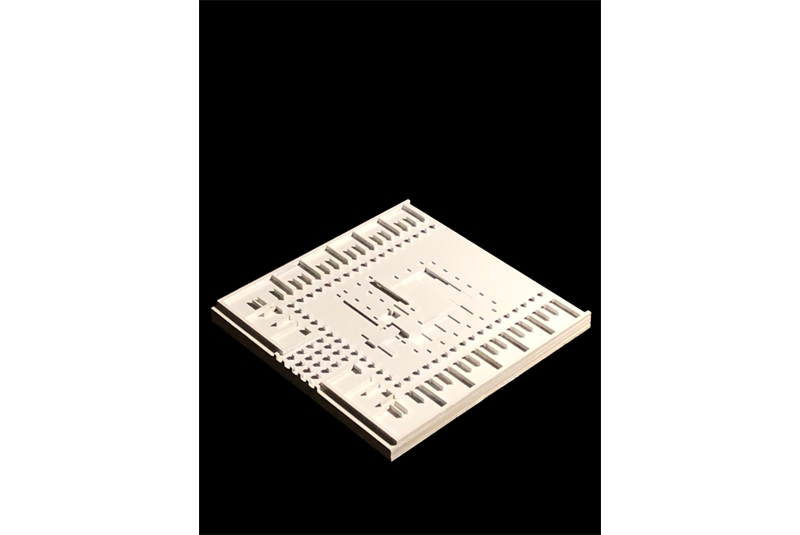
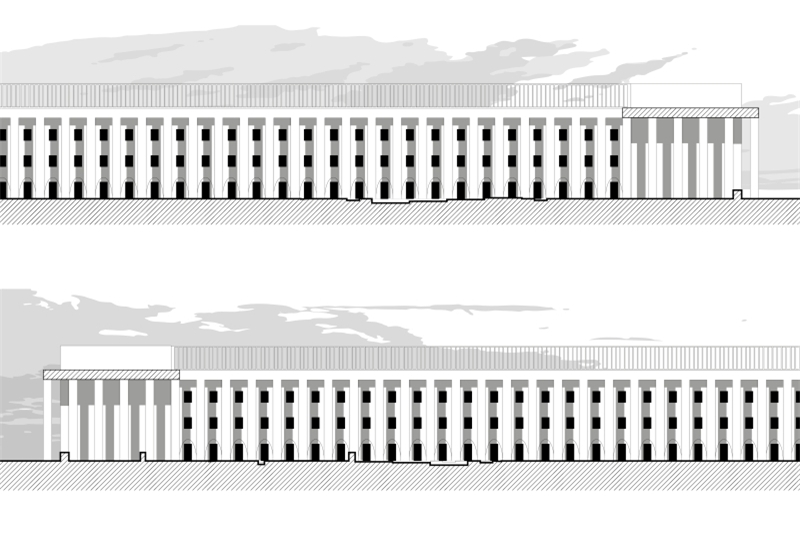
So, anti-monument is not a negative concept: it is a form of expression that allows the emergence of alternative narratives (Stevens et alii 2018), a theoretical basis and reasoning cue for the project proposal. Thus, the central core of the memorial lies in focusing on the Other, on all that has altered and adapted the use, functions, and perception of the building. The Climat, a true palimpsest of designing action, is thus taken as the starting point of a logical mechanism at the end of which it is transformed into negative forms etched into the ground. The Climat, such a strongly connoted architectural object, thus becomes a set of further forms, which are finally available for reuse.
An archaeological analysis for an architecture project
The project is constructed as an archaeology of architectural forms, extracting the logic behind its construction and assembling the simple elements identified in it (Motta, 1992). And if the project, and the building in which it is embedded, are designed by analogy, then the Memorial will bring the logic of their forms to maximum clarity, becoming a key to read the Climat.
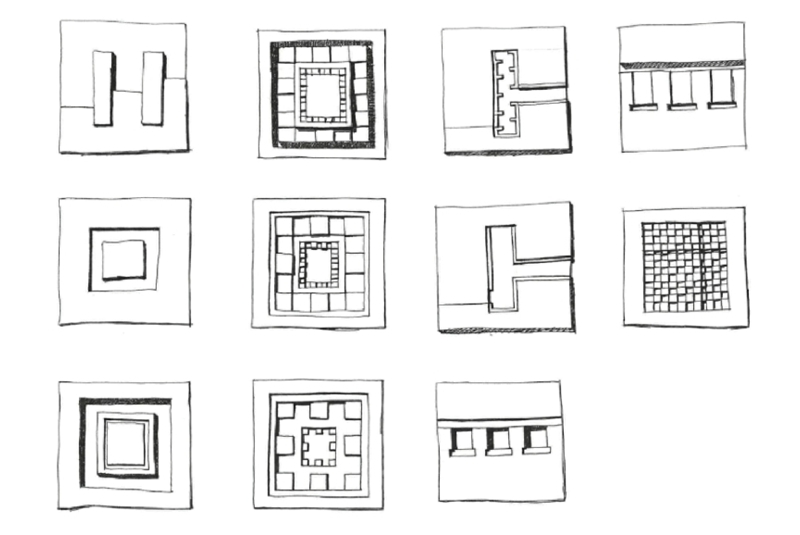
An attempt was made to identify the logic of its composition according to the categories of geography, typology, distribution, geometry and facade. For each one, having identified a specific representation, in plan, section or elevation, the current forms were stripped of their attributes, down to their structure: by removing further forms they would no longer be recognizable. As a geographic object, the two longest bodies of the building are actual terracing walls of the hillside facing the sea, identifying three floors at different elevations (first sketch in the upper right corner of the table). As a building type, it is a courtyard, but there are a series of enclosures formed by different architectural objects: the building body and the colonnade, which in turn can be composed into further elements that cannot be further reduced – the simple elements of architecture. As a distributive object, the staircase is regularly repeated in the plan, creating a homogeneous rhythm; in section it connects the different terraced floors. As a geometric object, the Climat is built from the repetition of a unit, the column, which gives a precise grid of proportioning, where sometimes irregularities take over, making the proportions shift. Finally, as an object of decoration, the façade has a colonnade, which is the public part, the real unchangeable and composed façade, and a wall behind it, that can be changed without altering the architectural design of the court.
An architecture project for an archaeological analysis
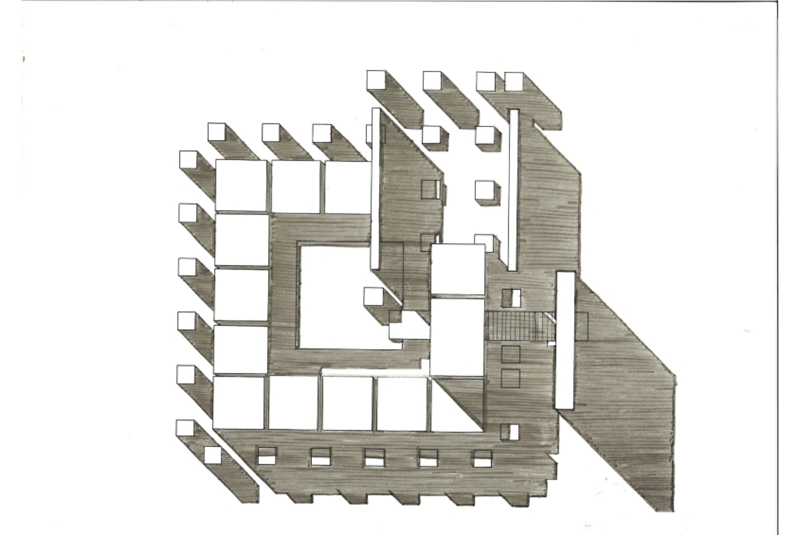
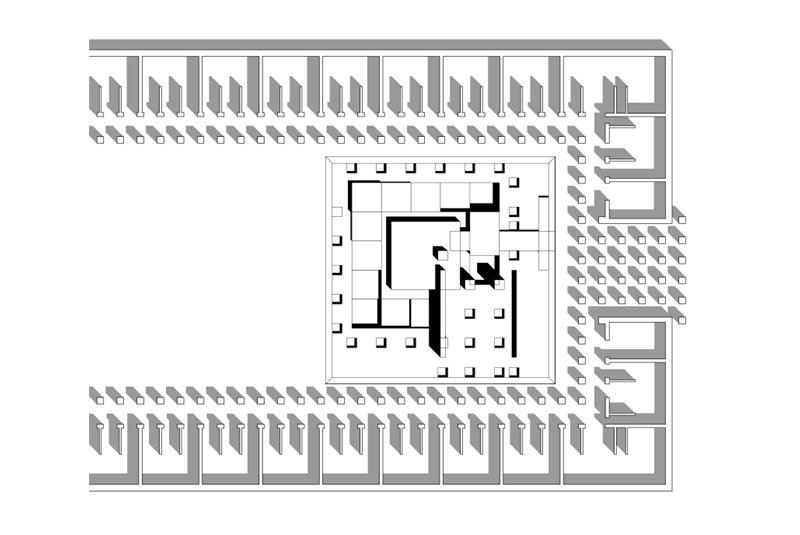
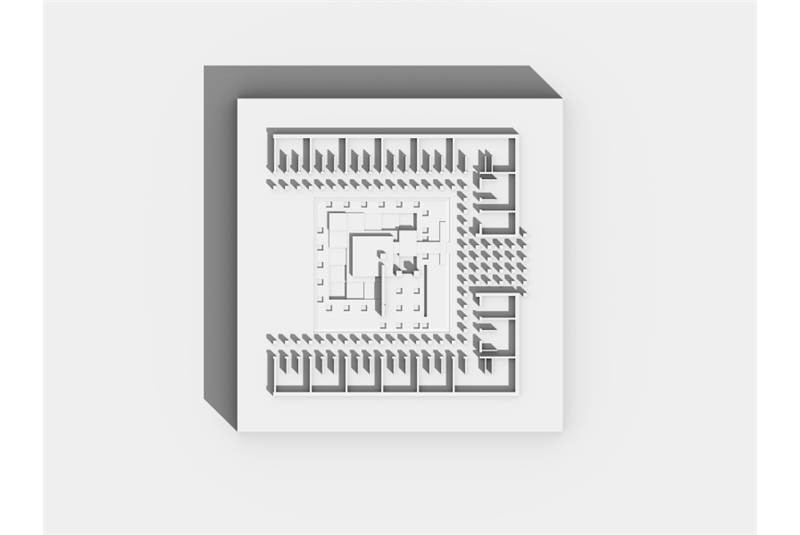
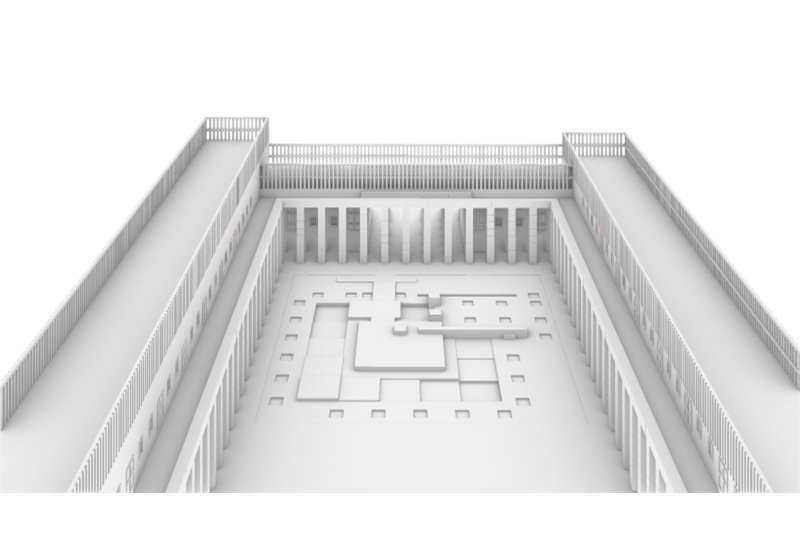
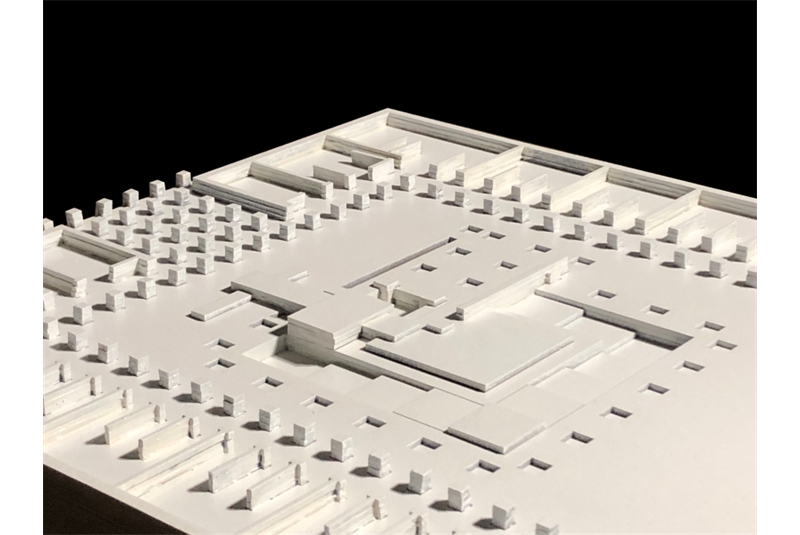
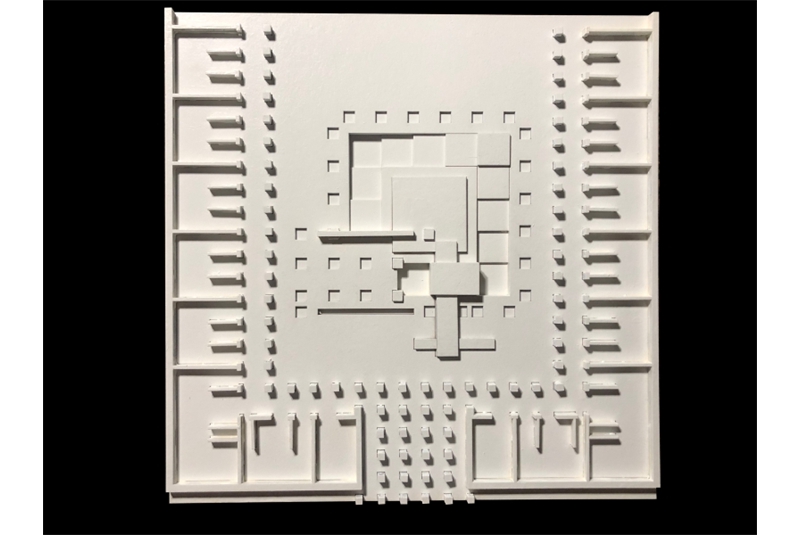
Achieving the lowest degree of recognizability means arriving at forms that no longer have the external attributes of the real object, but formal logics that can be found in other construction projects. That is the highest degree of universality of the project. As mentioned, the Climat breaks down into simple elements: court, enclosure, column and volume, which combine to create living units, peristyles and hypostyle rooms. In the design, these forms are taken up in their ground-level footprint, as negatives, conceiving the building bodies as basins around a raised central element. Similarly, the distribution leads from the level of the square to the center of the memorial through the series of basins, just as in the Climat the stairs lead from the lower terrace to the center of the court.
The construction type of the complex and the project is the courtyard building. The former consists of a building enclosure and a colonnade toward the court. These two enclosures are constructed in the same way, with one element that identifies an inner and an outer space, and another that, repeating itself, gives the architectural measure of the court space. The column fulfills the two functions for the peristyle, while for the building body the wall of the outer face is the separating element, and the septa of the housing units are the repetitive one. In the design, the columns are taken up in their footprint on the ground as impluviums around a central podium. However, both in the Climat and in the project, a second type intervenes to break the courtyard building, the hypostyle hall, denying it continuity.
The building then becomes the frame, the edge, the passepartout that frames and gives meaning to what is contained within it, arriving at a dialectical relationship of recognizability between center and edge. At the same time, the project is to be understood as an incision of the earth’s crust, revealing forms that have always been there waiting: the éspace lisse of the Climat de France courtyard is revealed as a éspace strié, an engraved space.
An ethnological analysis for a sculpture project
A further level beyond Climat’s geometric and compositional reading is the programmatic and social spirit of the building. Although out of scale, it is possible to read in its geometric and geographical conformation the traditional building type of the Arab-Muslim city: the mahalla, in Arabic محلة. Historically autonomous social institutions built around family ties and Islamic rituals, they are now, by a kind of metonymy, commonly known as neighborhoods in large cities and Muslim-majority towns (Dahmani 1983). The mahalla stood on an intermediate plane between private family life and the public sphere: through the solidarity of the mahalla, ceremonies, religious rituals, resource management, and conflict resolution were carried out, as well as simple community life and leisure time (Cresti 2015). It is in the context of the mahalla that the square of the Two Hundred Columns takes on additional significance. Today, the Climat represents a housing complex of monumental dimensions, secluded and thus with a strong idea of a closed and cohesive community within it. Thus one can speculate to give back such a large, impersonal and disorienting space to the function as a central point and gathering place for the community that it once had.
The art of space
The design therefore acts on the conformation of the ground, in order to create spaces for those who live in this monumental reality. The participatory conception – not so much of the design, but of the life of the memorial itself – has illustrious precedents.
Isamu Noguchi’s earthworks, his creations of Zen gardens and the incorporation of the natural element into man-made and monumental spaces, are clear examples of the need to create new approaches to space management with a strong influence of sculpture and a subjective and personal relationship with open space. A significant example is the Jardin de la Paix at the UNESCO headquarters in Paris, where the grandeur and rigid geometry of the large building is almost in contrast with the intimate spaces of the garden (Weilacher 1999).
Louis Kahn’s landscape architecture works, on the other hand, are a deep and intrinsic blending of architecture and landscape (Ashraf 2007), where indeed the architecture is a phenomenon of the landscape, as with the project for the Franklin Delano Roosevelt Memorial in New York (Brownlee, De Long 1995). Finally, Luis Barragan’s outdoor spaces also reconnect with the human dimension and the intermingling of the plastic arts and the architecture of lived spaces (Ambasz 1984).
The cues included, then, serve to treat the spaces of the Climat de France with the same gaze: on the one hand, combining the architectural form with the spatial and landscape component, and on the other hand, giving back to the Climat’s residents the use of the square with the creation of new spaces on a human scale.
In all the cases mentioned above, the relationship between the project and the observer is crucial to understanding its forms and geometries. Going beyond the subject-object relationship of the visual connection, the use of the space and its new forms – even in unorthodox ways, by the visitor/habitant/subject – is necessary to the very formation of the monument/memorial.
Live monuments
The project focuses on the need, exacerbated in contemporary times, to release the monument from a celebratory figure or intent and instead delivers it directly into the hands of the people who share space with it (Alfano et al 2022). The preconceived attribution of celebratory meanings to places and monuments has clashed in recent years with the growing awareness of the arbitrariness and temporariness of such interpretations, which have often turned out to be fallacious and biased. It therefore becomes necessary to think about a monument that is intended for the people who experience it on a daily basis (Ng 2023).
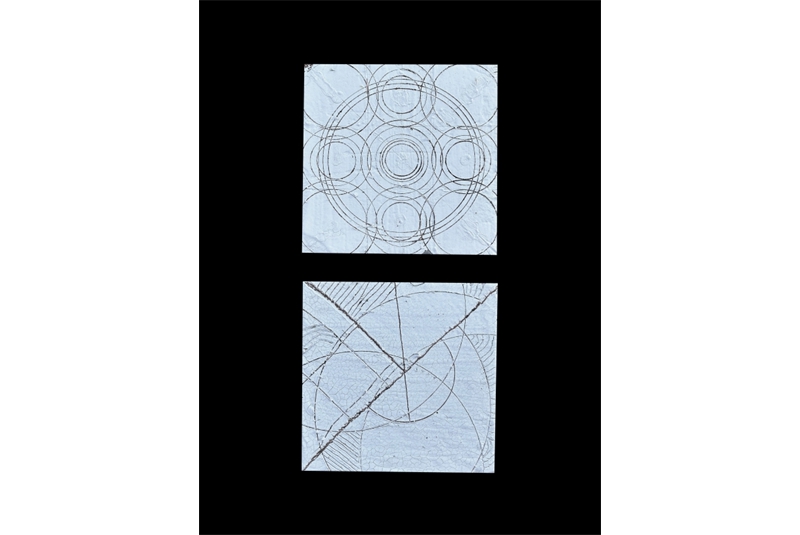
The project thus stands as an attempt to open the monument to a direct dialogue with the Other and with others. The surface finishing is in lime, a material that is widely used in the southern and eastern Mediterranean to refine buildings; thus, a vernacular sensibility is brought back to the interior of the Climat complex (Piernas Medina 2022). The monument acts as a means for interaction between the architectural object and the people through the technique of the sgraffito on lime, through which users are invited from the beginning to act and interact with it, by creating new layers, lettering, and bas-reliefs made with simple tools that everyone may have at their disposal (Lime Bank 2018).
Sgraffito is a masonry decoration technique of ancient origins, used since the Middle Ages in Europe and also widespread in Africa, which involves the application of two layers of plaster (one colored with natural materials and one with white lime) who are then engraved to reveal the underlying material. The sgraffito links an ancient technique to a rather widespread contemporary practice of engraving public surfaces with names, symbols or messages. Through it, people who inhabit the place are invited to intervene on the surface of the monument, creating drawings or texts that mark their passage within the space.
This triggers an ever-evolving narrative, a reversal of the passivity of classical and celebratory monuments at the center of squares: here the monument is immediately conceived, from its design, to be freely modified. A monument no longer made only to be looked at with detachment and reverence, but to be experienced, used and written, echoing the great debate on art as a shared gesture. Anyone, at any time, intervening, participates in the monument, making it active with his or her addition, in a process of democratizing art.
Towards a manifesto
The project does not detach itself from its connotation as a memorial but becomes so, in this case, as a shared and historical memory that coexists on the same object, continuously, without temporal hierarchies. It is a memory made up of continuous and infinite stratifications, and that finally lends itself to being a memorial of all and everyone, no longer only of a specific event or person.
A monument thus created to be “consumed,” no longer a motionless and static symbol, but a monument that is “alive,” in a continuous attribution of meanings by the people who interact with it in their daily lives. The actual and material action exercised by residents on the monument, whether through its use as a public and gathering space or through the technique of the sgraffito, is configured as a reappropriation of the space of the court of the Two Hundred Columns. The memorial thus goes from being a static object, created to be observed, to a dynamic and usable element in the lives of residents.
The project is an attempt to bring together different reflections. The reinterpretation from the positive to the negative of the structure becomes its opposite on a conceptual and practical level, handing the courtyard back to the people who live in it. The monument becomes in its continuous interaction a perpetual memorial – a memorial of anything and anyone –freed from its being a static object. The archaeology of forms disassembles and reassembles it into something else: an anti-monument.
Bibliography
ALFANO G., BERTONI C. and PALMIERI P. (2022) – “Clean Slates, Slates of Problems: Adventures of Cancel Culture”. Between, XII (23), 436-454 (May).
AMBASZ, E. (1984) – The Architecture of Luis Barragan. Museum of Modern Art, New York.
ASHRAF K. K. (2007) – “Taking Place: Landscape in the Architecture of Louis Kahn”. Journal of Architectural Education, 61(2), 48–58.
BARAZZETTA G. (2005) – “I cantieri di Ferdinand Puillon”. Casabella, 728-729 (December-January).
BONILLO J. L. (2001) – Fernand Pouillon Architecte Méditerranéen. Imbornon, Marseille.
BROWNLEE D. B. and DE LONG D. G. (1995) – Louis I. Kahn. Rizzoli, Milan.
DAHMANI S. (1983) – “Note sur un exemple de permanence de l’habitat et de l’urbanisme de l’époque antique à l’époque musulmane: Agadir-Tlemcen”. In: S. Lancel (a cura di), Actes du IIe colloque international sur l’histoire et l’archéologie de l’Afrique du Nord, pp. 437-449. Grenoble, 5-8 April 1983.
DUBOR B. (edited by) (1987) – Fernand Pouillon. Architetto delle 200 colonne. Electa, Milan.
FERLENGA A. (2003) – “Le pietre di Algeri”. Casabella, 706-707 (December-January), 49-55.
MOTTA G. (1992) – I frammenti della città e gli elementi semplici dell’architettura. CittàStudi, Milan.
NG E. (2023) – Cancel Culture: a critical analysis. Palgrave Macmillan Cham, London.
STEVENS Q., FRANCK K. A. e FAZAKERLY R. (2018) – “Counter-monuments: the anti-monumental and the dialogic”. The Journal of Architecture, 17 (6), 951-972.
UTTING B. e JACOBS D. (2022) – “Revisit Climat de France”. Architectural Review, 1490, 72-80.
VIDAL S. (2012) – “Entre distance et proximité : réflexion sur le passage de la démocratisation à la socialisation culturelle à partir de l’étude des Maisons Folie”. Marges, 2012/2 (15), 40-57.
WEILACHER U. (1999) – “Isamu Noguchi: Space as Sculpture”. In: U. Weilacher, Between Landscape Architecture and Land Art. Birkhauser Verlag, Basel.
WIDRICH M. (2019) – “After the Counter-monument. Commemoration in the Expanded Field”. In: S. Chattopadhyay, J. White (edited by), The Routledge Companion to Critical Approaches to Contemporary Architecture. Routledge, London.
Sitography
BANCA DELLA CALCE (2018) – Lo sgraffito: latte di calce da asporto. [online] Available at: <https://www.bancadellacalce.it/bdc/sgraffito/> [Last accessed 12 August 2023].
CANGIANO M. (2021) – Etica, intellettuali e mercato al tempo delle culture wars. Le parole e le cose. [online] Available at: <www.leparoleelecose.it> [Last accessed 07 September 2023].
CRESTI F. (2005) – L’Africa islamica: Algeria. Il Mondo dell’Archeologia. [online] Available at: <https://www.treccani.it/enciclopedia/l-africa-islamica-algeria_(Il-Mondo-dell'Archeologia)/> [Last accessed 20 December 2023].
HIDDEN ARCHITECTURE (2022) – Climat de France. Hidden Architecture Journal - Atlas. [online] Disponibile a: <https://hiddenarchitecture.net/climat-de-france/> [Last accessed 12 December 2023].
LAGARDE D. e ALLIK A. (2011) – Algérie: le logement hors de portée pour les jeunes. L’Express. [online] Available at: <https://www.lexpress.fr/monde/algerie-le-logement-hors-de-portee-pour-les-jeunes> [Last accessed 01 September 2023].
PIERNAS MEDINA A. (2022) – Bianco mediterraneo: l’uso della calce nell’architettura tradizionale e moderna. Architectural Digest. [online] Available at: <https://www.ad-italia.it/article/bianco-mediterraneo-luso-della-calce-nellarchitettura-tradizionale-e-moderna/> [Last accessed 30 August 2023].