
Although the tragedy of the shipwreck of 2013, like similar recurring events, belongs to present days, it is linked to an ancient history, which originated with the very idea of “Sea in the middle of the land”.
The idea of the Mediterranean was born with navigation. In structured forms, already starting from 11,000 years ago, man moves, along the coasts, between the islands and the continents, in search of congenial places that allow protection and landing.
The Mediterranean is therefore based on moving. The migration or diaspora provides critical knowledge of the territory in an attempt to establish a relationship with the natural forms of geography.
«The first use of a territory, the first awareness that man assumes, is constituted by the possibility of going through it, in the most direct way related to the oro-hydrographic structure» (Caniggia 1976).
What shape does the Mediterranean have? We wonder if the tragedy of the sinking of 368 migrants, has to do with the measure, with the physical distance that exists between Lampedusa and the coasts of Libya, between Europe and Africa, shores of the same “sea surrounded by continents”.
The composition entitled Méditerranée(s) by Lucas Monsaingeon[1] reconstructs a taxonomic drawing comparing many “impossible Mediterranean”. A progressive metamorphosis, starting from a round sea, to a perfectly rectangular basin. These paradoxical forms question the definition of the border, the boundary signs, and what is right to belong to the Mediterranean world and what is not. Where does the Mediterranean end? In the course of history, many have wondered about the precise and correct configuration of the Mare Nostrum.
Borders on cards overlap, often finding inconsistencies. What belongs on the surface to the European coasts, under the water level is geologically part of the African plate.
Planty of cartographs, which have followed one another over time, describe a distance that exists between the lands as never more than three hundred kilometers. In a geographical sense, therefore, there is no measure of “remoteness”, because everything is in a condition of relative “closeness”.
A closeness expressed in the relationship between nature and artifice, which is realized in the architecture and in the characters of the construction of cities and landscapes. An association of characters that holds together a very vast territory that makes the Mediterranean in the strict sense, a sounding board.
Braudel defines the presence of a “space unity” of the Mediterranean, built on a network of sea and land routes, and therefore of cities that “hold hands” together (Braudel 1987).
A world-system enclosed in a narrow space that reports situations and events even far away. “Diaspora” in fact comes from the Greek διασπορά “dispersion”, which in turn comes from the verb διασπείρω “disseminate”.
«In a certain way, on the edge of the greater Mediterranean, the importance and influence of the sea can be perceived» (Braudel 1987).
In this sense it is possible to think of «“Mediterraneanism” as a key for transmigrations, metamorphoses, quotations of words and ideas from one language to another» (Semerani 1991).
One of the characteristics that distinguishes this “unity of space”, is the sense of “uncertainty”[2], caused by overwhelming environmental, seismic or volcanic conditions, which condition a «human life aimed to transformation».
Many diasporas whose historical reality has been staged, not only in Europe but throughout the world, include those of exodus, flight, emigration, exile. They are involuntary, forced journeys, often with no possibility of return, and which involve experiences of disorientation, eradication, disintegration, loss of one’s identity. For their negative aspects are distinguished from travel in general (Braudel 1987).
In fact, the Mediterranean, in its emerged and submerged geography, has been over time a territory “witness” of events of destruction and death, from war conflicts to natural disasters, to the migration crisis of our day. Scenarios that show this place of the earth, as a “threshold” that highlights the differences and injustices.
The Mediterranean could be considered a “memorial in itself”. A “archive” (Matvejevic 1992), that preserves the true history of peoples, from origins to contemporaneity, and continues to expand, stratifying itself in a palimpsest of contradictions.
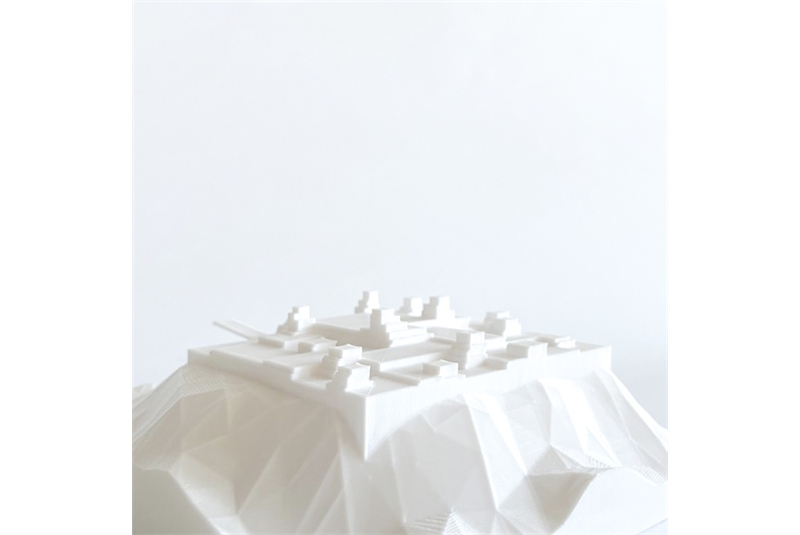
The design idea was to build a monument “in” the sea, the middle space, “terrain” of the order of events.
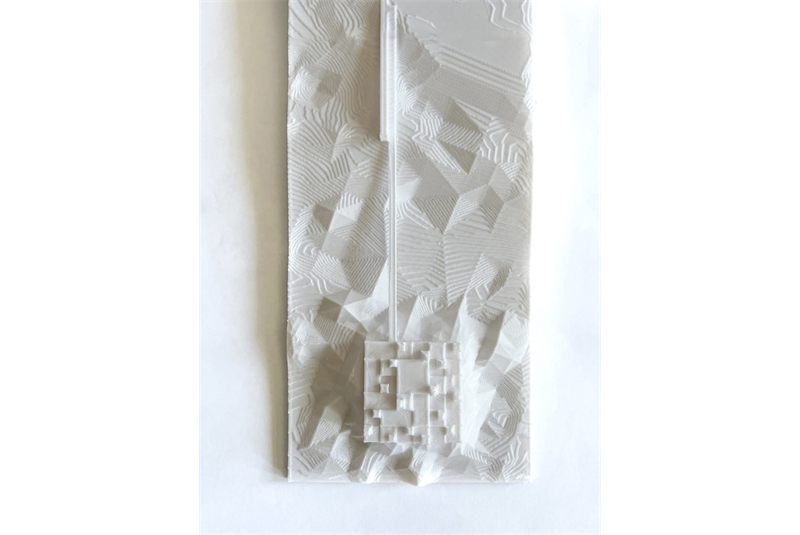
To build an island, off the coast of Lampedusa, which, like a sediment of natural geography, through a geological process “by invention”, emerges from the seabed of marine topography.
It affirms itself on the surface as a witness, of the victims of the shipwreck, and of all the other stories hidden under the water.
The act of “bringing to light” a further fragment of land emerged is an attempt to ensure that the monument is «participant in the events of the living element of the island, or the water»[3].
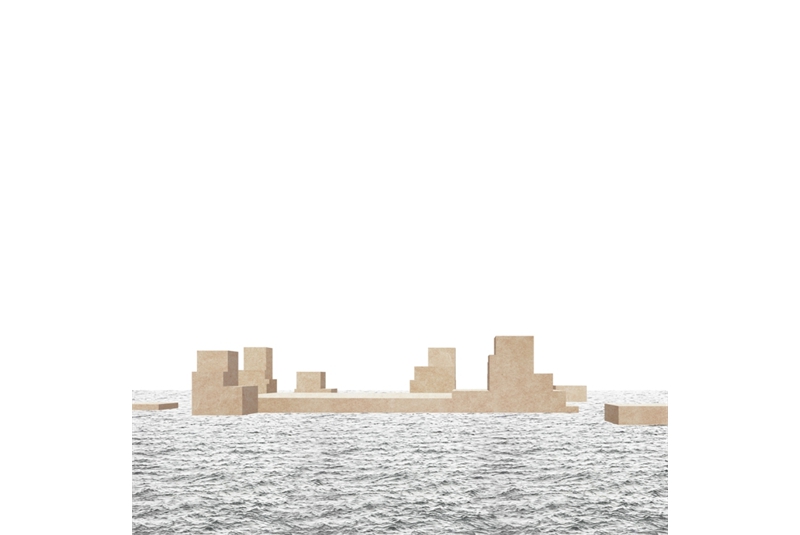
Building in water offers the possibility of experiencing a “duration” of the monument, as it manifests itself in different forms, interacting with the material in which it insists, through the natural rising of the tide.
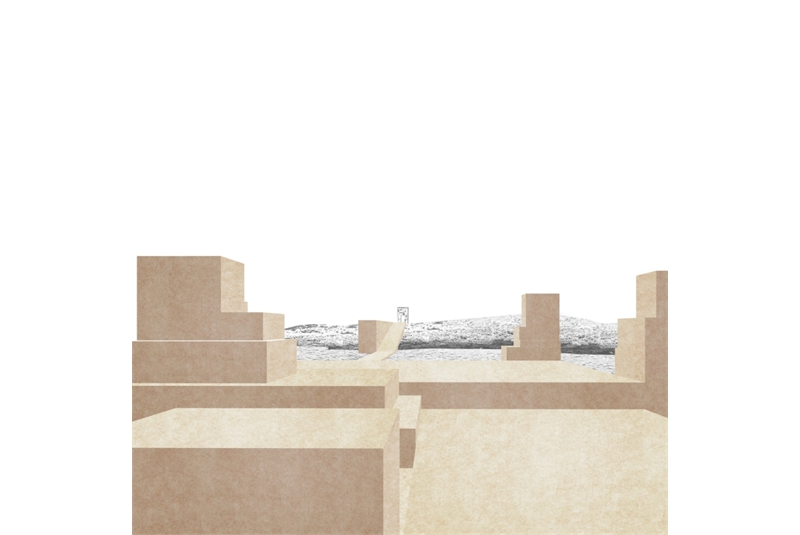
A condition of instability, which defines a “moving monument”, forcing to a double experience: at first, a feeling of remoteness, through the visual tension that is established from the earth to the island, in the observation of sculptural bodies, shaped by currents, immersed in water. Then, the possibility of reaching the isolated space at sea, almost in processional form, as a place of reflection and memory.
The observer takes on the role of actor, as he crosses and “inhabits” the memorial space.
The memorial leaves the “function” of “image” to be contemplated, to be a monument in-becoming, which changes several times during the day.
The composition for “topographic levels” leads to the approach «with difficulty and sacredness».
The project, as for a tectonic phenomenon, models the floor through vertical displacements. It is defined as a morphotype that wants to appear as “part” of an imaginary archipelago. It alludes to the figure of Lampedusa itself, in its entirety, with the stone walls “cut” alive, which is manifested as a “clod” of a more complex geographical system.
The relationship of the monument with the place is based on the rite.
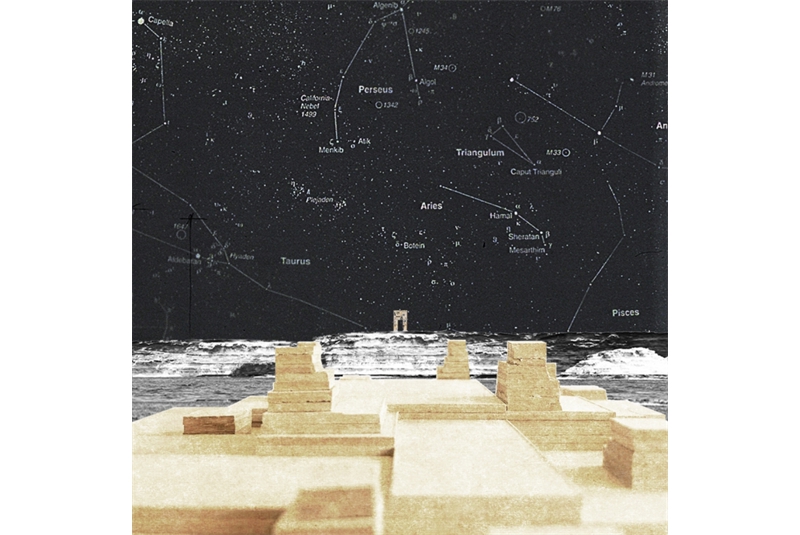
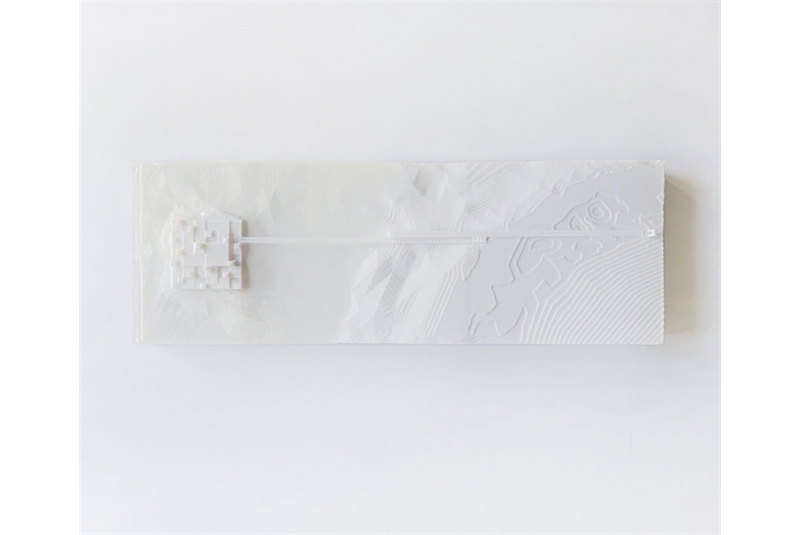
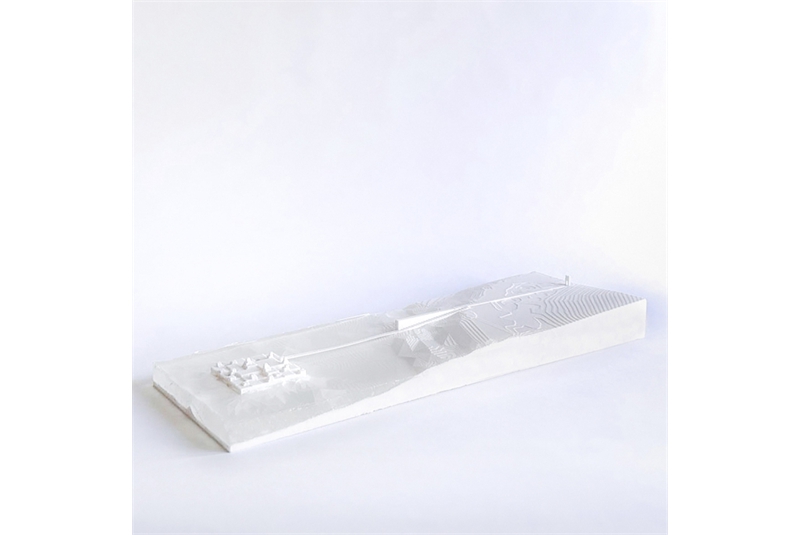
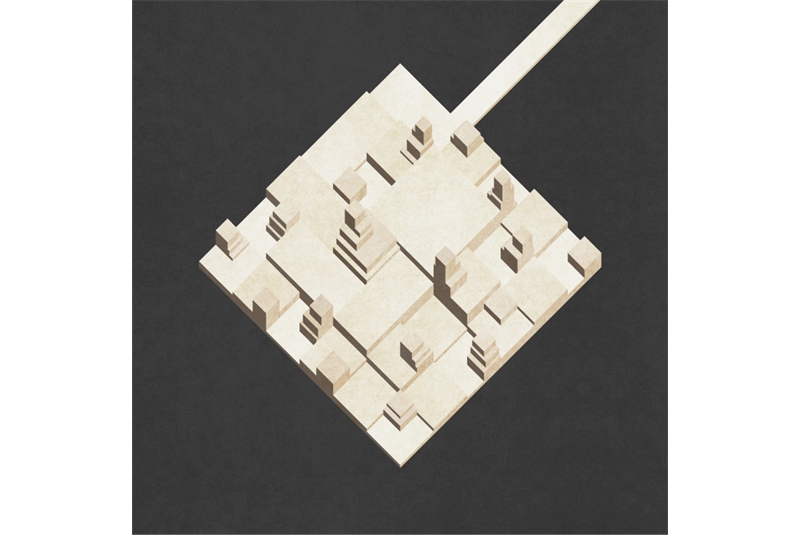
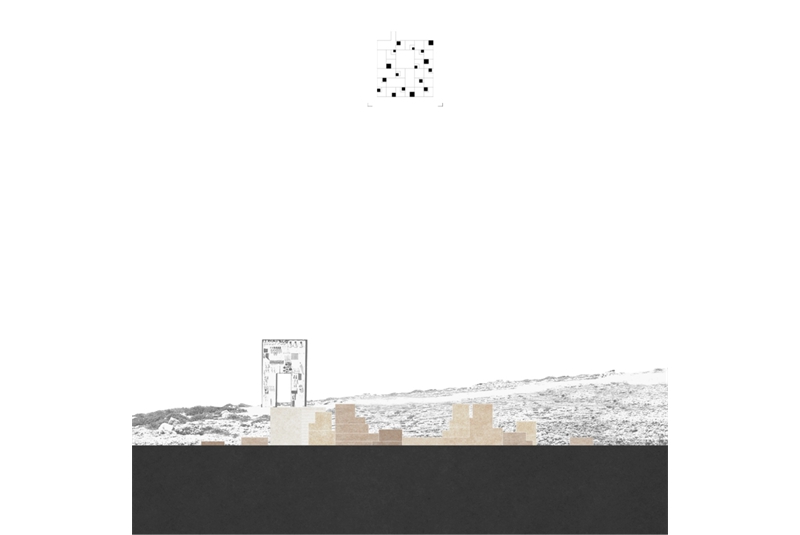
In correspondence of the promontory of Punta Spada, the memorial island is oriented in axis with respect to the Porta d’Europa. It identifies a “ritual path”, that from the door goes down on the rock, continuing in water like a “bridge” that, with the low tide, connects the island to the mainland.
The project intends to “physically describe” the place of the “southernmost point of Italy”: a linear walkway is set on the threshold of the sculpture of Paladino and marks the crossing for about 50m, up to a podium in an elevated position. It is flanked by a ramp, which solves the altitude jump from the rock to the shore, where the pier continues over the sea, for a hundred meters, until you reach the monument-site.
«The rite, in the two moments, contributes to the permanence of memory»[4], reconstructing by analogy, but on the contrary, the experience of the victims of the tragic events.
The composition of the sculptural bodies in the space-monument belongs to a “nocturnal writing”, taking up the words of Magris.
If the “diurnal” writing of the topography of the platform coincides with the truth of an “order”, the “nocturnal” one of the vertical “witnesses” corresponds to a state of mind. Another order, which is guided by the truth of the moment.
The destinies of Magrisian exiles from different regions, in one way or another, are victims of the lies and betrayals of modern society, fallen into the illusory perspectives of promised lands.
So also in the project, what seems like a destination is dispersed to the rise of water, and returns, with a new form, to be walking space a few hours later.
Nocturnal writing also refers to the character of sculpted volumes. Silent bodies, devoid of expressive dimension.
The project “accepts” an incompleteness of the form in the construction, which is only a fragment.
An emerged fragment that is a topographical interpretation of the morphology of the Mediterranean territory.
The shape of the platform and the sculptural elements is given by a “geological” process. In the sense that volumes are shaped by sedimentation and erosion, imitating not the forms of nature itself, but the “technique” with which time has changed them.
From this point of view, the project reflects on the relationship between matter and time. The stones that make up the surface of the Earth appear to us as unitary forms, while preserving inside and outside of them all the layers of time that has passed through them. In this the sculptural bodies tend to a figurativeness, in the sense that they intend to put “in figure” some elements of the physical reality of the Lampedusa coast.
What scale has a monument? Although the monument does not have a geometric scale of reference, it somehow “inherits” the proportions, from the “type” of construction, architecture to which it looks in the definition of its character. In this case, the place of the memorial is considered a public space, “resembling” the type of the Mediterranean “piazza”. A square, however, all exterior, which is compared only, on the one hand, with the limits of the coast of Lampedusa, and the horizon, on the other.
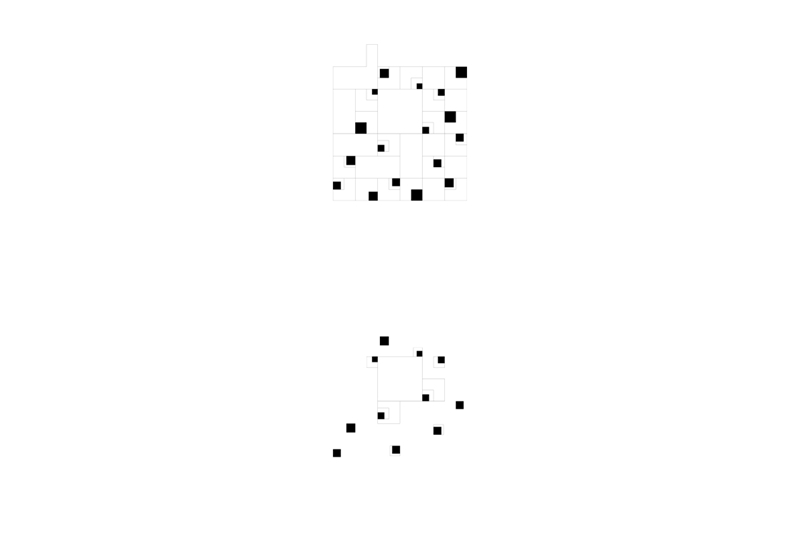
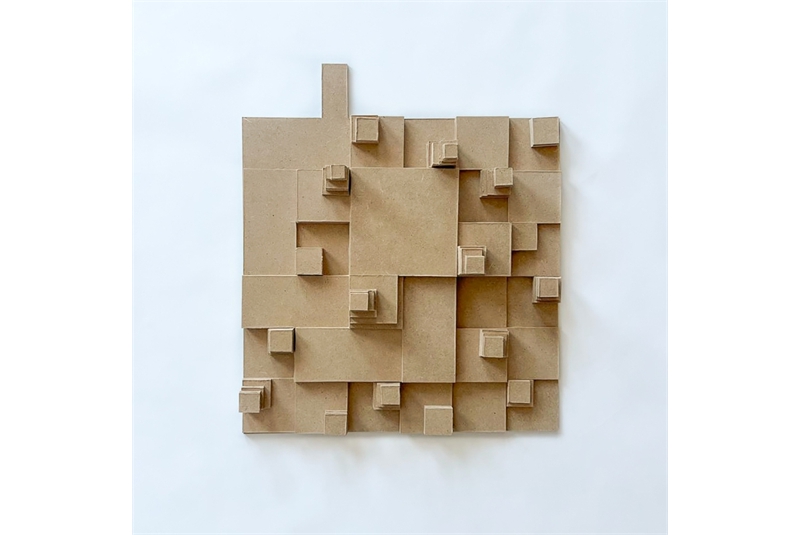
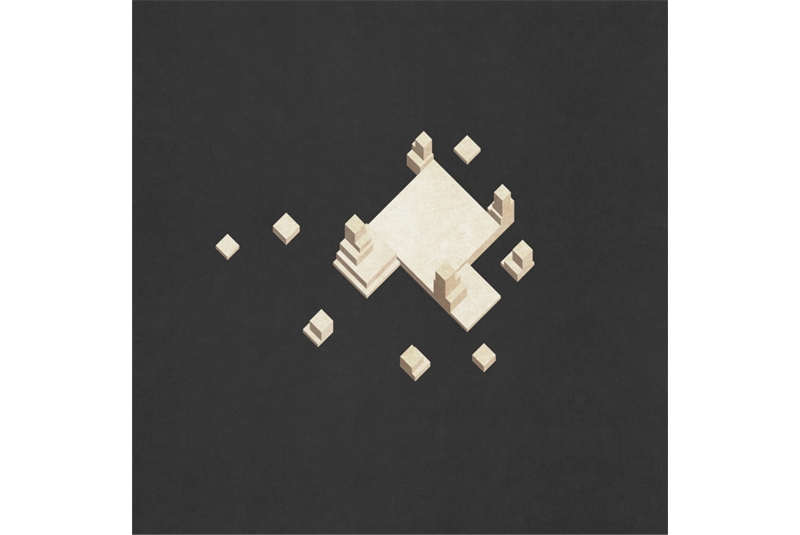
The island is measured in a square of thirty meters per side, modulated in a grid of five meters by five.
The grid-elements diversify with small height shifts, simulating the tectonic movement of the topography, as described above.
The system is “broken” by a series of double modules that together constitute the promenade towards the center of the space, defined in a square of ten meters to the side, which like a raised podium that allows observation.
On a second grid, of doubled matrix, rest bodies of the same material of the soil that, as for a process of sedimentation, rise in more vertical proportions, modelling themselves plastically in their development. As witnesses of quarry, these “symbolic” volumes are arranged in precise positions and according to a swastika design around the central podium, in order to orient the view and guide the contemplation towards the four cardinal points.
As the tide rises, the “witnesses” emerge, moving away from each other, revealing a new and unexpected composition. A constellation, that in the isolation of the “floating” bodies, reminds us by analogy the tragedy of the shipwreck of 3 October 2013.
*The title of the essay is a quote from the text of the song
Attraverso
l’acqua by Enzo Avitabile and Francesco De Gregori, 2016.
Note
[1] The drawing is a screen printing in Monseingeon 2017.
[2] The sense of “uncertainty” is, together with the “fragmentation” of the landscapes of land and sea, and the incredible ease of movement, one of the three peculiar characteristics of the Mediterranean life, identified by Horden and Purcell (2000).
[3] Resuming the report of Carlo Scarpa exposed to the city council of Venice in “defense” of the position of the Monumento alla Partigiana. (Scarpa 1968).
[4] In the relationship between ritual, monument and myth Aldo Rossi resumes some considerations of Fustel de Coulanges. (Rossi 1995, p.16).
Bibliography
BELTRAMINI G. (a cura di) (2009) – Carlo Scarpa e la scultura del ‘900. Marsilio, Padova.
BRAUDEL F. (1987) – Il Mediterraneo. Lo spazio, la storia, gli uomini, le tradizioni. Bompiani, Milan.
CANIGGIA G. (1976) – Strutture dello spazio antropico. Studi e Note. Uniedit S.p.a., Florence.
HORDEN P. e PURCELL N. (2000) – The Corrupting Sea: A study of mediterranean history. Wiley Blackwell, Hoboken.
MAGRIS C. (2005) – L’infinito viaggiare. Mondadori, Milan.
MATVEJEVIC P. (1992) – Breviario Mediterraneo. Garzanti, Milan.
MONSAINGEON L. (2017) – “Méditerranée(s)”. Classeur, 02.
ROSSI A. (1995) – L’architettura della città, Città Studi Edizione. Milan.
SCARPA C. (1968) – Dattiloscritto. Centro Archivi di Architettura Maxxi (Maxxi), Fondo Carlo Scarpa, 217, Doc 01,03.
SEMERANI L. (1991) – “Reali concrezioni marine”. Phalaris, 16, 1.