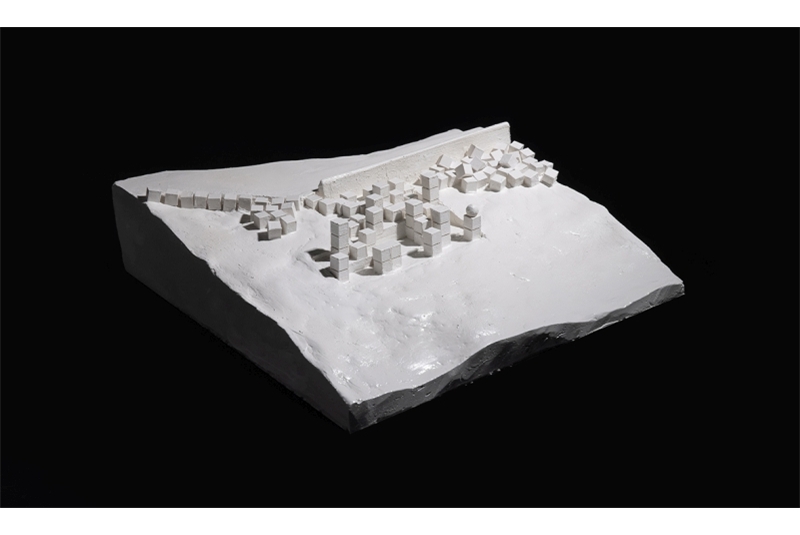
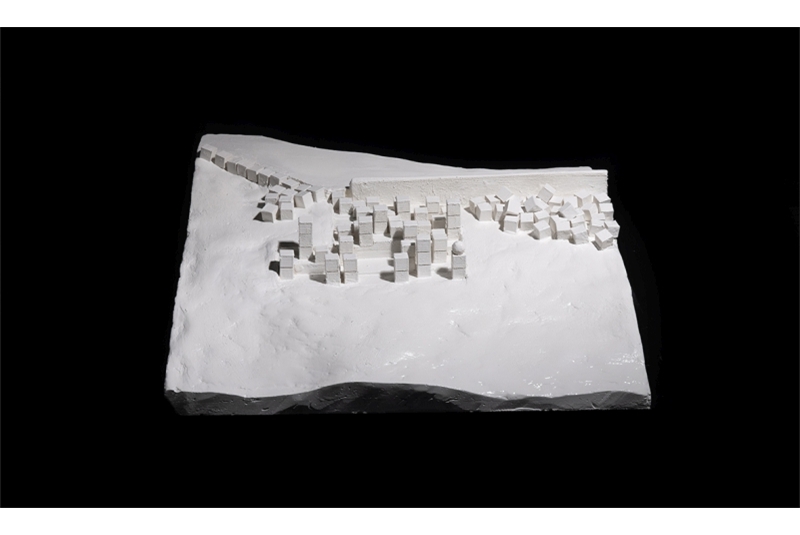
The Piazza Mediterraneo memorial, in the Favarolo pier, stimulates a continuous and intense reading of meanings, perceptions, suggestions and new interpretations of the coastal landscape and particularly of past events as a memoir of past tragedies. The pier is much more than a mere barrier of protection and safety from the waves of the sea; it is a place imbued with a high symbolic value in itself; it is here where the migrants who have just landed on the island and those rescued at sea are welcomed to receive first aid, it is also where the painful recognition of the victims takes place. The memorial intends to celebrate this specific event and at the same time stands as an emblem to affirm the universal value of dignity and human rights; the absence or lack of which in some nations induces large masses of the population to flee desperately, clandestinely and dangerously to other countries, increasing the constant flow of migration with all too often consequent massacres.
The new Piazza Mediterraneo also reveals other isolated punctiform elements scattered along the coastal strip: archaeological traces, remains of neolithic settlement, early christian necropolises, bunkers and forts dating back to the second world war. These places tell stories and events, through the figurative experience they can induce reflections, awake consciousness, moreover they can constitute a contribution to support the formation of an inclusive vision of the world, respectful towards diversity.
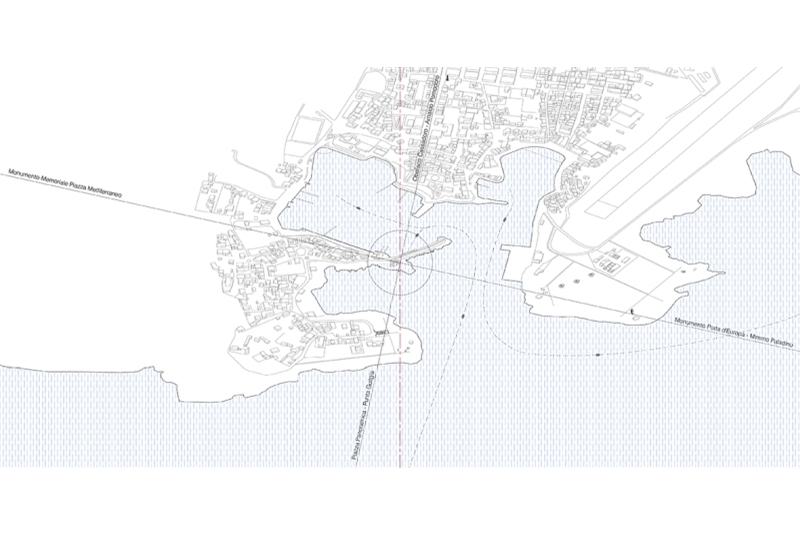
On a territorial scale, the project is configured in close correlation with the existing sculptural elements: to the north-east, the belvedere, the end of via Roma on which stands the Cassadoro obelisk, a tribute to the fallen of the wars, by the artist Arnaldo Pomodoro; to the east on Punta O’ Spada, the Porta d’Europa by the artist Mimmo Paladino; to the west on Punta Guitgia, the recent panoramic square, towards the city).
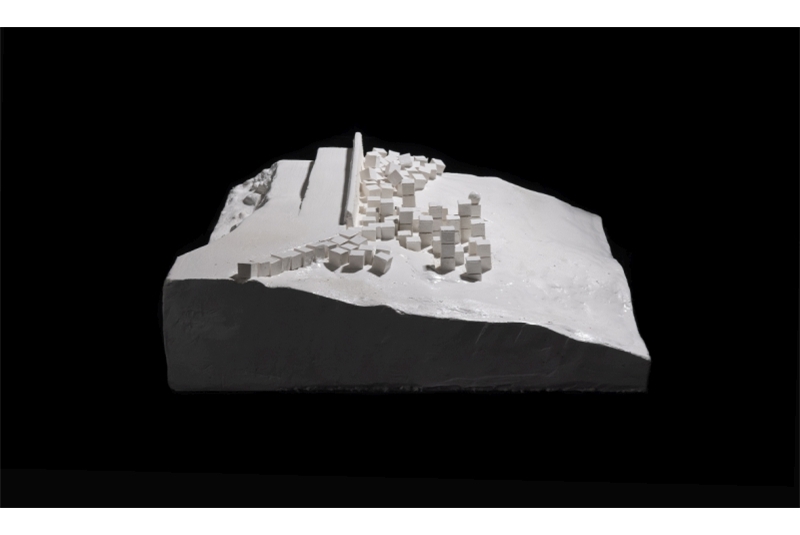
On an urban scale, it reconfigures the harbour, redefines the pier and aims to establish a physical relationship, through the complexity of liveable public open space, between the city, the pier and the sea, enjoying evocative views towards the horizon, of smells and sounds generated by the crashing of the waves. It is not usual for a memorial to appear also as an image of everyday life, expressing a confident impulse towards the future. This is made possible through the articulation of a path, a real public square, on different heights towards the historical landscape, thus making a new space in co-evolution with water. The memorial in fact originates from the relationship between nature and human imprint, between the sea, the reef and the port: so the naturalness and the artificiality of the matter and architectural form coexist in a symbiotic relationship involving past sense and current perception, in order to give back the image of a sculpture that rises onto the reef of the emerging pier, in different forms from the water, as if it were an archaeological find, a ruin from time immemorial, integrated in this place.
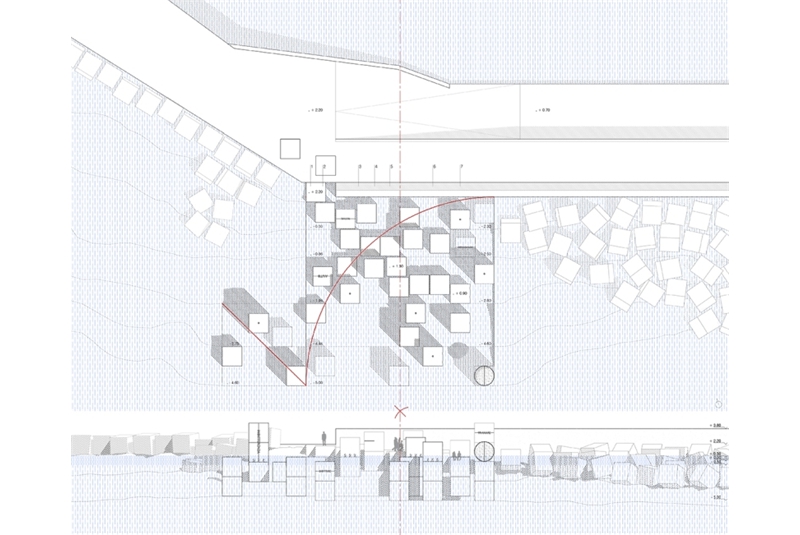
The existing breakwaters, purely functional engineering elements for port security, take on a new value and a new identity that goes beyond their technical function. Some of them are replaced and supplemented by sculptural elements with a high symbolic value, consisting of large cubes (2.5 m side size) of local limestone, split-cut, ochre-coloured, in chromatic and material continuity with the widespread existing tradition, harmoniously integrated in the context. The faces of the breakwaters, left sculpted by the natural, temporal erosion of the waves of the sea and evoking the impossibility of man to dominate nature, are engraved, in a sculptural manner, with artistic words and signs to induce reflection in memory of the indelible tragic event. The new breakwaters are placed by dry superimposition on a basin, obtained from an excavation on the rock, evoking an archaeological one, and by material subtraction of the limestone rock. It is the same basin, modulated in steps of different heights and depths, that makes the planivolumetric configuration of the Monument more variable, starting from specific alignments on an orthogonal grid, the different aggregation and superimposition of the individual cubic elements defines different areas, solids and voids, to determine specific and targeted views in close correlation with the emotional landscape context. The architecture of the memorial, with the expressive symbolism of the rigorous layout in which the repetition and elevation of the new breakwaters is articulated, is the exact image of the tragedies consumed off the coast, fixed in time, so much so that the missing parts, as the absence of breakwaters, apparently leave unresolved voids of perceptible lacks, which in opposition to the full ones exalt the figure of the proto-ruins, fitting harmoniously into the historical, artistic and archaeological context of the island. The project questions this human correspondence to the absence of something and it does so by attributing to the hollow space the value of an element capable of defining the presence of what the space itself contains.
The elements are concentrated at the nodal point, currently unresolved and unliveable, between the road and the walkway, mediated by a gate, of the Favarolo wharf. The sediment area of the basin, a square-shaped platform (24 m side size) with a square-shaped “tail” (10.5 m on a side) towards the sea of Cala Guitgia, guarantees a spatial continuity that mediates between the wharf’s planimetric layout and the road’s different layout, allowing the continuity of the wharf itself through the use of breakwaters that become figurative, sculptural and material elements structuring the project and characterising the port.
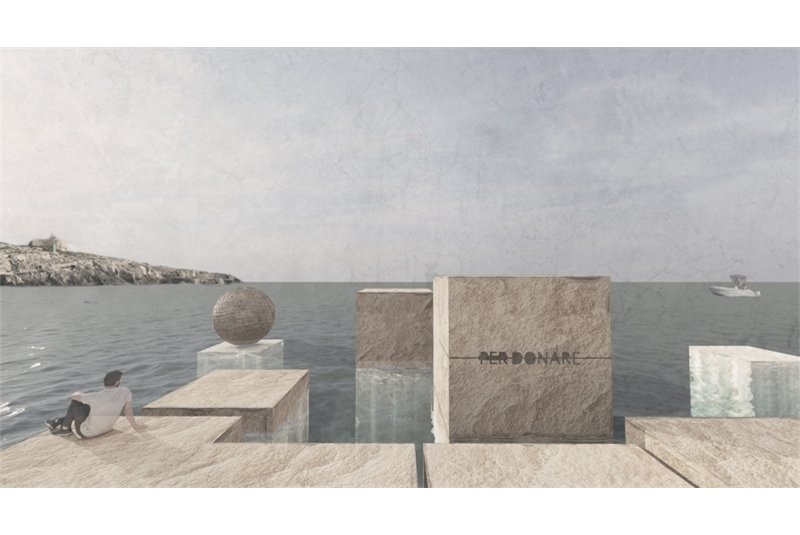
The memorial-Monument is completed with a rough spherical sculpture, placed on the upper surface of the most extreme cube towards the south-east, obtained by subtraction and polishing of material from a breakwater, to evoke the terrestrial sphere, a metaphor of an infinite welcoming embrace of solidarity between the people of the world.
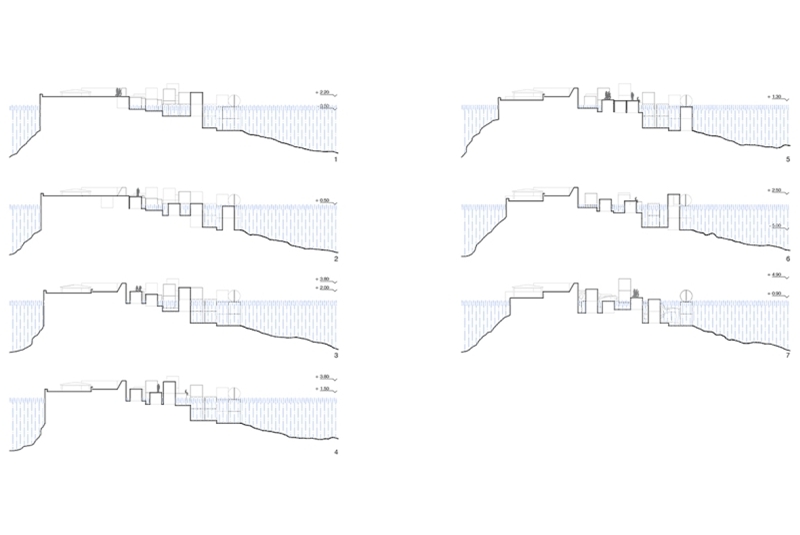
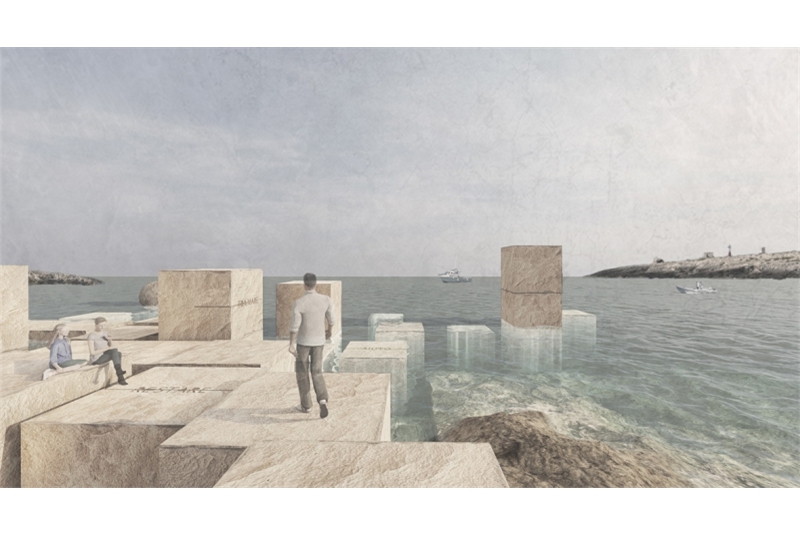
The memorial slopes down towards the sea with its stepped platforms and the cubic masses of the new breakwaters, the latter appearing as bulwarks of fragmentary and discontinuous ruins, eroded by time and the force of nature expressed by the sea and the weather.
The new breakwaters never collide, often arranged close together, almost adjacent but not joined (minimum distance of 10 cm), with a perceived autonomy in a unity of design, so that water can also pass between the interstices and erode the rock faces of the breakwaters, naturally continuing the initial human sculptural work (Figg. 3-4).
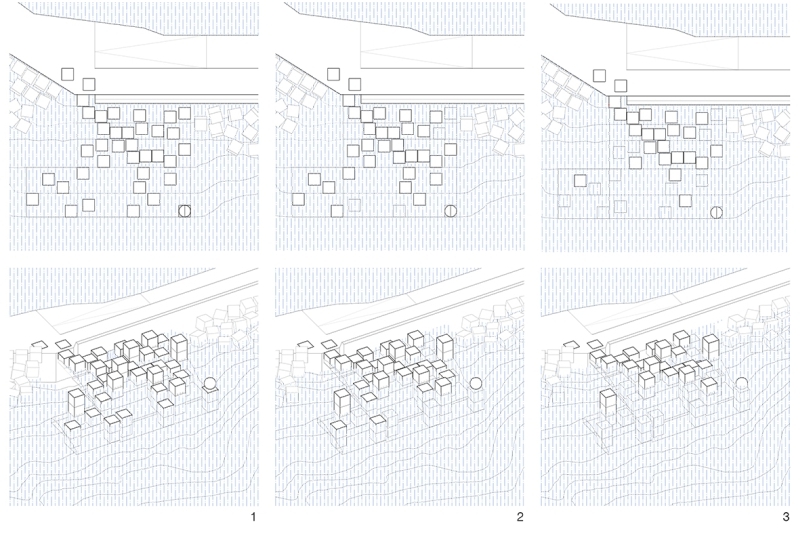
The changing effect that the design attributes to the memorial is synergistically combined with the natural element of the relationship with the sea, returning ever-changing spatial visions with visual effects generated by the transparencies and chromatic reflections of the water on the faces of the breakwaters. In fact, the varying level of the water's presence reveals or hides the breakwaters that can be glimpsed below the sea level, thus referring to an image that is always moving and evolving, correlating with the historical context of the island. The changing nature of the memorial, in relation to the water level, constitutes the metaphor of the sea that gives regenerating new life and at the same time takes it away. During high tide, it submerges, removing it from view while at low tide, it is unveiled, restoring it. In relation to the fluctuations of the sea, three different possible configurations are hypothesised: the low tide condition (q. -0.50 m) leaves all the breakwaters and the sphere visible; the high tide condition (q. +0.50 m) covers the majority of the breakwaters, submerging a part of the sphere; during the medium water level condition (q. ±0.00 m) many of them are visible and the sphere seems to float on the water. The connective and allegorical naturalness of water – life, death and rebirth – contributes to the solidarity between old and new, unveils the surfaced figures of architecture and recalls them as objects of a lost past.
The memorial, in its new breakwaters, has engraved words and sculptural signs towards the water, towards the shoreline and on the walking surface, to be read by those arriving from the sea, those walking on the pier and those walking along the Monument, to arouse emotions, feelings of solidarity and cooperation, to induce reflections on the human correspondence between the sense of the uniqueness of life and the memory of the events that took place. They are engravings of ambivalent words (forgive, suffer, remain, plot, indifference, join), with often opposite or different meanings if a prefix is deleted, to emphasise that issues with the proactive and purposeful intervention of man, as happens with certain words, conceal different perspectives and resolutions, open up the future and hope. Some breakwaters, those reached by the rising water level during high tide, become natural “musical instruments” that produce pleasant sound effects in addition to the changing auditory perceptions. The faces facing the sea and the sky have incisions and continuous communicating holes: the pressure caused by the movement of the waves causes the liquid to rise over the holes, thus compressing the air and producing the sound given by the venting generated by the recess. The work during the high tide, mainly linked to sunset, becomes an evocative and unprecedented “organ” of the sea.
The material used for the Monument is the local limestone, present on the island, which possesses intermediate characteristics compared to other stones found there, such as dolomite, which is harder and more compact, and sandstone, which, on the other hand, has lower hardness characteristics. Depending on the weather, limestone lends itself to a natural erosion effect, typical of the island’s northern coastline. The choice of limestone is also dictated by the desire to give the Monument durability over time, avoiding rapid deterioration and at the same time the need to resort to the local construction technique, overlapping and juxtaposition of limestone, and the involvement of specific craftsmen for the execution of a handcrafted work.
Light plays an important role in the architecture of the memorial; the rhythm of the design of the breakwaters causes a diffusion of shadows arranged differently depending on the movement of the sun during the day. The sun’s rays are absorbed by the surfaces of the breakwaters, which reflect and send back different lights and colours according to the varying presence or absence of water, algae and salt encrustations; those that are submerged more frequently become darker in colour, and in low tide conditions a chromatic stratification from wet to dry, from light to dark, is shown. The lunar night light, which gives the memorial a global image of mystery, is integrated by visually highlighting the single spherical geometric element on which a luminous vertical cut is made, visible from the different belvederes of the city and the coast, becoming a true sculptural fulcrum, visible in the area.
The intervention is integrated into the naturalness of the context with equally natural elements first sculpted by man and then destined to be sculpted by the sea, hence the evocative power and emotional beauty of the project. A play of the parts that continuously transforms the memorial, whose intervention excludes the use of iconic expressions that are extraneous to the essentiality of the work and the place, linked to the vicissitudes of migrants and the eternal mysteries of the sea.
Bibliography
BASCHERINI E. (2017) – “Comporre il dolore. Il monumento alla Partigiana Veneta di Carlo Scarpa”. In_Bo. Ricerche e progetti per il territorio, la città e l’architettura, 8 (12), 165-173.
BIGIOTTI S. and CORVINO E. (2015) – La modernità delle rovine. Temi e figure dell’architettura contemporanea. Prospettive Edizioni, Rome.
GALATEO S. (2016) – I Waterfront. I grandi Temi dell’Architettura. Hachette Fascicoli, Milan.
GUCCIONE M. (edited by) (2008) – Carlo Scarpa: il Monumento alla Partigiana ai Giardini di Castello, Venezia. Maxxi, Rome.
FRAGAPANE G. (1993) – Lampedusa. Dalla preistoria al 1878. Sellerio Editore, Palermo.
MARTINEZ ARROYO C., PEMJEAN MUÑOZ R. and DELGRADO CÀMARA E. (2019) – “La línea del agua. El monumento a la Partisana de Carlo Scarpa en Venecia”. Rita, 11, 36-43.
TAORMINA F. (2014) – Il viaggio delle pietre. Una visita in Israele e l’architettura dei vuoti. Aracne editrice, Rome.
TARANTO A. (2022) – Breve storia di Lampedusa. GraficaElettronica, Naples.