Between Archè and Techne. Subtle equilibriums in
the work of Oton Jugovec
Claudia Pirina
Fig.
1 - Cover of the first issue of the magazine “Arhitekt”.
Graphics by Edvard Ravnikar Univerzitetna knjižnica Maribor, September
1951.
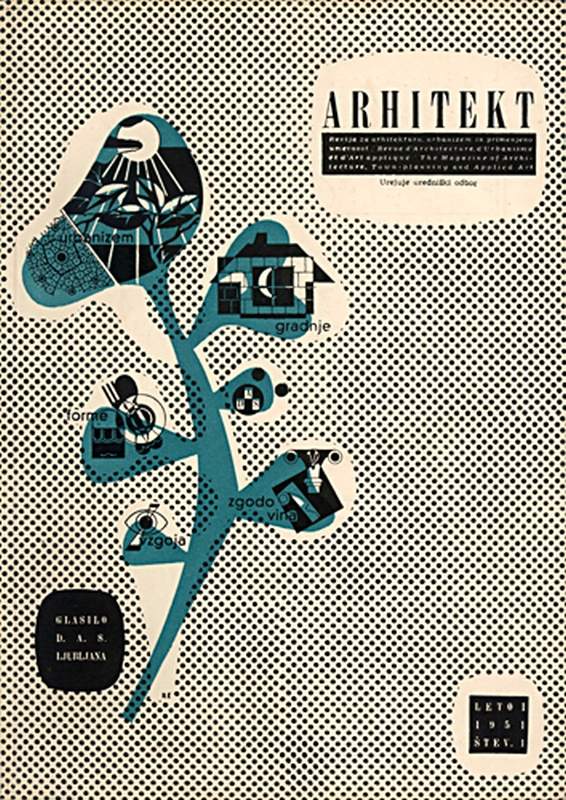
Fig.
2 - Jože Plečnik, Newspaper kios, Ljubljana and Oton Jugovec,
Prefabricated holiday homes, Ankaran. (photos from Zorec 2000-2001,
p.56 and drawings by C. Pirina and P. Ferrara).
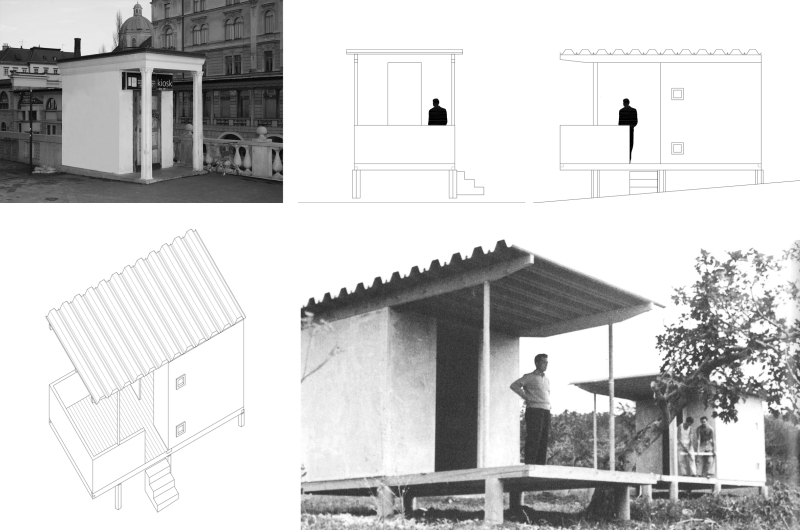
Fig.
3 - Oton Jugovec, Petrol filling stations and Oton Jugovec, Reteče.
Church (photo from Zorec 2000-2001, p.59 and drawings by C. Pirina and
P. Ferrara).
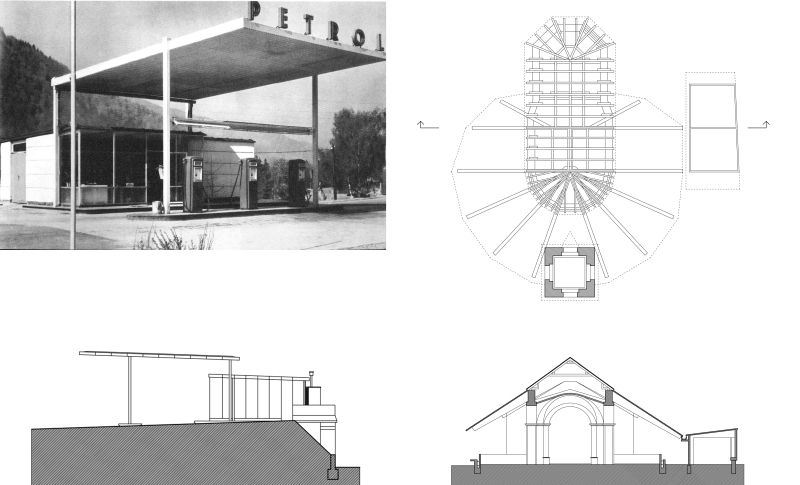
Fig.
4 - Types of traditional wooden structures of the kozolec and Oton
Jugovec, covering the archaeological remains of the medieval settlement
of Gutenwertha in Otoku (drawings by C. Pirina and P. Ferrara).
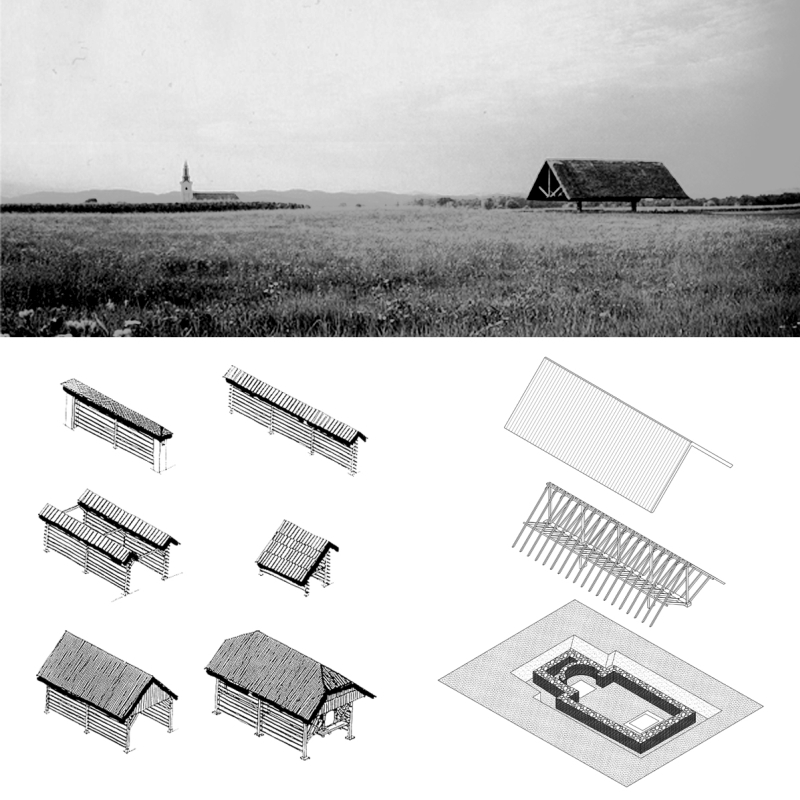
Fig.
5 - Joseph Wagner, Litografija Ljubljane iz zbirke Malerische Ansichten
aus Krain, 1842 - 1848 (Digital Library of Slovenia, id. no. QLYI3AXZ).
[online].
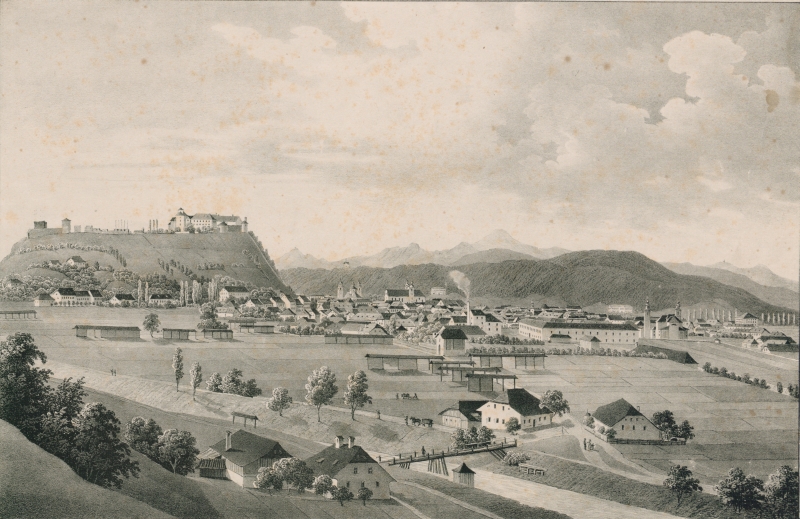
Fig.
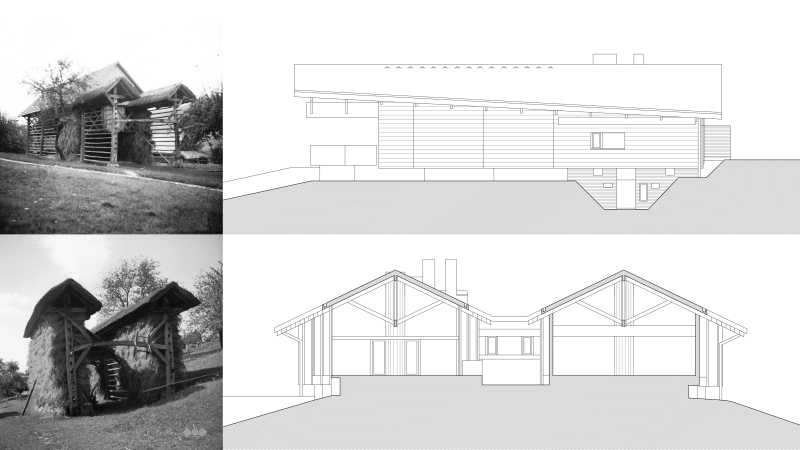
6 - Types of traditional wooden structures of the kozolec (Wikimedia
Common). Oton Jugovec, central building of the Partisan Rog Baza 20
(drawings by C. Pirina and P. Ferrara).
If we listen with attention to the writers and thinkers of
thinkers of the twentieth century when they express themselves on the
concept of modernity and compare them their opposite numbers of the
previous century, we are made aware of a radical lowering of
perspective and a drop in imaginative potential (Berman, cited by
Nicolin 1989, p.5).
At the end of the 1990s, Pierluigi Nicolin began the editorial of issue
64 of the magazine “Lotus” with some words by the American
philosopher Marshall Berman who, in his texts of those years, proposed
a series of reflections on the experience of modernity, starting from a
reading of the work of certain masters and their special cultural
relationship with certain cities. The issue of “Lotus”,
titled The Other Urbanism, is
introduced by an interesting essay by Manuel de Solà Morales in
which the Catalan architect rereads, in the key of an
“other” tradition, a series of contemporary urban projects
by «planners of the ‘other modern’, at one and the
same time enthusiasts for and enemies of modern life, [who] have been
able to grasp its ambiguities and contradictions without renouncing the
attempt to go beyond them» (Nicolin 1989, p.5). The
re-examination of the origins of certain phenomena contemporary to him
had the sense of focusing on the work of certain figures of planners
interested in identifying a method capable of interpreting modernity in
the sign of complexity and superimposition on the pre-existing city
«and for that very reason determinated to seek its most rigorous
transformation» (De Solà Morales 1989, p.7), far from the
abstractions and absolutisms of that current of modernity that arose,
according to De Solà Morales, after the Ciam Congress of 1929.
The ability of the selected projects to read the contexts and specific
conditions «of each part of the city, its perspective being the
great city as a complex and ever richer and more differentiated
artefact» (ibid) brought to attention a «complex history of
twentieth-century architecture - in which avant-garde and the tradition
are often intertwined in the creations of the same protagonists and
ideas pass through personal relationships that had little to do
with architectural movement» (Ferlenga 2022, p.23).
In the panorama of Slovenian architecture of what has been defined as
the third generation of architects, Oton Jugovec can be considered as
that figure whose sensitivity, together with a profound knowledge of
his own origins, has resulted in architecture in which respect for
tradition and dialogue with the roots of the territory have
«guaranteed an evolving continuity» (Zorec 2020). With his
work, Jugovec has managed to achieve a balance between modernity and
the local rural, artistic and architectural heritage, experimenting,
over time, with techniques and forms of modernity in search of his own
distinctive language. The evolution of his work reflects, on the one
hand, the knowledge acquired during his early years of training at the
Technical University in Prague, and on the other, the influences of the
Faculty of Architecture in Ljubljana and his teacher Edvard Ravnikar.
If from the Prague university he inherited «a solid technical
education and working discipline» (Zorec 2000-2001, p. 139), in
the Ljubljana faculty he was able to incorporate both Central European
and modernist instances. The establishment of the university in
Ljubljana by Ivan Vurnik and Jože Plečnik had in fact been
characterized by a Mitteleuropean breath «that would strongly
mark the whole evolution of the subsequent Slovene architecture»
(Mercadante 2023, p.2) through the work of Otto Wagner, Adolf Loos,
Peter Behrens or the interest in Expressionism and Bauhaus, or the
great structures of the Viennese Höfe (ibid). Between the 1929s
and 1940s, however, a series of Slovenian architects, including
Ravnikar, had frequented Le Corbusier's studio (Hrausky 1993, p. 37),
importing the instances of Modernism, later hybridized by the proximity
and relationship with Nordic Scandinavian architectural models, also
through their work within the magazine “Arhitekt” (fig. 1).
The figure of Ravnikar, and his cultural circle, can be considered the
pivot of a work of internationalization and cultural exchange that, in
some exponents of Slovene architecture, made possible over time that
process of invention of tradition
described and defined by Eric Hobsbawm (Hobsbawm 1987). Particularly in
Jugovec's work, it is possible to recognize a kind of evolution of
thought that, moving from an initial explicitly modernist attitude[1]
will arrive at a synthesis of modern architecture and Slovenian
tradition, in which the forms of the old will build subtle balances
with those of the new and, in which, the relationship with the place
and the environment will progressively acquire a central role for the
project.
In his search for a language capable of representing the genius loci
and a Slovenian identity, the place will represent «that part of
truth that belongs to architecture [...], the concrete manifestation of
man's dwelling whose identity depends on belonging to places»
(Norberg-Shultz 1979, p.6).
Construction and Place
In Jugovec's work, certain themes can be identified as central to
his research and can be used as keys to interpretation and
interpretation for his works. In his projects, the definition of form
can only be understood as the result of a synthesis of relationships
between “construction” and “place”, understood
according to multiple meanings. This synthesis, which «starting
from simple and partial elements, arrives at a complex and unitary
representation or knowledge»[2],
constitutes an element of interest and innovation that can be
identified as a method still fertile for new future design outcomes.
Experimentation with form seeks and finds profound reasons in the
relationship with construction, understood in the structural sense, but
also in the choice of materials and the precise control of
architectural details that distinguish the parts of the building. In
this sense, once again, the architect's training constituted an
important starting point, both through the teachings of the Prague
School, but above all as an outcome of the debate developed in
Ljubljana from the 1950s onwards. If towards the end of the 1940s it
was the legislation of the FLRJ government [Federativna ljudska
republika Jugoslavija] that defined architects as belonging to the
category of builders, it would be Ravnikar, in the following years, who
would claim a “different” status and role for the figure of
the architect (Mercadante 2023, p.6-8). At that particular moment in
history for Slovenia, which required the rapid reconstruction of
production fabric, roads and housing, Ravnikar, although he developed
specific research into prefabrication and the construction of
experimental architectural and structural models, at the same time
emphasised the importance of the architect's role as an intellectual,
as a creator of spaces. In his opinion, this capacity
requires [...] an observation of social facts and a specific
preparation, combined, however, with creative skills and an aesthetic
sense. The architect therefore, beyond his technical function, is also
a creator of cultural values, just as writers, sculptors or musicians
create culture (Ravnikar 1951).
Jugovec's works are strongly influenced by this cultural openness,
incorporating his precise technical-scientific knowledge with his
interests in poetry and music «in which he moved with equal
confidence» (Ravnikar 2000-2001, p.5) and with an innovative
spirit.
The technical-structural component will, however, accompany his
architectural research, together with his interest in the
«parallel and simultaneous development and [...] subjective
evaluation of all components, creating the exterior and interior space
[which] is the germ of individual expression» (Jugovec, in Zorec
2000-2001, p.139). All of Jugovec's production tends to balance
structure, construction and geometry, in an attempt to «find its
poetic potential as an expressive structure and as a system of
construction» (Frampton 1987, p.21), designing every smallest
detail[3], as learnt from Ravnikar and during his first three years of study at the Prague University[4].
His constructive experimentation will begin with an initial phase
dominated by the use of concrete and even prefabricated structures
which, passing through a rarefaction of forms and research into
lightness, will gradually arrive at the use of wood as a building
material identified probably as being more inclined to represent
Slovenian culture and tradition. The use of wood in fact, if on the one
hand it can be read in the sign of that previously mentioned influence
of Nordic architecture developed within the Ljubljana school, on the
other hand it recovers not only the popular traditions of local
architecture, but also the studies undertaken by Jugovec on design in
general and the works exhibited by numerous Slovenian architects in
some editions of the International Wood Fair in Ljubljana, the results
of which were also published in some issues of the magazine
“Arhitekt”.
This evolution of thought, and of the method of defining form,
manifests a gradual departure from the ways of international
standardization, with the aim of develop an architecture capable of
extracting and abstracting principles and forms derived from the study
of previous epochs, and the tradition of the place, in order to
«taking full account of the changeless atmospheric and
topographical conditions of a country, which are no longer obstacles
but springboards for the creative imagination» (Giedion 1960). In
settling in a place, memory and nature play thus play an equally
fundamental role as the constructive one. The memory of the place, and
of the traces present in it, is combined with the interest and the
ability to define, in the project, symbiotic relationships between
architecture and nature considered, «in a similar way to Aalto,
[...] a symbol of freedom» (Zorec 2000-2001, p.147).
The roof as a shelter
In Jørn Utzon's famous article entitled Platforms and Plateaus: Ideas of A Danish Architect
(Utzon 1962), the Danish architect describes the inspiration for his
architecture in the strange opposition between the Chinese roof-pagoda
and the Mexican pyramid, which are translated into the definition of
variously articulated ground-bases and suspended roofs in the form of
shelters. His evocative sketches tell of worlds in which, on rigid,
horizontal plinths, suspended pagodas float, capable of accommodating
habitable spaces and, at the same time, of metaphorically
“incorporating” the landscape.
This suggestion, and these sketches, well represent Jugovec's series of
architectures that articulate the theme of roofing in various ways and
can be used as examples of an original thought and design trajectory.
If on the one hand these architectures effectively express a logical
reason for materials and a constructive coherence, on the other hand
they progressively become bearers of the spirit of the places in which
they are inserted, weaving a dialectical relationship with geography.
The slender structures of the prefabricated holiday homes in Ankaran
are perhaps indebted to the image of the newspaper kiosk designed in
Ljubljana by Jože Plečnik on Petkovškovo nabrežje
at the entrance to the triad of bridges over the Ljubljanica. Realised
in the second half of the 1950s through the assembly of dry structural
elements, these structures experimented with innovative construction
materials and technologies, and were part of an international debate
that animated the new generations of architects in Europe and beyond.
Suspended wooden platforms, in the form of stilts, mediate the
relationship between the interior of the building and the sloping
ground on which the settlement rests. Slender pillars support
single-pitch corrugated sheet metal roofs, while walls made of ribbed
fibre cement Solonit panels
define the small 2.60x2.60 meter spaces that accommodate the residences
overlooking nature thanks to the covered terrace space that doubles the
essential accommodation (fig.2).
At the beginning of the 1960s, the dry experimentation on slender
single-pitch roofing systems reaches even clearer definition in the Petrol
station projects, in which the relationship between roofing and
partially glazed volumes defines a greater constructive and formal
otherness and autonomy between the parts (fig.3).
It is 10 years later that the work on the reconstruction of the church
in Reteče in which the roof, in the form of a shelter, constitutes an
element of formal innovation and contemporary grafting onto traditional
architecture. The structure of the traditional roof of the church is
reassembled above a sort of large suspended 'umbrella' that expands the
interior surfaces and radically changes the system of physical and
visual relationships between exterior and interior. A stained-glass
window, whose design clearly denounces its structurally
non-load-bearing function, protects the space of the hall characterised
by a slot of light at the foot of the building (fig.3).
In 1973, Jugovec designed and realised his most iconic and best-known
work of roofing the archaeological remains of the medieval settlement
of Gutenwertha in Otoku, in which an apparently suspended
double-pitched roof protects the imprint of ancient walls set into the
horizontal plane of the countryside. By accommodating a simple
sheltering function, it focuses even more attention on structural
precision and on its being an expression of the cultural heritage and
identity of those places. That spirit of construction which, according
to Luis Kahn, is reflected in a building's ability to clearly narrate
its nature by highlighting its structure, is embodied in Jugovec's
project in a few precise wooden elements suspended on two pillars, in
apparent precarious balance. But beyond the form, it is in the
relationship of tension between the roof and the ground that the
structure demonstrates its most interesting character. In
cross-section, the height of the gap between the lower edge of the roof
and the ground line produces a condition where the horizon is cut off
and the surrounding landscape is specially framed (fig.4).
If the work refers to the image of Laugier's hut, the logic of the
materials and the constructive invention are indebted to the
traditional wooden structures of the Slovenian kozolec
(fig.4), elements of vernacular architecture that punctuate the ancient
agricultural territory and characterise the landscape (fig.5). Among
the many and varied forms of these structures, the typology using two
central supports suspending small double-pitched roofs to protect the
hay that was stored on the central racks is particularly striking in
relation to the Jugovec project. In some cases of the tradition, the
doubling of such structures strongly recalls the image of the last of
the projects realised by the Slovenian architect in the late 1980s, of
the central building of the Partisan Rog Baza 20. The articulation and
complexity of the allocated functions gives rise to a building that
interprets, in a complex form, if previously described structural
figures. The splitting of the structure composes a volume in which 4
large wooden pillars support a pair of pitches that touch at certain
points in search of balance. The tapering in plan of the pitches in the
form of a trapezoid translates in section into an equally trapezoidal
figure that further articulates the volume and the relationship with
the surrounding landscape, which becomes the work's protagonist. Once
again, the form and construction of the building establish a
dialectical relationship with the site and seek in the horizontality of
the basement a dimension other than the sinuous lines of the ground
(fig.6).
Actuality of Jugovec's work
Attention to place and memory of local identities combined with
formal and structural invention from traditional materials are the
elements that characterize Jugovec's works analyzed in the text. In his
work, the coexistence and ability to combine the instances of modernity
with local peculiarities, if on the one hand they can be understood as
part of that architectural history of the 20th century interested in
investigating relations with tradition, on the other hand they
constitute the true elements of interest and topicality of his work. If
already during the last years of his career a number of prizes and
awards had drawn attention to his figure[5],
in recent years there has been a return to investigating his
architecture in his places of origin. If Maruša Zorec's careful
monographic work is in the sign of discipline-specific research, it is
interesting to note how some of her works transcend the specifically
professional dimension to be used in a broader imaginary. In the spring
of 2022, for example, the 27th Ljubljana BIO design biennial[6], entitled Super Vernaculars - Design for a Regenerative Future, explored those
practices rooted in vernacular traditions, systems, and
cultures and seeking alternative and innovative
narratives for the 21st century. […] Reviving traditional
practices is in no way about nostalgia or looking backwards,
it’s about saying that often there are very valid and common
sense responses and ways of doing things that were rooted in climate,
weather and terrain and developed for generations
that have been lost in our capital-centric,
industrial-centric recent era (Withers 2022).
In the main space of the Biennale, a central position was entrusted to the photographic series When International Style Went Local: Vernacular Modernism in Croatia and Slovenia, commissioned specifically for the event by photographer Adam Štěch, which included the Floating Roof in
Jugovec, perhaps demonstrating the recognition of the identity
character of this small piece of architecture and its ability to make
«still productive, to refer to an evolutionary chain of
figurative traditions grounded in the places of our present»
(Zermani 2022, p.4). In his work, «the complexity, the tangle of
facts (true or presumed) that clusters around each individual work, the
overlapping of different and contrasting temporalities, the
intersection of experiences and thoughts» (Settis 2023) attests
to his ability to “design” a “new” modernity
that is useful to investigate for the challenges of our time.
The “new beginning” [in fact] can only take place
[…] through a re-connection with the inherent nature of places,
with what still resists in its own recognisability, with what is
inscribable in a narrative (Zermani 2022, p.4).
Notes
[1] In his monographic work on
the figure of Jugovec Maruša Zorec identifies a turning point
between these two phases following the architect's departure for Libya
between 1967 and 1969
(Zorec 2000-2001, p.143).
[2] "Synthesis" in Treccani online dictionary. Available in https://www.treccani.it/vocabolario/sintesi/
[3]
«Jugovec was a master of detail. He had this knack of how to
do something from before. He could have been a watchmaker, and if he'd
been in Switzerland he'd certainly have been a millionaire, because he
would have invented a new watch» (Potokar 2022).
[4] In an audio recording of
his studies in Prague in 1985, Jugovec himself states that his desire
to draw every detail probably stems from the lessons he learnt in
Prague (Zorec 2000-2001, p.17).
[5] Republic of Slovenia, 1967
Fund Prešeren Prize for the construction of the nuclear reactor
in Podgorica, 1984 Prešeren Prize for achievements in
architecture; Jože Plečnik Foundation 1979 Plečnik Prize
[6] The biennial was held in Ljubljana from 26 May to 29 September 2022 and was directed by Jane Withers.
Bibliography
BERMAN M. (1985) – L’esperienza della modernità, Il Mulino, Bologna.
DE SOLÀ MORALES M. (1989) – “Un’altra
tradizione moderna. Dalla rottura dell’anno trenta al progetto
urbano moderno”. Lotus, 64, 6-31.
FERLENGA A. (2022) – “La fine del Regionalismo”.
FAMagazine, [e-journal] 61, 19-27. DOI:
10.12838/fam/issn2039-0491/n61-2022/922.
FRAMPTON K. (1987) – “La corona y la ciudad: breve nota sobre Jørn Utzon”. Arquitectura, 267, 16-26.
GIEDION S. (1960) – “Introduction”. In: K. Frank, The Works of Affonso Eduardo Reidy, Alec Tiranti, London.
HOBSBAWM E. (1987) – “Come si inventa una tradizione”. In: T. Ranger, E. Hobsbawm (edited by), L’invenzione della tradizione, trad. di E. Basaglia, Einaudi, Torino, 3-17.
HRAUSKY A. (1993) – “Funkcionalizem v slovenski arhitekturi
med obema vojnama”. Arhitektov bilten, št.117/118.
NORBERG-SHULTZ C. (1979) – Genius loci. Paesaggio Ambiente Architettura, Electa, Milano.
MERCADANTE R. (2023) – “La ricerca delle radici nordiche
della modernità nell’architettura slovena degli anni
Cinquanta. Edvard Ravnikar, France Ivanšek e la vicenda
editoriale di “Arhitekt” (1951-1963)”. EdA Esempi di
Architettura, January.
NICOLIN P. (1989) – “L’altra urbanistica”. Lotus, 64, 5.
POTOKAR R. (2022) – “Poetic Regionalism. Interview with
Janez Lajovic”. Piranesi, 44-45, Autumn, vol.27. [online]
Available on:
<https://piranesi.eu/44-45/interview-with-janez-lajovic> [Ultimo
accesso 30 luglio 2023].
RAVNIKAR E. (1951) – “Za samostojno stroko arhitekture”. Arhitekt, št. 1.
RAVNIKAR V. (2000-2001) – “Oton Jugovec. Foreword”. In: M. Zorec, “Oton Jugovec”. Piranesi, 11-12.
SETTIS S. (2023) – “Sovrapposizione di temporalità e
incrocio di pensieri”. Interview by S. de Bosio. L’indice
dei libri del mese, 3 aprile [online] Available on:
<https://www.lindiceonline.com/arti/arte/sovrapposizione-di-temporalita-e-incrocio-di-pensieri-intervista-a-salvatore-settis/>
[Ultimo accesso 30 luglio 2023]
UTZON J. (1962) – “Platforms and Plateaus: Ideas of A Danish Architect”. Zodiac, 10, 112-140.
WITHERS J. (2022) – “10 Questions With … Jane
Withers”. Interview by G. Dunmall. Interiors Design, 24 maggio.
[online] Available on:
<https://interiordesign.net/designwire/10-questions-with-jane-withers/
> [Ultimo accesso 30 luglio 2023]
ZERMANI P. (2022) – “Luogo”. Firenze Architettura, 2, 3-5.
ZOREC M. (2000-2001) – “Oton Jugovec”. Piranesi, 11-12.
ZOREC M. (2020) – Maruša Zorec in Slovenia. Ereditare una tradizione.
Online meeting “Architects and Territories” Thursday 22
October 2020 organized in collaboration with the Order of Architects of
the Aosta Valley.