Neglection of Modernism. Montenegrin coastal architecture
Viktorija Nikolić, Tamara Marović
Fig.
1 - Types of hotels according to the architectural conception of the
objects (elaboration: T. Marović).
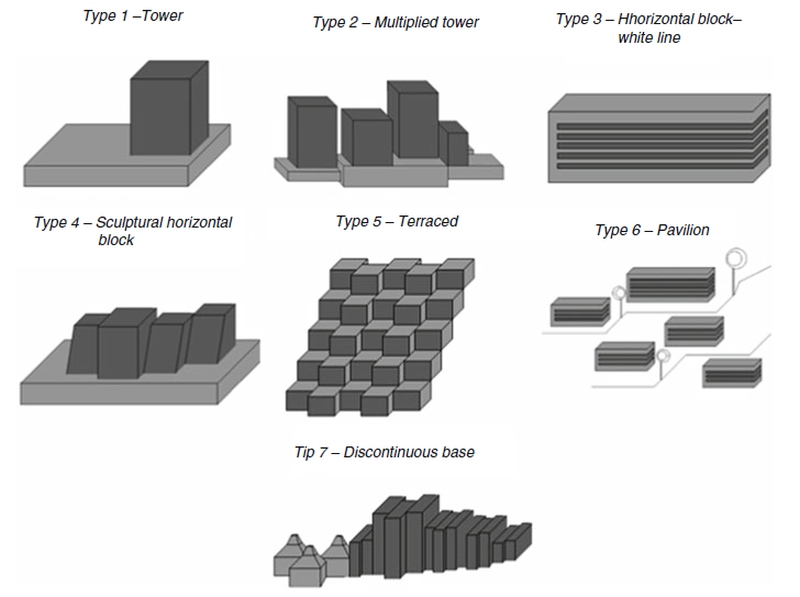
Fig.
2 - Milan Popović, Hotel Korali Floor plan (source:
https://architectuul.com/architecture/hotel-korali).
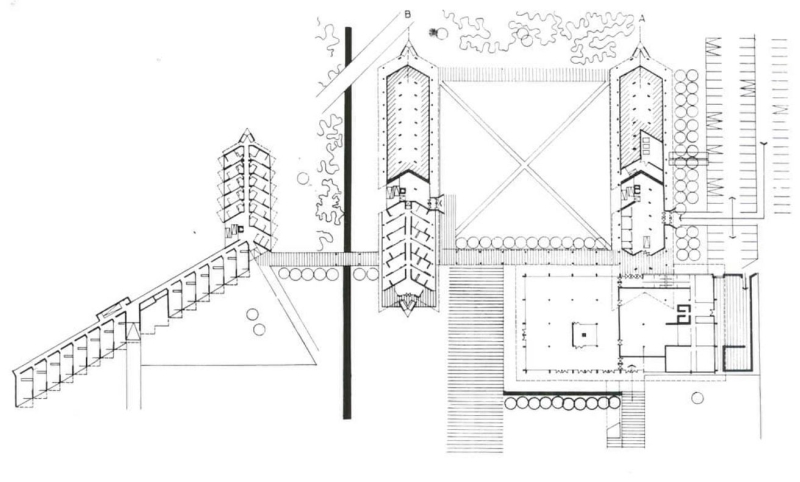
Fig.
3 - Milan Popović, Hotel Korali Façade segment (source:
https://architectuul.com/architecture/hotel-korali).
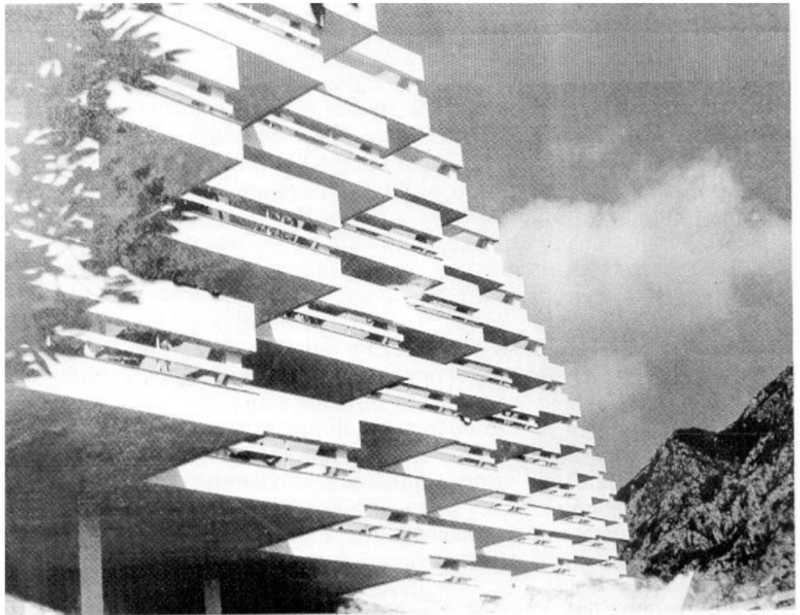
Fig.
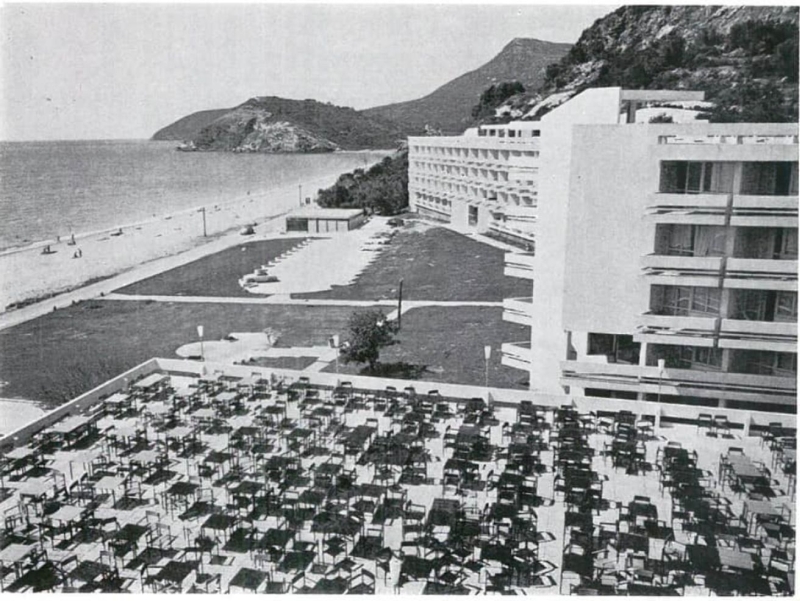
4 - Milan Popović, Hotel Korali Roof terrace (source:
https://architectuul.com/architecture/hotel-korali).
Introduction
In the case of most socialist regimes, as was the former Yugoslavia,
utopian projects are evident, born as objects of contemplation between
political ideology, focused on a common sense of unification of
national identity and social change. Yugoslav modernism was a gesture
of rebellion against the Western Modern Movement and socialist Realism.
Situated between the capitalist West and the Communist East, Yugoslav
architects responded to contradictory demands and influences. The
architectural design approach of the former Yugoslavia in socialist
period, was characterized by ambitious constructions and in many
cities, including the Montenegrin coast, highly reflected in the most
important Montenegrin architects, such as Milan Popović[1].
At the time, the pure Montenegrin coast offered fantastic spatial
opportunities for architectural expression, resulting in structures
that whether defied the nature, or were in harmony with it. From
international-style architecture to brutalist "social condenser"
– radical diversity and idealism of the nation have been
demonstrated in Montenegro.
After the collapse of Yugoslavia, following the fall of the
political ideology, the architectural ambition was interrupted and was
no longer reflected in the identity and mentality of the citizens. The
utopian dream has now been abandoned and turned into a nightmare.
Ideology of development of society and socialist
architecture in Montenegro
When speculating the principles of strengthening national identity
and love for the country, one must take into account that,
«…the socialist state went on to pursue a relatively
independent brand of socialism based on workers’ self-management,
becoming the torchbearer of a ,,Third Way’’ in the
bifurcated world of the Cold War.» (Stierli, M. and Kulić, V.,
(2018), p. 7). The introduction of the "paid vacation" concept enabled
the working class to get acquainted with the culture, nature and other
riches that Yugoslavia had to offer.
The symbolic role of tourism, as a generator of social development,
was of great importance in Tito's Yugoslavia: large, impressively
designed modernist hotel complexes were the leading means of showing
the success of the "Third Way" politics and radical internationalism,
and thus the architectural expression reflected modernity, freedom and
innovation, while respecting local tradition, «…as the
design of commercial hotels shifted from elegant modernist
tower-and-slab typologies of the early 1960s to the increasingly
complex group forms and megastructures in the following decade.»
(Kulić, V., (2018), p. 37). Whether for socio-political or commercial
purposes, the main objective at the time was to inspire the masses to
travel.
Spatial planning of the coastal zone of Yugoslavia was directed in
1969, with the adoption of the regional spatial plan Južni Jadran[2] in a way that, among other
things, tourism and infrastructure connections within the country were
emphasized, while also establishing a better and more accessible
connection with the Mediterranean countries and Europe. On the
territory of Montenegro, it included all coastal municipalities, but
also three continental cities: Titograd (today Podgorica), Cetinje and
Danilovgrad. Of the thirteen tourist areas planned by the Južni
Jadran, four were planned in Montenegro: Boka Kotorska with its
center in Herceg Novi, Budva coast with the center in Budva, Ulcinj
coast and Skadar Lake with the center in Ulcinj as well as central
hinterland formed around Cetinje. This strategic plan has led to the
mass movement of the population towards the cities, especially
considering that Montenegro was the least urbanized area of Yugoslavia
before World War II, so tourism fully generated the development and
architecture of the Montenegrin southern region.
Many architects in Montenegro began to develop their own formal
strategies increasingly distinct and recognizable in architectural
composition, creating a unique style with elements of brutalism. The
1960s and 1970s are referred to as the golden age of Montenegrin
architecture with great enactment of public competitions and with the
consequent construction of expressive buildings. More than thirty
hotels and touristic resorts were built in this period in Montenegrin
Coast, carrying a special architectural expression - inspired by modern
principles, with a particular regional character. The diversity of
landscapes conditioned by the morphology of the southern region was
particularly inspiring in terms of the architectural approach of the
authors. Extraordinary environments have been created blurring the
boundaries between landscape, architecture and sculpture, so different
typologies of objects are recognized.
Objects have been identified as ones that stand out with their
volume in relation to the landscape in regular cubic masses –
both in a strict form (tower) and in a discontinuous one, forming
masses reminiscent of a city silhouette (multiplied tower); then
buildings of smaller floors with a characteristic horizontal white
line, i.e. prominent horizontal structural elements (horizontal
block/white line); modified sculptural block in relation to all planes
of the object (sculptural horizontal block); compact structure that
adapts to the terrain and becomes an integral part of the landscape
(terrace type); free structures in the space that form a tourist
settlement (pavilion type); and buildings that are irregular in shape
at the base, of various volumes and materialization of the
façades (discontinuous base). [Fig.1] (Marović, T., 2021, p.
238-239)
Architecture of the coastal region through the oeuvre of
architect Milan Popović. Case study: hotel Korali
A specific architectural approach to the design of hotel facilities
on the Montenegrin coast is particularly noticeable when analyzing the
design oeuvre of Montenegrin architect Milan Popović, an outmost
modernist and the main representative of constructive functionalism in
Montenegro. His work is characterized by innovative ideas, but also by
the simplicity of strict function of the objects he designed. At the
same time, his specific expression was dominant throughout the
territory of Montenegro and recognizable through all the typologies of
the buildings: hotels, universities, residential buildings, hospitals,
schools, student dormitories, etc.).
Milan Popović is the only Yugoslav architect to be a five-time
laureate of the Republic award of the newspaper Borba for
architecture[3]. Out of a total of
seven hotels he designed on the Montenegrin coast, three were awarded
with the above-mentioned award: hotel Oliva in Petrovac
(1965), co-author Vladislav Plamenac; hotel Korali in
Sutomore (1968), and hotel Kastel Lastva in Petrovac (1973).
Other two awards he received were for two exceptional examples of
brutalist architecture in Montenegro: Clinical Hospital Center in
Podgorica (1974), co-author Božidar Milić and Technical faculties
building of the University of Montenegro, in Podgorica (1977),
co-author Pavle Popović.
In the case of hotel Korali in Sutomore (1968), the
characteristic modernist form is achieved, but at the same time, the
concept radiates authenticity and artistic approach. The hotel is
designed as a pavilion and consists of three units, each of them
containing 200 beds, showing the magnificent architectural skills in
achieving a perfect functionality of the hotel wings. Although the two
pavilions are placed perpendicular to the shore, all rooms and terraces
are rotated towards sea by a 45 degree angle, assuring the sea view
[Fig.2].
Describing the pavilion type of buildings, Maroje Mrduljaš
states that
[…] the pavilion-like agglomerations strive for a more
intense interaction between architecture and nature. These urban
planning schemes include terraces, promenades, public infrastructure
and landscaping, in order to take full advantage of the local
vegetation. (Mrduljaš, M., (2013), p.192)
Observing the architectural form of the hotel Korali, the
pavilion concept can be perceived in a way that it leans on the
landscape of the hinterland, but at the same time it dominates the
space by the form of broken masses, while creating an extension of the
coastal and promenade zone, introducing visitors to a new landscape of
the coastal environment. It is a characteristic example of a modernist
architecture, because of its simple form created by the very elements
of construction.
The function of the hotel can be read and discerned directly from
the façade, with an undoubtedly visible difference between
rhythm and fragment [Fig.3]. The continuous straight line and white
façade are clearly expressed, as a characteristic segment and
materialization of the hotel typology of this period on the Montenegrin
coast. The building exudes a strong attitude towards accomplishing the
idea of new movements in architecture, but also in politics, society,
and development in general.
Given their position in urban tissues, many tourist facilities had
an enormous impact on society, thus becoming not only places for
vacation, but creating an entertaining environment for a socialist man,
who could finally afford various forms of consumerist lifestyle. In
that sense, open roof terraces of an enormous area were designed for
hotels Korali and Oliva, which was a gathering
place for the most important social events, serving not only the hotel
users, but also the local population [Fig.4].
The disappearance of an architecture
In terms of architectural expression and the complexity of the
circumstances within which it was created and shaped, socialist
Montenegrin architecture should be treasured as a valuable heritage of
the 20th century. However, after the disintegration of
Yugoslavia, «the commons – from urban public spaces to the
various civic, educational, and cultural facilities – have been
subject to shady privatization schemes, reduced to mere real
estate» (Stierli, M. and Kulić, V., (2018), p. 8), which led to
disappearance or reconstruction of these structures without
appreciation for the heritage. Therefore, we only witness the outlines
of what can be called the characteristic socialist architecture of the
coastal area today.
The above-mentioned awarded project for hotel Korali, is
an example of a current state of total abandonment of socialist
Montenegrin architecture due to the negligence of the institutions,
especially in terms of protection of heritage and author’s
rights. Following the recent event of “reconstruction” of
the hotel Korali, leading to a total demolition of one wing,
it is evident that the current society doesn't recognize its value
enough to invest more in order to preserve a unique modernist and
awarded architecture piece, which represented a symbol of an ideology
and society. In this case, it was more important to respond to
requirements of today’s tourism concepts, than to celebrate
architecture. Furthermore, this is a reflection of a much broader image
of the socio-cultural fracture, thus provoking controversies, scandals
and different opinions.
At the same time, the economic and political crisis in which the
countries of the former Yugoslavia find themselves, leads to the
impotence to face the past that continues to haunt the present. One can
argue that the general attitude and indifference of the society towards
the socialist architecture and heritage, could be the consequence and
attempt to deviate from past ideologies. However, regardless the limbo
in which this architecture seams to exist, perhaps its bareness and
vulnerability might be the stage for some new actors to act, but with
honest sensitivity towards its uniqueness.
Notes
[1] Milan Popović (1934-1985) was
a Montenegrin Architect, graduated in Faculty of Architecture in
Belgrade in 1958. He was a leading architect in Republic Institute for
Urban planning and Design of Montenegro (from 1961), who created a
number of significant buildings in Montenegro.
[2] Regional Spatial Plan for
South Adriatic, later known as “Jadran I”,
covered the entire coastal zone of Yugoslavia and was a result of
cooperation between the Government of SFR Yugoslavia and the United
Nations Development Program. Numerous experts from Europe and the
region participated in the development of the plan.
[3] The Workers' Council of the
newspaper Borba introduced the award on February 19, 1965.
Federal and republic awards of this newspaper, have been awarded for
the best architectural works in Yugoslavia continuously for 26 years.
Architecture promoted through one, at that time, significant daily
newspaper, represented the best way to establish a good communication
between architecture and society (Alihodžić, R., (2015).
Bibliography
ALIHODŽIĆ R. (2015) ̶ Arhitektura u Crnoj Gori 1965-1990 (Kroz
prizmu „Borbine“ nagrade), CANU, Podgorica.
BAUDRILLARD J. (2016) - The Consumer Society: Myths and
Structures, SAGE Publications, Nottingham.
DIMITRIJEVIĆ B. (1950-1974) ̶ Potrošeni socijalizam,
Kultura, konzumerizam i društvena imaginacija u Jugoslaviji,
Edicija REČ, Beograd.
KARDELJ E. (1977) ̶ Sistem socijalističkog samoupravljanja,
Privredni pregled, Beograd.
KULIĆ V. (2018) – Building Brotherhood and unity:
Architecture and federalism in socialist Yugoslavia in Toward a
concrete utopia: architecture in Yugoslavia 1948-1980, The Museum
of Modern Art, New York.
KULIĆ V. and MRDULJAŠ M. and THALER W. (2012) ̶ Modernism
in-between: The Mediatory Architectures of Socialist Yugoslavia,
Jovis, Berlin.
JOVANOVIC W. S. and LINKE A. (2017) ̶ Socialist Architecture;
The Reappearing Act, The Green Box, Berlin.
MAROVIĆ T. (2021) – “Landscaped Green Areas of the Coast
of Montenegro”. In: Joksimović D., Đurović M., Zonn I.S.,
Kostianoy A.G., Semenov A.V. (eds), The Montenegrin Adriatic
Coast. The Handbook of Environmental Chemistry, vol 110, p.
238-239 Springer, Cham.
MARKUŠ A. (2008) ̶ 50 neimara Crne Gore,
Arhitektonski forum, Podgorica.
MRDULJAŠ M. (2013) ̶ “Adria, Kroatische”. In: E.
Beyer, A. Hagemann, M. Zinganel (eds), Holidays After the Fall
– Seaside Architecture & Urbanism in Bulgaria and Croatia,
Jovis, p.192, Berlin.
STIERLI M. and KULIĆ V. (2018) – Toward a concrete
utopia: architecture in Yugoslavia 1948-1980, The Museum of Modern
Art, New York.
TAYLOR K. and GRANDITS H. (2010) ̶ Yugoslavia/s sunny side: a
history of tourism in socialism (1950s-1980s), Central European
University Press, New York.
United Nations (1969) – Program za razvoj, Vlada SFRJ
Regionalni prostorni plan južnog Jadrana, Dubrovnik.