




How did you choose the project
area?
The place was not chosen by ASA. This project was designed for the
Government of Rwanda, specifically for the Rugerero sector in Rubavu
District. Local authorities selected the land based on its location,
accessibility to a large number of people and proximity to other public
facilities (sector office, police station, main asphalt road, etc.).
What relationships with other service
structures in the urban context have been taken into consideration?
The Rugerero Health Center is located near a square that houses several
other public facilities, including the sector office, the police
station (with a temporary prison) and various shops. Furthermore, the
main paved road connecting Kigali to Musanze in Gisenyi passes directly
in front of the square making it easily accessible. After local
authorities chose the land for the Health Centre, ASA conducted a
thorough investigation of the area and analyzed the site constraints
and potential uses. It turned out that the local community often
gathered in the square. The Health Center would also attract community
members, especially mothers with young children during vaccination
campaigns. With this in mind, ASA decided to create an additional
common space in front of the Health Centre, connected to the square but
with a dedicated seating area. This project initially included a large
avocado tree that existed in the square, which ASA integrated into the
design. Unfortunately, however, the local authorities decided to cut
down the tree, thus nullifying the effect intended by the design
choice. Despite this inconvenience, the square remains an important
meeting place for both the local community and the patients of the
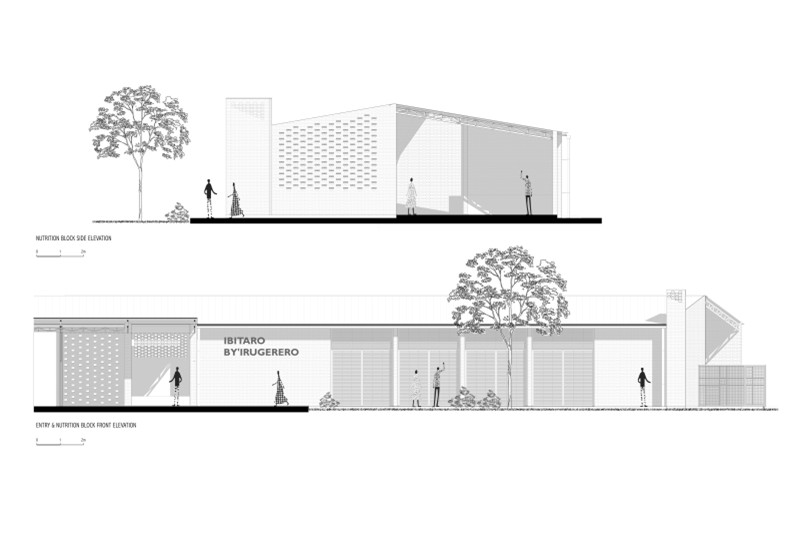
Health Centre, creating a strong connection between the entrance of the
facility, the open area of the nutrition block and the existing
common space.
Which factors and forms of the urban
area in which the project is located influenced the design choices?
The urban fabric surrounding the Rugerero Health Center is dense, but
composed mainly of small, one-story buildings. The main mode of travel
for the local population, including to and from the health centre, is
pedestrian. Some individuals may use bicycles or motorbike taxis, but
cars are not used frequently as they are typically only accessible to
wealthier individuals.
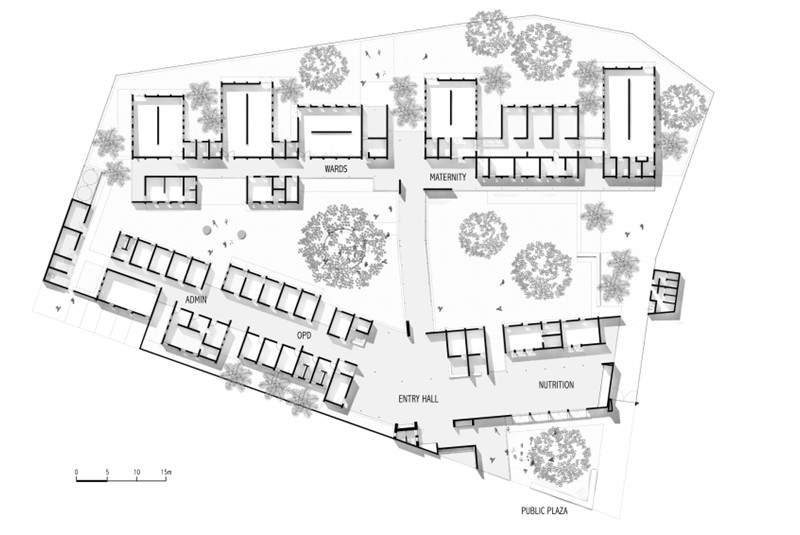
The center consists of a single-storey building with several blocks
detached from each other, connected via covered passages. Inside the
structure there is only a small car park that can accommodate four cars
and, although an access route has been designed for ambulances to reach
the maternity ward, it is currently not used.
Were citizens involved during the
planning phase? In what mode?
ASA, acronym for Active Social Architecture, firmly believes in the
participatory design approach. Therefore, we always involve different
local community stakeholders in our design process, including local
authorities who train health center nurses and the local community
itself. Furthermore, we ensure that a significant number of women are
included in both the design and implementation process. In the case of
Rugerero HC, ASA used data collected during community-level activities
on design, spatial layout and programming preferences to incorporate
local cultural heritage into the Health Center planning. Some examples
of how our design choices were influenced by citizen input include: the
creation of an open communal space where mothers with children can
gather for vaccination campaigns and nutritional training courses while
having direct visual control over their children; the secondary and
more private entrance to the HIV laboratory and consultation room for
patients who do not wish to be seen seeking care (due to stigma); the
open connection between the blocks that provides clear orientation
through the use of colors and the direct visual connection between the
blocks; the addition of a pit latrine (traditional toilet) outside the
building so that people can use leaves instead of toilet paper (which
would clog the toilets located inside the building); finally the design
of a water kiosk accessible from the common area where people can
refuel with 20 one-litre jerrycans (since most families do not have
access to clean water) with collected filtered rainwater, among others,
from the roofs of the building.
During the planning phase, what was
the contribution of health and social workers? (doctors, nurses, social
workers, ...)
Our local partners, an NGO called Health Builders, are made up of
doctors, nurses and social workers who focus on training the local
community. Their main emphasis is on coaching and mentoring individual
health center workers. Instead of training individuals on generally
accepted procedures, standards or best practices, their trained
healthcare management consultants meet individually with healthcare
professionals to address their goals. This process provides ASA with
valuable information, design input and feedback that is continually
integrated into the architectural product and implementation process.
How was the functional program
defined?
The program was based on three main criteria. First, the national
guidelines on health center facility requirements outlined by the
Rwanda Ministry of Health. Secondly, the inputs received from local
authorities and healthcare specialists, who are our partners, on how to
make the space more efficient and what additional facilities can be
added. These include a separate HIV laboratory, TB isolation room,
maternity block design, rainwater filter room, among others. Finally,
our design inputs as architects, taking into consideration the local
community’s way of life. This includes integrating open space,
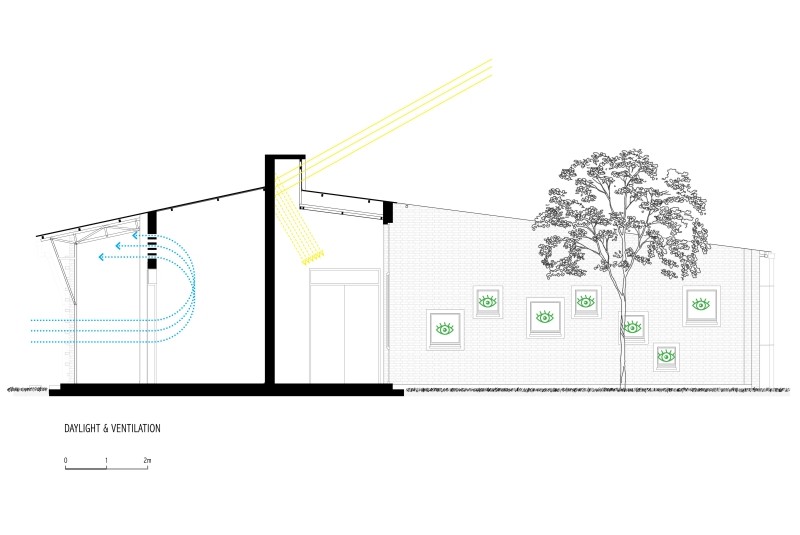
landscape and nature to speed up patient recovery on wards, designing
skylights to use natural light to reduce running costs and prevent
darkness issues during power cuts, adding of a water kiosk and
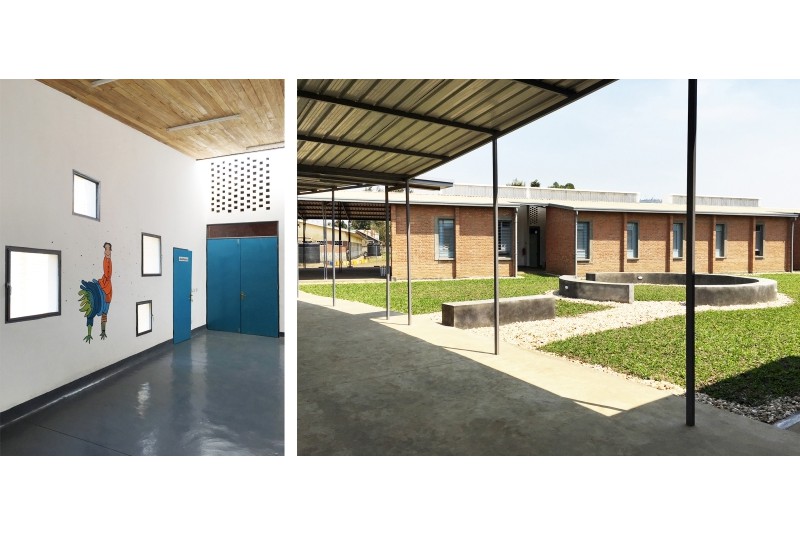
paintings on the walls of the pediatric departments.
What typological and formal references were taken into consideration?
Throughout the conceptual design process, we considered various
typological and formal references to ensure a well-thought-out design.
One of the references we considered was the courtyard type, which
emphasized the use of open spaces to connect different program areas
while maintaining privacy for each space. However, after careful
consideration of the specific needs of this project, we opted for a
more linear system. Four blocks are connected on two lines and the
center is connected via a “promenade” that runs through the
place.
What are the reasons and fundamental
characteristics of the typological choice of articulation of spaces?
The articulation of the spaces and the typological choice of this
project were guided by several key factors. First, ASA prioritized
local climate characteristics in the design process. In the northern
region of Rwanda the climate is mild and constant throughout the year,
with an average temperature of around 20ºC. This allowed us to
avoid expensive air conditioning and heating systems and adopt a more
open design that integrated circulation and waiting areas into
sheltered outdoor spaces. Secondly, we aimed to integrate sustainable
passive systems into the design. Adequate cross-ventilation was
essential to minimize the spread of airborne diseases, particularly in
gathering spaces. As a result, we opted for a long, narrow block type
that ensures cross-ventilation in all rooms and spaces. Patients
circulate in sheltered outdoor areas overlooking the gardens: to
minimize direct heat gain through the west facade, we arranged
corridors along the west sides as porches, creating a buffer between
the interior rooms and the gardens. Finally, it’s worth noting
that ASA worked with a limited budget for construction. To keep costs
low, we adopted a single-story block system with outdoor air
circulation and minimized actual enclosed interior areas. We also used
a cost-effective construction technology, with minimal use of
reinforced concrete. These design choices ensured that the structure
could be built within budget without sacrificing functionality,
sustainability or user experience.
What role do the connection, distribution and waiting spaces and the
reception areas play in the project?
Connections, distribution, waiting areas and reception spaces are an
integral part of the project, facilitating the movement of outpatient
patients, patients and staff within the structure. Additionally, these
spaces serve as multipurpose areas where patients can wait, move
around, and community members can gather for education and awareness
campaigns, depending on the time of day. In the Rugerero HC, space
utilization and efficiency are maximized by using larger,
multifunctional areas instead of actual corridors to connect the
various functional areas, such as consultation rooms, laboratories and
departments. These areas serve as reception spaces where patients can
register for mutual assistance, undergo triage or be directed to
different consultation environments. They also provide spaces for
vaccination campaigns, training and movement between different blocks.
These spaces are further connected to the surrounding gardens,
establishing a strong link between the closed areas of the structure
and the natural landscape.
How was the internal-external
relationship interpreted?
It is important to note that the natural environment plays a
fundamental role in this structure. Green courtyards are strategically
positioned between all built bodies to incorporate nature into the
complex’s environment while providing privacy and open spaces to
families and children who visit inpatients or accompany outpatients.
The traditional way of living in Rwanda involves spending most of the
day outdoors and almost all routine activities take place in outdoor
spaces. Our design embraces this practice, making users feel
comfortable and “at home” while in a healthcare facility.
Finally, the view of the greenery surrounding the buildings is offered
to patients in the departments not only to improve their mood but also
to speed up the healing process.
What is the solution to achieve
spatial flexibility?
There are two solutions underlying the flexibility of the structure.
Firstly, common spaces such as waiting areas and connectors have an
open-plan layout that can be subdivided with furniture or used as a
large collector as needed. Secondly, the modular system can be used for
programs so that each space dedicated to a specific function (such as
offices) can have a different use in the future if necessary (such as a
consultation room).
What role did the choices of language
and relationship with the culture of the context have in developing the
project?
During the design process we give a lot of value to the heritage of
local culture, lifestyle, traditions and beliefs. Our goal is to create
a highly contextualized architecture that is efficient in serving users
while respecting their culture and promotes a sense of ownership in the
community. Our approach is community participatory and we conduct
research based on it to develop a project that is accepted and used and
which may have a different background than that of the architect.
What technological requirements were
taken into consideration in the project? In particular, through which
passive technologies suitable for dealing with local climatic
conditions?
At ASA, we prioritize the use of local materials and technologies in
our projects to minimize construction costs and reduce the carbon
footprint from transportation. This approach is reflected in our design
for Rugerero HC, where we used low-tech systems that were easy to
implement, allowing the local community to participate in the
construction process. We used locally sourced materials such as stone
foundations and locally fired clay bricks for the walls, as well as a
low-tech roof package made up of highly reflective iron sheeting,
recycled sound insulation and local pine wood. Additionally, we
collaborated with a local cooperative of women who assembled panels of
woven eucalyptus branches for screens and door panels.
In addition to reducing construction costs, our design also integrates
passive systems that minimize facility management costs and maximize
user comfort. We focused on cross ventilation, orientation, use of
daylight and mitigation of direct heat gain to guide our design
strategy and overall volume layout. We have also installed solar water
heaters, rainwater harvesting systems and skylights to reduce energy
consumption and promote sustainability.
What are the key factors in the
design of a healthcare building, specifically in your intervention
context?
The fundamental key factors in designing a healthcare building in the
African context are: the provision of improved toilet facilities and
the provision of hand washing stations with clean water. These are
factors that considerably improve public health and hygiene in areas
where access to basic healthcare infrastructure is limited, and it is
crucial to include a sanitation facility within the health center
premises.
Is there a coherent methodology for
tackling this type of project?
There is no single approach to tackling this type of design. However,
through years of experience, we have learned how to increase the
success of projects in this context. Our approach is to design with the
goal of empowering communities, which means that the role of the
architect is only a small part of a larger network of interconnected
elements, including the community and its leaders, local governments,
local partners and their outreach efforts. Our approach is to use our
creativity to interpret space from the point of view of end users,
while also positioning ourselves as tools for social improvement.
Can design and architecture
contribute to the patient’s recovery?
Yes, design and architecture can certainly contribute to the healing of
patients. In healthcare settings, the physical environment can have a
significant impact on a patient’s overall well-being and
recovery. Studies have shown that well-designed healthcare facilities,
especially with integrated elements from the natural environment, can
lead to better health outcomes, shorter hospital stays, reduced stress
and anxiety, and greater patient satisfaction.