Technology is universal but the aesthetics of art is unique to different cultures. So I set out to translate the African idioms and aesthetics to our contemporary scene. (Demas Nwoko)
In the trilogy Things Fall Apart, Chinua Achebe (1958) describes, through the tragic events of the main character Okonkwo, the chronicle of the tormented history of Nigeria from the beginning of the British conquest to the post-colonial period, marked by the painful civil war in Biafra between 1967 and 1970 following a relatively late independence, occurred in 1960.
It was an era of profound and sometimes lacerating political, social and economic changes that matured under the pressure of «the euphoria of political independence» (Okeke-Agulu 2015), as well as the transition of two cultures, the African one linked to tradition and the Western one imposed with colonization.
The numerous research and extraordinary experiments, in particular those of the first ten years of the postcolonial period, conducted with the «desire for a return to “origins”, to those cultural conditions shared by indigenous people» (Low 2014), are the testament of a particularly lively and fruitful period for the country from a cultural and architectural point of view.
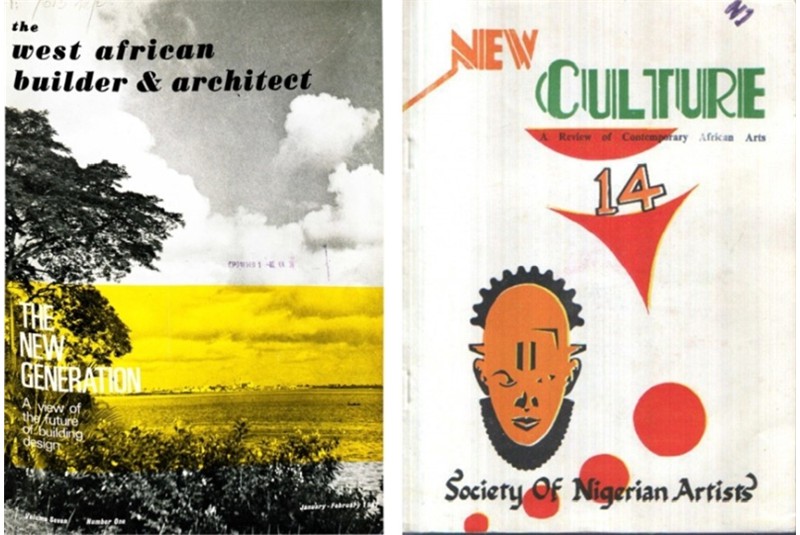
Cities such as Lagos (capital of Nigeria until 1991, before it became Abuja), but also Ibadan, capital of Oyo, an ancient Yoruba state, Zaria in the north of the country and Enugu in eastern Nigeria, were all laboratories of critical thinking[1], true Ateliers de la Pensée (Mbembe and Sarr 2017). Here intellectuals, artists and architects were engaged in the construction of a specifically African identity – the concepts of Africanism[2] and Negritude[3] were an important part of the cultural discourse – in which to combine tradition and modernity, also starting from the verification of the experience of Tropical Architecture[4]. There are many essays published in the magazines The West African Builder Architects (WABA)[5] and then in New Culture: A Review of African Arts[6] (Fig.1) highly critical of the group of architects exponents of Modern Tropical Architecture, which had wide spread in the former British colonies of West Africa.
Technology is universal but the aesthetics of art is unique to different cultures. So I set out to translate the African idioms and aesthetics to our contemporary scene. (Demas Nwoko)
In the trilogy Things Fall Apart, Chinua Achebe (1958) describes, through the tragic events of the main character Okonkwo, the chronicle of the tormented history of Nigeria from the beginning of the British conquest to the post-colonial period, marked by the painful civil war in Biafra between 1967 and 1970 following a relatively late independence, occurred in 1960.
It was an era of profound and sometimes lacerating political, social and economic changes that matured under the pressure of «the euphoria of political independence» (Okeke-Agulu 2015), as well as the transition of two cultures, the African one linked to tradition and the Western one imposed with colonization.
The numerous research and extraordinary experiments, in particular those of the first ten years of the postcolonial period, conducted with the «desire for a return to “origins”, to those cultural conditions shared by indigenous people» (Low 2014), are the testament of a particularly lively and fruitful period for the country from a cultural and architectural point of view.
Cities such as Lagos (capital of Nigeria until 1991, before it became Abuja), but also Ibadan, capital of Oyo, an ancient Yoruba state, Zaria in the north of the country and Enugu in eastern Nigeria, were all laboratories of critical thinking[1], true Ateliers de la Pensée (Mbembe and Sarr 2017). Here intellectuals, artists and architects were engaged in the construction of a specifically African identity – the concepts of Africanism[2] and Negritude[3] were an important part of the cultural discourse – in which to combine tradition and modernity, also starting from the verification of the experience of Tropical Architecture[4]. There are many essays published in the magazines The West African Builder Architects (WABA)[5] and then in New Culture: A Review of African Arts[6] (Fig.1) highly critical of the group of architects exponents of Modern Tropical Architecture, which had wide spread in the former British colonies of West Africa.
An architecture and form of urbanism will emerge closely connected with the set of ideas that have international validity, but reflecting the conditions of climate, the habits of the people and the aspirations of the countries lying under the cloudy belt of the equatorial world.
This is how Maxell Fry and Jane Drew, British architects who designed numerous projects in West Africa from 1949 to 1960, manifested in the book Tropical Architecture in the humid zones (1956) their optimism on the role of tropical architecture in the construction of African cities in the post-colonial period. An architecture defined and codified by culturally neutral quantitative parameters, in which objectives such as comfort, control of ventilation and solar radiation through passive strategies, replace any pretense of forced modernization.
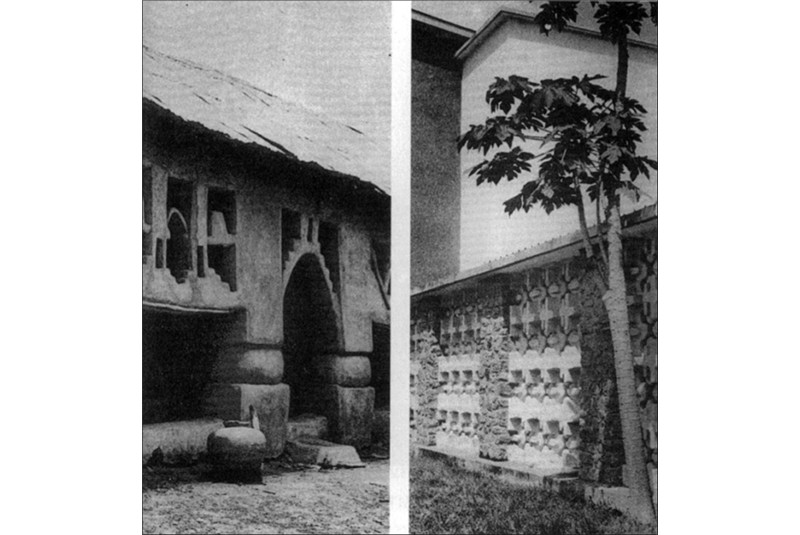
Well in contrast to this position is Ulli Beier, a German intellectual expatriate in Africa, involved in the construction of the Mbari Artist and Writers Club in Ibadan, founder and editor of Black Orpheus, a magazine that gave voice to writers and artists of the Black Diaspora and to the new generation of English-speaking Africans, including Demas Nwoko himself. In European Architecture in Nigeria, an essay published in the magazine Art in Nigeria in 1960, he clearly criticise Tropical Architecture: «It is probably an inevitable result of historical, economic and social factors that nearly all public buildings of importance are being built by European architects, and in a style and technique foreign to the country». He refers specifically to the buildings created by the two architects in Ibadan, in particular those in the University College campus (1948-1958) located among the «soft undulating lines of a Nigerian town», which he describes as «hard, angular, glaring white, unapproachable, deaf to the most basic principle of African life [which is] rhythm ». Their quality is unsatisfying when compared with traditional architecture, even when they reproduce some devices for climate control, such as patterned grills, breathing walls, perforated screens, «symbol of the rigidity of mechanized, materialistic Western culture» (Beier 1960), whose abstract image Beier juxtaposes in the essay, by contrast, with the figurative and formal power of the thick, patterned brocken walls of traditional Yoruba raw earth architecture. (Fig. 2)
Position also shared by Zbignew R. Domochowsky, member of the academic staff of the Faculty of Architecture of the Kwame Nkrumah University of Science and Technology, founded in 1957 in Kumasi (Ghana) and committed to the diffusion of knowledge of Nigerian vernacular architecture. He observes, referring to the students:
They should not repeat the ancient patterns, nor copy them in any revivalist attempt […] but [be, N.d.T.] fully aware being in the service of their contemporaries. In the same way the present-day Nigerian architects should fulfil their duties to the 20th century Nigerian society which their own. Accepting tradition as the starting point of their creative, independent thinking, they should evolve in steel and concrete, glass and aluminium, a modern school of Nigerian Architecture (Domochowsky 1990).
Moreover, already Udo Kultermann, who in Neues Bauen in Afrika (1963) underlines the link between tradition and innovation and how the art of building does not simply consist in correctly adopting architectural devices in response to climatic needs but «is related to space, volume, light, movement and harmony», believes that African architecture, whose millenary value he recognises, has entered a new phase.
The innovative approach is placed in this cultural context, a sort of synthesis between the principles of Tropical Architecture and the elements of local tradition, undertaken by Demas Nwoko, painter and sculptor, artist-designer as he likes to define himself, and architect since the ‘70. Like «most Nigerian nationalists are not cultural nativists; they are eclectics, desiring to keep what is useful and attractive in the old and fuse it whith the new» (Coleman 1958), Nwoko also presents himself as an atypical figure, with a multifaceted and entirely personal training path, so much that his work can be defined «individual modernism» (Bassey 2012).
The myriad of cultural influences that constituted the true African cosmopolitanism of post-colonial Lagos, the studies conducted at the Nigerian College of Arts, Science and Technology in Zaria then affiliated to Goldsmiths College in London where Nwoko joined the avant-garde group of the Nigerian Art Society (later called Zaria Rebels), as well as the time spent in Paris at the École des Beaux-Arts and the Center Français du Théâtre, and travels to Europe, Japan and the United States certainly had a decisive influence on his education. His research, result of a poetic expression carrying a strong emotional and symbolic charge, was first formalized in the manifesto Natural Syntesis (1960) the aim of which was the fusion between indigenous and Western ideas, forms and construction techniques, because «our new society calls for a synthesis of old and new, of functional art and art for its own sake» (Okeke 1982) and subsequently in the magazine New Culture: A Review of African Arts (1978), characterized by a high degree of experimentation from a formal and compositional point of view. His first architecture, The New Culture Studio with adjoining residence, which began to be built in 1967 in Oremeji near Ibadan, is its transposition, as well as a clear answer to Maxell Fry’s polemical observation:
I am commonly asked to what extent the development of contemporary architecture draws on the cultures indigenous to the countries in which it takes place, to which I could reply: How much continuing life is there in these cultures? Have they contemporary validity? Are there artists (?) who can state them in contemporary terms? (Fry cited by Okoye 1993).
The building, conceived as a place to organize workshops, theatrical and musical performances and encourage cultural exchanges between artists, refers to the traditional architecture of Yoruba royal palaces, some of which still exist[7].
Generally located in a large space within the city, they were made up of a succession of courtyards, square or rectangular, according to a system of hierarchies that regulated not only their public and private use, but also the political and religious one. In the public court, which was not conceived as a specifically theatrical space, enthronement rites, ceremonies and public meetings were celebrated.
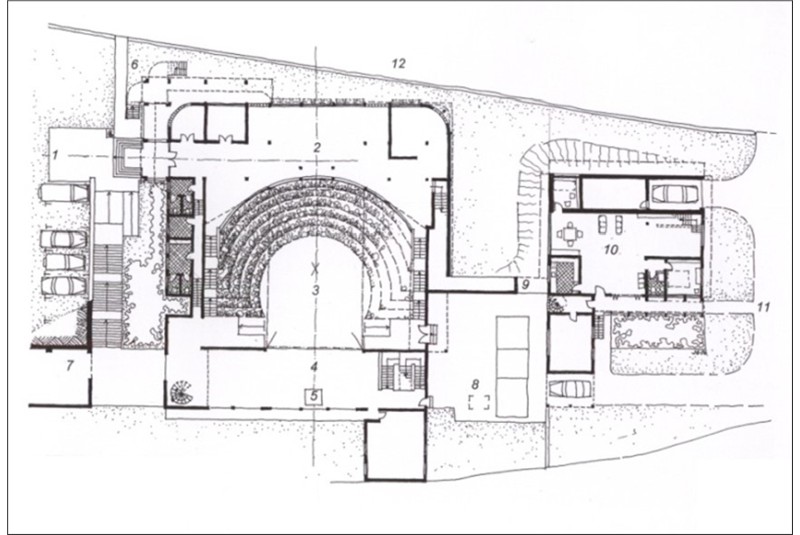
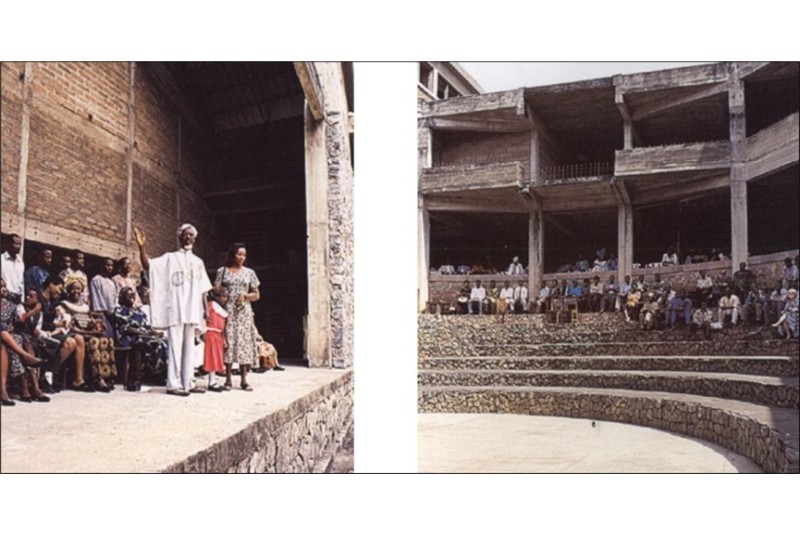
It’s in the central space of an open courtyard that Nwoko inserts a small amphitheater, around which he arranges the volumes of the ateliers (Fig. 3, 4) and on the opposite side the raised proscenium, as in the amphitheaters of ancient Greece or in the theater in the round, a theatrical typology particularly widespread in London in the ‘60s. A solution that Nwoko then experimented within the Akenzua Cultural Center Benin City (1972), of which the New Culture Studio can be considered the prototype.
By contaminating and reinterpreting references drawn from traditional Nigerian architecture and from the ancient and modern Western world, Nwoko builds a theatrical space that didn’t exist in the architecture of royal palaces, and for performances that until then had not required a properly architectural arrangement, demonstrating the ability of African architecture to transform itself over time to respond to the new needs of society.
Just as the «ancestors created architectural solutions that resolved their natural environmental problems whithout any form of dependence on an outside source», so Nwoko, in order to guarantee the best confort, uses materials and construction techniques taken from tradition, as well as a series of devices for the control of lighting and natural ventilation, which he will later propose in other buildings, accompanied by some significant transformations.
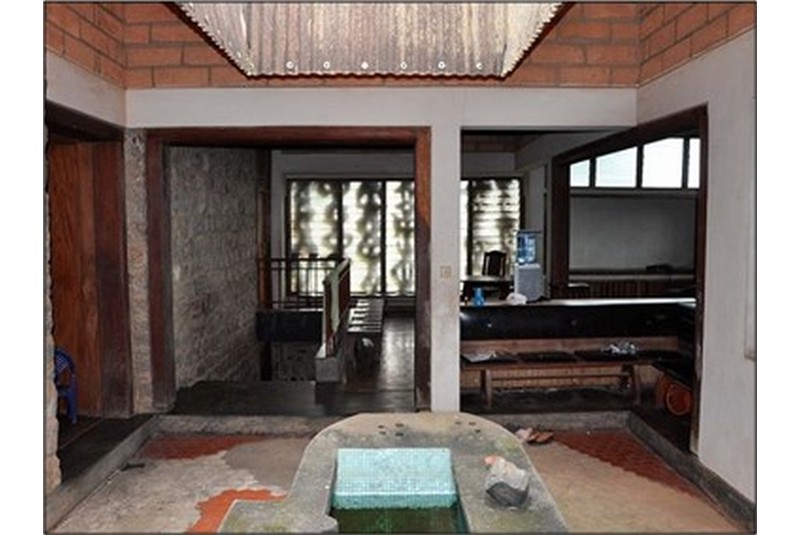
Considering that some solutions proposed by the architects of Tropical Architecture are ineffective, such as cross-ventilation by means of large windows screened by brise-soleils, in the living area on the third and last floor of the residence he placed an impluvium, a central tank for collecting the rainwater, channeled through a truncated-conical fiberglass element (compluvium) in order to moderate the temperature and lighting of the space (Fig. 5).
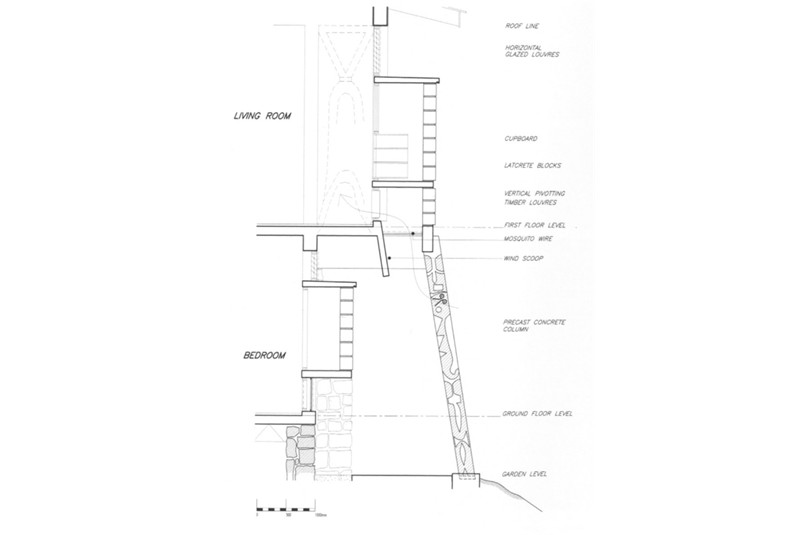
Natural ventilation is instead entrusted to the few openings located at floor level or in the upper part of the walls in order to trigger the down draf chimney effect, which is associated with the compactness of the volume in Latcrete, a cement and laterite brick patented by the same Nwoko, which helps to thermally regulate the internal microclimate (Fig. 6).
Nwoko’s refusal to establish a direct visual dialogue between the internal and the external, of perceptive continuity between the inside and the outside of the inhabited space through the window, as Bassey (2012) observes is very clear:
The house is a shade into which man retreats. In this shade, man escapes the harsh tropical glare as well as the heat. The house is thus a place to rest both the eye as well as the soul for the eye is the window to the soul […] the exterior should not merge with the interior because both have distinct aesthetic attributes, which makes blending both artificial and uncalled for.
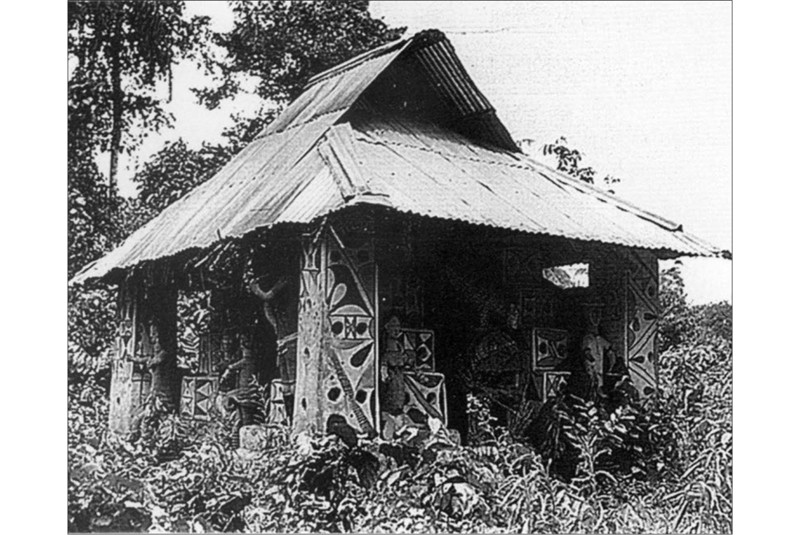
One of the most interesting aspects of his house in Idumuje-Ugboko, built in 1976, is the reinterpretation of the Mbari House (Fig. 7), also called the House of God, a sacred architecture characterized by an imposing four-pitched roof supported by four massive decorated supports and the traditional house ad impluvium, which gather together various rooms under a large roof organized around an open-air courtyard. It is a typology widely spread in the area that extends from Niger to Benin City, and a typical example is the Umera Ozi’s House in Onitsha, illustrated by Domochowsky in his An Introduction to Nigerian Traditional Architecture (1990).
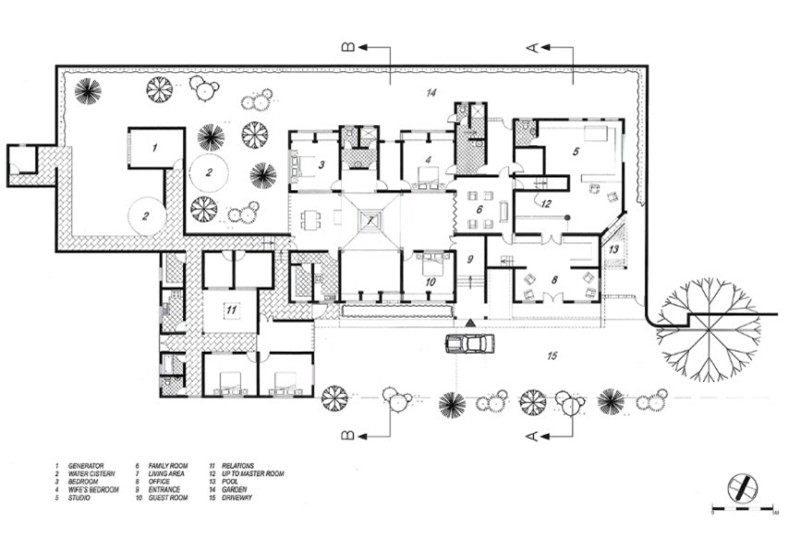
Reinterpreting the court, which in African culture is a multifunctional space where domestic life takes place and where social relationships are maintained, Nwoko designs a sort of micro-settlement divided into three courts: the external service court, the private court on which overlook the bedrooms, and the public courtyard par excellence in which family activities take place and guests are welcomed (Fig. 8).
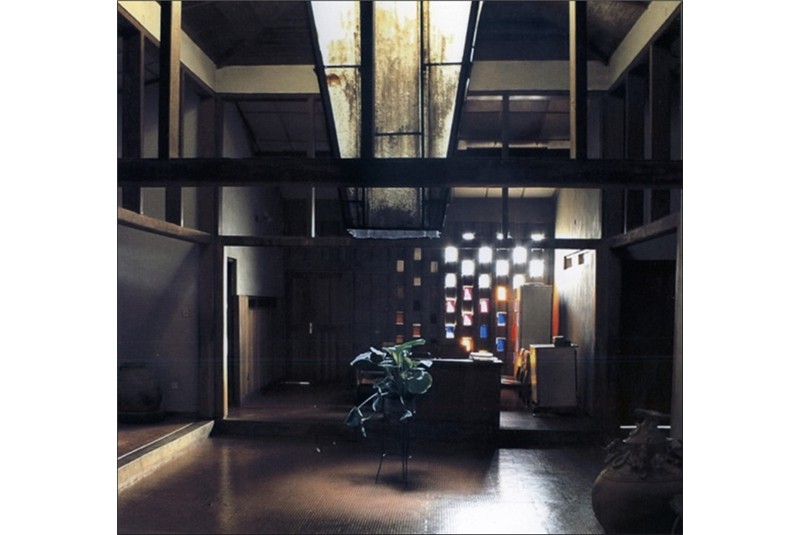
Nwoko tries to highlight the impression of interiority of these spaces, denying the internal-external visual relationships, using for this purpose architectural devices with which to mediate the entry of light into the rooms: brise-soleil and screens with elements in stone (claustra) and the impluvium, located in the heart of the building, a device with which to guarantee ventilation, cooling and water collection. This is how Nwoko describes the inclusion of this traditional element:
The roof configuration was such that rainwater collected in the centre of the house. A pool of light was let into the centre of the house trough the impluvium opening. This created a dramatic effect of light and shade in the interior of the house…the funnel shaped centre of the roof reduced the amount of rainwater…to a gentle cascade…a sense of conquest of the harsh elements of weather pervades the peaceful atmosphere… (Nwoko cited by Godwin and Hopwood 2007) (Fig. 7).
Unlike traditional houses in which the impluvium, from a formal point of view, is an open void coinciding with the courtyard, here it is transformed into a space dominated by an inverted truncated conical compluvium also in fiberglass, that allows natural light to penetrate indirectly, giving the domestic space an almost sacred dimension (Fig. 9).
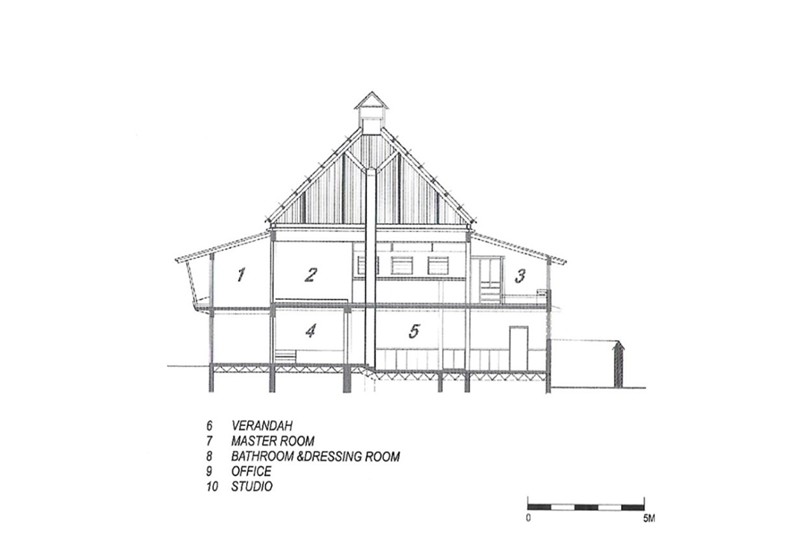
If the plan generates the project, the same attention is given to the design of the section: the area on the first floor is dominated by the powerful volume of the four-pitched roof covered with wooden panels, supported by a central pillar, reminiscent of a trunk of tree, and characterized by a steep declivity (Fig. 10). The reference is once again the construction typology of the Mbari House «a home of images, filled to overflowing with sculptures and paintings in home to the presiding deity» (Achebe 1958) and the traditional houses of the Awka area, in the south-east of Nigeria.
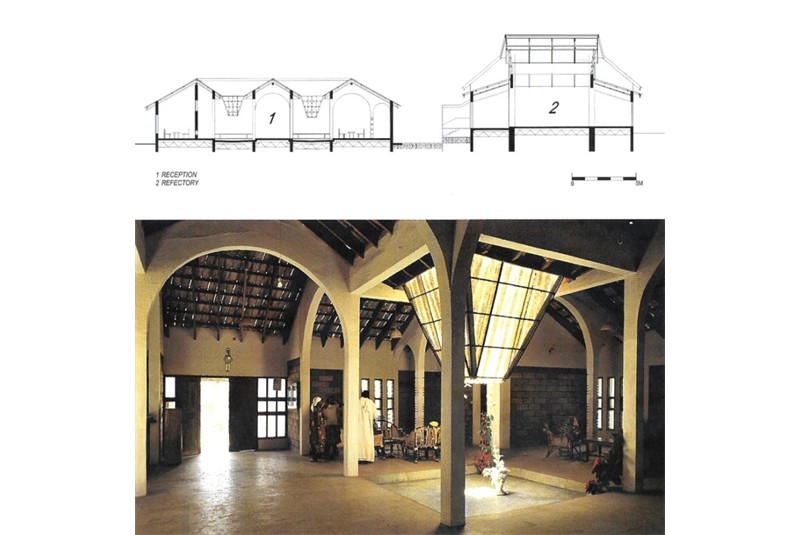
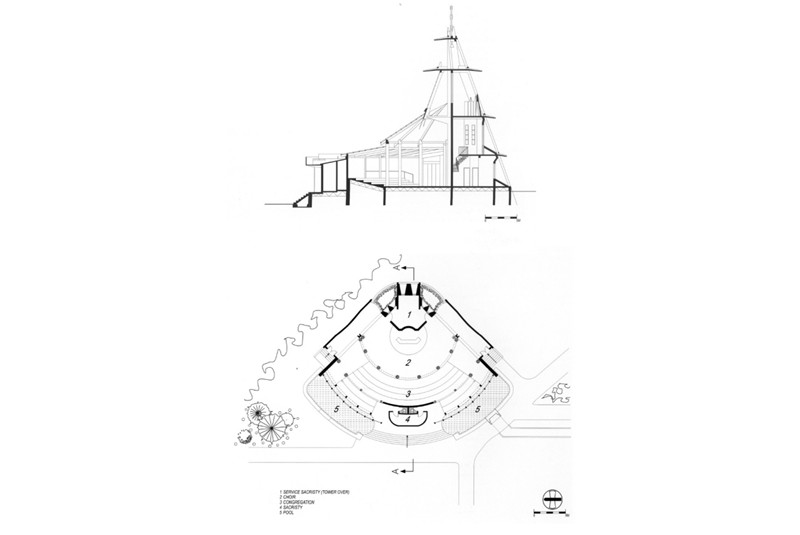
The impluvium device is also proposed by Nwoko in some religious buildings: in the Benedictine monastery of Ewu (1987-2005), where the space for welcoming guests is dominated by two impluvia, which contribute to strengthening the two courtyards on which they are centered, further accentuating the dichotomy between inside and outside (Fig. 11), and in the chapel of the Dominican Institute Complex in Ibadan (1970-1975). Here, in addition to being a ventilation device, it acquires a symbolic richness: placed in correspondence with the altar, it lights up the crucifix directly from above, diffusing the light inside the church which, with its semicircular room centered on the altar, seems to refer to the theatrical space conceived for the New Culture Studio (Fig. 12).
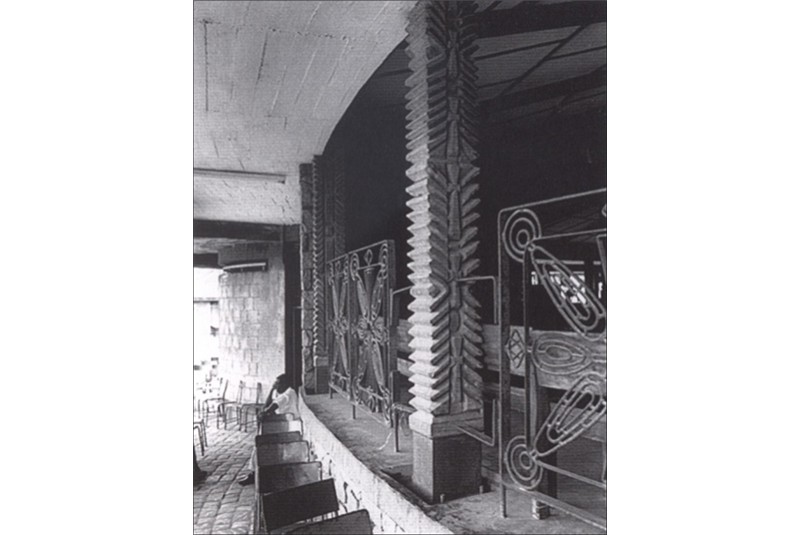
It’s no coincidence that in the paper Art in Religion, published later in New Culture (1979), describing the chapel, Nwoko confirms the idea of having aimed to create an open stage auditorium of a theater, putting believers and priest in a close relationship, which is not foreseen in the Christian liturgy. A choice strengthened by moving the entrance of the believers laterally – in most Christian churches the altar is in line with the main entrance – and by the construction of a sort of “cavea” with a semicircular system of elaborate carved wooden columns. The circulation area between the rear part of the seats and the external space, expanding, becomes a sort of churchyard, a meeting place, which evokes the interstitial spaces and courtyards between the homes within the compounds (Fig. 13).
As in the New Culture Studio, Nwoko does not limit himself to taking on elements of vernacular architecture, but reinterprets the spatial organization of sacred Christian and traditional African architecture, implementing a process of contamination and hybridization that gives rise to new formal and spatial solutions, capable of giving an original and peculiar response to the requests of the tropical climate. Referring to the chapel, Noel Moffat wrote in the Journal of the Royal Institute of Architects (1977): «Here, under (the) tropical sun, architecture and sculpture combine in a way in which only Gaudi perhaps, among architects, has been able to do so convincingly». Reread the architecture of Demas Nwoko, in particular those created in the first decade of the post-colonial period and still little explored today, belonging to an “other” path compared to the Modern Movement and the experience of Tropical Architecture, with which they were however intertwined, offers new interpretative tools of concepts such as hybridity, contamination and métissage, which become the object and tool of the contemporary architectural project. The subtended climatic thought, alternative to the lesson of tropical Modernism according to which the, NdT] key to aesthetics in the tropics appears to be a dramatic ascent on the definite and the artificial: the creation of order” where tropical climate, nature and tradition can have an influence as long as [it, NdT] remains an influence rather than something to copy» (Fry and Drew 1964), can instead indicate a new way forward, because as Doxiadis (1966) stated «[…] there are many types of tropical climates and our behavior should not be always the same. Our attitude should be the same, but not our solutions».
[1] The Art Society in Lagos, the Mbari Artist and Writers Club in Ibadan and Enugu and the Nigerian Art Society in Zaria, made up of a group of young artists from the Nigerian College of Arts, Science and Technology (now Ahmadu Bello University).
[2] Born at the end of the 19th century in the Caribbean and the United States as a movement of ideas and emotions, with the beginning of the process of decolonization of Africa, Pan-Africanism turned into a movement that aimed at the political unity of the African continent as well as the valorization of African cultural heritage and the celebration of the return to the motherland from which the diaspora began. Among the people associated to it, we can find the American W.E.B. Dubois, the Jamaican Marcus Garvey and Kwame Nkrumah, the first president of Ghana after independence, who brought together the first Conference of Heads of State of independent Africa in 1958 and the first Pan-African Congress in the African Motherland.
[3] The first formulations of Negritude were developed by the group that in 1934 created the magazine L’Étudiant noir, in whose editorial team Aimè Césaire and Léopold Sédar Senghor participated. The magazine, which called for a radical reevaluation of African roots (the “Mother Africa”) and of transnational culture, distanced itself from Marxism and surrealism by affirming the priority of the cultural function over the political one, while claiming the need to propose an independent path for the construction of black identity.
[4] The Tropical Modernism movement began in the late 1940s and lasted until the end of the 1970s.
[5] The West African Builder Architects published in Lagos during the 1960s, engaged in debates regarding architecture and culture, architecture and responsibility, architecture and morality, was the only architecture magazine to document the most important projects carried out in the western African area.
[6] New Culture: A Review of African Arts, a magazine of contemporary African art, founded by David Aradeon and Demas Nwoko in 1978, a year after the second African Festival of Arts and Culture (FESTAC) hosted in Lagos, proposed a return to the study of traditional arts. Unlike Black Orpheus, it remained a local magazine, although the most important, in which architecture was treated as complementary to art.
[7] The royal palaces of the Yoruba tradition, that still exist and are part of the UNESCO heritage, are the royal palaces of Abomey and Porto Novo, both in Benin; the Royal Palace of Oyo in the state of the same name, in south-western Nigeria.
An architecture and form of urbanism will emerge closely connected with the set of ideas that have international validity, but reflecting the conditions of climate, the habits of the people and the aspirations of the countries lying under the cloudy belt of the equatorial world.
This is how Maxell Fry and Jane Drew, British architects who designed numerous projects in West Africa from 1949 to 1960, manifested in the book Tropical Architecture in the humid zones (1956) their optimism on the role of tropical architecture in the construction of African cities in the post-colonial period. An architecture defined and codified by culturally neutral quantitative parameters, in which objectives such as comfort, control of ventilation and solar radiation through passive strategies, replace any pretense of forced modernization.
Well in contrast to this position is Ulli Beier, a German intellectual expatriate in Africa, involved in the construction of the Mbari Artist and Writers Club in Ibadan, founder and editor of Black Orpheus, a magazine that gave voice to writers and artists of the Black Diaspora and to the new generation of English-speaking Africans, including Demas Nwoko himself. In European Architecture in Nigeria, an essay published in the magazine Art in Nigeria in 1960, he clearly criticise Tropical Architecture: «It is probably an inevitable result of historical, economic and social factors that nearly all public buildings of importance are being built by European architects, and in a style and technique foreign to the country». He refers specifically to the buildings created by the two architects in Ibadan, in particular those in the University College campus (1948-1958) located among the «soft undulating lines of a Nigerian town», which he describes as «hard, angular, glaring white, unapproachable, deaf to the most basic principle of African life [which is] rhythm ». Their quality is unsatisfying when compared with traditional architecture, even when they reproduce some devices for climate control, such as patterned grills, breathing walls, perforated screens, «symbol of the rigidity of mechanized, materialistic Western culture» (Beier 1960), whose abstract image Beier juxtaposes in the essay, by contrast, with the figurative and formal power of the thick, patterned brocken walls of traditional Yoruba raw earth architecture. (Fig. 2)
Position also shared by Zbignew R. Domochowsky, member of the academic staff of the Faculty of Architecture of the Kwame Nkrumah University of Science and Technology, founded in 1957 in Kumasi (Ghana) and committed to the diffusion of knowledge of Nigerian vernacular architecture. He observes, referring to the students:
They should not repeat the ancient patterns, nor copy them in any revivalist attempt […] but [be, N.d.T.] fully aware being in the service of their contemporaries. In the same way the present-day Nigerian architects should fulfil their duties to the 20th century Nigerian society which their own. Accepting tradition as the starting point of their creative, independent thinking, they should evolve in steel and concrete, glass and aluminium, a modern school of Nigerian Architecture (Domochowsky 1990).
Moreover, already Udo Kultermann, who in Neues Bauen in Afrika (1963) underlines the link between tradition and innovation and how the art of building does not simply consist in correctly adopting architectural devices in response to climatic needs but «is related to space, volume, light, movement and harmony», believes that African architecture, whose millenary value he recognises, has entered a new phase.
The innovative approach is placed in this cultural context, a sort of synthesis between the principles of Tropical Architecture and the elements of local tradition, undertaken by Demas Nwoko, painter and sculptor, artist-designer as he likes to define himself, and architect since the ‘70. Like «most Nigerian nationalists are not cultural nativists; they are eclectics, desiring to keep what is useful and attractive in the old and fuse it whith the new» (Coleman 1958), Nwoko also presents himself as an atypical figure, with a multifaceted and entirely personal training path, so much that his work can be defined «individual modernism» (Bassey 2012).
The myriad of cultural influences that constituted the true African cosmopolitanism of post-colonial Lagos, the studies conducted at the Nigerian College of Arts, Science and Technology in Zaria then affiliated to Goldsmiths College in London where Nwoko joined the avant-garde group of the Nigerian Art Society (later called Zaria Rebels), as well as the time spent in Paris at the École des Beaux-Arts and the Center Français du Théâtre, and travels to Europe, Japan and the United States certainly had a decisive influence on his education. His research, result of a poetic expression carrying a strong emotional and symbolic charge, was first formalized in the manifesto Natural Syntesis (1960) the aim of which was the fusion between indigenous and Western ideas, forms and construction techniques, because «our new society calls for a synthesis of old and new, of functional art and art for its own sake» (Okeke 1982) and subsequently in the magazine New Culture: A Review of African Arts (1978), characterized by a high degree of experimentation from a formal and compositional point of view. His first architecture, The New Culture Studio with adjoining residence, which began to be built in 1967 in Oremeji near Ibadan, is its transposition, as well as a clear answer to Maxell Fry’s polemical observation:
I am commonly asked to what extent the development of contemporary architecture draws on the cultures indigenous to the countries in which it takes place, to which I could reply: How much continuing life is there in these cultures? Have they contemporary validity? Are there artists (?) who can state them in contemporary terms? (Fry cited by Okoye 1993).
The building, conceived as a place to organize workshops, theatrical and musical performances and encourage cultural exchanges between artists, refers to the traditional architecture of Yoruba royal palaces, some of which still exist[7].
Generally located in a large space within the city, they were made up of a succession of courtyards, square or rectangular, according to a system of hierarchies that regulated not only their public and private use, but also the political and religious one. In the public court, which was not conceived as a specifically theatrical space, enthronement rites, ceremonies and public meetings were celebrated.
It’s in the central space of an open courtyard that Nwoko inserts a small amphitheater, around which he arranges the volumes of the ateliers (Fig. 3, 4) and on the opposite side the raised proscenium, as in the amphitheaters of ancient Greece or in the theater in the round, a theatrical typology particularly widespread in London in the ‘60s. A solution that Nwoko then experimented within the Akenzua Cultural Center Benin City (1972), of which the New Culture Studio can be considered the prototype.
By contaminating and reinterpreting references drawn from traditional Nigerian architecture and from the ancient and modern Western world, Nwoko builds a theatrical space that didn’t exist in the architecture of royal palaces, and for performances that until then had not required a properly architectural arrangement, demonstrating the ability of African architecture to transform itself over time to respond to the new needs of society.
Just as the «ancestors created architectural solutions that resolved their natural environmental problems whithout any form of dependence on an outside source», so Nwoko, in order to guarantee the best confort, uses materials and construction techniques taken from tradition, as well as a series of devices for the control of lighting and natural ventilation, which he will later propose in other buildings, accompanied by some significant transformations.
Considering that some solutions proposed by the architects of Tropical Architecture are ineffective, such as cross-ventilation by means of large windows screened by brise-soleils, in the living area on the third and last floor of the residence he placed an impluvium, a central tank for collecting the rainwater, channeled through a truncated-conical fiberglass element (compluvium) in order to moderate the temperature and lighting of the space (Fig. 5).
Natural ventilation is instead entrusted to the few openings located at floor level or in the upper part of the walls in order to trigger the down draf chimney effect, which is associated with the compactness of the volume in Latcrete, a cement and laterite brick patented by the same Nwoko, which helps to thermally regulate the internal microclimate (Fig. 6).
Nwoko’s refusal to establish a direct visual dialogue between the internal and the external, of perceptive continuity between the inside and the outside of the inhabited space through the window, as Bassey (2012) observes is very clear:
The house is a shade into which man retreats. In this shade, man escapes the harsh tropical glare as well as the heat. The house is thus a place to rest both the eye as well as the soul for the eye is the window to the soul […] the exterior should not merge with the interior because both have distinct aesthetic attributes, which makes blending both artificial and uncalled for.
One of the most interesting aspects of his house in Idumuje-Ugboko, built in 1976, is the reinterpretation of the Mbari House (Fig. 7), also called the House of God, a sacred architecture characterized by an imposing four-pitched roof supported by four massive decorated supports and the traditional house ad impluvium, which gather together various rooms under a large roof organized around an open-air courtyard. It is a typology widely spread in the area that extends from Niger to Benin City, and a typical example is the Umera Ozi’s House in Onitsha, illustrated by Domochowsky in his An Introduction to Nigerian Traditional Architecture (1990).
Reinterpreting the court, which in African culture is a multifunctional space where domestic life takes place and where social relationships are maintained, Nwoko designs a sort of micro-settlement divided into three courts: the external service court, the private court on which overlook the bedrooms, and the public courtyard par excellence in which family activities take place and guests are welcomed (Fig. 8).
Nwoko tries to highlight the impression of interiority of these spaces, denying the internal-external visual relationships, using for this purpose architectural devices with which to mediate the entry of light into the rooms: brise-soleil and screens with elements in stone (claustra) and the impluvium, located in the heart of the building, a device with which to guarantee ventilation, cooling and water collection. This is how Nwoko describes the inclusion of this traditional element:
The roof configuration was such that rainwater collected in the centre of the house. A pool of light was let into the centre of the house trough the impluvium opening. This created a dramatic effect of light and shade in the interior of the house…the funnel shaped centre of the roof reduced the amount of rainwater…to a gentle cascade…a sense of conquest of the harsh elements of weather pervades the peaceful atmosphere… (Nwoko cited by Godwin and Hopwood 2007) (Fig. 7).
Unlike traditional houses in which the impluvium, from a formal point of view, is an open void coinciding with the courtyard, here it is transformed into a space dominated by an inverted truncated conical compluvium also in fiberglass, that allows natural light to penetrate indirectly, giving the domestic space an almost sacred dimension (Fig. 9).
If the plan generates the project, the same attention is given to the design of the section: the area on the first floor is dominated by the powerful volume of the four-pitched roof covered with wooden panels, supported by a central pillar, reminiscent of a trunk of tree, and characterized by a steep declivity (Fig. 10). The reference is once again the construction typology of the Mbari House «a home of images, filled to overflowing with sculptures and paintings in home to the presiding deity» (Achebe 1958) and the traditional houses of the Awka area, in the south-east of Nigeria.
The impluvium device is also proposed by Nwoko in some religious buildings: in the Benedictine monastery of Ewu (1987-2005), where the space for welcoming guests is dominated by two impluvia, which contribute to strengthening the two courtyards on which they are centered, further accentuating the dichotomy between inside and outside (Fig. 11), and in the chapel of the Dominican Institute Complex in Ibadan (1970-1975). Here, in addition to being a ventilation device, it acquires a symbolic richness: placed in correspondence with the altar, it lights up the crucifix directly from above, diffusing the light inside the church which, with its semicircular room centered on the altar, seems to refer to the theatrical space conceived for the New Culture Studio (Fig. 12).
It’s no coincidence that in the paper Art in Religion, published later in New Culture (1979), describing the chapel, Nwoko confirms the idea of having aimed to create an open stage auditorium of a theater, putting believers and priest in a close relationship, which is not foreseen in the Christian liturgy. A choice strengthened by moving the entrance of the believers laterally – in most Christian churches the altar is in line with the main entrance – and by the construction of a sort of “cavea” with a semicircular system of elaborate carved wooden columns. The circulation area between the rear part of the seats and the external space, expanding, becomes a sort of churchyard, a meeting place, which evokes the interstitial spaces and courtyards between the homes within the compounds (Fig. 13).
As in the New Culture Studio, Nwoko does not limit himself to taking on elements of vernacular architecture, but reinterprets the spatial organization of sacred Christian and traditional African architecture, implementing a process of contamination and hybridization that gives rise to new formal and spatial solutions, capable of giving an original and peculiar response to the requests of the tropical climate. Referring to the chapel, Noel Moffat wrote in the Journal of the Royal Institute of Architects (1977): «Here, under (the) tropical sun, architecture and sculpture combine in a way in which only Gaudi perhaps, among architects, has been able to do so convincingly». Reread the architecture of Demas Nwoko, in particular those created in the first decade of the post-colonial period and still little explored today, belonging to an “other” path compared to the Modern Movement and the experience of Tropical Architecture, with which they were however intertwined, offers new interpretative tools of concepts such as hybridity, contamination and métissage, which become the object and tool of the contemporary architectural project. The subtended climatic thought, alternative to the lesson of tropical Modernism according to which the, NdT] key to aesthetics in the tropics appears to be a dramatic ascent on the definite and the artificial: the creation of order” where tropical climate, nature and tradition can have an influence as long as [it, NdT] remains an influence rather than something to copy» (Fry and Drew 1964), can instead indicate a new way forward, because as Doxiadis (1966) stated «[…] there are many types of tropical climates and our behavior should not be always the same. Our attitude should be the same, but not our solutions».
Notes
[1] The Art Society in Lagos, the Mbari Artist and Writers Club in Ibadan and Enugu and the Nigerian Art Society in Zaria, made up of a group of young artists from the Nigerian College of Arts, Science and Technology (now Ahmadu Bello University).
[2] Born at the end of the 19th century in the Caribbean and the United States as a movement of ideas and emotions, with the beginning of the process of decolonization of Africa, Pan-Africanism turned into a movement that aimed at the political unity of the African continent as well as the valorization of African cultural heritage and the celebration of the return to the motherland from which the diaspora began. Among the people associated to it, we can find the American W.E.B. Dubois, the Jamaican Marcus Garvey and Kwame Nkrumah, the first president of Ghana after independence, who brought together the first Conference of Heads of State of independent Africa in 1958 and the first Pan-African Congress in the African Motherland.
[3] The first formulations of Negritude were developed by the group that in 1934 created the magazine L’Étudiant noir, in whose editorial team Aimè Césaire and Léopold Sédar Senghor participated. The magazine, which called for a radical reevaluation of African roots (the “Mother Africa”) and of transnational culture, distanced itself from Marxism and surrealism by affirming the priority of the cultural function over the political one, while claiming the need to propose an independent path for the construction of black identity.
[4] The Tropical Modernism movement began in the late 1940s and lasted until the end of the 1970s.
[5] The West African Builder Architects published in Lagos during the 1960s, engaged in debates regarding architecture and culture, architecture and responsibility, architecture and morality, was the only architecture magazine to document the most important projects carried out in the western African area.
[6] New Culture: A Review of African Arts, a magazine of contemporary African art, founded by David Aradeon and Demas Nwoko in 1978, a year after the second African Festival of Arts and Culture (FESTAC) hosted in Lagos, proposed a return to the study of traditional arts. Unlike Black Orpheus, it remained a local magazine, although the most important, in which architecture was treated as complementary to art.
[7] The royal palaces of the Yoruba tradition, that still exist and are part of the UNESCO heritage, are the royal palaces of Abomey and Porto Novo, both in Benin; the Royal Palace of Oyo in the state of the same name, in south-western Nigeria.
Bibliography
ACHEBE C. (1958) – Things Fall Apart. London, Heinemann.
AKINSEMOYIN K. e VAUGHAN-RICHARDS A. (1976) – Building Lagos. Lagos, F. & A. Services.
BASSEY N. (2012) – Demas Nwoko’s Architecture in Ezumeezu: Essays on Nigerian Art and Architecture: a Festschrift in Honour of Demas Nwoko. Glassboro, NY, Goldline & Jacobs Publishing.
COLEMAN J.S. (1963) – Nigeria: Background to Nationalism. Berkeley, University of California Press.
DOMOCHOWSKY Z. R. – An Introduction to Nigerian Traditional Architecture, Ethnographica Ltd Ethnographica. London, 1990, vol.1-3.
DOXIADIS C. (1966) – “Building urban environments in tropical climates”. 16793, Doxiadis Archive.
FRY M. e DREW J. (1964) – Tropical Architecture in the humid zones. Londra, B. T. Batsford.
GODWIN J.AND HOPWOOD G. (2007) – The Architecture of Demas Nwoko. Lagos, Farafina.
HADDAD E. G., RIFKIND D. e DEYONG M. S. (2014) – A critical history of contemporary architecture: 1960-2010. Farnham, Ashgate Publishing, Ltd.
KULTERMANN U. (1963) – Neues Bauen in Afrika. Monaco di Baviera, Ernst Wasmuth Tübingen.
KULTERMANN U. (1969) – New Direction Africa Architecture. New York, George Braziller.
LOW I. (2014) – “Architecture in Africa: Situated Modern and the Production of Locality”. In: E. G. Haddad e D. Rifkind (a cura di), A Critical History of Contemporary Architecture 1960-2010, London, Routledge.
MBEMBE A. e SARR F. (2017) – Les Ateliers de la pensée. Écrire l’Afrique-Monde. Parigi - Dakar, Philippe Rey - Jimsaan.
MOFFAT N. (1977) – The Journal of the Royal Institute of British Architects, June.
NWOKO D. (1979) – “Art In Religion”. New Culture. A Review of Contemporary African Arts, vol. 1-8.
NWOKO D. (1979) – “Architecture and Environmental Design”. New Culture. A Review of Contemporary African Arts, 1.
OKEKE U. (1982) – Art in Development. A Nigerian Perspective. Nimo, Documentation Centre, Asele Institute.
OKEKE-AGULU C. (2015) – Postcolonial Modernism: Art and Decolonization in Twentieth-Century. Nigeria Durham, Duke University Press.
OMEZI G. (2008) – Towards A New Culture Rethinking The African Modern. The Architecture of Demas Nwoko. London.
RIFKIND D. (2004) – A Critical History of Contemporary Architecture: 1960-2010. Surrey, Ashgate.