When walking inside the vast area of the monument, one will feel alone and lost.
There is no representation of any specific memory, but rather an experience of total disorientation
that the loss of all rational control generates.
With these words, Peter Eisenman commented on the Berlin Memorial, inaugurated in 2005 and designed by himself and Richard Serra. The 2,711 stelae, driven directly into the ground with a gesture as radical as it is absolute, formed a wavy ensemble, like a dark wave sinking and rising according to the variations in ground elevation. The hallucinatory sense of space repeats itself infinitely, combined with the vertigo of the labyrinth/non-labyrinth: "There is no space for reason in this project; the theme is the reason that becomes madness," Eisenman continued.
The memorial, in itself, is a monument erected in memory of an event to be remembered. However, there is a difference between memory and recollection. While the latter records the emotional and subjective aspects (the term recollection includes the Greek origin of the word heart), memory is an intellectual faculty capable of receiving more data and imprinting them in the mind objectively and more detachedly. Somehow, recollection involves an entirely personal instant emotional state, while memory aspires to be a collective and permanent fact.
Memorials aspire to a condition of transcendence and immanence at the same time: rooted in the place and linked to a specific temporal circumstance, yet they transcend all time and place due to their universal significance. Memorials express a deep symbolic meaning shared by a community that recognizes itself in them. Memorials speak to us; memorials evoke. These were the meanings of the Design Competition for a Monument-Memorial announced by the magazine FAM in 2023, and the outcomes are commented on here. Three contexts were chosen, two of which are in the Mediterranean area. At the same time, the third is a case of unfinished work by an author: the Marchiondi-Spagliardi Juvenile Institute by Vittoriano Viganò.
The theme of the Mediterranean elects the island of Lampedusa as a symbolic place, a tragic place of arrival and transit, of hope and death. The terrible event of October 2013 is a fact to be commemorated. The Mediterranean is also a space of relationship, the medium through which different cultures and politics meet and clash: a fragile space, the result of continuous negotiations, conditioned by historical and political changes, a field dense with events at every moment of its history, a space with uncertain boundaries, and variable geometries, susceptible to ruptures, shifts, metamorphoses. Such a complex and meaning-laden ensemble requires an interdisciplinary approach: architectural, artistic, literary, anthropological, geographical, and political in the broadest sense of the term. An artist accompanies the architect in almost all the proposals presented here, and the word runs parallel to the form. On the memorial theme, a mutual correspondence between images and texts is established, a reciprocity that sometimes overlaps, blurring the boundaries of one another.
La Fata Morgana (the motto of the first project) is a floating platform subject to marine currents and drifting with them, even though it is anchored to the seabed. It is surmounted by a large wheel, itself supported by a wooden truss. The imposing structure (the wheel is ten meters high) reacts to the wind by resonating and drifting with the marine currents. It is visible day and night, with lights that evoke religious processions. La Fata Morgana suggests the provocative nature of the project, reworks certain folkloric rituals, reasoning on an idea of deception and illusion, and declaring its attitude to the cultures of impermanence. There is a circular correspondence between words and forms; one motivates the other without a hierarchical order but is mutually indispensable.
In Torre Viva / Torre Afona, the correspondence between text and image lives in an inverse relationship: the architecture, powerfully evocative, precedes the written explanation, which consists of the dry description of data centred on the double (the above/below relative to sea level) and open to analogical references. Torre Viva, studded with 368 openings on the four emerged faces, groans at the passage of the wind, becoming a signal of itself like a lighthouse, while Torre Afona remains closed and silent in the depths of the sea. The cross-shaped plan that connects them directs the arms toward the four winds.
In Passaggi di Stato, the vision broadens to the vastness of the horizon. Here, the landscape is marked by the transitional characteristics between the Mediterranean and desert climates and the incessant blowing of the winds. The drawings accompanying the text are maps and territorial sections composed of multiple pencil-drawn sheets. Words and images run in parallel, reinforcing the sense of the proposal; the allegorical alternation of light and darkness, fragile elements, and stone excavations configure the Monument Memorial's extensive landscape system made of connections and experiences of the traversed space. However, what is the Mediterranean? The question posed by Fernand Braudel and cited in the Oltremare project brings us back to its origins. The myth of the Mediterranean begins with its geological stratification, evoked by many of the proposals illustrated in these pages, because "the layers of the earth are an unlimited museum of signs that evade the rational order and social structures that limit art" (R. Smithson)[1].
Furthermore, the Mediterranean is, above all, a condition even before being a physical place: the medium terrae is a space of relationship crossed by a dense network of invisible and yet traceable routes; it is a resounding of idioms that bounce from one shore to another[2]. The first act of the proposal, Oltremare, is founded on these idioms and the letters that compose them. The single letter is the material of collective memory, as the Mediterranean city is a palimpsest, an overlapping of writings, a stratified city par excellence[3]. Moreover, oltre (beyond) means beyond or on the other side, indicating a crossing beyond one's realm, a going beyond the limit beyond which one enters a zone (conceptual or physical) not regulated[4].
A low podium, almost a solid surface that hollows out towards the sea level, draws the place of a temporary landing. Straddling between land and water, slightly rotated concerning a body of water over which it overlaps, the podium wrinkles the ground elevation, converging like in a theatre towards the scene offered by the sea and those arriving from the distant horizon. A half-submerged base in the water is oriented according to chosen coordinates. Numbers and letters define it and materialize in small scattered sculptures. Memory and warning simultaneously seem to be evoked, as in the monument to the resistance by Gino Valle inaugurated in Udine on April 25, 1969. In Valle's project, the square enclosure was suspended on three pillars and projected over a semicircular basin where water flowed intermittently. Francesco Tentori exalted its "purism and the ability to reach a simplicity that could guarantee artistic validity and longevity"[5] The tension towards primary figures is the character that unites several projects.
In Mediterranean Inspirations[6], the monument is formally understood as an enormous massif emerging from the waters of the Mediterranean, partly excavated, partly extruded, in memory of the 368 migrants lost at sea. It is a primitive, assertive figure, a sort of monolith, counterbalanced by a cluster of crystal prisms grouped at the centre, at the point closest to the water, as if they were bodies of people. The memorial relies on the power of metaphor, just as in the proposal Every Creature is an Island in Front of the Sea, where an installation floats in the waters of the Mediterranean, here defined as a sediment of natural geography that emerges from the marine topography through a geological process of invention. The platform, tied to the mainland by a slender walkway, rises and falls in the sea according to the movement of the waves. By analogy, the thought runs to the Monument to the Partisan realized by Augusto Murer and Carlo Scarpa in the mid-Sixties and still emerging from the Riva dei Giardini in Venice.
The memorial is more and different from ordinary architecture; it brings together architectural and sculptural work and evokes a collective sentiment that it represents even through language silence. In Landscape and Silence, the wave motion of the waters is used, captured in depth by a sort of flexible organ pipe that amplifies its resonance[7]. With a text full of suggestions crossing different forms of expression (from philosophy to poetry to music), it reaches the silence of all language and, therefore, the most powerful of expressions. It is undoubtedly an anti-rhetorical vision reflecting the idea of the anti-monument: after all, even the Mausoleum of the Fosse Ardeatine, designed by young architects, was considered such at the time. Now, it is one of the most significant memorials of the massacre of March 1944, perpetrated in Rome at the caves of Ardeatina Street. Similarly, visitors are accompanied on a memory journey, simulating the persistent existential instability which migration forces. Here, too, what matters is the path and emotional immersion rather than a static yet participatory contemplation.
Lampedusa also means the hoped-for landing, the dock from which one departs or arrives, and the port assumes a symbolic value. Ports are points of departure, arrival, and transit. Sea Ports are open to many semantic interpretations: they are the places of significant literary, iconographic, and pictorial narratives. "A new beauty has been born. As always, it is born from the waste of what we thought we knew, from the growth of a non-urban but oceanic periphery that knows". Aldo Rossi’s words[8], as surprising as they are unexpected, written as commentary on Gabriele Basilico's photos, still astonish today for their relevance. In the project Fatto dall’uomo e scolpito dal mare, the Favarolo pier becomes a symbol. Here, the memorial originates from the relationship between the natural and the artificial, between the sea and the port, and it slopes towards the water with the squared blocks of the breakwater, fragments, and ruins worn by time and the continuous motion of the waves. The project focuses on these elements, adding others, also squared, with letters engraved on the landward side; other texts will be added over time. Finally, when the project’s action concerns the ground, when it becomes a furrow, engraving, labyrinth marking a path of no return, the transit provokes anxiety and disorientation. Transiti is an evocative title: the path, described by the authors as silent and disorienting, refers to a condition of exodus, passage, escape. It is unknown if there will be a possible exit; perhaps technology could alleviate this by simulating an illusory virtual reality. The landing takes the form of a semi-submerged dome and the project becomes visionary, delineating a primordial condition, selecting as its figurative antecedents the Cretto di Burri in Gibellina or the Eisenman Memorial in Berlin.
Another context in which the idea of Memorial is tested is offered by the Marchiondi-Spagliardi Juvenile Institute by Vittoriano Viganò, designed in the mid-1950s, never completed, and now protected after decades of abandonment and decay. The unfinished is like "a broken shell: the interior, revealed, lets us discover a fascinating world" as stated in the project report Senza titolo: the authors rightly cite Francesco Venezia, who becomes a key to interpreting the ruin, the unfinished, the open work with an undeniable value of vitality, discovery, and invention. In this case, the reflection goes beyond architecture[9]: in the school of life conceived and designed for troubled boys, Viganò had abolished bars, creating a supportive context, a small open city capable of creating empathy with its young residents suffering from existential discomfort. The Memorial thus emphasizes this aspect: the unfinished in architecture allows those who inhabit it to interact with it actively without being subjected to constraints. It is a tool of democracy and vitality, an open work that welcomes and accepts modification in harmony with the community that experiences it. Confronting the complexity of Viganò's thought to bring it to Memory without betraying its integral sense is not easy. But if one considers that in the unfinished the process of realizing the idea becomes clearer, and it is possible to know details otherwise inscrutable in the finished work, the reasoning becomes clearer. The proposal for Dimensione libera is based on this reflection, daring a parallel with the most famous unfinished sculpture in the world, exemplary: Michelangelo's Pietà Rondanini. There is no doubt that observing a process in its making, as happens on construction sites, lays bare the true essence of space, its relationship with matter and form, allowing those who interact with it to insert themselves into an ongoing dialogue. The unfinished leaves ample room for the free interpretation of possible completeness, leaves room for imagination and spatial experience. The Dimensione libera proposal consists of an abstract three-dimensional structure that permeates a longitudinal space and accommodates in its growth a series of solid volumes. It stands as a manifesto of architecture emphasizing the compositional principle of rationalist inspiration (references point to the settings of Albini, Pagano, Persico, Nizzoli, BBPR, etc.). The proposal realizes the linear structure as a spatial continuum, ultimately applying that principle of abstraction which, quoting Antonio Monestiroli’s phrase mentioned in relation, “performs a reduction of phenomena to some essential traits that do not belong to any of those phenomena but encompass and represent them all.”
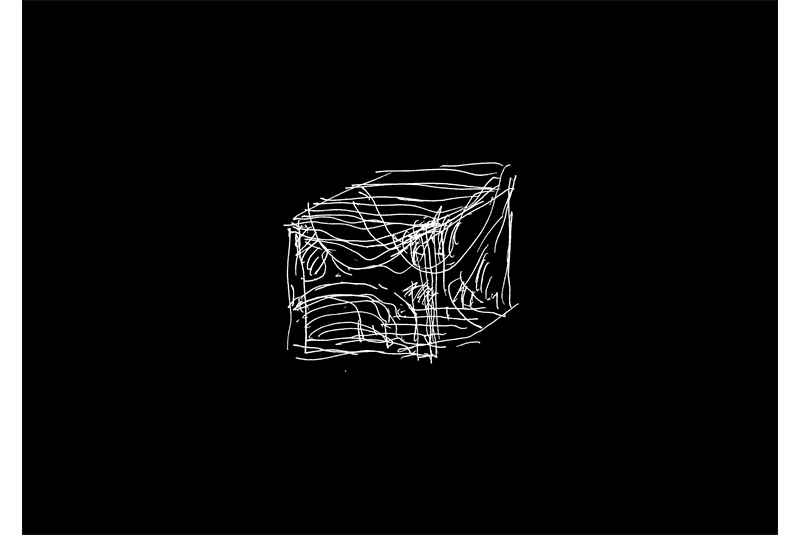
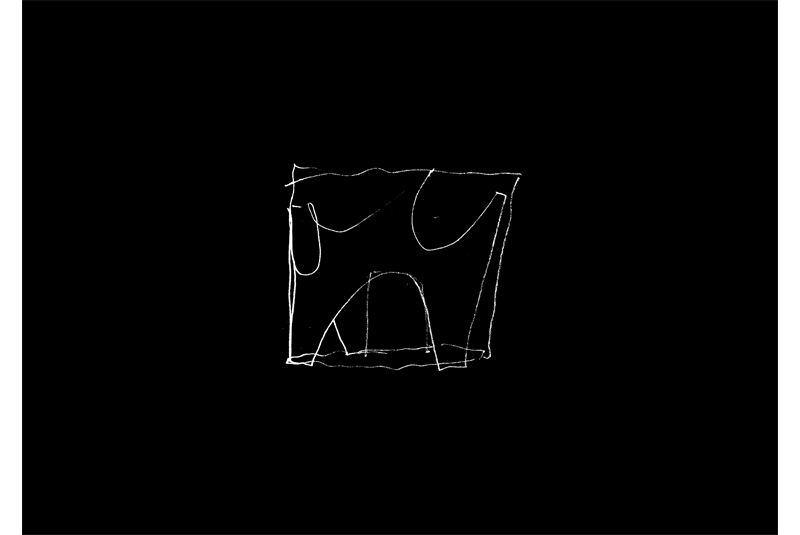
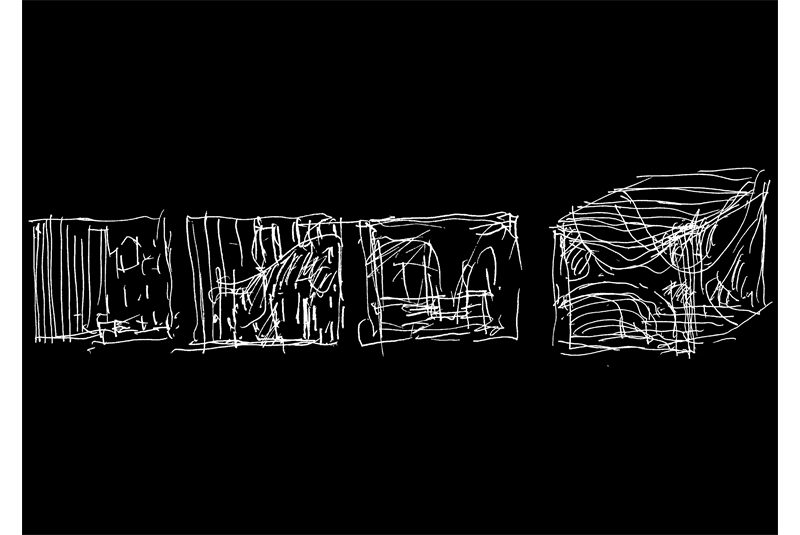
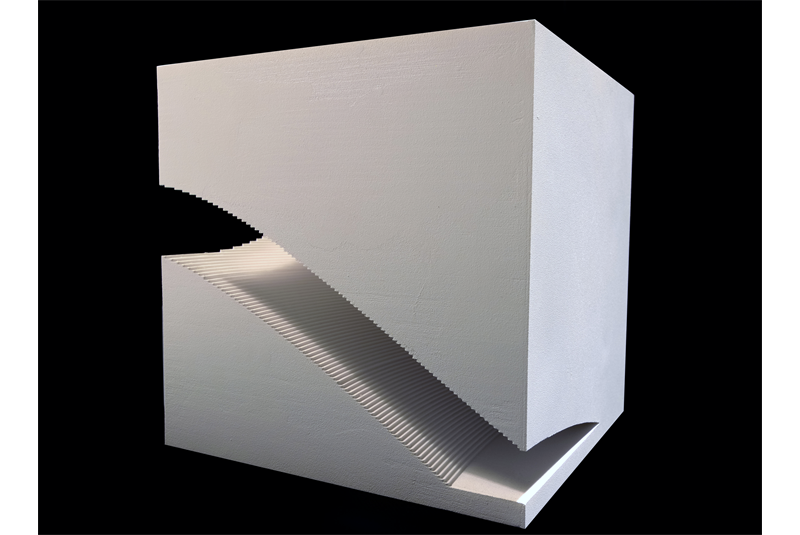
Among the strategies explored, there is also that of simulating a possible completion. It is the door left open by the unfinished, it is the opportunity that the project La simmetria del non speculare seizes, transforming it into a proposal. Viganò had not managed to complete this small city, which also included the Theater, the Gymnasium, the Church, and other services. The proposed project sets up some installations in the remaining voids: they are the extra-places, in memory of what was not fully completed but not for this reason less real than what was realized. Finally, the last context, Fernand Pouillon’s Climat de France, built in Algiers in the 1950s, can also rightfully belong to the Mediterranean context but with a gaze that starts from the South, no longer along the itineraries of tourism and Myth, but from the tragic routes of migrations. In the Plan Oblique proposal, a narrow and long ramp marks a longitudinal axis throughout the length of the inner courtyard, the Great Square of the 200 columns; it is an oblique plane in mirrored steel that views and surpasses Pouillon’s complex, exceeding it in height. The choice is clear, it wants to be a counterpoint to the rigidity of the great courtyard regulated by prime numbers (1,3,5,7) and at the same time an element of rupture, already announced outside. The mirrored coating reflects, dematerializes, disorients. The oblique blade, the relation reads, is like a wound inflicted on the enclosure of the Great Square, highlighting the contradictions and conflicts between Algeria and the Muslim population, between the original idea of domestic monumentality and the current condition of urban ruin. La memoria è il luogo in cui accadono le cose per la seconda volta: the project for a memorial at Climat de France, the last project’s report reads, involves the reading, decomposition, and recomposition of the archetypal forms of Fernand Pouillon’s building. With an abstract but not less interesting approach, Climat de France is reduced to a frame of a developing palimpsest: the ground is shaped with a new decomposed and recomposed topography, the heart of the community that inhabits it and reappropriates it each time by modifying it.
In Pouillon’s intentions, the large Algerian complex wanted to recreate a Casbah "no longer medieval but ultra-modern", to give the poorest of Algeria their domestic monument, the same one they baptized as the Great Square of the 200 columns. It is along this line of reasoning that the Monument-Memorial connects with the community that identifies with it and symbolically appropriates it. The Monument-Memorial thus enters our Present actively, with the ability to construct narratives as places of a collective mythology in which each of us can identify.
[1] Smithson, R., "A
Sedimentation of the Mind: Earth Projects," in Flam, J. (ed.), Robert
Smithson: The Collected Writings, University of California Press,
1996.
[2] See Anselmi, S., Storie
di Adriatico (1996) and Ultime Storie di Adriatico
(1998), published by The Mill.
[3] Andriani, C., & Micara,
L., Archeologies in Mutazione, Gangemi Editore, Rome, 2013.
[4] If we go back to the Sanskrit
prefix "ut," the root of the Latin etymology "ultra," it also means
"outside." See also Andriani, C., "Oltre_ Metabolisms of the Urban-Port
Margin," in Moretti, B. (ed.), Beyond the Port City: The Condition
of Portuality and the Threshold's Fields, Jovis Ed., 2020.
[5] Francesco Tentori was part of
the commission for the competition announced by the Municipality of
Udine in 1958. The chosen project was "Forra," which was appreciated
for its urban planning value and ability to create a public space full
of symbolic references in a substantially empty square.
[6] The title takes up the
well-known essay by Paul Valéry, "Inspirations
Méditerranéennes," from the conference held at the
Université des Annales on 24 November 1933.
[7] There are examples of this
kind in contemporary art. Among the installations created along
waterfronts, particular mention should be made of The Sea Organ (2005)
by the architect Nikola Bašić, who won multiple awards for this
work, the first in the world to exploit wave motion and transform it
into a soundscape.
[8] Aldo Rossi in Basilico, G., Sea
Ports, Art&, Udine, 1990.
[9] Vittoriano Viganò's
Marchiondi-Spagliardi Juvenile Institute was very well received by
critics, particularly Reyner Banham, who considered Viganò's
complex the first brutalist work in Italy.
Bibliography
ANDRIANI C. and MICARA L. (2013) – Archeologie in
Mutazione. Gangemi, Roma.
ANDRIANI C. (2020) – “Oltre_Metabolismi del
margine urbano-portuale”. In B. Moretti, Beyond the Port
City: The Condition of Portuality and the Threshold’s Fields.
Jovis, Berlino.
ANSELMI S. (1996) – Storie di Adriatico. Il Mulino,
Bologna.
ANSELMI S. (1997) – Ultime Storie di Adriatico. Il
Mulino, Bologna.
ROSSI A. (1990) – “Presentazione”. In G. Basilico, Porti
di mare. Art&, Udine.
SCARPA C. (1977) – Memoriae causa. Valdonega,
Verona
SMITHSON R. (1996) – “A Sedimentation of the Mind: Earth
Projects”. In J. Flam (ed.), Robert Smithson: The Collected
Writings. University of California Press.