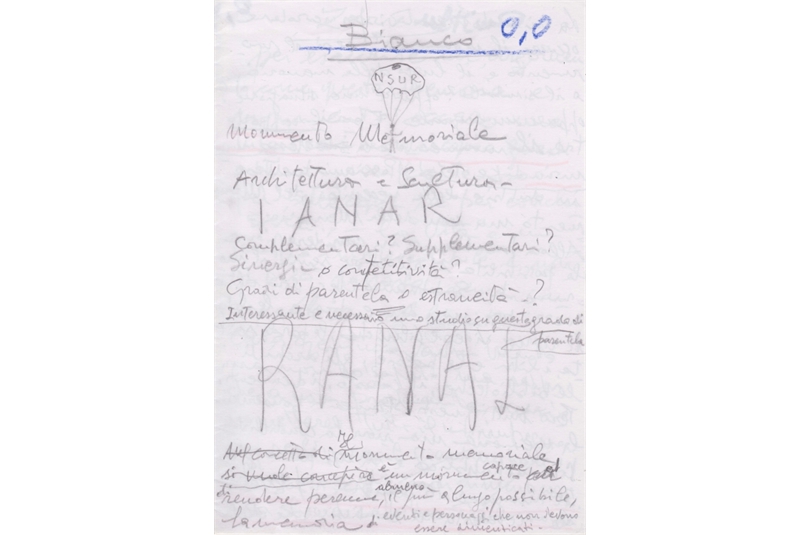
White
Memorial Monument
Architecture and Sculpture
Complementary? Supplementary?
Synergy or competitiveness?
Degrees of kinship or unfamiliarity?
A study into this degree of kinship is interesting and necessary
A memorial monument is a monument that keeps the memory of events and
people who should not be forgotten alive, at least for as long as
possible.
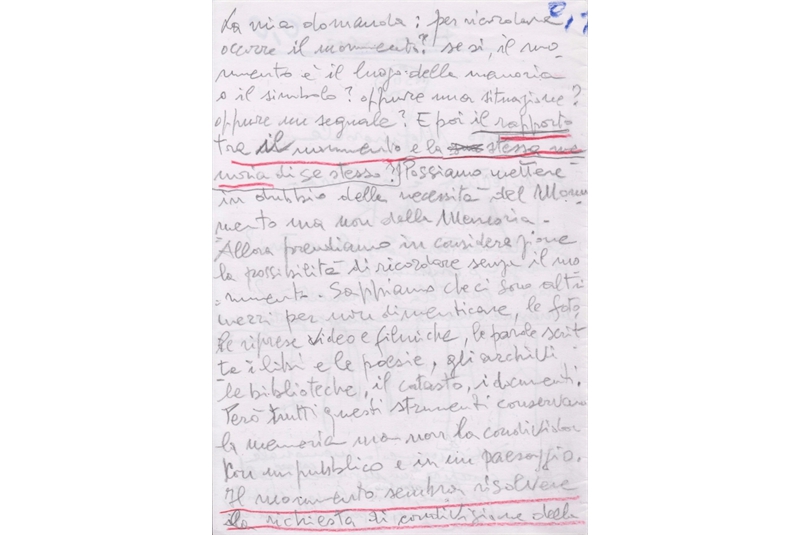
My question is: do we need a monument to remember? And if we do, is
the monument the place of the memory or the symbol of it? or a
situation? or a sign? And what exactly is the relationship between the
monument and the actual memory itself? We can certainly question the
need for the monument, but not the need for remembrance.
So, let us consider the idea of remembering without the monument.
There are other ways of not forgetting something, such as photographs,
video clips or films, the written word, books and poems, archives,
libraries, registries and documents.
However, while these all preserve the memory, they do not share it with
a wider public or within a landscape.
A monument would seem to be the answer to the desire to share the
memory in a communal and public place.
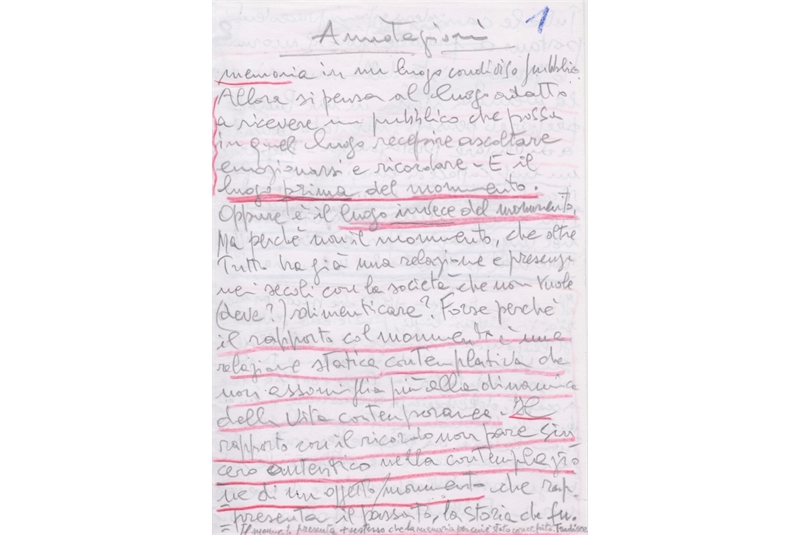
Notes
So, what is needed is a place where people can come to see, listen,
become emotional and remember. The place comes before the monument. Or
it is actually the place rather than the monument. But why not the
monument, as something that already has a relationship and a presence
over the centuries, in a society that does not (or should not?) forget?
Perhaps it is because the relationship with the monument is a static
and contemplative one that no longer resembles the dynamics of
contemporary life. The relationship with the memory seems neither
sincere nor authentic when it simply comes down to contemplating an
object or monument that represents the past, times gone by. The
monument is presenting itself, rather than the memory it is supposed to
represent. It betrays that memory.
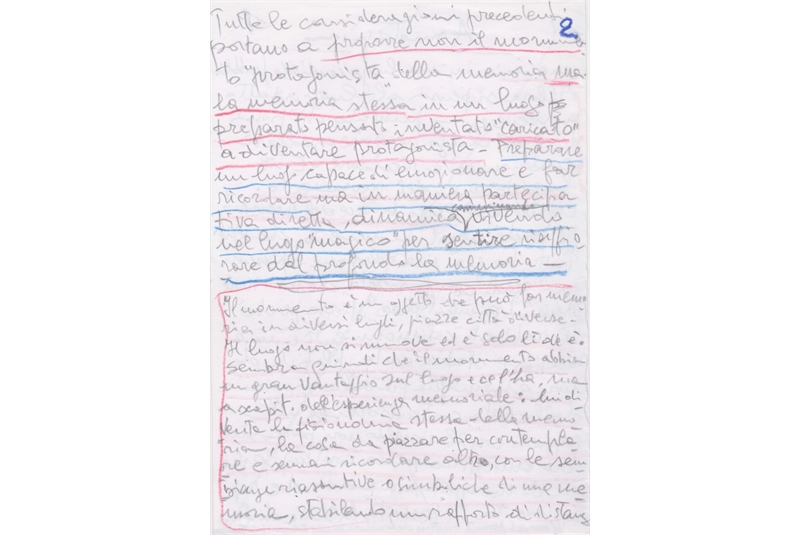
All the above considerations lead to the concept of the monument no
longer taking “centre-stage”, but rather the memory itself,
in a place that has been prepared, conceived, invented and
“charged” with taking centre-stage. The idea is to prepare
a place that strikes an emotional chord and allows people not just to
remember, but to participate in a direct and dynamic manner, walking
through and experiencing something in a “magical” place
which allows that memory to resurface from the depths of their
consciousness.
A monument is an object that allows remembrance in different places,
squares and cities. The place does not move, it remains there,
precisely where it is. A monument would therefore appear to have a
major advantage over a place, and it does in a certain sense, but to
the detriment of the actual experience of remembrance: it becomes the
"face" of the memory, the object placed there to contemplate and maybe
to remember something that has the summary or symbolic appearance of a
memory, but establishes a relationship of distance and respect: almost
godlike.
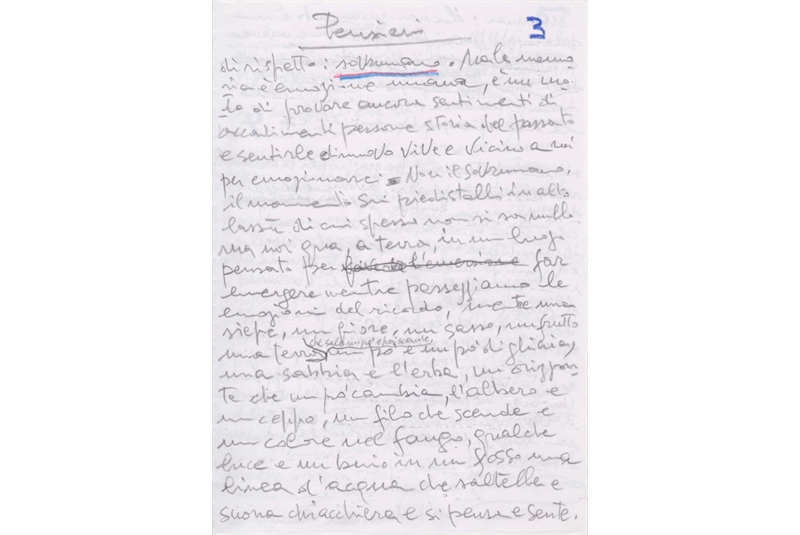
Thoughts
But memory is a human emotion, it is a way of still having feelings
about events, people and the past that brings them alive and closer to
us, moving us.
It is not something godlike, the monument on a pedestal looking down on
us from above, about which we often know nothing. It is here among us,
on the ground, in a place designed to bring out the emotions of the
memory as we walk by. It is a bush, a flower, a rock, a piece of fruit
or a piece of ground, something that rises and then falls, a patch of
gravel, sand or grass, a horizon that changes a little, a tree and a
stump, a thread that descends and a colour in the mud, a little bit of
light and a little bit of dark in a hole, a waterfall that cascades
with a sound like music, chatters to us and makes us think and feel.
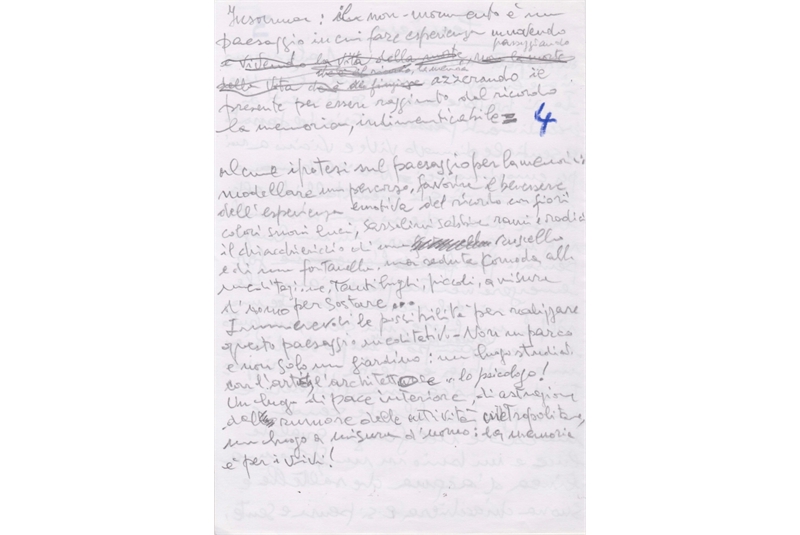
In short: a "non-monument" is a landscape in which we experience
something by moving and walking, leaving the present to be reached by a
recollection, a memory, the unforgettable.
Several ideas on the memorial landscape: modelling a path, promoting
the sense of well-being of an emotional experience and the memory
itself, with flowers, colours, lights, pebbles, sand, branches and
roots.
The chatter of a stream or a fountain, a comfortable seat for
meditation, so many small places, on a human scale, to pause and
reflect …
There are numerous possibilities for creating this contemplative
landscape. Not a park and not just a garden, but a place designed with
the artist and the architect and the psychologist!
A place of inner peace, an abstraction from the noise of city life, a
people-friendly place: memories are for the living!
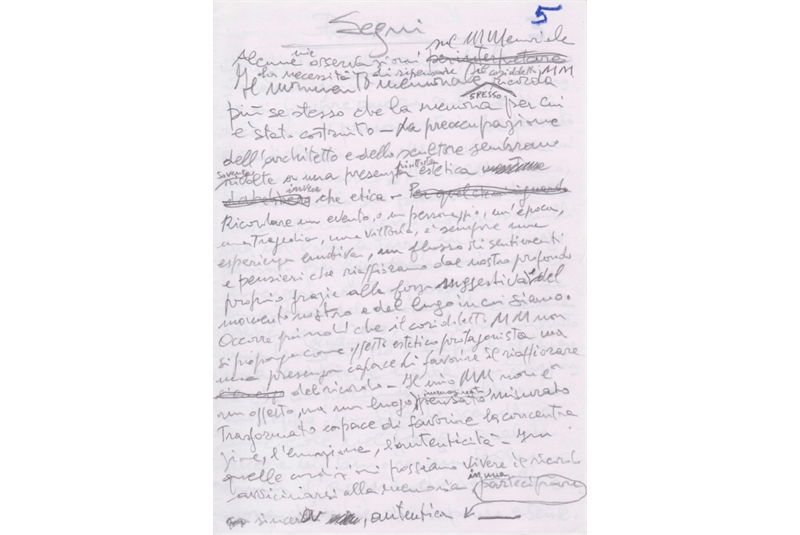
Signs
Several of my observations on the Memorial.
There is a need to rethink the concept of a memorial monument.
A memorial monument is often more a memory of itself, rather than of
the memory for which it has been built. The main concern of the
architect and the sculptor would often seem to be focused on aesthetics
rather than ethics.
Remembering an event, a person, an era, a tragedy or a victory is
always an emotional experience, a rush of feelings and thoughts that
reappear in the depths of our consciousness, thanks to the power of
suggestion, the moment and the place in which we find ourselves. The
so-called MM itself should therefore not be the visual focus, but a
presence that allows that memory to return.
My MM is not an object, but an imagined place, designed, measured,
transformed, capable of provoking concentration, emotion and
authenticity. In those conditions, the memory comes closer to us and we
can experience it with a sense of sincere and authentic participation.
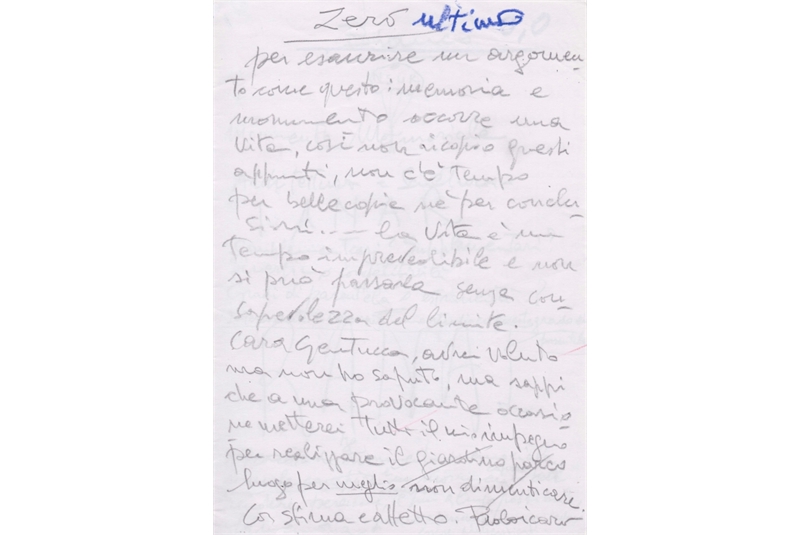
Zero
Covering a topic such as memories and monuments exhaustively would take
a lifetime, so I am not copying these notes, there is no time for neat
copies or conclusions ... life can be unpredictably short and you
cannot spend it without being aware of that limit.
Dear Gentucca, I wanted to but I didn't know how, but please understand
that, if the enticing occasion were to arise, I would do my utmost to
develop the best place for never forgetting.
Yours with appreciation and affection.
Notes on the “memorial monument”
If it is a memory (of events, people, important historical facts, human endeavour) that we want to preserve, confirm and consolidate, in order not to forget, then I will dwell first on that memory and then ask myself which ways are the best for preserving it and, possibly, celebrating it. Memories are present in our everyday life, in both a voluntary and involuntary way. I want to focus on voluntary memory, leaving involuntary memory to experts in the human psyche. We use our voluntary memory constantly, in order to be able to function with sufficient awareness, deciding the logical sequence of our actions. When we forget why we have opened the fridge, we make a concerted effort to remember which item we intended to take from it, we try to remember, just as you do when you encounter someone who says they know you and you try to recall, not always successfully, what their name is and even where you met them, in order to return the greeting. We need to make an effort to remember. But we also need to make an effort not to forget. In our everyday actions, this often simply means not forgetting to buy something or an appointment or a payment, whereas, in the continuity of distant or even remote and historical events, the effort not to forget is totally different and much more complex. This effort combines the culture we possess, in terms of knowledge of facts, circumstances and social, political and economic conditions, together with the environment and education, individual concepts and preconceptions, of each person who does not want to forget and, on the contrary, feels the need to remember. We could refer to this feeling as a historical conscience, and therefore an awareness that is both individual and collective and that needs a collective, strong and penetrating public testimony in bringing it from the past into the present in order for it not to be forgotten: it is like pulling a bucket full to the brim with the history and stories of humanity from a well that is tens or hundreds or even thousands of years in depth. This could be the foundation for a memorial concept.
Above all, I imagine a possible project for a memorial place as
outdoors, a narrow emotional path for one person, who walks in a spiral
towards the centre, yin and yang, helping them to concentrate on
themselves and allowing the memory to become an emotion. There are a
multitude of solutions to design and delimit the spiral, depending on
the soil, the areas, the surrounding environment, all in relation to
the nature of the memory and with everything allowing an emotional
resurfacing of the reason for which we are walking, alone, on the
spiral path.
Another path, a design once again dictated by the various circumstances
already listed in part, could be a horizontal hourglass: a convergence,
as scene from above, towards a “critical” point, where the
emotion of the memory enters into the true nature of the Ego. The path
then opens slowly and brings us back to the present, as we emerge from
the deep well of the past.
I have to specify here that, for me, a path is, for the time being, simply a line but, in the actual natural landscape, it becomes a material physical dimension, with measurements and proportions, and even the memory itself of the hypothetical path makes a difference. In passing from the initial idea to the actual construction, it is obviously necessary to consider all the elements involved, sometimes as obstacles and sometimes as beneficial suggestions. The final design considers all the elements and is always subject to variants, with the original, interior spiritual structure always acting as a guide.
Last but not least, a place where the right conditions exist for the concentration that assists remembrance, whether it is a page of history or a prestigious person, could be considered not as a monument, but as a memorial place, in which to walk, to stop and to reflect, meeting ourselves in the silence and thanking the memory for the emotions it affords us in thinking about the past.
Paolo Icaro
“Reading back over what I wrote (with a slight sense of
embarrassment), I felt that my proposal for a memorial place needed to
be coloured with joy: a moment of existential enrichment, retracing a
memory is vital nourishment, an ecological delight.
Exaggerating to make the concept clearer, I imagine a playground for
the soul, populated not with symbols but with incentives, etc., not a
visit to a cemetery!!!!!!!!”