Around (and within) ‘Lo spazio al centro in Kahn’
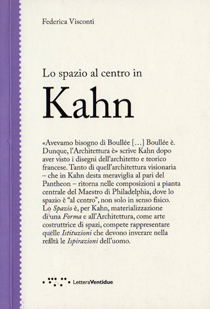
Lo spazio al centro in Kahn by Federica Visconti, part of LetteraVentidue's Figure series, stems from the author's elective and personal obsession with the thought and work of the “Estonian master from Philadelphia”.
This obsession is not coincidental – elective to be precise, that is, knowingly identified among the many possible ones – it’s a deliberately chosen focus that has deep roots going back to her doctoral thesis[1]and continues virtually unchanged in interest and intensity over time and in subsequent work. This book represents a kind of transcendence and sublimation of the initial thoughts formed during her doctoral research, which will undoubtedly continue to evolve towards new interpretations and readings.
The difficulty in identifying a true conclusion for this work and the sequence of analytical readings it presents is evident, leading Visconti to propose two different epilogues with some analogous traits: the first focusing on the National Assembly Hall of Sher-e-Banglanagar (with its primordial idea linked to the Pantheon in Rome), and the second on the Four Freedoms Park and the Roosevelt Memorial in New York, a posthumous work completed on the former Welfare Island nearly forty years after its conception, based on sketches and drawings found in Kahn’s archive.
In the incpit, Federica Visconti traces her obsession with Kahn back to Livio Vacchini’s thoughts on architectural ‘masterpieces’.[2] I, mindful of the ontological sense of this series based on the correspondances[3] between architects separated only by space and time but aligned in thought, tend to attribute this persistent focus on Kahn’s work and figure also to the obstinacy reminiscent of Rossi.[4] After all, Kahn’s entire experience is marked by the same persistence in wanting to “center a theme to develop, make a choice within architecture, and always try to solve that problem” with varying solutions that demonstrate the refinement of variable responses against the constancy of the problems. One of these themes, according to Visconti, is the Human Agreement, the basic quality of any form of dwelling, private or better yet, civil and collective: “I think a plan is a society of rooms. A good project is one where the rooms have talked to each other”, wrote Kahn himself.[5] In this sense, Kahn’s civil and classical dimension – timeless and therefore always contemporary, not in terms of language but in its constant relevance – represents a universal, educational, and formative experience available to all and for all, genuinely operational as it is truly aimed at the project and the possibility of its renewal.
Drawing is a fundamental tool in this investigation: sections and elevations, views and perspectives, and of course, plans and diagrams reconstruct and reveal the deep and intimate sense of the ‘central space’ around which the entire composition lies. Thus, drawing assumes an almost surgical tone, performing a precise dissection that penetrates the forms of solid and massive architecture.
The carefully selected works – certainly not exhaustive but not reductive either for the expected result – intertwine Kahn’s travel experiences in the early 1950s between Greece, Egypt, and Italy (especially), as well as his writings and theory, which are absolutely coherent and inseparable from the practical exercise of architectural design. Italy – and more broadly, ancient and particularly Roman architecture – represents a rich heritage of forms and principles for Kahn, available to feed the imaginative invention of the project: avoiding pure citation, Kahn chooses the more refined path of abstraction and analogy because “pure forms have already been experimented with in all their variants” [6], as he wrote in a letter to his studio collaborators, legitimizing the natural attitude of the ancient to be interpreted and still interpretable today. Perhaps it is this constant and continuous reference to the ancient, to the expressive potential of ruined forms suspended in an immutable and motionless time, that is the basis for Kahn’s maturation of thought around the primary space of the ‘room’ in all its possible meanings, from the idea of the gathered and introverted patio of the unfinished Morton Goldenberg House in Rydal (1959) to the ‘summary’ space, gathered but open and oriented of the Salk Institute for Biological Studies in La Jolla (1959-1965), united by the same will for a relationship with nature but different in spatial conformation: closed/concluded or open/infinite; from the hall of the First Unitarian Church in Rochester (1959-1967) to the hall designed for the Hurva Synagogue in Jerusalem (1968-1974), united by the similar idea of community celebrated in the central space.
The critical readings of this selection of works – all notably from the late ‘50s to early ‘70s, a period of extreme maturation of Kahn’s architectural thought – aim to uncover the various compositional and expressive ways in which “the theme of human institutions and representativeness” has been developed and resolved. Kahn recognizes the “real essence” of contemporary architecture’s problem in the ontological concept of space: “Our problems are all new, our spatial questions are new, and this is therefore the time that must strive to create better institutions than those that already exist. Our institutions are very modest today. They are not good institutions because the spaces that must serve them are outdated. We must find the realm of space that can serve these institutions well today [...] it is terribly important”.[7]
The conclusion is deliberately left open by the author, who consciously suspends judgment, almost waiting for other future developments.
In the first epilogue, Federica Visconti explores the space of the National Assembly Hall in Sher-e-Banglanagar (1962-1974), recognizing it as corresponding to the Halls of Rochester and Jerusalem, all ideally underlying the grand domed space of the Pantheon. The second epilogue addresses the Roosevelt Memorial and the Four Freedoms Park in New York (1972), almost a sublimation of the long ‘canopy’ of the Salk Institute that here, however, closes – only seemingly – after a long journey in a ‘new’ nature with “a place to stay”: an open-air room facing the East River. This is a space of pure contemplation that abstracts from the rest of the world – here exemplified by bustling Manhattan – left behind. “I had the idea that a memorial should be a room and a garden, that was all I had. [...] The garden is somehow a sort of personal control of nature. And the room was the beginning of architecture”[8] Kahn needed only these few words to describe an idea of landscape finely nuanced, all defined by perspective changes and slight movements of the ground that give a character of new theatricality to the journey into the renewed nature of the ancient Welfare Island.[9]
And in the end, once again a room, because “the room is the beginning of architecture”.[10]
Thus, certainly not by chance, “I Love Beginnings” [11] is the title chosen by Visconti for this last chapter.
More than an epilogue, a new beginning.
Valerio Tolve
[1] Federica Visconti, L’Architettura per la Ricerca Scientifica, Ph.D. Thesis in Urban Design, XIII cycle, Università degli Studi di Napoli “Federico II”.
[2] Livio Vacchini, Capolavori. Dodici architetture fondamentali di tutti i tempi, edited by B. Pedretti, R. Masiero, Umberto Allemandi & C., Torino 2007.
[3] “I was struck by the phrase in which Baudelaire states that there are correspondences” Aldo Rossi, Autobiografia scientifica, Pratiche Editore, Parma 1990.
[4] “The first principle of a theory, I believe, is the persistence in certain themes, and it is precisely the artists and architects in particular who focus on a theme to develop, to make a choice within architecture, and to always try to solve that problem. This persistence is also the most evident sign of an artist's validity and autobiographical coherence; just as Seneca stated that the fool is the one who always starts over and refuses to continuously follow the thread of their own experience.” See Aldo Rossi, Architettura per i Musei, in Aa.Vv., Teoria della progettazione architettonica, introduction by Giuseppe Samonà, Edizioni Dedalo, Bari 1968.
[5] Louis I. Kahn, “The Room, the Street, the Human Agreement” in A.I.A. Journal no. 56, September 1971.
[6] See Maria Bonaiti, Architettura è. Louis I. Kahn, gli scritti, Electa Milano 2005.
[7] Louis I. Kahn, Talk at the Conclusion of the Otterlo Congress, 1959; in id., Essential Texts, edited by R. Twombly, W.W. Norton & Company, New York-London 2003.
[8] Louis. I. Kahn, 1973: Brooklyn, New York, in “Perspecta” n. 19, 1982.
[9] Oliver Wainwright, Dead man building: is Louis Kahn’s posthumous New York project his best?, in “The Guardian”, 3 july 2014.
[10] Louis I. Kahn, Draft-AIA National Gold Medal, Kahn Collection, folder 1971, Box LIK n. 52; in Loius I. Kahn, The Room, the Street, and the Human Agreement, in id., Essential texts, op. cit.
[11] Louis I. Kahn, Lecture at International Design Conference, Aspen, Colorado, 1962; in id., Essential texts, op. cit.
Book features
Author: Federica Visconti
Title: Lo spazio al
centro in Kahn
Language: italian
Publisher: LetteraVentidue
Edizioni,
Siracusa
Characteristic: 12 x
18 cm, 128 pages, paperback, b/w
ISBN: 9888862428477
Year: 2023