Inescapable Analogy
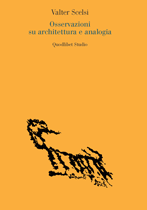
Dialogue between analogy and architecture. Skirmishes, winks, a sort of giga-call (rationality and freedom) to the multiplicities of reality. Scelsi's book published by Quodlibet is all this and more. There is nothing to explain, nothing to demonstrate, but to venture accompanied by the author on a reading path, at times logical and at times evoking, states of mind into the world of analogy when it shows itself through architecture.
Throughout the text, one is accompanied in a kind of serendipity. At times the flow of the narrative seems to want to be rational, at others it is imaginative, open to different perspectives. Images and stories emerge that compose a varied and articulated cultural description through architecture. An interdisciplinary, multi-experiential, geometrically one might say multi-dimensional dimension, which remains suspended but enriching.
Analogy is the theme from which a number of variations develop, but which always eludes definitive description. The theme, the analogy through architecture in the contemporary, is never fully defined, because there is no need to do so. It is not a matter of circumscribing and delimiting, but of acting and observing.
It is a theme with variations that develop on different planes and where the thematic material, the analogy, is read from different voices. Machines to forget, Laurel & Hardy, The construction of the Caprarola image, From Cyber-flanerie to Electronic Iconology, these are the titles of some of the chapters that give an idea of the spacing.
The many protagonists of contemporary architecture cited and commented on in relation to analogy are another example, very different but, in the end, very related: there is no escaping an analogical logic, even if always interpreted otherwise (by Rossi and Ungers, among others).
Analogy is still relation. But what kind of relation? How many kinds of relation are possible? And then, is it possible to distinguish architecture from other places of being in the world. Heidegger is immediately evoked. To be there, to be here, in the contemporary, now with all the contradictions and hidden coherences that are masked, but which ultimately connote the structure of this, and not another, reality.
By association, another of Heidegger's words comes to mind (from that Building Dwelling Thinking contained in Gianni Vattimo's Essays and Discourses edited for Mursia in 1976), according to which ‘dwelling comes before building’, where the theme of relations with the memory of contexts and contexts interpreted in the light of memory and, therefore, of the innumerable analogical forms of understanding and interpretation inevitably comes into play. In a lecture in 1985, held for the inauguration of the Bra Cultural Centre, where the theme was the legitimation of the architectural project, Vattimo understood this
legitimation as a form of constitution of horizons of validity through dialogue, which is dialogue with the tradition to which we belong and dialogue with others [...], where constitution is at bottom rather a modification of the environment to which we already belong than the institution from scratch of a structure.
And it is precisely in this dimension of relationship and modification that analogy deserves to be understood and made aware, as it is rich in interdisciplinary interrelationships and subjective interpretations of experience, but which inevitably, as architecture, lands in the concreteness of living. Wearing different but, somehow, always similar forms to something.
What also emerges strongly in the moods and modes of the now that we are experiencing is precisely the dialectic between recall and resonance of the deep structure of reality, and the need to escape from codified schemes and languages. How, in essence, through the worlds of analogy, a way is sought for languages and thoughts that are necessarily current, but which always recall at root some presence of memory, of cultures, of the partiality of knowledge. It is not just any old way, heterogeneous among many, banal, imitative of fashions, but a way rich in culture and thought that is not mapped out, it is to be discovered and constructed cooperatively through multiple experiences. What appears to be a contamination between ‘the arts’, the different knowledges, the range of performers has underlying a weave of more or less transparent analogies, nonetheless present. What could Oliver Hardy, the 1890 design for the Great Tower of London (a London Eiffel Tower, fortunately never built), Gabetti and Isola, Le Corbusier and Botticelli's Communion of St. Jerome have in common? Underlying this is the intuition of analogies present in all, but not reciprocal, similarly structuring, yet completely independent.
The relationship between thought and doing, or rather between thought and realised work, between desire and ‘facts’ - which for architecture are the very concrete places in which one lives, works and lives - cannot but possess an analogical dimension, where memory, but also the direct observation of the multiple expressions of the different cultures of a globalised and increasingly interconnected world, determines factual consequences. Thought is matched by facts and questioned facts are followed by new thought, emerging thought. There is, therefore, an underlying stone guest that cannot seem to escape: the analogical dimension of any emergence of thought and reality, the presence of any possible development. All the opposite of a single thought, but the expression of a single generative root of behaviour, albeit very different, where architecture, if questioned and realised, is an implacable witness. But it is precisely the richness of perspectives that requires critical and non-superficial thinking. Scelsi's text in this regard is rich and generous.
The significant reference, neither exclusive nor characterising, to Aldo Rossi, to whom the title of the book's second chapter, Forgetting Machines, refers, who uses the expression in his Scientific Autobiography where he states, precisely, that we are all inevitably machines for forgetting, is a relevant key to Scelsi's book, also because ‘inevitably’ the relationships with what is at the basis of all reasoning of building, but not only, are always partial both out of necessity and will, out of limitation and desire. In other words, it is always impossible to possess all the elements, particularly today in a complex reality, articulated by sectors, but globalised by dynamics, where divisions clash in globality and almost always do not compose themselves but remain united only in their common heterogeneity. It thus becomes consequent to have to choose which evocations, which suggestions, which elements to bring to the outcome of the project and the concretisation in the moment of implementation. Hence, forgetting something, often too much (comment in the margin), when choosing some form of analogy. But the wealth of quotations, of references brought into the field in some of the most important chapters of the book, certainly An Analogue Education, Analogue and Contemporary and the aforementioned Forgetting Machines, have the merit of showing - not so much for those who approach with a didactic enumerative interest, but for those who go beyond it and form a critical thought - opens up a wide range of references that does not exclude, but often arouses, the ethical dimension of thought. The picture that emerges, therefore, analogous to the expression of architecture and the life to which it is inextricably intertwined, even in design thinking alone, is an open scenario, laden perhaps with intrinsic contradictions, but rich and fertile with developments.
Book sheet
Author: Valter Scelsi
Title: Osservazioni su architettura
e
analogia
Language: Italian
Publisher: Quodlibet
Characteristic: 176 pages,
dimensions 14 x 3.4
x 21.4 cm
ISBN: 9788822920522
Year: 2022