Siiri Vallner (b. 1972 in Tallinn) is an architect whose projects have left a strong mark on the image of contemporary Estonian architecture (Lige 2015). Vallner started her studies at the Estonian Academy of Arts in the early 1990s. It was a time of transition in Estonian architecture[1]. If during the Soviet era architecture was centralised and nearly entirely at the service of the state, now the country moved to the other extreme. Virtually anything that could be privatised was privatised, and for the first 10-15 years, construction was largely directed by the private sector looking for quick income. It was a time of turmoil for the government sector and the underfunded arts and architecture education. In this anxious situation, Vallner was one of the first to embark on exchange studies to Copenhagen, where the Danish government had a special study program for foreigners, where teachers (among others Jan Gehl – the world-famous urbanist and an advocate of good public space) preached about the architecture and urban planning of the welfare state through in-depth tours.
A few years later, Vallner set off to Washington DC to study at the Virginia Polytechnic Institute and State University. Jaan Holt, an Estonian expat, served as a professor of architecture there and helped to organize scholarships for Estonian students. Holt himself had been a student of Louis Kahn and Kahn's long-time 'personal' engineer August Komendant[2]. While Kahn had left Estonia as an infant, Komendant left Estonia as an adult during the Second World War. This Holt-Komendant-Kahn "bloodline" has been an important narrative in Estonian architecture, as on the one hand it has helped to bridge the discontinuity between the current period and the independence preceding Second World War, while on the other hand, it has sought to reinstate the country with the mainstream of modern architecture from which it was forcibly separated for half a century.
After her studies, Vallner spent a year living in New York, working in an architecture office. When she came back to Estonia, she founded the architecture office KavaKava together with her colleagues. In 2004 Estonia joined the European Union, which initiated the construction of many public buildings and infrastructure projects through various support programmes. The appearance of Estonian architecture in the last twenty years is largely the result of high-level architectural competitions for EU-co-funded public building, where Vallner has picked up many prize-winning places[3]. In 2008, when she received the Young Architect Award and the accompanying travel scholarship, she undertook a classic Grand Tour through Italy, Greece and the Middle East to India.
This interview was conducted in May 2024 as part of the research project Updating the Grand Tour. Memory and Invention of the European Built Environment. The interview took place in KavaKava's office, in one of the early-20th century wooden houses of the Kalamaja district of Tallinn. On a more general level the interview focused on how travel affects architectural studies and meaning-making. Considering the Estonian specificity of the interview, it is important to mention the name of Jaan Holt, who was mentioned several times in the interview, and the contribution of the Virginia Tech School of Architecture to the development of Estonian architecture in the decades following the restoration of independence.
Gregor Taul: The aim of our conversation is to talk about the Grand Tour and travelling in Europe and beyond. Yet, one does not have to go abroad to experience architecture. In order to have a deep spatial experience, it can sometimes be enough to leave the classroom and see a building on site. Perhaps we could start with your architectural studies and move chronologically from there. Would you talk about your studies at the Estonian Academy of Arts (EKA) and about your first study trips abroad?[4]
Siiri Vallner: I started my studies in the 1990s and I think that travelling was really different compared to the way it is today. Society itself was very, very different[5]. If one managed to go somewhere, the effect was much more influential. On the other hand, there wasn't, and couldn't have been, any planning or forethought – you just had to take your chances.
The first place I went to study abroad was Copenhagen. I studied there for one semester and it was so radically unlike the way we were studying at the time, that I couldn't even put the two experiences together. In fact, I didn't dare to talk about it with others – I thought they would laugh at me. Now it seems so obvious, but back then I didn't have the tools to fully comprehend it or relate it to the Estonian context. Their approach was very people-centred and social, whereas in the 1990s, in Tallinn, people would jokingly refer to this kind of thinking as "hedgehog architecture" – where one supposedly grasps the world from below, rather than above.
In any case, I got a good taste of this perspective, because what I learnt in the lectures was confirmed in the urban space. The Danes had a special programme for international students, with a clear intent on spreading their culture and architectural ideology. In addition to the lectures, we had a lot of study tours, where we went to see the same objects we had discussed in the classroom. Thus, we learnt through concrete examples how Danes, who were supposed to be even more introverted people than Estonians, have created an open and friendly society through architecture. It was through these visits to architectural works that I genuinely realised for the first time that actual understanding comes from experience not theory. I can study something for a hundred hours in the classroom, but when I see and experience it for an hour on the spot, the impact is so much greater.
GT: Although the Erasmus mobility programme was established in 1987, Estonia joined in 1998 and the first students participated only in 1999[6]. Student mobility also took place during the Soviet era when the partner universities were from the Soviet Union and the Eastern Bloc. The 1990s were an intermediate period in that previous links had been broken and new ones had not yet been established. Did students seek out exchange studies opportunities themselves, or were they helped to do so by, for example, the then dean Veljo Kaasik?[7]
SV: Back then, there were no Erasmus or other programmes. I can't remember where this Danish opportunity came from[8]. I think it may have been thanks to Veljo Kaasik. Two students from our course went to Denmark, and later Oliver Alver also went on the same programme[9].
GT: Did you have the opportunity to practice as an architect and was there perhaps even a danger that Copenhagen would take you in and you wouldn't come back?
SV: I was only in my third year at the time and the idea hadn't occurred to me. But when I went to study in the US in 1998, they did have this American practical approach of attracting foreign students and then giving them short-term work permits. It is good for them to have a lot of energetic highly skilled young people that they can use, but who will soon leave and not retire there. I took advantage of this opportunity by working both during and after my studies.
GT: Am I right that you were in Copenhagen during your third year, then came back to Tallinn, did your fourth year and then headed to the US?
SV: Yes, I finished the fourth year at EKA. The funny thing about our course was that just when we were finishing, there was a reform in higher education from a four-year programme to a 3+2 Bologna system. Our course got caught in the middle of the process. I think it's not common knowledge, but we finished in four years without doing a master's thesis. Later on, our diplomas were equated with a Master's degree. So we have about 15 architects who write MA after their name but who in a way don't have a master's degree. It was so vague at the time because some of us actually started the fifth year, but then the school did not know what to do with us. So, at the beginning of that fifth year, I had the chance to go to study in the US.
GT: You mentioned how radically different Estonia's economic situation was compared to Denmark. How did you manage? I can imagine that it was easier to get by in the left-wing, bohemian Copenhagen than in the elegant capital of the United States?
SV: Actually, everything in Copenhagen was neatly organised for us by the programme. I was living with a host family and had a scholarship and other privileges. I did well there. In the US, on the other hand, it was easier because I could work. But to be honest, in those days, it wasn't like you went somewhere and your mum or dad gave you the money. You had to manage on your own.
Although, of course, Jaan Holt's support was solid. At that time, the architecture department was away from Virginia Tech's main campus in a small space in Washington DC. It was a tiny school where – you might say – Jaan Holt's ideology reigned. It was important for him to invite students and visiting faculty from all over the world, who would spend a year or two there and then move on.
GT: Who else from the EKA students went there?
SV: Before me, Toomas Tammis had been there as a student and Andres Alver as a lecturer. Hanno Grossschmidt was there at the same time as me. Tomomi Hayashi, who came to Estonia also studied there. I don't remember at the moment, but there must have been more[10]. As there were few options before the Erasmus period, it was a definite and very good choice.
GT: On the one hand, Jaan Holt's contribution was clear and practical – through him, a whole generation had the opportunity to study and work in the United States and develop professionally in very different circumstances. On the other hand, something poetic and mythological goes hand in hand with his name.
SV: It is very mythological!
GT: Yes, the fact that he was a student of Louis Kahn and August Komendant. How did you perceive that at the time, and how do you explain this connection to yourself in retrospect?
SV: I admit that there's a clear "bloodline" theme. But if I now think about it from the Grand Tour perspective then I would actually connect this connection to the more medieval tradition of journeyman years of craftsmen rather than the travels of 18th century aristocrats. In this sense studying under Holt was more like a relationship between the master and the apprentice. If I need to categorise architecture, I see it as craft. Even though we do it with computers, it's a discipline where nothing happens without mind and hands. It's also person-centred as much is done and learnt individually. When I think about medieval times, it was the case that the apprentice had to go far away during his years of wandering – one couldn't go to the next village, but had to enter different cultures, had to practice with previously unknown masters. One local master was not enough.
GT: In medieval Tallinn, masters seldom handed down their workshops to their sons. As the saying goes: «blood is thicker than water». If your own son messed things up, it was hard to throw him out of the house because of the family bonds. It was more useful to take on a travelling apprentice, with whom you could develop a respectful relationship based on professional merit.
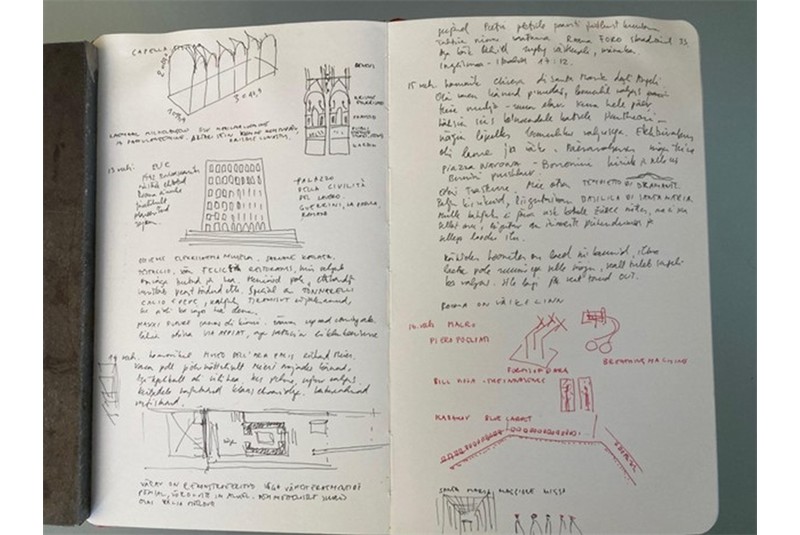
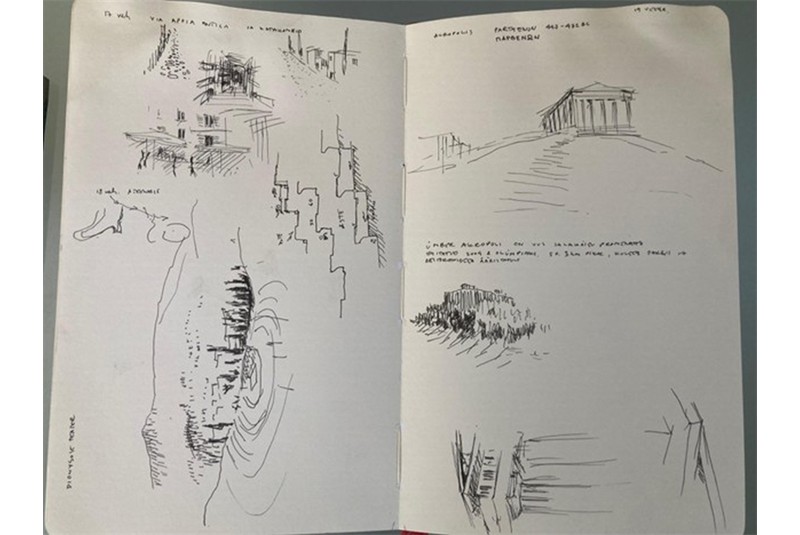
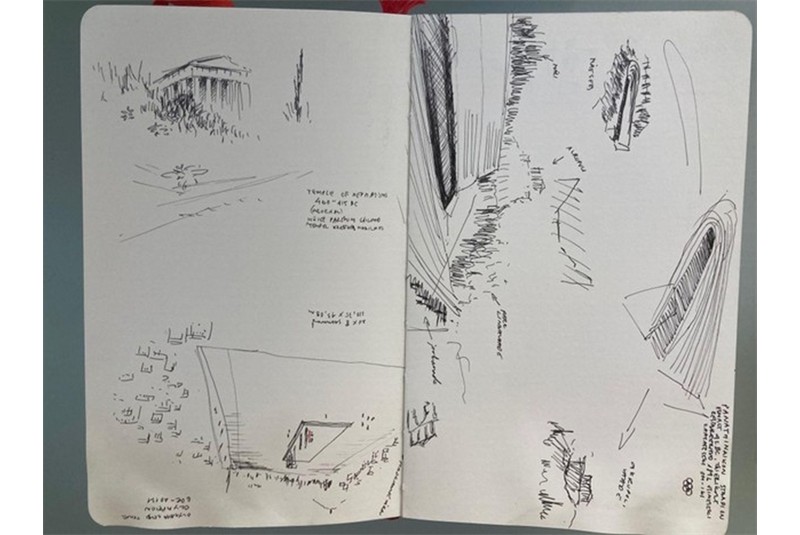
SV: Well, for example, one of the things that Holt thought was very important was drawing and sketching with your own hand. Because computers had already arrived and many people thought it was cool to model on screens, the analogue direction was not the most popular thing at that time. Although we were critical of Holt's obsession at the time, I still have a very strong attachment to sketching[11].
Of course, Holt worshiped Kahn, but Carlo Scarpa was also very important to him[12]. That's why one of our important teachers was Marco Frascari, who came from Scarpa's class. Kahn's and Scarpa's sensibility is a bit similar, and that certainly came through in the teaching. If you would put it in the Estonian context, then... Well, I think we are a small country and such a focus on one or two greats would not work here as it would hijack the whole teaching. But if you have a country as big as the US, then it can work, because each school of architecture has its own identity and they can educate their students as followers of a specific school.
Yet, from a personal point of view it's of course a very special feeling when you know that the knowledge comes directly from the original source.
GT: I imagine that studying in the US involved visiting Kahn's buildings around the country?
SV: Yes, but it wasn't really organised by the school. Because I was such a decent student, I just did it all on my own. This was a big difference from my studies in Denmark, where experiencing architecture on the spot was a crucial part of the programme. In the US, we did it ourselves.
GT: Can you tell me more about how this school worked. Holt had just retired (Komendant 1975) and you were more or less among the last students of his school. Do you recall if in that context, there were any study trips organised through the institution?
SV: I don't think so; at least not during my time. At the same time, for Americans, organising a trip, for example, to Philadelphia to see Louis Kahn's work would have been like us taking a trip to Tartu, which isn't very far. But I suppose it was also the peculiarity of that moment and that school.
GT: So now we know something more about the Tallinn school of architecture, about Copenhagen and about Virginia Tech. When you came back to Estonia, you were welcomed back by the local architectural community and were perhaps later joined by others who had trained in the United States. So, we know this exchange of people, but what about the exchange of ideas? How do you see this journey, in retrospect, from the perspective of how it might have influenced the values that characterise your architecture?
SV: It's hard to point to a specific impact. The trip to Denmark actually freed me because it gave me a completely different perspective through which to look at society and architecture. Going to America gave me the certainty that architecture is a viable career. I think that from the point of view of direct experience and conception of architecture, nothing can replace the study of buildings. This is what my studies in Denmark and the United States taught me. It was fundamentally about looking and trying. This is certainly something that continues to influence our architecture.
When we came back to Estonia, we spent years talking about architecture with our colleagues – debates in which we saw architecture as the result of mutual influence (Tammis 2014; Woodfield 2009). These were not academic discussions about architecture, but rather a kind of research product that all of us students brought from foreign schools and readings, and we had some nice magazines at hand. When we then had the opportunity to realise our projects, we remained faithful to the conviction that projects are very concrete discussions or experiments: very clear arguments are created through architectural choices (Hermann 2013; Alver et alii 1998)[13].
GT: However, you never went to explore Finland. You never travelled to Turku and you never walked the Aalto Road.
SV: Why do you ask that? Years later I received the Young Architect Award scholarship to undertake a classic Grand Tour[14]. The first and most important place I visited was Finland, specifically the Aalto Road. For me, Aalto has always been a very important architect and continues to be[15].
GT: When you came back home, after this experience, did you contribute in any way to rethinking how architecture is taught at EKA?
SV: When I started teaching, about ten years ago, at first I was just participating in some design studios. Later, I started running two design studios oriented towards field research. This approach reflects what I learned from the Danes. We never undertake a project unless we connect to a real site and in-depth on-site study. Of course there is always a narrative, but more important is the study of real places.
With one of these studios we visited Viimsi – a suburb of Tallinn – where we observed the building typologies built there, mainly detached villas. Since the students have lived their whole lives in this car-friendly but otherwise alienating suburban environment, they had never been able to question it[16]. In a sense, they finally saw it. I saw students who lived in Viimsi say they couldn't believe the public spaces they lived in were so terrible. Why had they never noticed before? Because we were able to look at it, experience it and analyse it together. This experience was also the starting point for the project they developed (Drobot and Thakur 2022).
In the second studio, our study trips became a bit longer. We went to Nuustaku, in the southern part of Estonia, and examined the building heritage of the 1930s there[17]. Before that trip, we studied this subject through the works of architectural historian Mart Kalm (Kalm 2001)[18]. However, it could not be compared to what we felt being there on site. For a day it was like travelling back in time, when we arrived at the complex of buildings from that era: the local social centre, the school, the town hall, the fire station hostel and about eight simple workers' houses, built on a street layout that reflected the planning of those years. I called Siiri Nõva, whose family member had previously designed those 1930s buildings, and she guided us for the day (Parbus and Ruudi 2014)[19]. At her home, a house designed by her grandmother in the 1930s that has been transformed and expanded by successive generations of her family, we talked about the ideals that shaped that generation of Estonian architects. The house itself expresses these ideals very well[20].
That generation was rooted in the spirit of the time, national romanticism, shaped by the Kalevala[21]. Siiri showed us some family heirlooms from the 1930s, including her grandmother's bag which bore an embroidery of a Kalevala design. The rationalist architecture of the 1930s didn't seem to me to have anything to do with the Kalevala. But there, at that moment, it was presented to me as a whole, inseparable. You could also touch it with your own hands: the building itself, the living history, the family heirlooms that tell something of that mentality.
Siiri also told us how as a child she and her sister could play for hours in the forest, picking berries, without ever being checked on by their parents. This tells us a lot about their ideology: trust in children, in nature. Going to Nuustaku became for me a way to understand not just the architecture but the entire mentality of that generation. One thing that had given me hope for post-Soviet Estonian society was that these myths and cultural values that had shaped Estonians and that had helped create the conditions to achieve independence before the war, were still there, even if hidden deep under five decades of occupation.
GT: The next question really guides us to the end of the interview. For an architect in training today, what architectural journey would you recommend, that you missed or that you think is essential to do?
SV: I would focus more on Estonia or neighbouring countries rather than going further afield. I believe that for us the cultural heritage here is really rich. We really have many good historic buildings, not excluding ruined industrial structures. I'm not an anthropologist, but I believe this heritage makes visible these different cultural phases that have shaped or ruined our society. If we need to face ourselves first, it is here, in our places, that we see ourselves best for what we are. I am certainly pro-travel. When students don't have the means to go very far, I suggest they take the ferry to Helsinki, where they can then spend a week without spending much money. This doesn't replace a longer trip, but it still offers a taste of the fact that a building studied in class is not the same as a building experienced on site (Aalto-Alanen 2023).
As for myself, there is one thing I would have liked to do, but I could no longer fit it into my schedule: a trip to the American Southwest. Raine Karp, an important Estonian architect, has written about the Spanish architectural monuments out there[22]. I read his descriptions and wanted to take that trip. The idea of visiting that monumental architecture, of such different scales, is also stimulating.
GT: Thank you very much! Is there anything else you want to say?
SV: I would just like to reiterate what I said earlier: there are many young people teaching today at the Estonian Academy of Arts[23]. They cannot offer study trips in the same way that lecturers at large universities do. It has to be the full-time professors who organise them. If they don't, then study trips won't happen. Also, it is important that lecturers organise quality study trips. Casual trips can also turn into negative experiences, which are worse than no trip at all (Taul 2024; Karp and Väljas 2016).
[1] On this topic, see Ruudi 2020.
[2] Carl-Dag Lige's monograph (2022) offers a vivid overview of Komendant's career. See also Komendant's memoirs about his time spent working together with Kahn (Komendant 1975).
[3] On this topic, see e.g., Taul 2016.
[4] From the 1950s until the 2000s in Estonia architecture was taught at one institution – the Estonian Academy of Arts (during the Soviet period it was known as the State Art Institute of the Estonian SSR). The fact that architecture students have closely collaborated with the visual artists and have been actively involved in the alternative culture scene has left a strong imprint on the way the architecture community identifies itself.
[5] Estonia restored its independence in August 1991. The collapse of the Soviet Union led to rapid inflation and the extreme transition from socialist to free market economy during which most people lost their savings. In 1992, the average monthly wage in Estonia was 35 € in today's currency. The situation was not made any easier by the fact that Europe as a whole was in recession at the time. It was not until 1994 that the last Soviet troops left Estonia, and it was only at the end of the decade that the government managed to gain control over criminal groups and the shadow economy. On the other hand, the 1990s were a period of social, economic and cultural liberation, and even fantastic euphoria, which makes framing the zeitgeist of the era challenging. As much as there were lucky individuals who succeeded in their business, there were others, such as the tens of thousands of former state-owned factory workers who lost their jobs and found themselves in a serious state of abandonment.
[6] See Fedotov 2024.
[7] Veljo Kaasik (b. 1938) is an Estonian architect and lecturer. Being in dialogue with Robert Venturi and postmodern architectural theory, Kaasik was one of the first in Soviet Estonia to critically rethink the legacy of modernist space. After the collapse of the Soviet Union, he headed the Faculty of Architecture at the Estonian Academy of Arts. Under his leadership, the thinking of the previous period was abandoned, many new and young architects took up teaching positions, relations were established with Western universities, and a conceptual approach and an urbanist view of architecture were introduced (Tammis 2014).
[8] Vallner's exchange was part of Denmark's International Study Program DIS. It was conceived in the 1950s to create links across borders for students in post-war Europe. Field studies and study tours became an integral part of programming in the 1980s. In the 1990s DIS started hosting students from Eastern Europe through the Danish Fund for Democratization (Woodfield 2009).
[9] Architect Oliver Alver (b. 1977) studied at the Estonian Academy of Arts from 1997 to 2001.
[10] Architects Mihkel Tüür (b. 1976) and Ivan Sergejev (b. 1987) also studied at Virginia Tech. Siiri Vallner invited Tomomi Hayashi (b. 1971) to Estonia where they initially worked together. Years later Hayashi and Grossschmidt (b. 1973) formed their own architecture office in Tallinn. As all of those mentioned have achieved important positions in Estonian architecture – be it as lecturers, chief city architects or practising architects – it can be said that the cooperation initiated by Jaan Holt has played a crucial role in the development of contemporary Estonian architecture.
[11] In Estonian architecture Siiri Vallner is known for her love of sketching. For example, in 2013, when philosopher and architecture lecturer Eik Hermann published an article on scribbling as a conceptual tool in spatial design, it was illustrated with ten pages of sketches by Siiri Vallner and Indrek Peil (Hermann 2013).
[12] Marco Frascari (1945-2013) studied with Carlo Scarpa at Venice IUAV University and received his PhD in architecture from the University of Pennsylvania. He served as a Professor of Architecture at Virginia Tech from 1998 to 2005. See Frascari, Hale and Starkey 2007.
[13] In 1998, they compiled their concepts and projects in a book that gives a good overview of the architectural ideals of the time (Alver et alii 1998).
[14] The Young Architect Award is a prize awarded to an innovative architect up to forty years old working in Estonia whose work has contributed to the promotion of Estonian architecture in the world. The prize has been awarded since 2008 by the Union of Estonian Architects in co-operation with Heldur Meerits and the travel agency Go Travel. The Young Architect Award gives the winner the chance to travel anywhere in the world, giving the opportunity to expand their vision and contribute back to the development of the country. At the time, the prize also included the publication of a monograph on the architect's work (Paulus 2008).
[15] This approach to the Aalto's work, which emphasises the inseparable intertwining of Aino and Alvar's creative output on the one hand, and their shared sympathy for Italy on the other, is underlined in a recent biography by the architects' grandson Heikki Aalto-Alanen, based on previously unpublished letters from the family archive (Aalto-Alanen 2023).
[16] Viimsi is a rural municipality neighbouring Tallinn. In the 1990s and 2000s Viimsi was the place where the newly rich gathered. As one of the wealthiest municipalities in Estonia, it is notorious for its car-centric identity (Drobot and Thakur 2022).
[17] Nuustaku is the historic name of the Southern Estonian town of Otepää.
[18] Mart Kalm (b. 1961) is an Estonian architectural historian, member of the Estonian Academy of Sciences and served as the rector of the Estonian Academy of Arts between 2015 and 2025. His 2001 monograph Estonian 20th Century Architecture is the most comprehensive insight into Estonian architecture to date, and has also served as a basis for the next generation of architectural scholars to come up with new interpretations. Kalm has been an acclaimed lecturer for decades, teaching 20th-century Estonian architectural history to architecture students at EKA, including tours of Estonia (Kalm 2001).
[19] Siiri Nõva (b. 1967) is an architect who focuses on historic buildings. Siiri Nõva grew up and still lives in the house designed by her grandmother Erika Nõva (1905-1987) in 1937. Erika Nõva was the first professional female architect in Estonia. In the 1930s she worked at the Settlement Office run by the Estonian Ministry of Agriculture which established new areas for settlement on land owned by the State. This led her to design hundreds of farmhouses – including her own house in Nõmme – that were inspired by traditional farm dwellings housing people on one side and livestock on the other (Parbus and Ruudi 2014).
[20] Erika Nõva grew up in a family of seven in the village of Muuksi. One of her brothers – August Volberg (1896-1982) – also became a highly respected architect (Hallas 1996).
[21] As a context, Estonia in the 1990s was characterised by rather fundamental debates about (national) identity, which inevitably had a cultural-political dimension. While conservatives felt that Estonians should forget the entire Soviet occupation and continue building the nation-state from where they left off before the war (an idealised vision of the golden age of the 1930s – national romanticism), at the other end of the political spectrum such myth-making was viewed ironically. The public debate was full of extreme views, but the truth is that the political, social, cultural and spatial interruption from the pre-war Republic of Estonia was so profound that people had no idea or experience of it. The Soviets succeeded in transforming Estonian natural and built environment to such an extent that the few glimpses of life in the 1930s that Vallner describes here created then – and still create today – a jarring experience of time travel. Against this background, abstract debates about the evaluation of the past on the political left-right axis become secondary (Taul 2024).
[22] Raine Karp (b. 1939) studied construction at the Tallinn Polytechnic Institute (1957-1959) and architecture at Tallinn State Institute of Applied Art (1959-1964). He created some of the boldest examples of 1960s-1980s modernism in Estonia. As a distinguished architect Karp was able to travel widely. He visited Tokyo soon after the 1964 Olympics and was impressed with the solemn structures he experienced there (Karp and Väljas 2016).
[23] The Estonian Academy of Arts is characterised by a rather small number of full-time lecturers. Across the whole university, about 70% of teaching is done by short-term contract visiting lecturers and only 30% by full-time faculty members. This means that the vast majority of visiting lecturers are practising architects, designers and artists whose relationship with the university is limited to teaching and who do not usually have administrative or research responsibilities.
AALTO-ALANEN H. (2023) – Aino + Alvar Aalto: A Life Together. Phaidon, London. ↩ ↩
ALVER A., KAASIK V., TRUMMAL T. (1998) – Over the buildings and beyond: urban projects & articles 1994–1998. Alver, Kaasik, Trummal, Tallinn. ↩ ↩
FEDOTOV D. (2024) – "The Case of Estonia: Educational Internationalization Strategy and Student Mobility". Journal of Comparative & International Higher Education, 16 (2). ↩
FRASCARI M., HALE J., STARKEY B. (edited by) (2007) – From Models to Drawings: Imagination and Representation in Architecture. Routledge, New York. ↩
DROBOT D., THAKUR D. (2022) – Life in suburbia - Viimsi: studio project 09.2021-05.2022. Estonian Academy of Arts, Tallinn. ↩ ↩
HALLAS K. (1996) – Eesti arhitektuur 1920-1940. Museum of Estonian Architecture, Tallinn. ↩
HERMANN E. (2013) "Scribbling as a vehicle for architectural ideas-in-the-making". Ehituskunst, pp. 6-25. ↩ ↩
KALM M. (2001) – Estonian 20th century architecture. Prisma Prindi Kirjastus, Tallinn. ↩ ↩
KARP R., VÄLJAS M. (2016) – Architect Raine Karp. Estonian Museum of Architecture, Tallinn. ↩ ↩
KOMENDANT A.E. (1975) – 18 years with architect Louis I. Kahn. Aloray, Englewood (N.J.). ↩ ↩
LIGE C.D. (2015) – "To Think In Actual Space, With Actual Materials: An Interview with Siiri Vallner of Kavakava Architects". ArchDaily december 30. Available on: <https://www.archdaily.com/779647/to-think-in-actual-space-with-actual-materials-an-interview-with-siiri-vallner-of-kavakava-architects> [last accesses january 27 2025]. ↩
LIGE C.D. (edited by) (2022) – Miracles in Concrete. Structural Engineer August Komendant. Birkhäuser Verlag and the Estonian Museum of Architecture, Basel and Tallinn. ↩
PARBUS T., RUUDI I. (2014) – "Emancipating architecture. Erika Nõva and the modernist architecture discourse from a gender-critical perspective". In: Proceedings of the Art Museum of Estonia 2 (9), pp. 279-288. ↩ ↩
PAULUS K. (edited by) (2008) – Siiri Vallner: young architect of the year 2008. Union of Estonian Architects, Tallinn. ↩
RUUDI I. (2020) – Spaces of the Interregnum: Transformations in Estonian Architecture and Art 1986–1994. Estonian Academy of Arts, Tallinn. ↩
TAMMIS T. (2014) – "Breakthroughs in architecture education at the EAA in the 1990s". In: M. Kalm (ed.) From School of Arts and Crafts to Academy of Arts. 100 years of art education in Tallinn. Estonian Academy of Arts, Tallinn. ↩ ↩
TAUL G. (2016) – The Estonian National Museum's main building at Raadi. An essay on spatial culture. Estonian National Museum, Tartu. ↩
TAUL G. (2024) – Monumentality Trouble. Monumental-Decorative Art in Late Soviet Estonia, Latvia and Lithuania. Estonian Academy of Arts, Tallinn. ↩ ↩
WOODFIELD S. (2009) – Trends in International Student Mobility: A Comparison of National and Institutional Policy Responses in Denmark, Germany, Sweden and the Netherlands. Kingston University, London. ↩ ↩