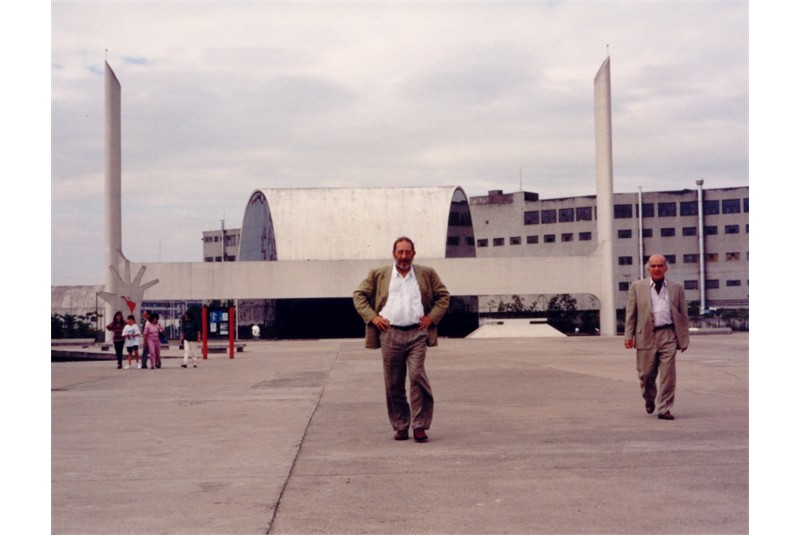
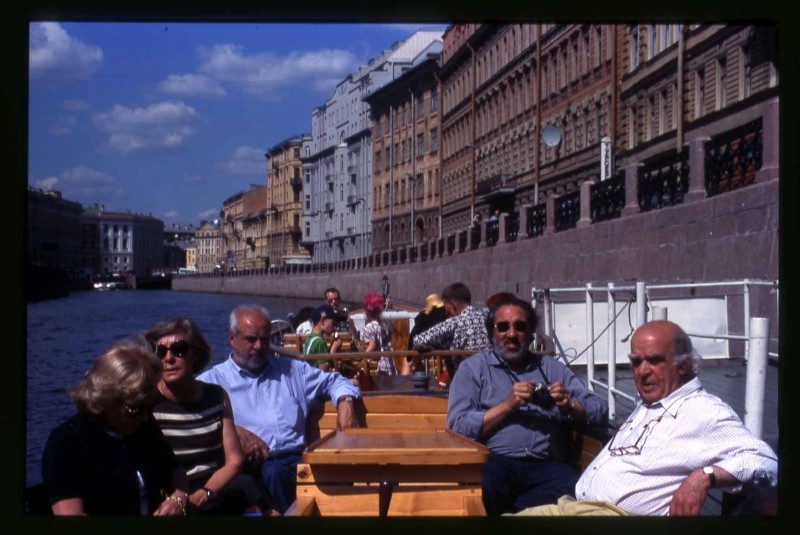
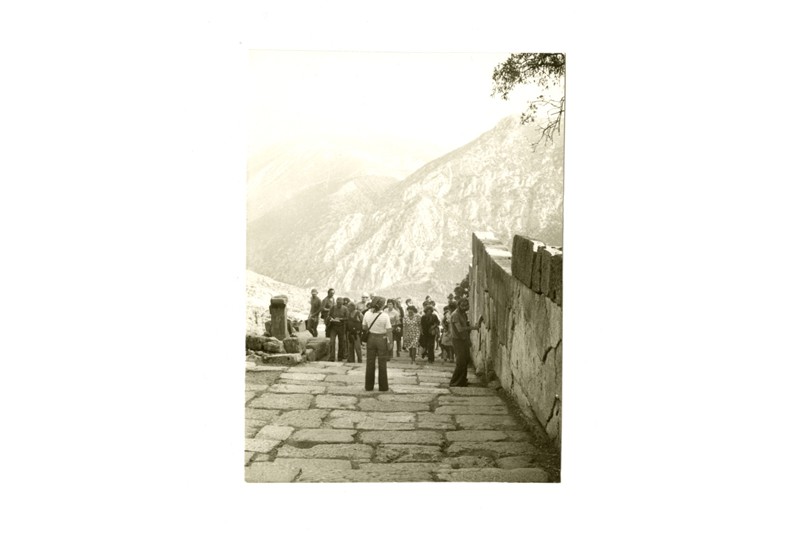
In 2024, during the same week, at approximately the same time, just before lunch, and in the same place, the Aleixo Studio Office building, the UpGranT Porto team from the Faculty of Architecture - University of Porto had a conversation about the idea of “Grand Tour” in Architecture with each of Porto´s Pritzker Prize laureates – Álvaro Siza (born in 1933, distinguished in 1992) and Eduardo Souto de Moura (born in 1952, distinguished in 2011).
The conversations were based on a common script. They were structured around three main themes: foundational travels, relevant travels not taken or to be taken, and the proposition of an updated Grand Tour within today´s architecture culture.
Enthusiastic about these topics, each conversation was more than just a moment to collect or verify travel data. Instead, it was a moment of direct and face-to-face reflection about the personal experience of each shared or unforgotten moment. The abundant references to each architect’s personal life and professional trajectory allowed us to understand the different contexts in which they moved and travelled, as well as their positioning in relation to the discipline of architecture, society and culture as a whole.
It is well known the significance Siza and Souto de Moura attribute to travel within their design practice as a fundamental opportunity to learn and their long and extensive travel practice, which is widely documented.
It is also known that Siza and Souto de Moura are close friends who share projects and travels. They both work in a building designed by Siza and live in a building designed by Souto de Moura. They graduated and taught at the same School (Porto Fine Arts School), even though they are from different generations and have distinctive positions in relation to a universal culture and architectural affinities, which find expression in their spatial narratives. While Siza is initially considered the architect of the housing problem, with a special interest in Alvar Aalto or Adolf Loos, Souto de Moura is the architect who pursues the public demand, with a special interest in Mies van der Rohe.
This suggests that, by comparing the two conversations, it is possible to identify relationships of coincidence but also distance between the perspectives of the two architects and obtain relevant notions for clarifying an updated perspective of the concept of “learning by travelling” in Architecture.
This article focuses on reading the conversation with Siza in counterposition to Souto de Moura´s dialogue, sometimes overlapping and other times side-by-side in the attempt to illuminate a set of particular characteristics of the travels that they distinguish as being fundamental lessons for an Architect. A specific journey that can simultaneously be characterised in multiple aspects, admitting the singularity of each architect within their architectural discourse.
The construction of this hypothesis of counterposition is based on the transcription of the two recorded conversations and on an initial stage of editing – in which the necessary passages are clarified by using published writings – and translation – focused on establishing the meaning and intention of the arguments, highlighted by the gestures and facial expressions that marked the moments of the conversations.
This article, however, attempts to go beyond the annotated publication of the two conversations. It aims to place itself at the limit of editing and construct a reflection on what an architecture journey can be today, informed by the personal experiences of the two protagonists. We can recognise a set of echoes and material evidence capable of supporting a formulation of an initial perspective, which the article reinterprets in the form of notes and selected conversation sequences.
Siza and Souto de Moura unanimously state that they travel because in-situ experience is irreplaceable, be it for the construction of a deepened architectural culture or an informed design practice. Both sustain that other sources of information, such as books, visual representations, travel reports by other architects, or social media accounts, can anticipate, incite or be a source of inspiration for new travels, however, they do not have the ability to replace the direct experience of an architectural artefact. The information these mediums offer is conditioned by the author/curator´s particular perspectives and does not allow the architect-traveller a personal, open vision.
Siza refers to the architectural journey as a precious learning tool, which Souto de Moura entirely agrees with, linking it to a state of mind. Consequently, we understand that what distinguishes Architecture travel from other trips is not only the set destination, theme or duration. It is mainly the predisposition of the traveller to observe, record and decipher in-situ enigmas, with the ultimate aim of a heightened memory construct as available material within the complex creative process.
Souto de Moura confesses that the exotic, in the sense of the unknown, does not particularly motivate or interest him. He admits the relevance of experiencing through travel what one already believes in or has prior knowledge of, informed mainly through readings or research, and travels as an opportunity for confirmation. At the same time, he recognises the possibility of disappointment while travelling when reality turns out to be different from what he had formulated through the study of indirect sources. Also interesting is the hypothesis he raises about refusing to directly experience a tainted place or building, which, although it does not allow him to confirm his reading, protects him against disappointment - this is the case of 860-880 Lake Shore Drive apartments.
Siza and Souto de Moura rarely refer to journeys other than architecture-related ones. Souto de Moura only remembers two or three trips he took without an architectural dimension, with family or childhood friends, mainly to Italy but also to the Balkans, namely Montenegro.
Siza, in turn, refers to family trips to the different Spanish provinces (Galicia, Andalusia, Catalunya, etc.) prior to his entry into the Fine Arts School, although many of the aspects he recalls already refer to architecture – namely the well-known recollection of how Gaudi’s work in Barcelona awakened his interest to architecture within sculpture.
The two architects reaffirm that, apart from the mentioned travels, all others are architecture-related, whether they occur in a work-related environment or leisure-related circumstance.
In the context of work travels, Souto de Moura explains that whenever his architectural practice involves travelling, he takes the opportunity to study in-situ selected architectures or themes, be it buildings or landscapes, for example, through a commission in Bordeaux and a conference in Caen, he visits Second World War structures along the north-western French coast, Brittany, exploring the theme of “Architecture without narrative”, previously encountered through the philosopher Paul Virilio´s Bunker Archaeology.
Regarding leisure trips, both Siza and Souto de Moura recall the different groups of friends, architects and professors with whom they travelled, namely Fernando Távora and Alcino Soutinho. These were annual journeys of medium duration, organised according to a theme with a complex itinerary, whether due to the distances or number of places visited.
In Souto de Moura´s case, he highlights the importance of in-depth preparation and good contacts in the places to which one travels. Siza adds the importance of having a leading member, who introduces the trip with drawings, suggests preparatory readings and studies enough to frame and explain the places to be visited.
As a group premise, Siza highlights the common view on Architecture and, consequently, shared interests in architectural culture, although with distinctive elective affinities.
Regarding the group's dynamics, Souto de Moura reports that these trips allow for occasional group dispersion and individual readings, enhancing unique experiences, like when with Fernando Távora, he shared a unique sunrise in the sanctuary of Machu-Picchu in complete silence among the guides´ arrival through the Inca paths.
Souto de Moura adds to these travels what he denominates as routine trips. These are recurring, short travels to relatively close and empathetic places, such as Paris and Madrid, always carried out within a specific routine and an identical schedule — same hotel, restaurants, bookshops, galleries, walks, etc.
While travelling, both Siza and Souto de Moura have their own strategies for observing, studying or recording the in-situ reality. It is well known that Siza´s drawings are his constant companion. Souto Moura acknowledges that he draws very little, especially with Siza, with rare exceptions, but takes photographs. He tries to memorise through informal gestures and spontaneous photography what catches his eye, which is often not portrayed in technical publications, be it construction details or transitions, like in the case of the Farnsworth House.
Siza also recognises that he acquired the taste and habit for travel with the Porto Fine Art School. He highlights three travels – Paris, Venice and Helsinki – financed by the Calouste Gulbenkian Foundation. These scholarships allowed interdisciplinary groups of students and professors of Architecture, Sculpture and Painting to travel for several days. Siza describes these trips as an opportunity to observe (draw and photograph) paintings, sculptures, architecture and see cinema (banned/censored films), but also as a possibility to establish new contacts and enhance local connections, namely schools and architects.
Siza and Souto de Moura share the notion that architectural travel may not be available over time. In his youth, travelling was closed to Siza due to the country's political situation and not all trips were accessible at all times in Siza's life. Professional responsibilities prevented Siza and Souto de Moura from travelling, and today, for personal reasons, health, and others, Siza and Souto de Moura travel much less frequently.
Throughout the conversations, Siza and Souto de Moura reference multiple travels they did not complete for different reasons. However, when specifically asked about the relevant travels that were not taken, the response is diverse, with Siza looking into the past while Souto de Moura looks to the present or near future.
Siza recalls two planned group travels that he missed but heard echoes with a mixture of interest and regret – the journey to Constantinople and the road trip crossing the United States until Los Angeles.
Souto de Moura, in turn, imagines two travel destinations to the Orient, which he will not be able to carry out. These are travels that have their origin in publications from disciplines other than architecture and intend to explore themes on the rustic construction of the house with natural materials, the city as a large house and the house as an elementary unit of the city — wooden villages in the mountains in Japan and brick villages in China, which Souto de Moura sees as reminiscent of Pompeii in the East.
When asked about the selection of an essential journey and the preposition of an updated Architecture Grand Tour, Siza and Souto de Moura’s proposals again differ in purpose, destination and theme.
Souto de Moura proposes a specific travel where young architects can learn about Architecture within the discipline. He underlines a journey to Germany aimed at studying the before and after of the Modern Movement, with the aim to show the permanent capacity of Modernity to renew itself, whether through the Bauhaus experimentation or the work of Schinkel and Mies van der Rohe, so that they understand that the Modern Movement is more than just about form.
In contrast, Siza avoids setting a destination, theme or time frame and evokes the necessary freedom of choice for each young student. He places the entire world as a destination hypothesis. He calls upon the Vitruvian man, self-aware with humanist culture, who selects his travels based on personal interests and stimuli, on the matters that have impressed him and whom he inspires to be.
Siza opens the door for us with a smile, gathers coffee, water, and tobacco and notes the topics we are interested in discussing.
Souto de Moura awaits our arrival on a coffee break at the main entrance. On the meeting table are two printed maps to be explored, one of Europe and the other of the World, and his black notebook, where he prepared our conversation and kept the script that we previously shared.
Throughout the conversations, it is impressive the pleasure and the enthusiasm Siza and Souto de Moura shared in reminiscing on their travels, how much they have travelled and the current disappointment in their limitations and restraints to travelling.
With these conversations, we can verify how Siza and Souto de Moura are distinct architect-travellers who nevertheless share a common point of view or review themselves in the same meaningful idea of “learning by travelling”.
An example of this shared empathy is the journey to Rome on the return trip from Sicily in the early 1980s, evoked by both architects in these conversations. For Souto de Moura, this is the best journey he took with Siza. For Siza, this is the occasion for the most precise image of Souto de Moura. After a month of working in Sicily, sitting in Piazza Navona, Siza and Souto de Moura simply decided to stay for three more days. They eat, drink, talk and draw (the ruins in the Forum, Trajan's Market, etc), nothing more. Both remember perfectly the Grand Tour feeling during those perfect days.
Hence, we may conclude that Siza and Souto Moura's Architecture travels are a living and active idea that admits different ways of being. The travels permit possible alternatives and remain continually open to new contributions and inscriptions. They are undoubtedly made possible by the impossibility to separate the person from the architect. Architecture and life, in symbiosis, are part of Álvaro Siza and Eduardo Souto de Moura's way of being in relation to layered universal culture and are reflected in their Grand Tour(s). They constitute perfect days, just as the days of these conversations were perfect.
The authors would like to thank Álvaro Siza and Eduardo Souto de Moura for their willingness to schedule the conversations (on August 3 and July 30, 2024) and for the generosity with which they carried them out.
SIZA VIEIRA A. e MORAIS C. C. (2009) – 01 textos. Civilização, Porto.
SIZA VIEIRA A. (2017) – Conversaciones com Álvaro Siza / por Luis Fernández-Galiano. Fundación Arquia, Madrid [conversazione originale (2016) disponibile su Arquia/maestros 10].
SOUTO DE MOURA E. (2018) – Conversaciones com Eduardo Souto de Moura / por Luis Fernández-Galiano. Fundación Arquia, Madrid [conversazione originale (2016) disponibile su Arquia/maestros 11].