We understood the Grand Tour not so much about the journeys architects undertake to visit architectural works, but rather the migrations, interminglings, and encounters involving those works that constitute the very substance of their material nature. In other words, recognising the analogies which establish similarities and kinships between buildings, both directly and indirectly: Álvaro Siza's visit to the bookstore by Alvar Aalto in Helsinki's Kluuvi district transfigured into the library of the Faculty of Architecture in Porto; the "strange" atmosphere that John Hejduk perceived when visiting the Palazzo della Civiltà Italiana in Rome, which would forever mark the character of his own architecture. In other words, this is a way of revisiting and bringing up to date the idea of the Grand Tour, the same approach that led the Adams brothers to traspose Diocletian's Palace into the Adelphi Terrace in London. Similarly, in the gardens and architecture of Postdam, we can trace Schinkel's travels to Syracuse and Capri.
The mechanism by which this transposition occurs is varied and complex. The transposed object must first be seen, but even more important is the memory of what has been seen; as this recollection produces a "fragment of thought", freed from the constraints of the specific reality of place and time, ready for the transfiguration process. In this way, through what Goethe called the "associative faculty of the mind", heterogeneous materials become re-composed and re-signified, giving rise to new categories which, in the long run, can be accepted and shared as conventions or rules. This was the case with the genre of the "picturesque journey". Painters and architects transferred impressions from their travels to the south, including literary and philosophical narratives, and a rich repertoire of "Italian" iconography, into painted landscapes—compositions of elements made newly available to the emerging art of gardening, whose beginning was formally established by Horace Walpole in his Essay on Modern Gardening (1771). In this sense, the character became fixed and transmissible through a repertoire of images; a rhetoric to be understood precisely as a repository of figures, meaning above all "places", or "commonplaces", ensuring the shareability of a discourse and thus its degree of persuasion.
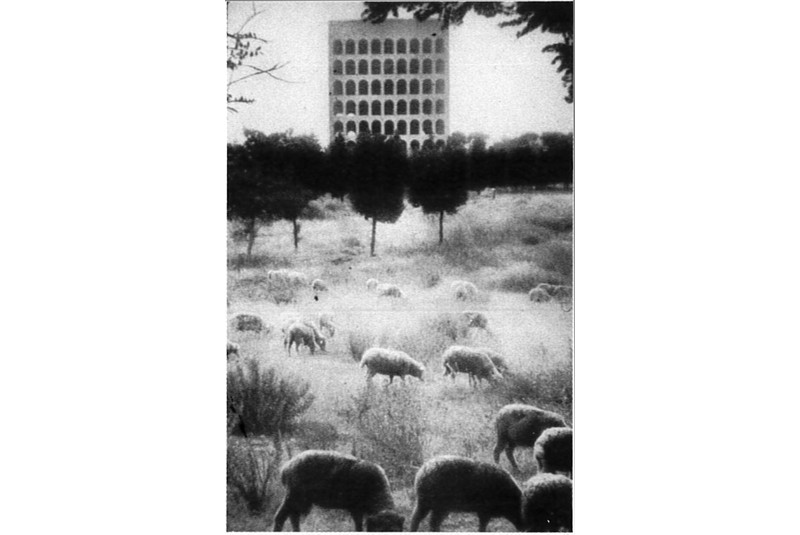
The mechanism grew even more complex and the interconnections more intricate in the case of John Hejduk, who recounted his encounter with Italian architecture through two images published in a New York newspaper in the late 1940s: a photograph of Libera's Palazzo dei Congressi and one of the Palazzo della Civiltà Italiana by Guerini, Lapadula, and Romano in Rome's EUR district. In the case of the Palazzo della Civiltà Italiana, Hejduk was indebted primarily to the sense of estrangement evoked by the juxtaposition of the palazzo's arches with a rural and "seemingly bucolic" landscape. The presence of grazing sheep in the overgrown meadow generated that surreal atmosphere described by Michael Hays in Architecture's Desire (2009) and the kind of strangeness which Harold Bloom (2010) considers a poetic category. The second photograph, taken from below, captures a rearing horse atop a pedestal: «Two photos expressing evacuation; an excavation; yet instead of earth being removed it was the air brushed away. […] Two photos expressing a past disaster and indicating a future warning. A place of theatre where the actors had long since disappeared; yet the stage lights had been left undimmed, undiminished; forgotten» (Hejduk 1980, p. 8).
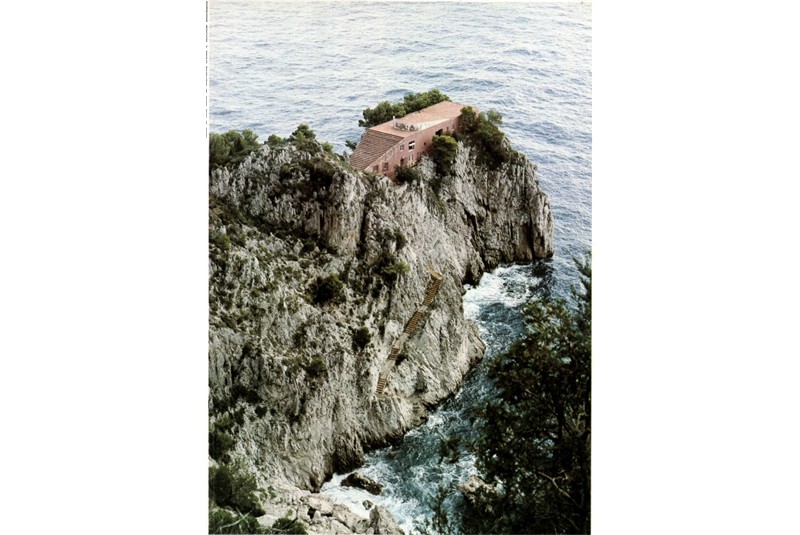
In 1953, John Hejduk and his wife Gloria visited Rome, and the memory of the photographs drew them to the EUR district and Libera's Palazzo dei Congressi. The open-air theatre on the building's roof, with its rhythmic sequence of Carrara marble seats arranged along an inclined plane, were to mark the beginning of everything: many years later, when asked to write an article about another building by Libera, the Malaparte House in Capri, Hejduk (1985, p. 34; Amistadi 2019) associated the two staircase-theatres and, addressing one of his young students, declared: «Have you ever read the article on the Malaparte House? That has something to do with your question [shows drawings of stepped seating house]. This is the beginning of it all. It's a wall. From the horizontal to the vertical. Abstract.» From that article onward, the staircase-theatres of Libera's buildings would recur in numerous Hejduk projects, from the small theatres of the Berlin Masque, such as the Pantomime, the Public, and the Reader Theater, to the New England Masque, and finally the Wall House, where the square wall, against which space and time are compressed, recalls the velarium on the roof of the Malaparte House:
The roof-stair-theater-seats is of a funnel shape, narrow at the bottom expanding as we rise. The perspective is distorted, the lateral is emphasized, geometry has been warped. If we arrived upon the flat plane roof and if the roof did not contain as it does a curverlinear wall, our sense of uneasiness would not be so fearful. So the stair leads up to a sacrificial horizontal. We see that on that plane is an enclosure. What lies behind it? The most fearful, a nothingness, an enclosure that encompasses a void. We are in the midst of ancient rites. Libera has set the stage for an awesomeness.
(Hejduk 1980, p. 12)
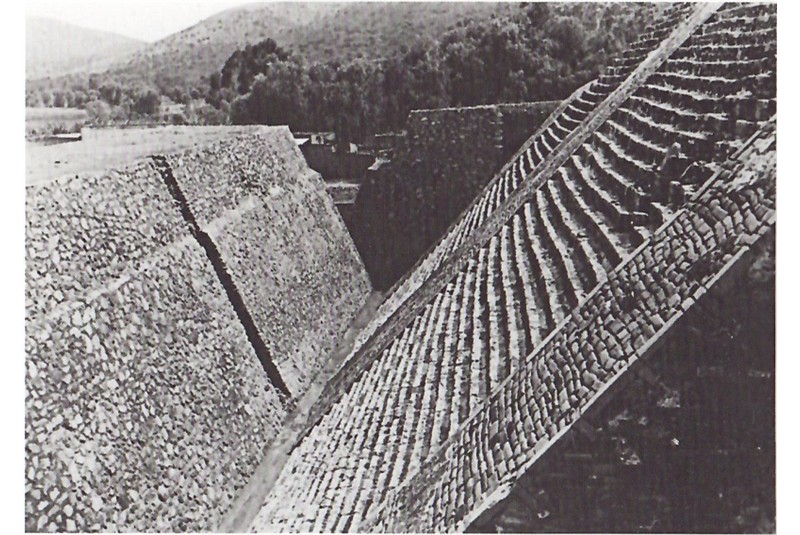
We could associate other staircases with another journeys, such as Aldo Rossi's travels in the United States and to Mexico City, as reported in an issue of Soundings (Amistadi, Clemente 2017). However, we will instead present the example of Anni and Josef Albers, who, starting in 1935, visited Mexico fourteen times. The encounter between Albers and the architecture, textiles, and decorations of indigenous Mesoamerican culture, the meeting of Bauhaus Constructivist principles with pre-Columbian civilization, would generate one of the most evocative and authentic artistic experiences of the twentieth century: the Homage to the Square series of paintings. The catalog of the Josef Albers in Mexico exhibition, held at the Guggenheim Museum in New York from November 2017 to April 2018 and curated by Lauren Hinkson, includes a map of the grand tours undertaken by the Albers in Mexico between 1935 and 1967. Hinkson writes (2020, p. 52):
ON JOURNEYS. The following plates feature six pre-Columbian archeological sites and one city that Josef and Anni Albers visited during their fourteen journeys to Mexico. The sites selected represent their most frequented or beloved destinations—evident from the great number of photographs that Josef took at these sites and the paintings that bear their names. […] Rather, the works reflect the diversity of form, composition, and experiments in color theory that Albers continued to develop over the decades he spent traveling through Mexico. Touring by car, the Alberses often traveled with friends and family members, including Anni's parents, Toni and Siegfried Fleischmann; Theodore (Ted) and Barbara (Bobbie) Dreier; Swiss artist Max Bill; and psychoanalyst Fritz Moellenhof and his wife Anno, among others. Beyond their immediate impressions, recorded in correspondence over the years, the legacy of this "incredibly beautiful country" as taken in during their 'greatest vacation' appears throughout Josef's photocollages and paintings over subsequent decades. The Alberses were guided to the pre-Columbian monuments by maps readily available at gas stations, including the map they used in 1965, produced by the national oil and gas company Pemex, and reproduced on this page. However, they also journeyed farther afield to areas rarely visited by other tourists. "We did not venture into areas inaccessible by car," Anni wrote, "but we visited pyramids, enormous ones and small ones, somewhat out of the way, which left us in awe of the great concepts of their architecture." […] What Josef loved about Mexico was that no matter how often he visited, he found the country "exciting and stimulating, over and over again".
The journeys to the archaeological sites of Monte Albán, Mitla, Teotihuacán, Tenayuca, Uxmal, Oaxaca, and Chichen Itza in Yucatán would forever change Albers' artistic universe. The conventional understanding of a painting on canvas as a dual relationship between figure and background is transcended, and in Truthfulness in Art, regarding the decorations on the walls of Mitla, Albers stated (Hinkson 2020, p. 39):
We will have difficulties with its patterns in finding what is figure and what is background. As we see them here reproduced in black and white and when we follow the white form, we see a complete composition but soon the black left-overs tell us just as intensively "we are not background, we have the same right to tell you a composition", they have the same activity.
The evocative power of the architecture, the emotions, and the suggestions of the journey took on the value of a revelation for Albers. The link between travel, experience, and architecture assumes further profound implications in the narrative of Aldo Rossi's A Scientific Autobiography. The latter is a contemporary and fundamental testimony to the role and importance of the Grand Tour and, more generally, of educational journeys in our present time. A Scientific Autobiography represents a real journey which gradually unfolds and interweaves a magnetic field of similarities, analogies, images, correspondences, and connections between works of architecture which are remote from each other in time and space. Indeed, in reading Rossi's account, we can perceive the vibration and power of these analogies, of these figures, which detach themselves from the flow of the narration to become something else. At which point, between the journey, its narration, and its figures, the invention of architectural forms, as shown in Rossi's projects, can happen in an instant or take years. In any event, the germination time that elapses between the journey, imagination, and the invention of architectural forms remains a mystery.
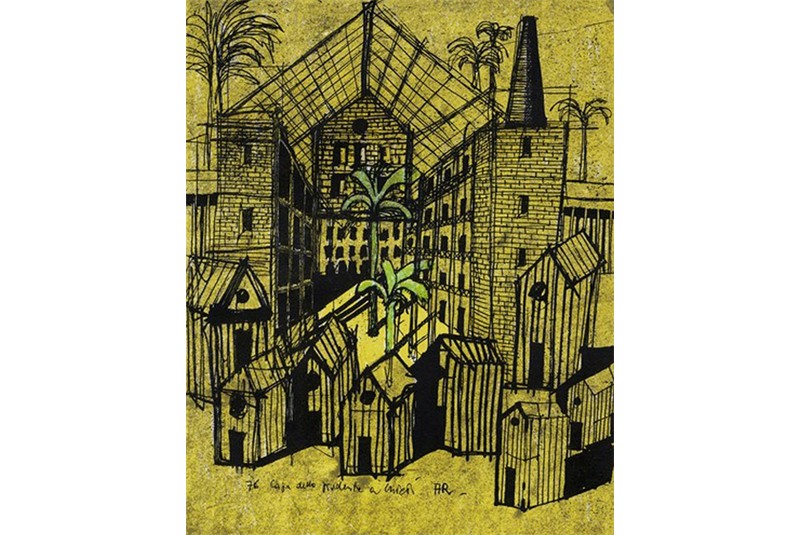
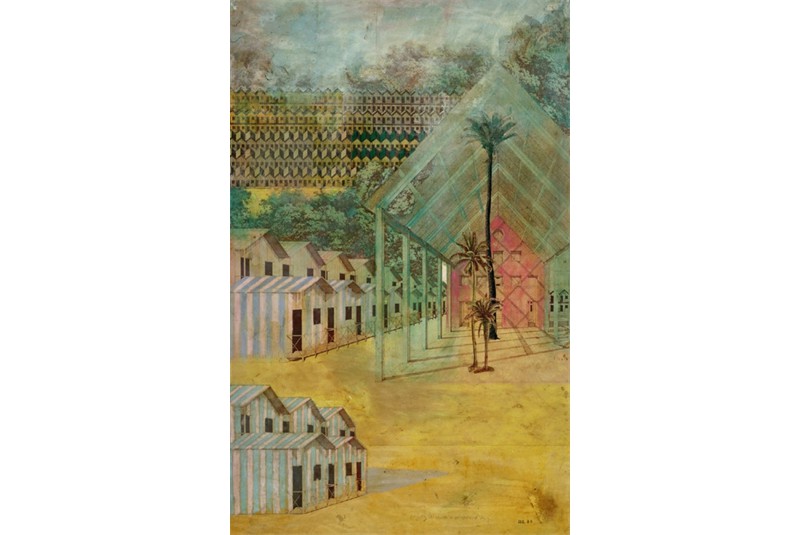
Among Aldo Rossi's projects, there is one in particular where childhood, travel, and experience were transfigured into images of a place meant to relive a memory of happy days and project it into the future. This was the student housing project for Chieti, designed in 1976. The image of this place, as stated in the project report, «is born from functional, logical, and economic unity and may or may not reflect, depending on personal projections, a fantastic world» (Rossi 1987, p. 112). Beyond the typological references and assemblages and the idea of an urban foundation for the site, what interests us at this point is the connections between the project's forms, the theme of travel, and the desire for happiness. It is quite evident that, the project's forms, both the student houses and the main collective building, clearly evoke the image of beach cabins. Consequently, they awaken in us memories of summer, of vacation time, of a festive and joyful period: «of encounters, of love, perhaps even of boredom». Going on vacation to the sea, spending time on the beach, this, too, in some way, is a small yet significant journey, especially during childhood. Vacation time is so intense that, when it ends, we are already longing for the next one. In this way, summer holidays condense a series of events, and then memories, linked to the experience of the sea, the body, and play, so vivid that, in the end, beach cabins end up crystallizing these experiences in their design, transfiguring into symbolic facts, into objects of affection.
In A Scientific Autobiography, Rossi (1999, pp. 55-57), speaking of The Cabins of Elba, the island where he spent his summer holidays, wrote:
Each place is remembered to the extent that it becomes a place of affection, or that we identify with it. I think of Antonioni's film Professione: Reporter (The Passenger) and of a place particularly dear to me on the island of Elba to which we gave the same name, although there is no apparent resemblance between the place and the film apart from the light and the sun. Yet the association is also appropriate because this place was connected with a loss of identity, as was Antonioni's film. […] For example, I realize that in discussing Antonioni's film I was alluding to the drawing The Cabins of Elba, but this later became the project for student housing at Chieti, while in other drawings I have called it Impressions d'Afrique (and not only as an homage to Raymond Roussel). At the beginning of his novel Roussel tells us that the theater was surrounded by an imposing capital city formed of innumerable cabins […] In the 1976 project at Chieti, I associated this vision with student housing. […] Now I envisioned a village, in which an unfinished public building with huge girders stood atop massive brick walls. A Mediterranean-African appearance was created by these cabins as well as by the large palms which I had thought about for years and which turn up everywhere in my observation, not only in the broad streets of Seville (where the small houses similarly constitute a city which one identifies with vacation and hence summer), but also aligned along the lake in front of the houses, where I have always found them to be like a signal, a symbol, the very memory of a house.
In traveling, in the act of journeying, the relationship with experience and knowledge is essential. We often say that traveling is, first and foremost, having an experience, and at the same time, we affirm that this experience is, in some way, an opportunity for knowledge acquisition, an opportunity for growth. Perhaps for this very reason, as many have noted, travel is always a Bildungsreise, a tool for learning. And every form of learning is, in the same way, almost always a test of oneself, an experiri. Ex-perire, as we know, evokes a spatial crossing, a passing through, a traversing. Experience and travel, therefore, would seem to be bound by an ancient kinship (Tagliapietra 2017, pp. 73-84). In short, every journey secretly demands a small but necessary dose of courage. It is no coincidence that, as Walter Benjamin showed, Erfahrung ("experience" in German) contains the same root as fahren, meaning "to go". And this "going" is, above all, a crossing which gradually settles and accumulates in our soul, later resurfacing in our lived life, either in an entirely unexpected manner or precisely when necessary, in the forms of recollection and memory (Benjamin 1995, pp. 89-130).
For Benjamin, the experience of modern man was primarily tied to life in the city, in the great metropolis. The city as a true forge of experiences and, at the same time, a vast dream-making machine. The city, the urban reality, the architecture of the city, Benjamin told us, offer us the possibility of encountering what can genuinely surprise us or, conversely, what can deeply unsettle us. I would like to quote a beautiful reflection from Benjamin, found in Images of the City, which, as is well known, represents a sort of narrative account in which the experience of traveling through cities "withdraws" into written memory, with the hope of soon activating a new and more authentic Erfahrung[1]. Authentic also because, in these images of cities, the traveler never ceases to seek out ancient places which can allow us to glimpse the future. And above all, new, due to the blending of dreamlike-imaginary elements with the reality of concrete life. Benjamin wrote (2007, p. 17):
More quickly than Moscow itself, one learns to see Berlin through Moscow. To someone returning home from Russia, the city seems freshly washed. There is not dirt, but no snow either. The streets seem in reality as desolately clean and swept as in the drawings of George Grosz. And how true-to-life his types are, has become more obvious. What is true of the image of the city and its people applies also to the intellectual situation: a new optics is the most undoubted gain from a stay in Russia. […] But, equally, this is why the stay is so exact a touchstone for foreigners. It obliges everyone to choose his stand-point. […] The question at issue is not which reality is better or which has greater potential. It is only: Which reality is inwardly convergent whit truth? Which truth is inwardly preparing itself to converge with the real? Only he who clearly answers these questions is "objective". Not toward his contemporaries (which is unimportant) but toward events (which is decisive). Only he who, by decision, has made his dialectical peace with the world can grasp the concrete. But someone who wishes to decide "on the basis of facts" will find no basis in the facts (Jennings et alii 1999, p. 22).
Ultimately, every journey is, above all, a reliving of the journey, remembering it through narration. A screen of consciousness through which we approach and learn to know something through something else, as Benjamin said. Whether this knowledge comes from similarity, analogy, allegory, or contrast, is not what matters. What matters is transforming every experience into forms of retention and a transfiguration of temporality, before everything inevitably slips into oblivion. However, this narration needs to develop a particular intensity, an emotional intensity which, little by little, can condense and articulate itself into figures.
Among the most enigmatic and cherished figures for Benjamin was that of childhood. After all, every journey departs from and always returns to childhood. The first traveler par excellence is the child. The child, through his or her real childhood, testifies that the value of experience intimately resides in a mixture of imagination and expectation, and dwells in the time of waiting, which in childhood wavers, bound as it is to the desire for happiness. As in Rossi's story, we can easily associate the time of childhood, summer, celebration, and play with the time of education (Clemente 2008), an education and a time unfettered from material urgencies and specific interests. Despite minor jealousies and petty cruelties, isn't the experience of school and vacations, in general, an experience of a time in harmony with the states of mind of childhood? And thus, in harmony with the desire for happiness? A happiness that is authentic precisely because it is uninterested in mere possession?
And furthermore: isn't the time of university studies—or shouldn't it be—a time of education, full of expectation and the search for happiness? Here, an analogy is established. Just as with childhood and vacation time, also the student residence in Chieti evokes a happy place. A distant, playful place, generated by images of seaside cabins. Certainly, these houses-cabins, with their exotic tone, allow us to see the very essence of every journey, whether real or imaginary, before we can even understand it. They allow us to see the inexpressible. Every authentic Grand Tour takes shape and begins from the desire to discover something that matters to us. Something we consider important, even if outwardly futile. But that we fail to recognize around us. We can't even put it into words. The journey, then, is a journey of discovery that progressively brings to the surface that hidden latency, which is, if truth be told, the very essence of consciousness. The forward movement of consciousness is a deepening within itself, a drawing closer to the truth that is its own happiness.
[1] As is well known, for Walter Benjamin the modern man lives in a time in which technological and commercial reality reduces, schematises and impoverishes every human experience in relation to things. In order to rescue things and thereby revitalise human experience, Benjamin sketches the figure—or type—of a human being who is more interested in the history and physiognomy of things than in their value as commodities or in their material usefulness (Benjamin 2012).
AMISTADI L. (2019) – "Una casa come loro. Curzio Malaparte e John Hejduk". In: A. Borsari, M. Cassani Simonetti e G. Iacoli (a cura di), Archiletture, Forma e narrazione tra architettura e letteratura. Mimesis, Milano-Udine. ↩
AMISTADI L. e CLEMENTE I. (a cura di) (2017) – Aldo Rossi, Soundings 1/II. Aiόn, Firenze. ↩
BENJAMIN W. (1995) – "Di alcuni motivi in Baudelaire". In: R. Solmi (a cura di), Angelus Novus. Einaudi, Torino. ↩
BENJAMIN W. (2007) – "Mosca". In: E. Ganni (a cura di), Immagini di città. Einaudi, Torino. ↩
BENJAMIN W. (2012) – "Esperienza e povertà". In: A. Pinotti e A. Somaini (a cura di), Aura e Choc. Einaudi, Torino. ↩
BLOOM H. (2010) – [Titolo mancante nel testo originale]. ↩
CLEMENTE I. (2008) – Infanzia della forma. Opere e progetti di Aldo Rossi. Adda Editore, Bari. ↩
HAYS M. (2009) – Architecture's Desire. [Editore mancante nel testo originale]. ↩
HEJDUK J. (1980) – "«Casa come me»". Domus, 605. ↩ ↩
HEJDUK J. (1985) – Mask of Medusa. Rizzoli International, New York. ↩
HINKSON L. (a cura di) (2020) – Josef Albers in Mexico. Guggenheim Museum Publications, New York. ↩ ↩
ROSSI A. (1999) – Autobiografia scientifica. Nuova Pratiche Editrice, Milano. ↩
ROSSI A. (1987) – "Progetto per la casa dello studente di Chieti, 1976". In: A. Ferlenga (a cura di), Aldo Rossi Architetture 1959-1987. Electa, Milano. ↩
TAGLIAPIETRA A. (2017) – Esperienza. Filosofia e storia di un'idea. Raffaello Cortina Editore, Milano. ↩