Polytechnic culture and educational trips
Ever since the establishment of the Regio Politecnico di Milano in 1863, the educational trip has played a vital role in the teaching approach, motivated by the belief in the value and importance of direct contact with the most innovative examples in the field of infrastructures, industrial plants, and constructions for training student engineers (AA.VV. 1981; Buratti and Selvafolta 2013). Such teaching practice was also advertised, primarily in the institutional communication section “Effemeridi”, included annually in the Programma del Regio Politecnico. It was also disseminated more widely through articles in popular newspapers and a comprehensive series of technical-scientific journals that flourished at the time, such as «Il Politecnico» or «Il Giornale dell'Ingegnere-Architetto ed Agronomo». The aim was to demonstrate the practical influence of polytechnic training in promoting the new entrepreneurial spirit that was ready to revitalise Italy at the turn of the nineteenth and twentieth centuries.
The focus “on the new”, strongly aimed at action, resulted in favouring construction sites as destinations. Such propensity was also transferred to the trips organised for the course for student architects activated in 1865, where this practice was received and further enhanced in an institutional form, assigning it a properly pedagogical role, as «a true complement to the courses from 1911 to 1941» (Lori 1941, p. 81) «in the belief that only direct contact with the manifestations of nature could foster an active and responsible design culture» (Selvafolta 2008, p. 119).
In the context of Boito's historicist culture, the focus on an operational dimension led to prioritising sites where significant restoration efforts were actively ongoing. This began with the visits organised in 1867 by Boito himself to the restoration of the churches of Sant'Abbondio in Como and San Michele in Pavia, then extended to locations in Padua, Pomposa, Ferrara. After Boito stopped teaching at the Politecnico, there were two visits (in 1908 and 1912) to the reconstruction works by Gaetano Moretti on the bell tower of San Marco in Venice and the sites in Ravenna directed by Corrado Ricci, visited in 1908 and 1914.
Even when the destination of the journey was Rome, the itineraries allocated limited time to classical remains, guiding student architects to explore the origins and development of Italian medieval art in the ancient Christian basilicas. Modernity, however, was not neglected, with visits to the new government and ministerial buildings then under construction, intended to exemplify the new national style.
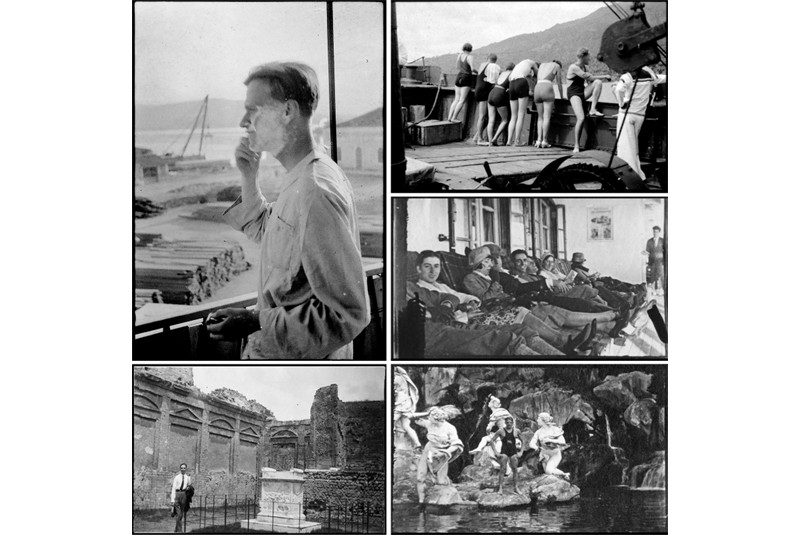
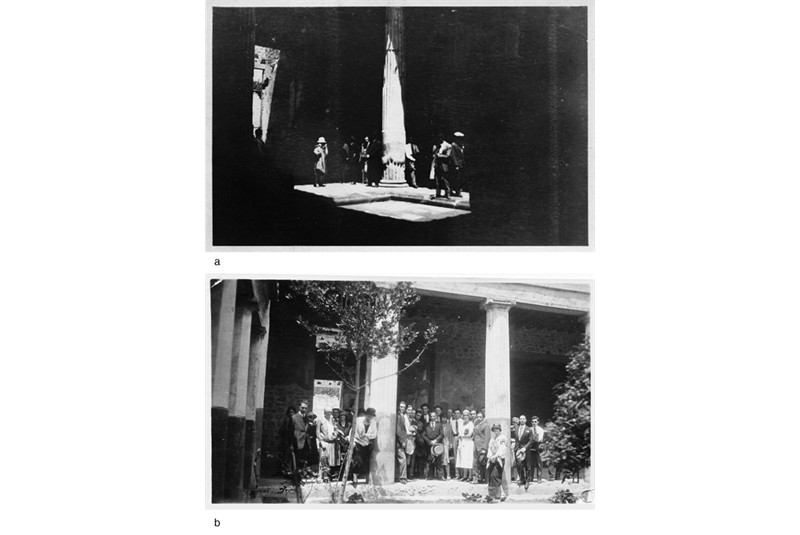
The educational trip to Naples and its surroundings in July 1926 marked a radical shift in the selection of trip destinations. Regrettably, the Politecnico's historical archives lack any record of this journey[1], although its organisation — which involved a large group of students and teachers, sometimes accompanied by their wives — must have required considerable effort and financial resources, as testified by the extensive photographic documentation available at the APB-Archivio Piero Bottoni, Dastu-Politecnico di Milano[2].
The trip occurred in July 1926, on the Genoa-Naples segment of the Genoa-New York route, aboard the luxurious steamship Conte Biancamano, launched the previous November with interiors designed and decorated by Luigi Coppedè. For the return journey from Naples to Genova, the Politecnico delegation travelled on the equally comfortable Duilio, the first transatlantic liner built entirely in Italy, in service since 1923 on the same route.
The lack of archival material prevents us from determining the overall duration of the trip; however, some handwritten annotations by Piero Bottoni on the back of his photographs (preserved in the APB photographic collection), however record 6-14 July 1926 Gita d'istruzione a Napoli e dintorni (6-14 July 1926 Educational trip to Naples and surroundings).
Numerous photos were taken from the Conte Biancamano to capture the beauty of the coasts and seascapes, as well as of shared everyday life and playful moments. Even more numerous are the shots of the visited places: Naples, the Amalfi coast, the excavations of Pompeii, and the Royal Palace of Caserta. The abundance and content of the photographs taken on the steamer, as well as the number of places visited after disembarking, suggest that the dates noted by Bottoni correspond to disembarkation and re-embarkation at the port of Naples. Therefore, excluding navigation times, the actual tour began on 6 July 1926 and lasted nine days until re-embarkation on the Duilio.
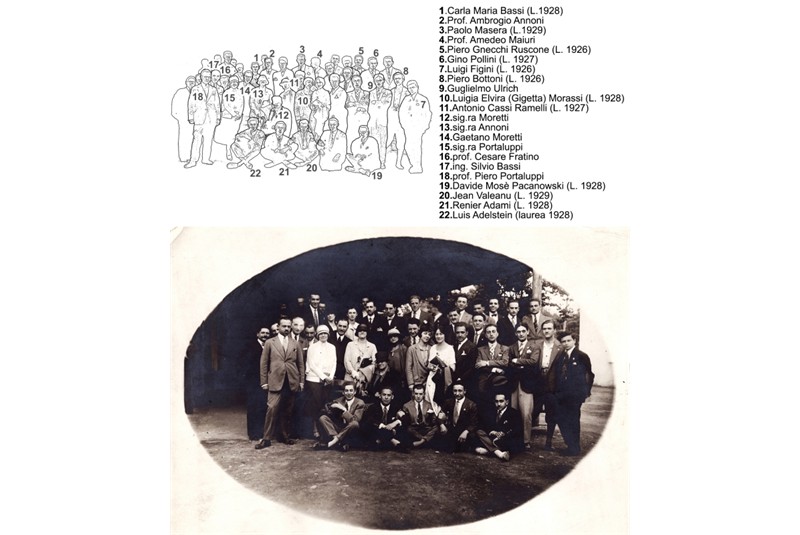
Regarding the participants, by comparing the notes by Bottoni on the back of a photograph showing a group of forty-six people in the courtyard of La Vesuviana plant with information available at the ACL-Historical Archives and Museum Services, Politecnico di Milano[3], we were able to identify some teachers[4], and sixteen of the thirty or so participating students. Some of them, in the years following graduation, would establish themselves as leading figures in the culture of the project, which later became known as Scuola di Milano (Canella 2010).
In addition to Bottoni, Luigi Figini, Gino Pollini, Piero Gnecchi Ruscone, and Antonio Cassi Ramelli, portrayed alongside illustrious professors, are the first two women architects trained at the Regio Politecnico: Elvira Luigia (known as Gigetta) Morassi and Carla Maria Bassi (Bucchetti et alii 2021, pp. 68-69), both graduated in 1928.
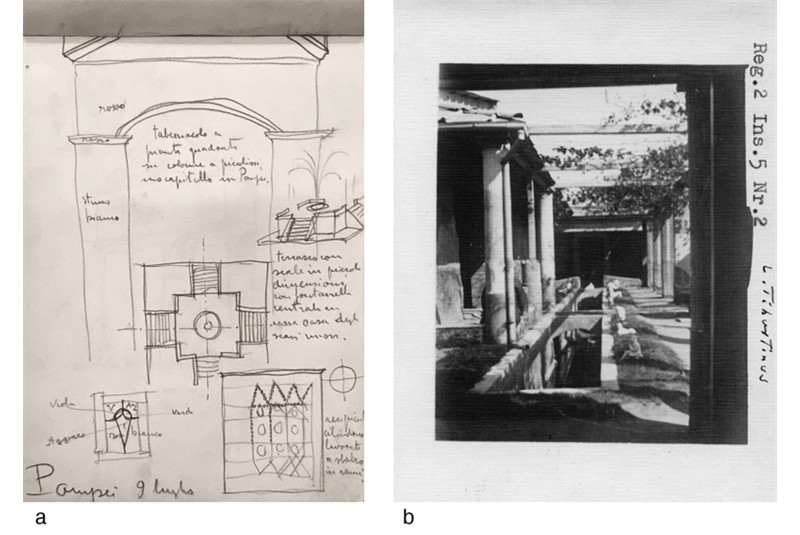
Of particular interest is the comparative analysis between the photographs and travel notebooks of some participants, notably Piero Bottoni[5], Luigi Figini[6], and Gino Pollini[7]. Such comparison clearly shows that, considering the amount of graphic and photographic material, the visit to the excavations of Pompeii became the pivotal point of the journey, a more intensely evocative moment and genuine serendipity for these young architects-in-the-making.
Direct contact with remnants from a much older past than the medieval remains (previously suggested as a model) clearly heightened participants' awareness of a kind of archetypal Mediterranean identity. For the journey's protagonists, this idea proved highly beneficial over time in shaping design, offering concrete alternatives to the language of Eclecticism and nineteenth-century ideas of living environment and urban development.
The toolbox of the Milanese polytechnic students
In examining the reasons and methods behind this radical paradigm shift, the question arises as to what fertile ground received the seeds of this new ancient modernity, and which knowledge and skills the “excursionists” already possessed.
The fertile ground consisted in the three-year programme at the Scuola speciale architetti of the Regio Politecnico di Milano, originating from the two-year preparatory school established by Camillo Boito. This was modelled after the polytèchnicienne didactic approach, functioning as a training course where the design of the new would explore historical forms through drawing in its various expressions and variations.
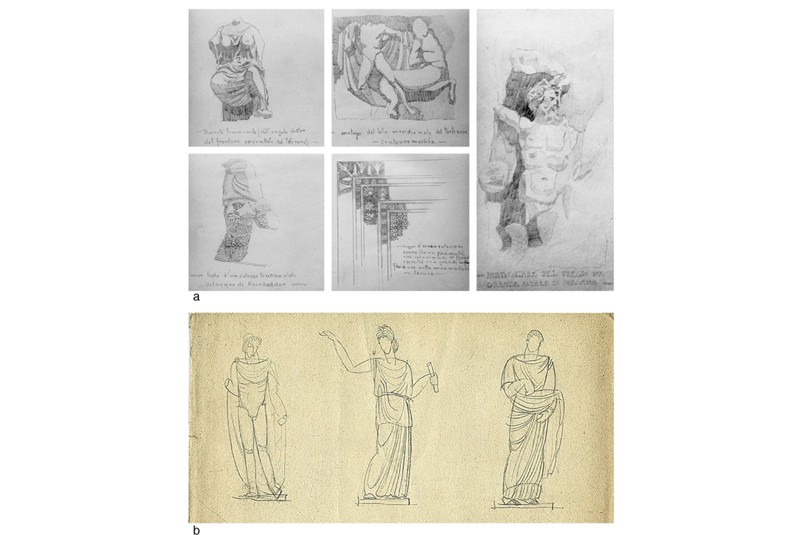
During the two-year period[8], the acquisition of the necessary graphic skills was ensured through attendance of the two-year courses in Ornato e Figura (ornate and figure) taught by painters such as Giuseppe Fei from Ferrara, a professor at the Regia Accademia di Brera, held concurrently with the preparatory courses in Architettura, which Ambrogio Annoni oversaw.
The effectiveness of this initial phase of architectural apprenticeship in mastering graphic representation is evident in the notebooks produced between 1921 and 1923 by Piero Bottoni[9]. These clearly demonstrate that even a student with a traditional high school diploma – lacking specialised graphic skills – gradually learned how to train eyes and hand, improving stroke quality and developing sensitivity to understand the significant plastic and compositional relationships within reality.
During the three-year continuation of the Scuola Speciale, in the courses Architettura 1, 2, and 3, Ambrogio Annoni was replaced by Gaetano Moretti – also teaching at Brera and later, in 1933, the first dean of the newly established Scuola di Architettura Politecnica – while Annoni taught the courses on Organismi e forme. Conversely, the drawing courses were divided into three-year programmes of Decorazione e Figura and Prospettiva (Santacroce 2024), initially taught by painters Giuseppe Fei and Giuseppe Mentessi (both associated with the poetics of the Lombard Scapigliatura movement) and later entrusted to Cesare Fratino, Mentessi's pupil at Accademia di Brera, though with a profile more distinctly focused on scenography and the representation of architectural space.
Overall, this pedagogical approach was based on combining design and graphic teachings, activated through the collection of graphic descriptions of examples, regarded as paradigmatic tested solutions to specific compositional, expressive, and constructive problems.
The path began with redrawing from books of classical antiquities, then continued the following year by integrating the redrawing of copies with a survey of Renaissance, Baroque, and Risorgimento examples. It reached its culmination in the final exercise of the fourth year, which consisted of a project drawn up "à la manière de ..", as a demonstration of the mastery of composition and construction acquired by the student.
In the final year, significant emphasis was placed on the in-situ study of the Lombard Romanesque period, covered by both the drawing and design courses and further examined in the optional course of Medieval Archaeology, taught by Ugo Monneret de Villard.
Boito's theoretical and didactic vision, in fact, highlighted the civic and spiritual values of fourteenth-century Lombardy as an exemplary model for future professionals and intellectuals of the young Italian nation. This type of architecture was exemplified in the knowledge and construction expertise of the magistri comacini.
Such values were to be instilled in student architects through a balanced approach, combining ex-cathedra lectures, bibliographic input, and direct physical engagement with artefacts.
The notebooks compiled by Piero Bottoni during his entire academic career (1921-1926) — as well as, though less systematically, those by Luigi Figini (who also graduated in 1926) and Gino Pollini, who received his qualification the following year — testify to the ongoing educational achievements of this pedagogical journey established since 1865.
Bottoni's carnet, however, records a pivotal moment during the 1926 trip, his contained sketches clearly showing the shift from Boito's regionalist approach to Mediterranean classicism. The latter, with its multiple interpretations, became the point of contact and comparison with the most progressive voices of the international scene at the time and, simultaneously, one of the distinctive features of the Scuola di Milano.
In fact, the analysis of the travel drawings shows how, during that experience, each student began to reveal the architect he would later become in his maturity, recognising, in the places and artefacts encountered during that youthful period, the same aspects and themes that would later define his distinctive traits and professional style.
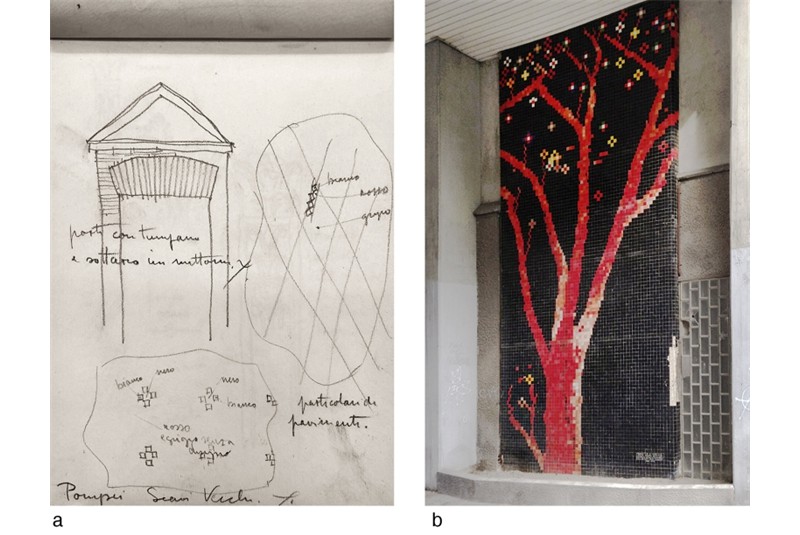
For example, during the explorations of Pompeii, Bottoni abandoned the precise and almost “surgical” graphics that characterised his previous notebooks, gathering quick sketches of the Pompeian wall decorations. These sketches aimed at capturing the chromatic aspects that were to form the basis of his reflections on the use of colour as an element of urban identity, which he fully articulated in the first complete theoretical expression a year after the trip, in the article Cromatismi architettonici (Bottoni 1927-28; Rossi et al., 2015).
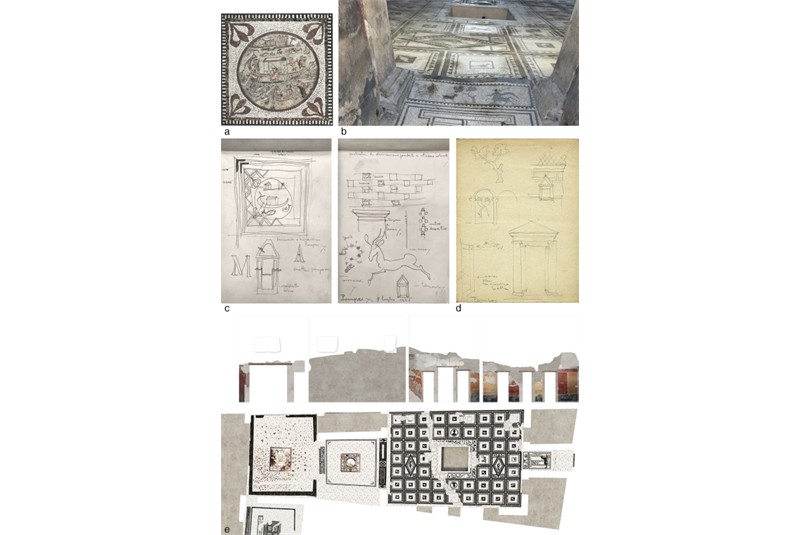
Yet, Pompeii also encouraged Bottoni to explore the beauty of mosaic art, whose secrets he sought to uncover through the feverish annotations depicting floor and wall decorations. These included valuable suggestions for geometric compositions, decorative motifs, and colour effects. Many years later, Bottoni would extensively dwell on these notes in Sesto San Giovanni, both in decorating the mosaic tree on a wall of the office tower and in the town's flooring hall.
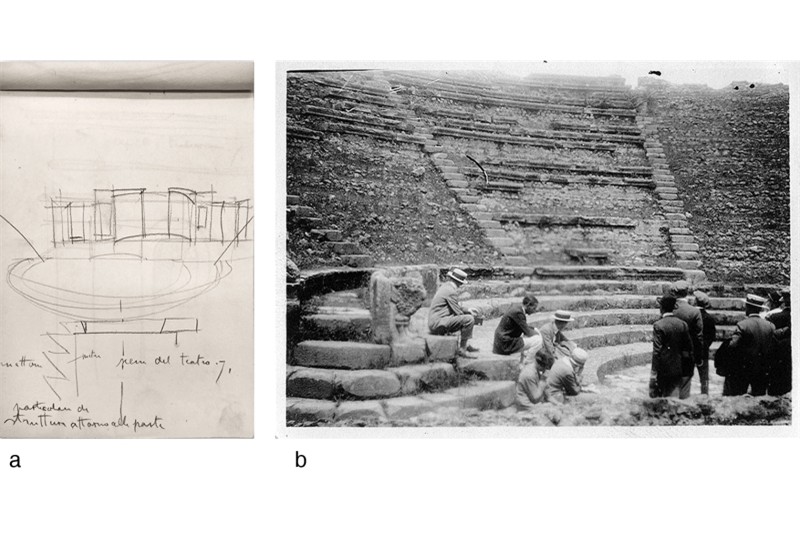
Bottoni showed the precocious sensitivity typical of an urban planner towards the crucial role played by collective spaces in shaping the urban fabric, the same trait he would show in the morphological design of the QT8 neighbourhood and, above all, in the plan for the Sesto San Giovanni Civic Centre. He paused both to describe graphically the Roman theatre of Pompeii and to photograph teachers and students engaged in surveying it on site, seated on the steps of the cavea.
Bottoni's concise and compelling sketch of the theatre, abandoning the meticulous graphic style of his previous notebooks, outlined the relationship between the cavea and the volumetric arrangement of the scene with just a few incisive lines. He chose to forgo detailed graphic work in favour of expressiveness, emphasising the importance of capturing those ancient deposit of collective values.
Pompeii. Towards the project
When one travels and practices the figurative arts — architecture, painting, sculpture — one looks with the eyes and draws so that the things seen can be internalised. The things captured through the work of the pencil remain with us for life; they are written, inscribed (Le Corbusier 1961, p. 37).
Observation is not a passive act; it is more than just recording; it is a form of active engagement judgment. In this context, the protagonists are the sketchbooks of a circle of friends and fellow students: Piero Bottoni, Luigi Figini, Gino Pollini, and their drawn (and photographed) record of the visit to the excavations of Pompeii. Their friend Giuseppe Terragni was not present on this occasion; he was in Rome, visiting the Forums, and the ruins of the capital (Ferretti et alii 2018; Ciucci 2005).
These carnets de voyage reveal the start of a journey towards the formalisation of Italian Architecture of Rationalism. These rapid sketches, interpret the ruins with their flaws and present a kind of original landscape, an extraordinary imaginative source.
As already mentioned, it is July 1926, amidst a murky political history becoming more and more obscure. In the suitcase, Le Corbusier's Vers une Architecture, as a gift to Gino Pollini from his artist friend Fortunato Depero, which came into the hands of the group of friends in 1925 (Panzeri vol. 84, 2015).
The lessons that the ruins teach are many and complex. They form a vital part of the architect's work, provided they are internalised through a tangible connection that appears in notebooks. Therefore, it is necessary to study them with the mind by drawing, reasoning through sketches, and understanding how walls merge into and modify the ground. For example, visualising what architectural forms can originate, in excavation or elevation, from walls, platforms, and columns. They train the eye and the intellect for a process of accumulation in the personal casket from which authentic inventions arise (Ferro 2007; Torricelli 2023).
Everyone perceives in the ruins what they already wished to discover. These powerful rediscoveries and derivations establish connections with distant architectures. Drawings are the actual space of discipline, an excellent synthetic moment, a necessary order of thought. They form a practice of “excavation” and amplification of the individual symbolic universe.
The group of young architecture students from the Milanese school viewed the ancient differently from their masters, Gaetano Moretti, Ambrogio Annoni, Piero Portaluppi, also showing some impatience with certain impositions. They challenged traditional methods of exploring architecture, discovering a form of “originality” rooted in a substantial and timeless logical-formal reasoning. The study of the ancient acted as a projection towards modernity, providing these young individuals with a rational framework.
Architecture was presented to us through studies of the Doric or Ionic capital abacus, reconstructions of ancient Roman temples based on the texts of Canina and d'Espouy, and generally through a series of purely formal, academic ideas that bore no relation to the forms of architecture being constructed at that time (Consonni et alii 1990).
These were exercises on styles by assuming the elements of design in a predominantly allegorical-representative key. All this was tight for these young architects-in-the-making.
Coincidences
«Le Corbusier exerted on us the same lyrical fascination of his technical and axiomatic prose». With its straightforward slogans, yet sharp and commanding like the points of a programme designed to stir souls and motivate them to struggle, Vers une Architecture revealed to each graduating student the path he was looking for. In other words, the way to finally bridge the gap between the language of architecture and the forms of everyday life, became clearer since the nineteenth century and was heightened by the war (Consonni et alii 1990).
Le Corbusier's itinerary (real and sketched) to Pompeii is the main trail, but now (in 1926) the state of the excavations is different and the group has an exceptional guide, the new Superintendent and Director of the excavations, Amedeo Maiuri.
Le Corbusier certainly brought about a change of direction. A new perception of the ruins emerged, old paradigms were overthrown. Every romantic, mawkish vision of the ruins was removed.
Le Corbusier built a bridge between Pompeii and the rest of the world: the ruins of Pompeii were fragments of architectures and operational tools; they became a "storehouse", a living reservoir of examples and architectural devices, revealing the poeticity of small, rational spaces. In a few words, Le Corbusier put into black and white what Goethe had already intuited: after the disappointment of the first impact, the ruins of Pompeii became a place of a new historical-cultural paradigm in the reception of the ancient (Goethe 1786-1788). This paradigm focused on morphology and type: the "mummified city", as Goethe called it, appeared to him in a new light, a set of "intelligent", "pleasant" compositions, no longer cramped and small. Thus began a sort of modern appropriation of the ruins, an overcoming of Winckelmann's monumental vision of the "great" and "noble" character of the ancient. But not only that, observing the architecture of Mediterranean houses, Goethe (and Le Corbusier in the same way) observed the continuity and correspondence between the world of antiquity and the modern one, recognising a logical-formal and structural permanence.
Added to all this is a special guide, who accompanied the Politecnico group in 1926, Amedeo Maiuri, appointed Superintendent of Campania and Director of the Pompeii excavations in 1924, just two years before "our" trip. Maiuri, the archaeologist-poet, a committed scholar but also a skilled narrator, described with the passion of the artist, the dedication of the historian and the precision of the scientist. He mixed real and imaginary. In short, he fascinated them all. And this matters.
These narratives opened up new architectural scenarios and new imaginations: the poetry of everyday life, the houses with peristyles, new proportions and new geometries became protagonists (Osanna 2017; Pappalardo 2017).
The itinerary in the city
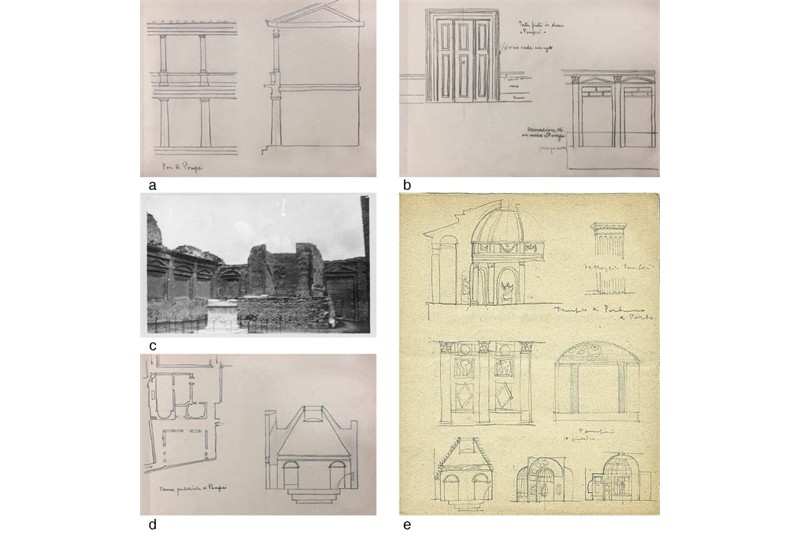
In the first part of the visit, there is a clear narrative intertwining with Le Corbusier. Along the climb with its large, slippery black lava stone slabs, they reached the Forum[10]. No one repeated Le Corbusier's sketches, but they drew new elements: the texture of the walls of the enclosure of the Temple of Vespasian, the reconstructive section of the portico, the section with skylight of the baths of the forum.
In front of them, the House of the Tragic Poet[11]. Le Corbusier's words (and sketches) resonated:
Questi scopi sono il muro (il pieno sensazione fisica) o la luce, lo spazio (sensazione fisica) [...] Le raffinatezze di un'arte consumata. Tutto è costruito intorno all'asse, ma difficilmente ci potrebbe essere traccia di una linea retta. L'asse è nelle intenzioni e il fasto da esso prodotto si estende alle cose umili che con un gesto abile (corridoi, il passaggio principale, eccetera) investe mediante l'illusione ottica. L'asse non è qui aridità teorica, ma collega dei volumi portanti e nettamente inscritti e differenziati gli uni dagli altri. Quando si visita la casa del poeta tragico si constata che tutto è in ordine. Ma la sensazione è ricca, si osservano abili disassamenti che danno l'intensità ai volumi: il motivo centrale della pavimentazione è respinto indietro dal centro della stanza; il pozzo dell'ingresso è dalla parte della vasca. La fontana in fondo è in un angolo del giardino (Le Corbusier 1924).
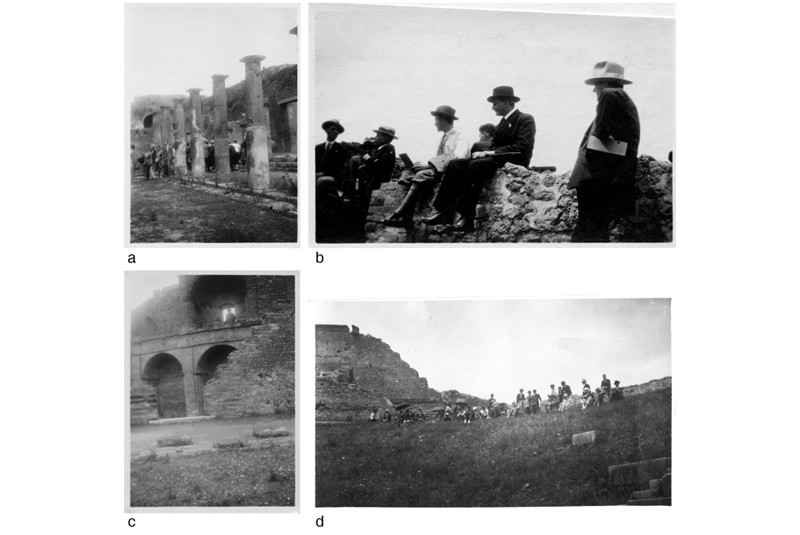
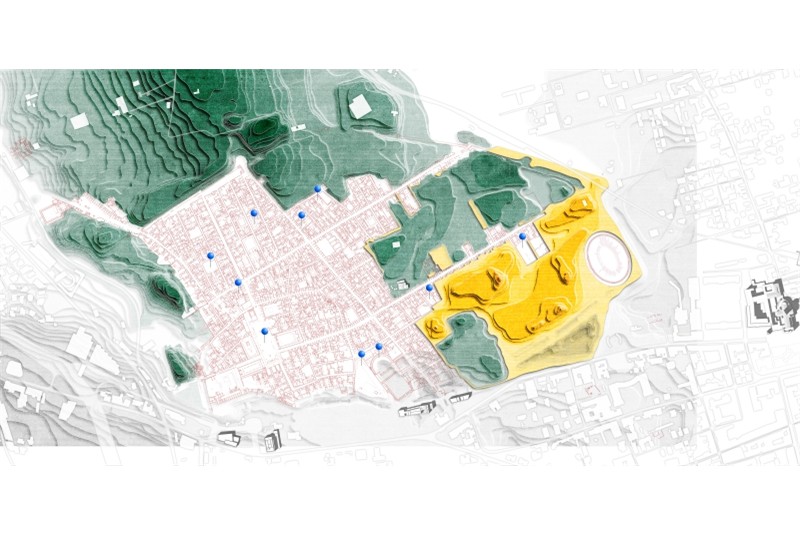
The Politecnico group crossed the oldest part of Pompeii and then turned along the street of the theatres to reach the triangular Forum (the Greek Forum) with its propylaea. The landscape, but above all the views of the theatre complex, struck them: they lingered for a long time and documented the Forum/Theatre/Palestra urban ensemble, the level changes, the connections, the grand staircase, and finally the Theatre. Walls, solids and voids, columns...
They went back up via Stabiana to reach the House of Marcus Lucretius[12]:
[...] Rispettate i muri. Il pompeiano non fora i muri. Ha una sacra devozione per i muri, ha amore per la luce. La luce è intensa se sta tra muri che la riflette. L'antico faceva dei muri, muri che si distendono e si raccordano per ingrandire ancora il muro. Così creava dei volumi, base della sensazione architettonica, sensazione sensoriale. La luce risplende con intenzione formale a una delle estremità e rischiara i muri. La luce risplende la sua impressione al di fuori attraverso i cilindri (non mi piace dire colonne, è una parola rovinata), i peristili o pilastri. il suolo si estende dove può, uniforme, uguale. A volte per raggiungere una sensazione, il suolo si alza di un gradino. Non ci sono altri elementi architettonici di interno: la luce e i muri che la riflettono in largo spazio e il suolo che è un muro orizzontale. Fare dei muri illuminati significa comporre elementi architettonici di interno. Resta la proporzione (Le Corbusier 1924).
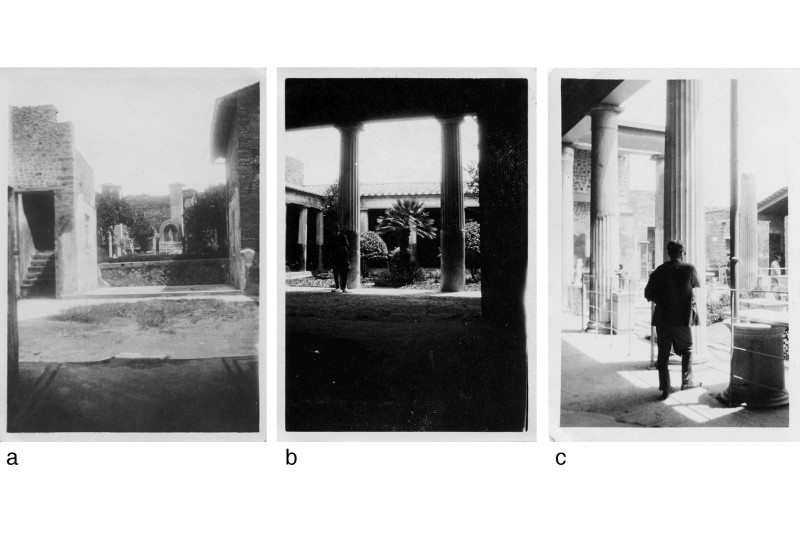
The Politecnico group continued the itinerary and visited the House of the Vettii[13], then crossed via del Vesuvio and turned into a small alley. Here was the most awaited Domus, immortalised by Le Corbusier's famous drawings, the House of the Silver Wedding[14].
[...] Ancora il piccolo vestibolo che toglie dai vostri pensieri la strada. Ed eccovi nel cavedio (atrium), quattro colonne nel mezzo (quattro cilindri) si innalzano all'improvviso verso l'ombra del tetto, sensazione e testimonianza di mezzi possenti; ma in fondo lo splendore del giardino visto attraverso il peristilio che dispiega con un gesto largo questa luce, la distribuisce, la segnala, estendendosi lontano a destra e a sinistra, definendo un grande spazio. Tra i due, il tablino che racchiude questa visione come l'oculare di un apparecchio. A destra e a sinistra due spazi d'ombra, piccoli. Dalla strada di tutti e brulicante, piena di cose pittoresche, siete entrati nella casa di un romano [...] A cosa serviranno queste stanze? È fuori questione. Dopo venti secoli, senza allusioni storiche, sentite l'architettura e tutto ciò è in realtà una casa molto piccola (Le Corbusier 1924).
In the majestic tetrastyle atrium, in half-light, the group photo immortalised the entire Politecnico party. A tribute to the master.
At this point, the group left the path traced by Le Corbusier and conventional visits and headed for the New Excavations. Here, the world of archaeology changed radically: while in the old excavations everything was already brought to light and musealised, here, among the new excavations, the landscape was that of the layers of the soil, of the moment when the underground world came to light and where imagination was needed even more to fill the spaces of uncertainty.
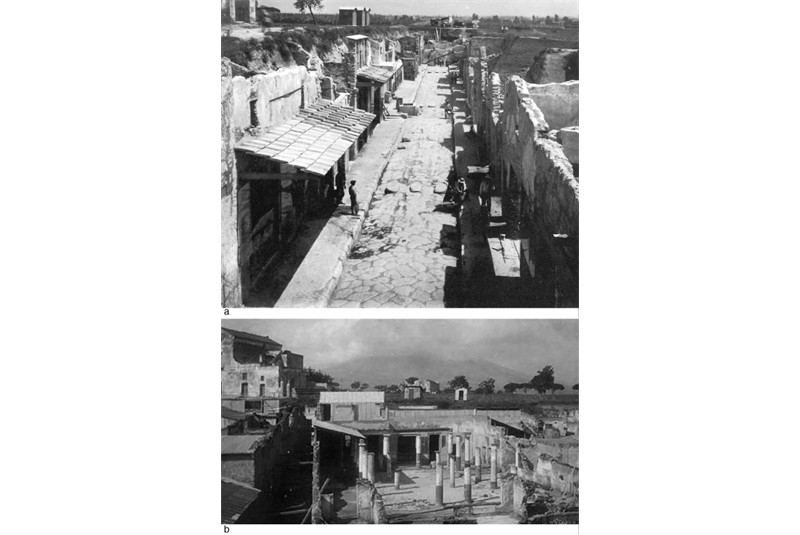
Via dell'Abbondanza was still a deep furrow between the embankments, the houses and the famous shops built façades that then seemed like film scenes. Some famous Domus were here and there re-emerging from the lapilli.
Maiuri in 1926, then in his forties, newly installed, continued the work begun by his predecessor Vittorio Spinazzola, that is, he started again from via dell'Abbondanza, bringing to light the long road route to Porta Sarno, the eastern gate[15].
Here Maiuri staged the spectacle of a Pompeii that was commercial and noisy (more so than the more residential and collected Herculaneum), bringing it back to life in dramatic terms and forms, with comparisons and similitudes, with sometimes audacious, sometimes playful "tricks" and juxtapositions. Nothing ever changes in man. He remains what he is (Osanna 2017; Pappalardo 2017). Nothing that could lead to the romantic interpretations of the nineteenth century[16].
The account of the ongoing excavations began with the House of Paquio Proculo[17], trapped in the frozen moment of the catastrophe during renovation work, forever unfinished. The voice of the graffiti scattered on the walls of the house echoed «that lively and vibrant outdoor life, which floods into the Fauces up to the front door. The traces of men and women, the trails of their passage, the shouting, the shops, the people, and the carts of the Via dell'Abbondanza remain recognisable» (Maiuri, 1959).
On the mosaic of the dog (Fauces), the floor gently sloped towards the atrium, transitioning from whole light into shadow. The small vestibule diverted the mind: the noise and hustle of the city, the voices of the people, fade away. On entering the Atrium, the cava-aedium; you had to imagine the shadow of the roof (built by Maiuri twenty years later). In the background, the splendour of the garden was visible through the peristyle, unfolding the light with a wide gesture, distributing it, signalling it, extending far to the right and left, defining a large space. When the doors remained open during the day, thanks to the skilful arrangement of the visual axes, one could look deep inside from the entrance. The home was a centre of social interaction and self-presentation; therefore, the guest, passing through the house, received a full impression of its spaciousness and lavish decorative features (Maiuri 1958; Ferro 2016). The group designed the third-style mosaic floor with black and white geometric patterns and figurative elements.
The last stop on the visit to the new excavations was the House of Loreio Tiburtino[18].
From the atrium, you pass into a small peristyle and from there into a long porticoed loggia covered with a pergola raised like a terrace above a large garden below, all enclosed by walls. Along the loggia runs a water channel, with statues of animals and herms arranged among the greenery on its edges. Between the columns, there are additional statuettes of the Muses, including a replica of Polyhymnia; in the centre, a tetrastyle temple stands among other water features; at the bottom of the canal, where waterfalls protrude, there is a biclinium with two paintings [...] These words will strike [...] (Maiuri 1960).
But it was “the golden hour”, at sunset, and the company left the excavations.
Reverbs
Thus, the excavated city appears as a grand work of architecture, almost a colossal abacus of building types and forms seen in their pure original essence, an excellent opportunity to imagine and initiate new transfigurations. The essence of architecture, freed from stylistic constraints, highlights the elaboration and composition of spaces, geometry, interior/exterior relationships, light and shadow, solids and voids, and visual sequences. A new way of interpreting the ancient is emerging. The path is opened for a new, synthetic, rational architecture. Much later, Figini wrote:
Herculaneum. Pompeii. In the central rectangles of grass, flowers, and trees, marble and water reflect blue strips of the vast Mediterranean sky. To the north, east, south, and west, surrounding you are the broad, horizontal bays – solid, squat, and fundamental – the columns of the Tuscan peristyle. On the shores of green lawns, fresh euripi flow into stone beds, white marble sculptures rise among the grass; and lazy waters, along with waterfalls, jets, and nymphaeums, create playful scenes. Long pergolas shade with vine shoots, sunny porches; flowerbeds suddenly appear from rectangular wall caissons, flourishing between pillars and columns, on the edge of small courtyards. Protected by the arcades' wings and solid walls, summer tricliniums and outdoor pools offer relief. High above the sea, terraces and sunlight stretch out, offering views of the horizon of two distant blues. Centuries of a deathly slumber have passed between lava and ashes in the town of Campania. With precise relationships of walls and greenery, air and sky, covered and open rooms, the houses of Herculaneum and Pompeii revive in the light of our sun, today more current and closer to us than ever.
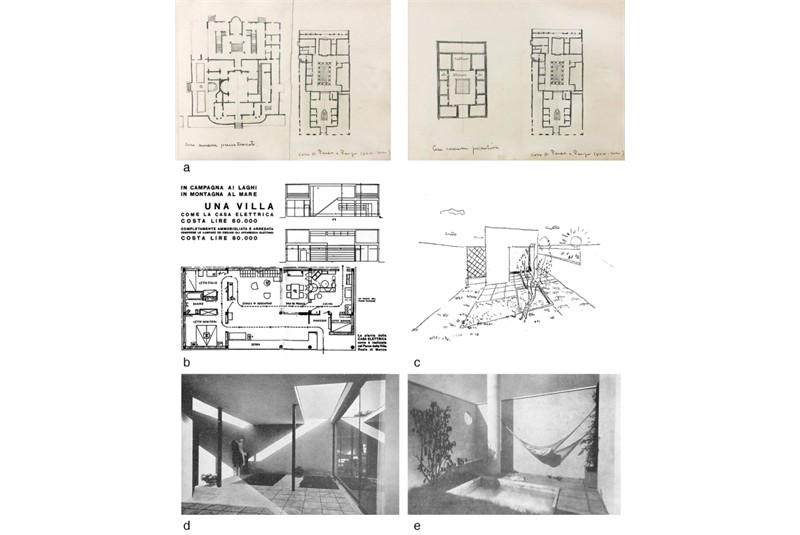
The reverberation in the new projects is evident. (Figini 1950) As an example among many, Figini's House at Villaggio dei Giornalisti (Journalists' Village) in Milan (1934-35).
Sketches and reflections in everyone's notebooks indicate the beginning of a formative journey towards the project, towards new means of expression capable of breaking down traditionalist superstructures. In the ruins, they saw primordial aesthetic values, a logical and “simple” architecture. Sketches and annotations show a precise search for cognitive and operational references for the ascent towards new aesthetic values.
But let's look back: all the architecture that has made the name of Rome glorious in the world is based on four or five types: the temple, the basilica, the circus, the round dome, and the thermal structure. And all its strength lies in having maintained these schemes, repeating them to the most distant provinces and refining them through selection (Group 7 1926, 1935).
In Pollini's notebooks, the plants of the Domus are compared with each other: Atrium, patio, sequence of paths, proportions; all these elements are evoked and transformed in the Casa Elettrica (Group 7 with Piero Bottoni, IV Triennale 1929-30) and in the Villa-Studio for artists (Figini and Pollini, V Triennale, Milan 1934).
The notebooks include reflections on the composition of the wall, the architecture, and the meaning of the wall face with the contrast/wall-column juxtaposition, as well as the full/empty aspects of the plastic-wall system.
Stone and brick have a centuries-old tradition of their own aesthetic, born from the possibilities of construction and now ingrained in us. The essence of ancient architecture lies in overcoming the heaviness of the material, which naturally tends to settle towards the ground. From this challenge, rhythm was born: the eye was satisfied by an element or a combination of elements when these, through form and placement, appeared to have achieved perfect static repose... Now, this scale of values, with reinforced concrete, loses all meaning and purpose: from its new possibilities […] it necessarily develops a new aesthetic entirely different from the traditional, and the overall framework of the construction, the rhythmic interplay of solids and voids, takes on entirely new forms (Group 7 1926, 1935).
And then:
[...] On the formal side, the new reinforced concrete architecture finds an analogy in the slender, straight and thin elements, in the simplicity of the planes, in the calm rhythm of the voids and solids, in which the alternation of geometric shadows creates a composition of spaces and values, reminiscent of the periods of origin of Greek architecture.
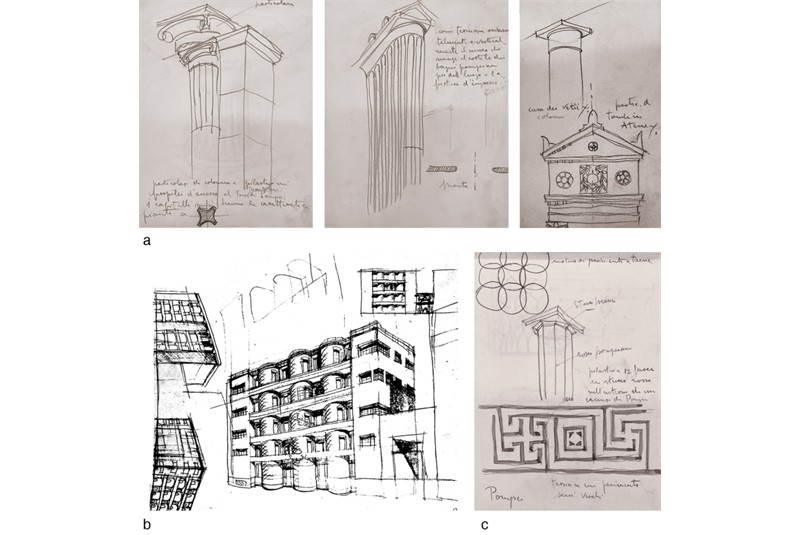
The trilithic system, in its most basic, synthetic, and primitive form, is clearly visible in the votive altars (tabernacles) of the Pompeian Domus, designed in detail several times by Bottoni, Figini, and Pollini. Their sketches concentrate on the column's theme, exploring different variations and possibilities concerning the wall, the entablature, and the tympanum.
The casual use of columns in Pompeian houses, done in a simplified style with square capitals and round-section columns as pillars, along with their colours, is reflected in the red column of Figini's house in the journalists' village in Milan, or in the columns of Bottoni, which will soon form the atrium of a building in Corso Sempione.
The light that creates reverberations on the walls and the uniqueness of the skylights at the baths of the forum will later become a central feature in the renowned churches designed by Figini and Pollini.
Thus, the question of the primordial is reborn: the original matrix becomes the inspiring principle and unprecedented origin of “new fables” and new metamorphoses.
The essay results from a collaboration among the authors in the framework of the Erasmus+ KA220-HED research project Updating the Grand Tour. Memory and Invention of the European Built Environment. M.P. Iarossi wrote the initial part on the Polytechnic culture and educational trip, and L. Ferro wrote the parts on Pompei, on The Toolbox of the Milanese Polytechnic students, as well as Towards the Project (Coincidences, The itinerary in the city, Reverbs).
All parts have been compiled thanks to the generous support of: APB-Archivio Piero Bottoni, Dastu-Politecnico di Milano; ACL-Servizi Archivi Storici e Attività Museali del Politecnico di Milano; Archivio del '900' del MART, Rovereto and Archivio Architetto Luigi Figini – AAF.
Special thanks go to C. Santacroce for the graphic reworking of Fig. 2 and M.V. Carosi, C. Forte, M. Saldarini, and G. Tarasco for editing the remaining images.
[1] This gap might be due to the transfer of the university to its new Lambrate headquarters in 1927, as indicated by the fact that between 1921 and 1927, neither the “Annuario” nor the “Programma” with its “Effemeridi” were published, which regularly reported these initiatives.
[2] The records of the collection, which houses Piero Bottoni's personal photographic archive, are available at: https://www.archiviobottoni.polimi.it/apbdocs/altri-documenti/fotografie-temi-vari.
[3] In particular, (unfortunately scarce) information from the Annuario 1926-27, the Registro Lauree 1965-66/1928-29 of the Fondo Registri, as well as individual personal files of the progressively identified participants, contained in the Fondo Miscellanea Laureati, were integrated and compared.
[5] APB, Fondo P. Bottoni. Travel Notebooks, vols. 6-7. See also Ferro (2007) and Ferro (2016).
[6] AAF, Archivio Architetto Luigi Figini, Box 4. Travel Notebooks, vol. II (1926).
[7] MART, Archivio Gino Pollini. Folder 38. Travel Notebooks. See also Crespi (2018).
[8] Until 1933, the year of the establishment of the Faculty, the training path for architect students included a common two-year period, called the Preparatory School (with courses in Mathematics, Geometry, Physics, Chemistry, Ornamental Drawing and Figure, Architectural Drawing) and a three-year professional course, the Special School for Architects.
[9] See in particular the sequence of notebooks 1, 3 and 4 held at the APB and notebooks 1-3 held at the Doctoral Students Fund of the Department of Architecture and Urban Studies of the Politecnico di Milano.
[10] As demonstrated by the numerous drawings by Bottoni and Figini in their travel notebooks.
[11] Le Corbusier dedicated an article to the Pompeian Domus: Le Corbusier (1924).
[12] As recorded in the notebooks of Figini and Pollini.
[13] Photos by Bottoni, Figini and Pollini.
[14] As attested by the group photos taken by Bottoni in the atrium.
[15] Between 1911 and 1923, Spinazzola's work at Pompeii consisted of bringing to light the southern front of via dell'Abbondanza with the facade elevations.
[16] See for example the volumes by Maiuri (1958) and Maiuri (1960).
[17] As recorded in the notebooks of Bottoni, Figini and Pollini and the photos taken by Bottoni. It was later published in Maiuri (1959).
[18] As testified by the sketches of Figini and Pollini. It was later published in Maiuri (1960).
AA.VV. (1981) – Il Politecnico di Milano 1863-1914. L’istituzione e gli insegnamenti. Franco Angeli, Milano. ↩
BOTTONI P. (1927-28) – ''Cromatismi architettonici''. La Casa Bella, 11-12, pp. 24-29. ↩
BUCCHETTI F. et al. (2021) – Architettrici. Pioniere, protagoniste, re-sistenti. Una storia di genere dell'architettura. Franco Angeli, Milano. ↩
BURATTI L., SELVAFOLTA O. (2013) – ''Il viaggio di istruzione in Germania degli allievi ingegneri-architetti del Politecnico di Milano nel 1876''. In: O. Selvafolta (a cura di), Gli Archivi del Politecnico di Milano, i luoghi, la storia e il progetto. Maggioli, Sant'Arcangelo di Romagna, pp. 58-71. ↩
CANELLA G. (2010) – Architettura e urbanistica milanese nel dopoguerra. Il Politecnico e la Scuola di Milano. Franco Angeli, Milano. ↩
CIUCCI G. (2005) – ''Terragni e gli antichi''. In: A. Grimaldi (a cura di), Giuseppe Terragni. Architettura per il moderno. Electa, Milano. ↩
CONSONNI G. et al. (1990) – Piero Bottoni. Opera completa. Fabbri, Milano. ↩ ↩
CRESPI M. et al. (2018) – ''Gli archivi di Gino Pollini. Il progetto del paesaggio e i viaggi d'istruzione nel 1926 e nel 1927. Le Corbusier in Italia e le fonti d'ispirazione''. In: S. S. Ghigino (a cura di), Il progetto del paesaggio: il disegno di Gino Pollini. Maggioli, Sant'Arcangelo di Romagna, pp. 111-127. ↩
FERRETTI R. et al. (2018) – Terragni 100. Disegni, progetti, opere: l'architettura come risposta. Electa, Milano. ↩
FERRO L. (2007) – ''Piero Bottoni, dagli anni di formazione al dopoguerra. Il disegno quale strumento didattico di conoscenza e progetto''. In: M. R. Nobile e A. Marotta (a cura di), Il disegno di architettura nel Novecento. La figura, la didattica, la ricerca. Clean, Napoli, pp. 248-257. ↩
FERRO L. (2016) – Il viaggio di Piero Bottoni, architettura e disegno. Franco Angeli, Milano. ↩
FIGINI L. (1950) – ''Le case di Ercolano e di Pompei''. Costruzioni-Casabella, 209, pp. 2-5. ↩
GOETHE W. (1786-1788) – Viaggio in Italia. ↩
GRUPPO 7 (1926, 1935) – Architettura. Il Poligono, Milano. ↩ ↩
LE CORBUSIER (1924) – ''Pompei. La maison du tragédien''. L’Esprit nouveau, 26. ↩ ↩ ↩
LE CORBUSIER (2001; rist. 1961) – Viaggio in Oriente. Laterza, Roma-Bari, p. 37. ↩
LORI M. (1941) – ''I viaggi di istruzione della Scuola di Architettura del R. Politecnico di Milano''. Nuovo Politecnico, 13, pp. 81-82. ↩
MAIURI A. (1958) – Ercolano. Istituto Poligrafico dello Stato, Roma. ↩
MAIURI A. (1959) – Pompei. I nuovi scavi e la villa dei Misteri. Istituto Poligrafico dello Stato, Roma. ↩
MAIURI A. (1960) – Pompei ed Ercolano. Fra case e abitanti. Vallecchi, Firenze. ↩ ↩
OSANNA M. (2017) – ''Pompei. Le metamorfosi''. Atti e Memorie della Società Magna Grecia, n.s. V, pp. 27-39. ↩ ↩
PANZERI A. (2015) – ''Figure del Novecento dell'Accademia di Brera. Appunti per Luigi Figini e Gino Pollini''. Atti dell'Accademia di Architettura di Bellinzona, vol. 84, pp. 119-122. ↩
PAPPALARDO U. (2017) – Pompei. La prima volta. Laterza, Roma-Bari. ↩ ↩
ROSSI M. et al. (2015) – ''Piero Bottoni, dalla visione d'artista alla pianificazione urbana. I cromatismi urbani tra Sesto S. Giovanni e Milano''. In: I. Valente e A. Marotta (a cura di), Il colore e la città. Colore, materia e segno nel progetto di architettura. Clean, Napoli, pp. 248-257. ↩
SANTACROCE C. (2024) – ''Il sistema progettuale-didattico tra le cattedre di Architettura e Disegno al Regio Politecnico di Milano 1863-1933''. In: F. M. V. De Rosa e C. Santacroce (a cura di), Il Disegno di Architettura a Milano: Ottocento e Novecento. Franco Angeli, Milano, pp. 18-28. ↩
SELVAFOLTA O. (2008) – ''Un laboratorio del moderno: la Scuola di Architettura del Politecnico di Milano (1920-1933) ''. In: A. Kordas e O. Selvafolta (a cura di), Dizionario dell'architettura del XX secolo. Il Melograno, Milano, pp. 114-131. ↩
TORRICELLI S. (2023) – Il disegno di architettura: dallo sguardo al progetto. Prospettive edizioni, Roma. ↩