Ludovico Romagni
«È per rimettere in moto la mia fabbrica di parole che
devo estrarre nuovo combustibile del mondo non scritto»
Italo Calvino1
In Italy, for several years now, we have been witnessing a split between theoretical thought and architectural design practice. This is a notion repeated to the point of exhaustion in every arena of disciplinary debate, in every painful moment of awareness of the increasingly evident dynamics through which architecture is excluded from the transformative processes of territory, city, and the built environment. We are confronted with a veritable mantra: it is becoming ever more difficult to find built projects in which one can even vaguely trace the rootedness of an author's theoretical thought.
It is evident that current theoretical and critical production — both Italian and international — struggles to identify a guiding thread capable of gathering and ordering the diverse theoretical and design research currently underway in our country. While until the 1980s Italian architectural production held a significant position within the international panorama, under present conditions it has become difficult to recognize a distinctive character or a coherent identity.
Nevertheless, within our territory there exist forms of excellence which, caught in the vortex of the pluriverse, the network society, and «liquid modernity», struggle to coherently situate their projects either within their own theoretical trajectory or within a virtuous field of comparison where embryonic theoretical formulations might emerge.
Immersed in this varied and multiple world, torn apart by the many shrewd and continuous initiations of knowledge that afflict a discipline grappling with every imaginable form of transition — digital, ecological, heritage sacralization, social drama, seismic, flood-related, and drought-related — around ten years ago I began reflecting, together with Cristiano Toraldo di Francia and Anna Rita Emili, on what new modes of architectural narration might be capable of responding coherently to the pressing demand for open consultation on the web. We held to one guiding principle: to differentiate ourselves as much as possible from the printed replica.
But what were, we might say "at that time" — considering the speed at which everything evolves — the technical possibilities that digital media made available to us? From the outset, we found a clear point of shared agreement: to begin narrating architecture starting from its built reality. That is, from conceived space, tangible elements, perceptible relationships, constructional aspects, and the materials employed. And what better way than through its dynamic perception?
At first glance, this did not appear to be a particularly innovative approach. Architecture has always played a leading role in the world of video, both directly and indirectly: as background, conscious scenography, an ideal setting for cinematic narration, and much more (Troiani, Campbell 2020). In our case, however, the aim was to grasp and enhance a specific expressive potential.
Following our initial experience — and not without reason — others also began to recognize this opportunity: The Architects Series by The Plan, the Conversazioni d'architettura promoted by Isplora or Yacademy, among others.
We found it fascinating and engaging to attempt to "lay bare" the author in front of his or her architecture, compelling them to remain within the project itself, seeking to unite design reflections with theoretical convictions by capturing them directly through the perception of space, the architectural element, the relationships among parts and with the site, and form. The intention was to keep the author as far as possible from secondary texts and layers of meaning, perhaps elaborated by others.
Through the progression of the moving image — traversing space and overlaying, in a subtly stroboscopic manner, the static vision of a targeted photograph, a study sketch, the image of a previous or unrealized project, a technical drawing, and even a sustainability device or a keyword — we believed it was possible to truly enter both the architecture and the thought that generated it. A narrative of simultaneity between moving and static images, between the idea and its construction, between the author's account and the immediacy of realization and spatial perception, between concept and development, between citation and its concrete suggestion.
It was precisely with Cristiano that we began producing video interviews filmed inside completed works together with their designers, capturing a consciously investigated progression of aspects: the author's personal trajectory — from education to "foundational" encounters — their projects, their idea of synthesis between theoretical thought/production and concrete work, the detailed account of the building's story, the acquisition of the commission, the idea, the difficulties, the actors involved, the construction, its details, and even its errors.
The initial idea was to create a website; a "free space", distant from systems of classification and accreditation that were ill-suited to recognizing the scientific value of anything diverging from the "normal assay." A place in which, starting from the video interview, anyone could express their own view in the form of a comment. This would, in any case, have been an unusual and unpopular choice, given the lack of scientific recognition of such contributions and the consequent difficulty of finding individuals willing to generously invest their time without receiving any form of acknowledgment.
There are, however, some virtuous examples that coexist with this difficulty: Città Bene Comune, promoted by the historic Casa della Cultura founded by A. Banfi in 1946, initiates a dialogue starting from the publication of a text and activates a discussion through a series of "free" reflections. Yet it is precisely its director, Renzo Riboldazzi, who points out the limited number of comments and in-depth contributions produced in relation to the quantity of texts published on the website, and more generally overall — a number that is partial, scant, not to say infinitesimal. Despite this difficulty, there remains the necessity to «sift what truly has value and deserves to be disseminated — because it is capable of generating new reflections, revealing some form of reality, opening up new concrete perspectives — from what appears insignificant or negligible»2.
In our case, the inevitable coordination or filtering of the debate generated by the publication of a video interview evoked the danger of having to rely on a potential moderator: a figure with a "high profile", assertive, an aspiring "messiah" immersed in the multiverse of our disciplinary relativism. This prospect filled us with a certain sense of dread, and we therefore sought alternative paths.
In particular, our attention was drawn to the website sfuitaliadesign.com, created by young researchers from different countries. A group of architecture and design students/researchers travelled the world interviewing architects within their studios, selecting them on the basis of thorough online research. They met Anna Rita Emili in her Rome studio, altro–studio, and the publication of the video interview — in which research themes, study models, and several iconic drawings clearly emerged — struck us deeply. It was a website also highly refined in graphic terms, with no written content at all3.
We thus began, in turn, to produce videos in which an author narrated their work in relation to their research. The first featured Cristiano Toraldo di Francia and was entitled «Da Quaderna alle dodici città ideali». We met him in his studio here at the School of Architecture and Design of the University of Camerino in Ascoli Piceno, where some models and drawings by Superstudio were preserved in a chaotic manner, alongside traces of didactic experimentation, posters, and manifestos from all over the world4.
I soon realized that the undertaking was extremely demanding and began to look around for some "measured" funding to support the initiative and expand the team. I managed to obtain a modest sum (made available by the University of Camerino), almost entirely allocated to the purchase of equipment for video production — cameras, microphones, and so forth. At that point, I believe I made a mistake: I persuaded Anna Rita Emili to create a "proper" open-access digital journal that would experiment with and hybridize architectural narrative forms, with ambitions — perhaps even "for ANVUR" — of scientific accreditation. Enter_Vista was thus born. The focus was precise: to intercept the difficulty of Italian theoretical and critical production in defining a line capable of gathering and ordering the theoretical and design research currently underway in our country. We therefore began meeting "good" architects within one of their completed works, where we believed their theoretical thought had taken root.
It is not easy to identify effective ways to communicate that inseparable — and often consolatory — binomial that pervades every context of disciplinary debate: the relationship between theory and design. Perhaps it is precisely at this junction that the true focus of our initiative is rooted. What characteristics should a contemporary architectural theory assume? What relationship can we establish, operationally and conceptually, between saying and doing, between thought and action, or in other words, between theory and practice?
With a certain melancholy, every morning upon waking, I recall — or try to recall — that architecture is an operational profession, whose meaning is realized in the qualitative transformation of landscape, city, and built space. Despite the historical dualisms of Zevi and Tafuri, I believe that every architect — even the most theoretical, even the academic "excluded" from practice — retains, in their inner convictions, the belief that theoretical thought cannot be separated from a vision of making. Indeed, theory must be investigated and articulated through the act of doing.
Our editorial initiative is founded precisely on this conviction: theory emerges and takes shape from concrete experience. Not as abstract elaboration, but as the definition of the reasons, conditions, and operational modalities of the discipline. In this sense, we hold that a genuinely architectural theory can only derive from a plurality of real experiences. As Giancarlo De Carlo aptly observed «Rarely have my reflections been theoretical. Rather, I have sought to extract fragments of theory from the experimentation I conducted while designing» (De Carlo, Buncuga 2001). In light of this perspective, our response to the question of how to make theory effective is clear: theory must derive from practice, not vice versa.
Federico Bilò reflects on how, in discussing architecture, we can distinguish an operational and a discursive dimension:
«Within the discursive dimension, we can further distinguish: there is poetics, there is criticism, there is historiography, and there is also theory […] etymologically, we all know that theory is vision, is looking, seeing; it seems to me, however, that theory is significant in our profession if, and only if, it is aimed at doing. Theory, then, as a vision of doing, or as the definition of the reasons and methods of the operational side of the discipline» (Bilò 2021, pp. 45–48).
A powerful image that has accompanied us over time is that proposed by Carlos Martí Arís: the centering — a temporary structure that supports the arch during construction — as a metaphor for theory. Invisible in the finished work, yet essential for its realization. Without theory, the work cannot stand. But once the work is completed, theory withdraws, leaving space for the built environment (Martí Arís 2007).
We are also convinced that the theoretical void has, at times, paved the way for superficial deviations. Architecture in the 1980s, for example, was often marked by excessive free rein, a creative impulse unmoored, as Francesco Remotti observes:
«the absence of robust and well-considered theorization is the factor that most opens the door to trends» (Remotti 2014).
Thus, we began to seek projects in which we believed the author had successfully rooted their thought. The selected projects are not flashy or dazzling, but in our view they identify the architect's production along a coherent trajectory.
By the time we reached the eighth issue, having met some of the most important masters of Italian architecture — some recently deceased — as well as the emerging "post-young" generation, I might venture a personal observation: in the narration of their projects, with few exceptions, theoretical anchors rarely overshadowed the aspects of constructive concreteness.
Architects such as Camillo Botticini, Enrico Molteni, or more recently Giovanni Vaccarini, oriented their reflection toward operational reality: formal research, design constraints, and the most appreciated improvements resulting from adjustments during construction.
Some expressed a distance, a need to escape, from an anti-constructive academic inclination. They felt compelled to seek elsewhere the means to enter the architecture itself, to grasp at the root the constructive aspect, the details, the definition of architecture through its specific characteristics, the definition of its constituent elements, and the relationships among them. In all cases, the importance of formative completion through experience abroad emerges — particularly in countries less affected by the theory/construction, research/production divide, especially Spain. Alternatively, they recall privileged relationships with exceptionally talented professionals in both Architecture and Design.
Paolo Desideri, describing the Florence Opera House, also reaffirms the central role of form in resolving design problems. He seems to distance himself from the compositional complexity with which he educated the — so dear to me — "generation of phenomena" in Pescara. Reality, Desideri states, simplifies; constructive complexity demands clarity and lucidity. His true masters, he confesses, were Sergio Musmeci and Pier Luigi Nervi, whose experimental legacy remains extraordinarily relevant today.
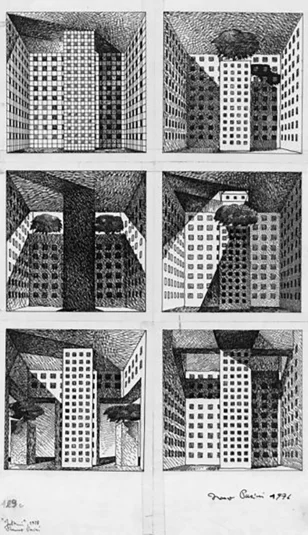
With Franco Purini and Paolo Portoghesi, the relationship between theory and design practice emerges with even greater incisiveness. For Purini, the Eurosky Tower in Rome represents the evolution of long-standing collaborations, particularly with Maurizio Sacripanti, in which a resemblance can be seen to some extraordinary drawings from 1964 that characterized his research: Interni from '76 (Fig. 1), Torri also from '76. He speaks of the dual soul of complexity: on one hand, explicit complexity manifested in the articulation of forms and materials; on the other — referring to Ungers' architecture — an apparent simplicity concealing a kind of "second text" that must be unveiled and discerned.
Similarly, the need to anchor architecture to the "earth," as evoked by Paolo Portoghesi, frees it from ideological and globalizing visions (Portoghesi 2005). In his works, such as the church in Calcata where we met him, he continues to seek symbolic geometries and musical proportions even within the concreteness of the prefabricated construction system used for the "dome" petals.
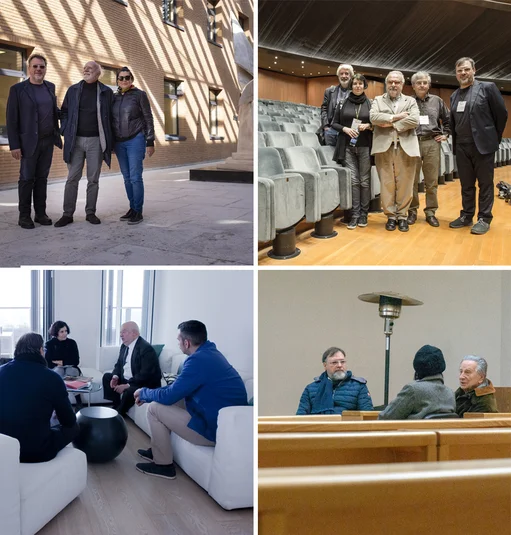
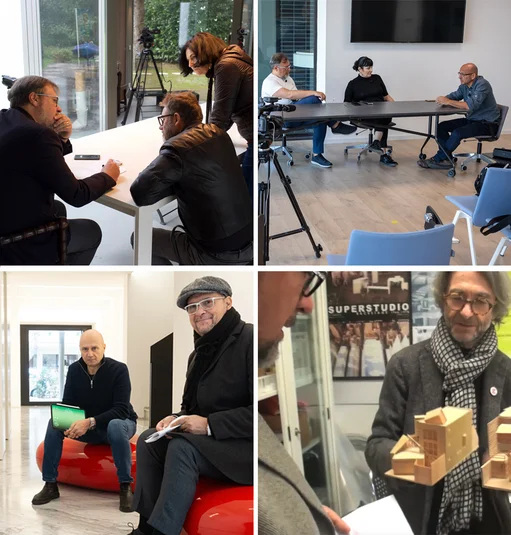
Moreover, Pepe Barbieri's attempt to create an "urban island in nature" at the Chieti Campus experiments with the themes of "small metropolises": land, dispersion, new relationships (Barbieri 2016) (Fig. 2/3).
I felt the need to retrace, in a synthetic and kaleidoscopic manner, the substantial work carried out so far in the progression of encounters, to reaffirm how, in the face of the realized work, reflective depth, anchors of meaning, and underlying significance simplify, lose intensity, and detach from the need for triangulations or attestations of reflexive methodologies. They pursue instead a neo-perceptive virginity, where the narrative becomes simple, where form resolves, where functional purpose dialogues with aesthetic sense and cultural linearity, and where the weight of secondary, tertiary, or quaternary meanings is lightened, sometimes nullified, surprising or even disappointing.
Unexpected descriptive clarity and the complex simplicity of the narrative, in my view, represent the most vivid testimony that the authors offer to the journal5.
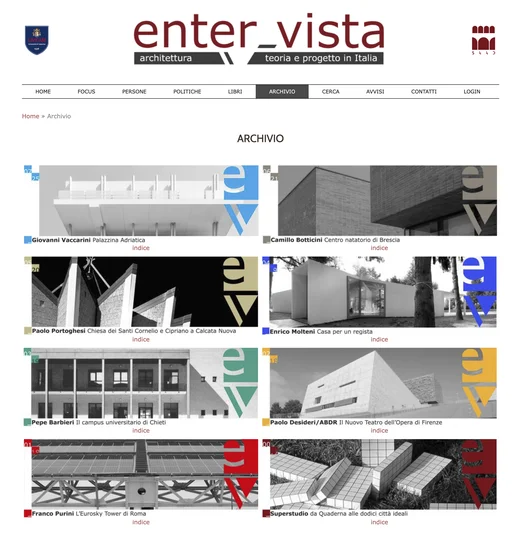
Enter_Vista is a multimedia electronic journal, published semiannually by the University of Camerino, School of Architecture and Design (ISSN 2612–0534). https://entervista.unicam.it/ (Fig. 4)
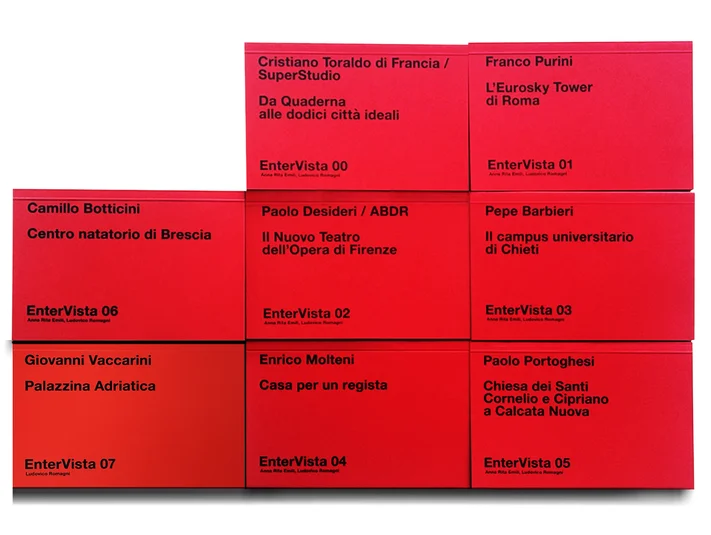
Alongside the digital version, a print edition is available, containing all the texts produced for each issue, including the complete transcription of the interviews, published by Plug_in in a "pocket" format (Fig. 5).
The journal's contribution lies in identifying certain peculiarities of Italian architecture through a series of video interviews with architects who have demonstrated — through their projects — a strong grounding in theoretical thought. The audiovisual medium, still rarely used in academia, can document an architect's work, formative theoretical journey, and research more directly and comprehensibly than traditional interviews. More broadly, the editorial project aims to develop an audiovisual product, accompanied by images and critical texts, to circulate online — within the portal of the School of Architecture and Design in Ascoli Piceno, UNICAM — capable of providing significant Italian contributions, also addressing an international audience. In the proliferation of digital publications, video offers the opportunity to reflect on the relationship between architectural design and modes of communication in the transition from print to the web. Today, this system intersects with an extremely diversified media multiverse that has transformed both language and content. Recent surveys show that among architecture students, the use of digital media as a source of information acquisition is becoming predominant, almost exclusive.
Despite numerous proposals for hybridizing forms of architectural communication, existing online journals almost always replicate the structure of print publications, publishing articles solely in PDF format, often accompanied by a selected collection of images. In reality, they seem to forego the exploration of the potentially infinite forms of communicative contamination. While this choice may, superficially, reflect an ethical or environmental principle related to reducing paper consumption, these journals are also constrained by accreditation criteria at various levels of scientific rigor, which do not favor "arrogant deviations".
Enter_Vista, which assumes an overall monographic character, enables — through the simultaneity of reasoning and visual perception, keywords related to images, and the interplay between theoretical reference and construction — a virtuous and exhaustive relationship between the new "medium" and the "end" of representing the fragile and uncertain certainties of the discipline. The video interviews, titled "10 domande a…" with English subtitles, constitute an authentic testimony of the architect from their formative years to the current state of their research. Each interview is conducted within a significant work by the featured architect. The selection of participants, agreed upon and approved by the journal's scientific committee, depends on their relevance both in terms of design and theory, as well as their level of recognition within the profession. The journal primarily targets the academic community but, thanks to its distinctive editorial format, can also reach a broader audience.
How is Enter_Vista structured? It follows two parallel channels of engagement, operating at different speeds: one audiovisual and one textual. In the video interviews, the discourse on architecture is captured within the architectural space itself. Physical immersion in the work represents the most direct attempt to convey the theoretical reflection underpinning the project in a less constructed, more immediate and simple manner. The video operates on the simultaneity of dialogue and extraction of key words, the static perception of photographic images and the dynamic experience of traversing space, initial sketches and architectural drawings, representation and physical space. The narrative is neither progressive nor strictly coherent; it does not aim to prove anything. Rather, it seeks to capture a form of neo-innocence, a drying out of reasoning, the essentiality of thought, immediacy and concreteness, a foundational restart free from superstructures. It aims to capture, in the words of the interviewees, the authentic meaning of choices, the essence.
Accompanying the video is a kind of "second text": a collection of essays by selected authors, tasked with amplifying the meaning of the work, highlighting the more complex structures of theoretical thought and the cultural and aesthetic relationships. This is perhaps the most traditional aspect, entrusted — sometimes reluctantly — to the rigid ANVUR-style rules and regulations, which do not consider the scientific value of video.
A "web of links" allows readers to access curricular information on all individuals participating in a specific issue, as well as the overall scientific and organizational structure, and to consult references for critical or bibliographic selection.
From the outset, Enter_Vista has confronted a central issue in contemporary disciplinary communication: the tension between extended, well-argued scientific reflection and the immediacy, brevity, and fragmentation imposed by digital media. The issue does not concern the medium alone but directly affects design culture and the ways in which architecture produces and transmits knowledge.
As Manfredo Tafuri repeatedly emphasized, the tools of representation and critical discourse are never neutral; they influence the forms of thought and the methods by which architectural knowledge is constructed (Tafuri 1968; 1980). The use of audiovisual languages, if adopted uncritically, can generate simplifications, spectacle, and a loss of depth; yet, when consciously governed, they can activate new forms of access to design and reconnect theory with practice.
In this sense, Enter_Vista's experimentation has been structured around two complementary speeds: the audiovisual and the written. The ambition has been to engage both the "distracted" attention of a broad audience — clients, professionals, administrators, students — and the focused attention of researchers. The early issues, which prioritized high-speed communication with extremely concise texts supporting the videos, revealed the limits of excessive compression, showing the risk of superficial interpretation. Hence, the conscious decision to increase the distance between the two narrative levels, not to force them into a single synthesis, but to preserve their critical autonomy.
On one hand, there is the concreteness of the realized work, conveyed through physical immersion in built space, addressing real problems and "emptying" the author of a pre-existing theoretical scaffold; on the other, there is the deepening provided by so-called "second texts," capable of delving into the architect's thinking through an external perspective, reconstructing their cultural and theoretical genealogy. This operational mode echoes the idea of theory as a temporary structure, necessary for the construction of a work but destined to withdraw once the architecture manifests itself in its concreteness.
More generally, experiences such as Enter_Vista demonstrate the possibility of building broad cultural projects not through the assertion of a unified paradigm, but through the critical accumulation of cases, positions, and practices. The monographic structure and the careful selection of works allow, through progressive focus, the delineation of a field of tensions in which the project once again becomes a tool of knowledge, confirming De Carlo's idea that architectural theory does not precede the project but derives from it as a critical extraction from practice.
Finally, the relationship with academic training represents one of the most significant outcomes of these experiences. The integrated use of audiovisual languages and critical texts proposes a complementary and experimental pathway to traditional educational models, fostering a form of learning that intertwines perception, narration, and reflection. Theory acquires meaning when it is configured as a vision of doing: immersion in the work, direct listening to the author, and subsequent critical discussion contribute to forming a design awareness that is less abstract and more rooted in experience. In this framework, Enter_Vista does not stand in opposition to academic research and teaching, but as a device capable of reactivating some of their foundational instances, experimenting with new ways of transmitting architectural knowledge in the transition from print to digital.
1 Calvino I. (2002) – Mondo scritto e mondo non scritto, Mondadori, Milano. ↩
2 Renzo Riboldazzi, as the director of the website casadellacultura.it, reflects on the difficulties of coordinating and fostering a constructive discussion around a book in a thoughtful editorial that outlines the objectives of the publication. Riboldazzi R. (2018) – Che cos'è città bene comune. Ambiti, potenzialità e limiti di un'attività culturale, https://www.casadellacultura.it/707/che-cose-citta-bene-comune (accessed May 27, 2025). ↩
3 The interview with Anna Rita Emili (2012) can be accessed on the website http://2012.sfuitaliadesign.com/interviews/altro-studio/ (accessed May 24, 2025). ↩
4 The interview with Cristiano Toraldo di Francia was conducted by Ludovico Romagni and Anna Rita Emili for Enter_Vista in 2016. https://entervista.unicam.it/archivio/superstudio-da-quaderna-alle-dodici-città-ideali (accessed May 31, 2025). ↩
5 The dialogues and videos with C. Toraldo di Francia, F. Purini, P. Desideri, P. Barbieri, E. Molteni, P. Portoghesi, C. Botticini, and G. Vaccarini, produced by Ludovico Romagni and Anna Rita Emili for Enter_Vista, can be accessed on the website https://entervista.unicam.it/. For each meeting, a "pocket-sized" monograph published by Plug-in was produced, containing the full interview transcript, a project sheet, and several critical essays written by different authors on the work and the architect. ↩
Troiani I., Campbell H. (2020) (eds.) – Architecture Filmmaking: Making Visible, Intellect Books, Bristol. ↩
Barbieri P. (2016) – Geocittà? In che modo, oggi, si abita, nello stesso tempo, un "luogo" e il "mondo", Listlab, Trento. ↩
Bilò F. (2021) – Per una teoria operativa. In: E. Vadini (ed.), Progetto, teoria, editoria, Quodlibet, Macerata. ↩
De Carlo G., Buncuga F. (2001) – Conversazioni con Giancarlo De Carlo, Eléuthera, Milano. ↩
Martí Arís C. (2007) – La céntina e l'arco. Pensiero, teoria, progetto in architettura, Marinotti, Milano. ↩
Portoghesi P. (2005) – Geoarchitettura. Verso un'architettura della responsabilità, Skira, Milano. ↩
Remotti F. (2014) – Per un'antropologia inattuale, Eléuthera, Milano. ↩
Tafuri M. (1968) – Teorie e storia dell'architettura, Laterza, Bari. ↩
Tafuri M. (1980) – La sfera e il labirinto, Einaudi, Torino. ↩
Fig. 1 – Purini F. (1976), Interni, ink on tracing paper.
Fig. 2 – Romagni L., shots from Enter_Vista.
Fig. 3 – Romagni L., shots from Enter_Vista.
Fig. 4 – entervista.unicam.it, the website.
Fig. 5 – The Enter_Vista 'pocket' editions, published by Plug_in.