Introduction
While most Estonians were never able to travel abroad during the
Soviet period, there were some professions that were somewhat better
placed to travel. One such profession was that of the architect (Gorsuch
2006). Most architects made up to three trips during three decades (Jagodin 2014).
Estonian historian Oliver
Pagel (2016) has pointed out
that the Soviet Union rarely allowed blue-collar workers or
country-dwellers to go on tourist trips. Communication with the outside
world was entrusted to people with higher incomes from the city, who
belonged to a higher social class or represented a prominent sphere of
life (such as architects, engineers, educators, doctors and senior
officials). Soviet tourists had to promote the international image of
the USSR and be able to develop a conversation with educated
Westerners.
This privileged status was in keeping with the historical mobility of
the architectural profession. Getting to know important buildings on
site has traditionally been part of the quest for architectural
excellence. This was also the case during the Cold War, both in the
East and in the West. From the point of view of socialist
modernisation, architecture was seen as a central ideological cultural
phenomenon (Belogolovsky
2014). This meant that Moscow was highly interested in both
learning from others and promoting its own building activities
elsewhere. As a result, around two hundred Estonian architects managed
to make at least one or two trips outside the Soviet Union between the
1960s and the late 1980s (Jagodin 2014).
While trips within the Soviet Union (and sometimes in other
socialist countries) were organised by the Soviet Estonian Association
of Architects (SEAA), trips outside of the Soviet Union were arranged
by the central Union of Architects of the USSR where the groups were
formed from members of all Soviet countries (Jagodin 2014). For each trip, Moscow
allocated a few places to each of the Soviet republic, which were then
distributed by lottery or other means. One can assume that these
opportunities were more or less democratically distributed. But
alongside them were some ‘more equal’ architects who
travelled a lot more than others. They were the administrative and
ideological leaders of the architectural world, who when travelling or
attending various conventions, seminars and congresses had a
representative role on behalf of the entire Soviet Union. From Estonia,
such men were Dmitri Bruns, the long-time chief architect of Tallinn,
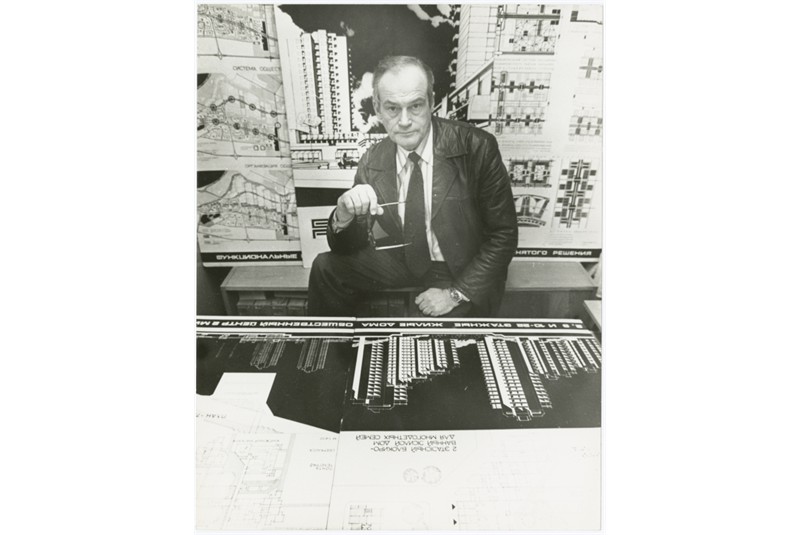
and Mart Port (1922-2012), the long-serving head of the SEAA. Port is
known to have made more than 30 trips abroad. In this article I give an
overview of Port’s travels abroad and discuss how he represented
them in his writings, and to what extent might they have influenced his
work.
For over two decades Port had a monopoly on power in the Estonian
architectural field. He headed the SEAA from 1955 to 1979 and between
1961 and 1989 he was the leading architect at Eesti Projekt – the
central state design institute where all grand urban development plans
were created and all major public buildings designed (Ojari 2012).
Alongside his work as an architect, urban planner and high-ranking
administrator, he was also a university teacher serving as a part-time
associate professor and later as a professor at the architecture
department of the State Art Institute of the Estonian SSR. Port was
also one of the most active writers on architecture in his time. He
published around a hundred articles in Estonian newspapers and
specialist journals, as well as dozens in major Russian-language
Union-wide publications. Interviews with him often appeared in the
press.
He was also a respected speaker on television and radio: the Estonian
Public Broadcasting digital archive contains sixty-seven broadcasts
with his participation, although the number of undigitised broadcasts
is probably larger. Port also published two books. In 1983 his overview
of Soviet Estonian architecture was published separately in Estonian,
German, Russian and English language (Port 1983). Seventeen years earlier he had
published a travel book about England (Port 1966), in which he shared his
impressions of the Sixth Congress of the International Union of
Architects (UIA) held in London in 1961. Besides the architectural
theme, the book introduced all fields of life in Britain in a popular
format to a wider audience. It is the only architect’s travel
book published in Soviet Estonia.
I begin this article with a discussion of Mart Port’s life and
work and then analyse his travels within the Soviet Union, the Eastern
bloc and capitalist Western Europe. As a bibliographical note, it
should be pointed out that this is a scarcely researched topic and much
of the discussion here evolves from Karen Jagodin’s (2014),
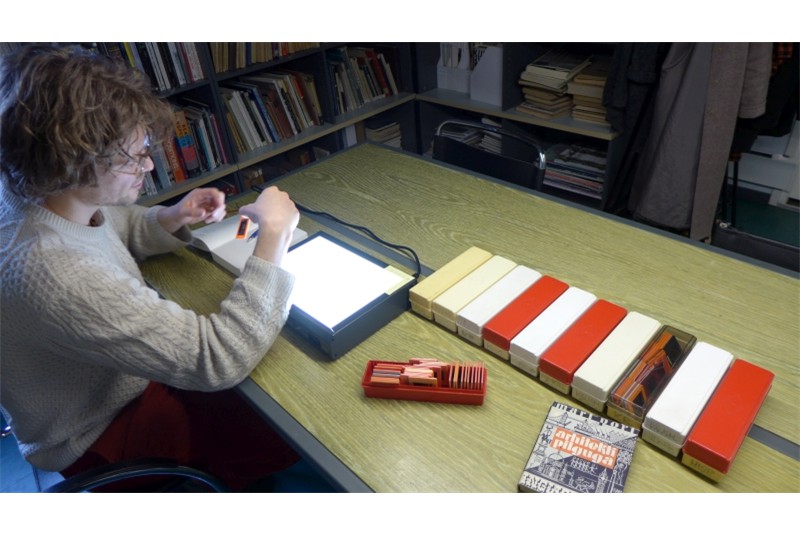
master’s thesis and the subsequent exhibition Architect's
Gaze. Bringing the West
Home aat the Estonian Museum of Architecture (14.02-06.04.2025).
As primary resources more than 100 articles by Port and interviews or
reportages involving him were consulted. Additionally I made use of
Port’s personal files kept in the archive of the Estonian Academy
of Arts and the Estonian Museum of Architecture.
Biographical overview
Mart Port was born on the 4th of January 1922 in Pärnu, in the family of a secondary school teacher. Shortly after his birth, his parents moved to Tartu, where his father Jaan Port found a job at the Institute of Botany, University of Tartu, first as a laboratory assistant, later as an assistant. Alongside the daily work as a gardener at the Tartu Botanical Garden his father studied at the Faculty of Mathematics and Natural Sciences where he defended his doctoral dissertation in botany in 1932. Two aspects of his father's professional influences on Mart Port's career have been highlighted. Firstly, the ever-present flora in his youth might have directed him to bear in mind the importance of greenery in large-scale urban projects (Metspalu 2019). Secondly, it has been suggested that his father's affinity to power may have stayed with Port – his father was one of the central ideologues of the nationwide home improvement campaign initiated by the Estonian president in the 1930s (Kalm 2012).
In 1929 Port entered elementary school and graduated from Tartu Boys High School in 1940. During high school summer breaks he worked as a railwayman, as a technician and on a ship as a machinist's assistant. Port has said that by the age of fifteen he had already been to Scotland (Veenre 2012). One could assume that this kind of early insight into the world fostered a passion for travel and a sense that the world was open to him throughout his life.
Estonia was occupied by the Soviet Union in June 1940. A few months later Port started his studies at Tallinn Polytechnic Institute. His studies were interrupted by Germany's attack on the Soviet Union – in June 1941 he joined the Red Army as a conscript. While his homeland went into the hands of Germany he was receiving combat training near the town of Kazan and for a short time worked as an engineer in the Chelyabinsk Tank Factory as part of the labour battalion. Port's view of life and architecture was pragmatic and calculated – his engineering practice and technical studies played a role in this.
After the foundation of national military formations, Port served in the Red Army and from 1942 he took part in the battles of the Second World War on the Kalinin, 2nd Baltic and Leningrad Fronts. He finished the war as a lieutenant and was awarded a medal for his involvement in the Battle of Velikiye Luki and the liberation of the Estonian SSR. Port's impeccable wartime CV ensured him a certain immunity in the Soviet system. Since a career in the Soviet Union could be hampered by an unsuitable family background his rise to prominence was not so obvious. Perhaps the fact that Jaan Port was disabled at home from the beginning of the war and died in 1950 helped to wash away this potential ideological taint.
After demobilisation in 1945 he continued his studies at Tallinn Polytechnic Institute. Simultaneously with his studies, he worked for a publishing house illustrating books and producing diagrams and mechanical drawings. Port became an accomplished illustrator – he used twenty-one of his own caricatures and architectural drawings to complement his book on England. Caricature had a special position in the Soviet system – on the one hand it was there to ridicule the negative aspects of capitalism, but on the other, such drawings could also be provocative against the Soviet way of life. From the point of view of the architect's profession, his caricature talent lay in his ability to quickly capture the essence of the situation, the most important structural element either at the level of the city, buildings or human relations.
He graduated with honours in 1950 and started working at Eesti Projekt, first as an architect, then as a senior architect, then as the chief architect of projects, and from the early 1960s as the chief architect of the institute. His early career is marred by the fact that during the Stalinist hunt for scapegoats to blame for bourgeois nationalism, he fiercely attacked one of the most important Estonian architects of the early 20th century, Edgar Johan Kuusik. Kuusik, who had already been subject to persecution – his wife had been deported to Siberia in 1945 – was now expelled from the Association of Architects. It was an act that was particularly difficult to forgive for the young architects of the 1970s and one that is still not forgotten today – for example, architectural historian Mart Kalm mentioned it in his obituary for Port (Kalm 2012).
In 1953 Port was elected vice-chairman of the Board of the SEAA and in 1955 Chairman of the Board, a position which he held until 1979 when he was famously overthrown by younger colleagues who held him responsible for the bureaucratisation of architecture and the stagnation of public space. Port was elected as a member of the Board of the Union of Architects of the USSR in 1955, and as a member of the Presidium of the Board in 1961. That year he also started working as an assistant professor in the Department of Architecture at the Tallinn State Art Institute.
Furthermore, he was a long-time member of the editorial board of the magazine «Ehitus ja arhitektuur» (Construction and Architecture) and the cultural newspaper «Sirp ja Vasar» (Hammer and Sickle). In addition to Estonian-language architectural criticism, he actively published "architectural propaganda" – this is how the popularisation of architecture was called at that time – in major Russian-language newspapers. On the occasion of the 50th anniversary of the newspaper «Pravda» in 1962, he was awarded the Order of Honour of the Presidium of the Supreme Soviet of the USSR for his active contribution to the development of Soviet journalism[1].
Mart Port was the only architect in Soviet Estonia to be awarded the title of People's Architect of the Soviet Union (Kurg 2009)[2]. When he was awarded the title an anonymous young colleague praised him by saying that «Mart Port has long since become synonymous with Estonian architecture» (Noor Kolleeg 1978). By then, Port had achieved all that could be achieved in the institutional field. Yet, for the more subversive intelligentsia, the term "honorary" signified an anecdotal prefix or even a swear word, and for many radically-minded architects Mart Port represented everything unpleasant about embracing the Soviet occupation.
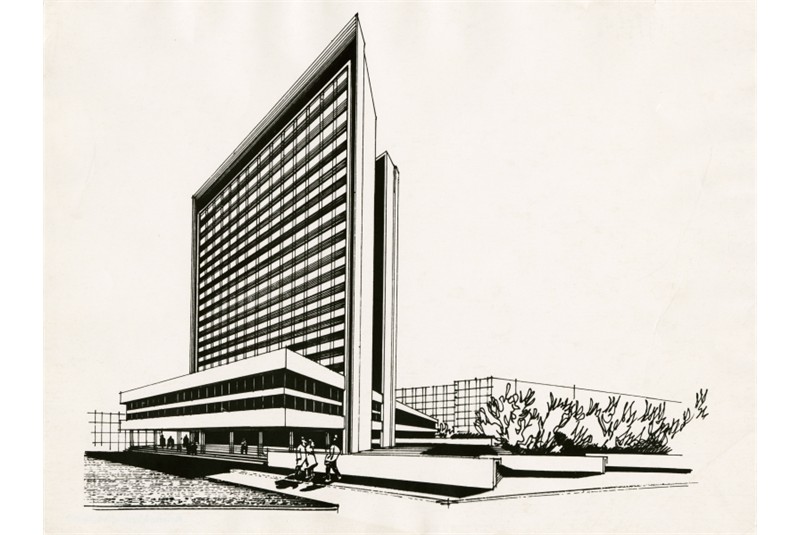
Port co-authored two hundred and fourteen architectural projects. Most of them were realised and nearly half of them were "type" projects which were repeated in different places. As a member of a collective he designed important high-rise buildings of Tallinn: the headquarters of the Communist Party (now the Ministry of Foreign Affairs), the Viru Hotel and the House of Designers (Ojari 2012). The fact that one man directed both architectural education and urban planning for almost forty years, and was the chairman of the Architects Association for twenty-five years, shows how personality-centred and stubborn was the power apparatus of the time. In this context the fact that Mart Port was not a member of the Communist Party was an exception that proved the rule – the Soviet state was not run by law, but men (Lewin 2005).
A few months after the collapse of the Soviet Union, architect and artist Leonhard Lapin published an article in which he bluntly summarised the 1970s in Estonian architecture as young Estonian architects vs. Mart Port: «The official architectural life of Soviet Estonia was dictatorially ruled by the gold-mouthed Mart Port, who, both in his words and cartoons, created beautiful visions of the triumph of communism in ideal cities of the future with rushing people and cars» (Trapeeż 1991). Opponents would call him a non-partisan party member. But the image of Port as a power-hungry leader during the Soviet era did not last long. Over the years, emotions dissipated, and as generations changed, his legacy has been reconsidered from different perspectives. Already in 1999, architectural historian Triin Ojari interpreted his oeuvre outside of the trauma narrative and called for an analysis of Soviet-era urban planning in the broader context of the 20th century modernisation processes (Ojari 1999). The media also continued to be interested in him because his opinions were expressed explicitly and he looked at everyday life from a distinctive perspective (Paulus 2004). If he once criticised the inflexibility of the Soviet construction system, now he condemned the narrow-mindedness of planning based on private capital and the lack of a central authority protecting the interests of the people (Ojari 2012).
<The travels of Mart Port
In 1958 Port became a member of the Estonian Society for the Development of Friendship and Cultural Ties with Foreign Countries, which was subordinate to a Moscow-based Soviet organisation that had been active for about twenty years. The association had an affiliate, the USSR-Finland Friendship Society, which in turn had an Estonian SSR-Finland section, of which Port was a member. This explains why and how Port travelled so often.
Together with the Society for the Development of Cultural Ties with Estonians Abroad, the aforementioned society published its own weekly «Kodumaa» (Homeland) from 1958 to 1991. The newspaper spread Soviet propaganda among Estonians living abroad, reporting every week on how this or that compatriot had decided to return to Estonia or how residents of the Estonian SSR could travel freely around the world. Mart Port's articles or stories about him appeared regularly in the newspaper (Port 1963, 1968, 1975, 1985; Raudsepp 1972). The Estonian exile communities were openly critical of the society and its newspaper. An emigrant newspaper put it bluntly: «The society has been operating in the Soviet Union for several decades and it has long been known that it performs intelligence and surveillance functions abroad and monitors foreigners entering the Soviet Union» ("Demobiliseeritud punasõdurid jäävad Eestisse" 1960). Since the KGB managed to destroy or transfer to Russia the Soviet secret police archives concerning Estonia, it is extremely difficult or impossible to establish how involved Port was in foreign intelligence services and the secret police and to what extent he had to report on his Estonian colleagues or on Estonians abroad (Leivat 2016). In the absence of documentary evidence, the hypothesis must be set aside. In chronological order, Mart Port's files allow the following trips outside the Soviet Union to be listed:
1957 Finland (tourism), Sweden (tourism) and the German Democratic Republic (GDR) (tourism)A trip marked as "tourism" was typically a group holiday organised by the Soviet Association of Architects (SAA), for which each Soviet republic had one or two places available. Moscow sent out the information to all the republics and the local architects' association chose the names of people to send to Moscow for approval. The itinerary, places to visit, visits to architectural studios, hotels and restaurants were organised by the SAA, but all expenses were borne by individuals. It was a rather expensive pleasure that few could afford. As can be seen, Port only made tourist trips to socialist countries and to Finland and Sweden, which were also cheaper because they were closer.
By comparison, architect Raine Karp recalls that his three-week trip to the United States in 1974 cost 1000 rubles, while his salary was 90 rubles a month. The trip therefore cost him a whole year's salary (Karp 2025). According to Karp, he could only afford such an expense because he lived with his parents and had minimised all his expenses.
Port visited East Germany most frequently (10 recorded trips) and Finland (five). There is no information about his trips abroad between 1976 and 1986 (apart from a reference to a paper presented at a conference in Athens between 1975 and 1980). This does not mean that Port did not travel during those years, only that, for some reason, his trips were not recorded or the administrator did not see fit to enter that data. According to Karen Jagodin (2025), many architects have incomplete records of their trips abroad. In 1979 Port lost his position as head of the SEAA, which led to a reduction in the number of government-paid representative trips abroad. However, this must not have been enough for him not to travel at all, since he was still at the top of the list in Moscow and continued to head the most important design institute in the Estonian SSR. When he was labelled as a "delegate" he travelled abroad as a representative of Soviet Estonia or the Soviet Union, for example to attend a congress.
Travels within the Soviet Union
Although the Soviet Union with its sixteen republics was one country, a permit was required to travel within the Soviet Union. Obtaining one was usually not difficult (Jagodin 2014). Researching and understanding Estonian architects' travels and exchange of ideas within the Soviet Union is more challenging than the topic of foreign travels. Similar to visual art, history of Estonian architecture is directed towards the West and local developments have been viewed against the backdrop of trans-Atlantic tendencies. On the one hand, this is understandable, because despite of its metropolitan status, the cultural role model of Moscow was minimal for Estonian art and architecture. Also in the memoirs by architects who lived during the Soviet period, Moscow is commonly presented as a negative place of no interest.
For example, Raine Karp has manifested that everything related to Russia made him so disgusted that he had no desire to visit Moscow or Leningrad voluntarily: he only did so in connection with foreign trips (flights started from Moscow) or on a couple of occasions to get signatures for design projects (Karp 2025). If we exclude the impact of Russian constructivism for the young architects of the 1970s, it is challenging to point out (voluntary) influences from Russia on Estonian architecture.
On the other hand, such a derogatory and selective view on Moscow and Russian culture conceals how active was the actual relationship of the Estonian cultural field with other Soviet republics and especially its political and ideological centre, Moscow. In 1970, seven million people lived in the capital of the Soviet Union, and this number grew steadily by about a million inhabitants over a ten-year period during the Soviet period (Vodarsky 1993). Moscow represented academic and technological might and was the epicentre of international communication which no doubt attracted and drew thousands of technocrats to its opportunities.
Work meetings, national and international congresses also sent Mart Port to Moscow. Since no records were kept of intra-Soviet travels in the personal files of the Association of Architects, it is unclear how many times he did so exactly. Port was elected a member of the Board of the Union of Soviet Architects in 1955 and a member of the Presidium of the Board in 1961, which meant very close contact with colleagues in Moscow. It also brought obligatory participation in the architectural life of other Soviet republics like attending congresses or participating in the jury work of competitions. For example, it is known that Port attended work-related events in Georgia in 1962 and 1972, Uzbekistan in 1971, Lithuania 1974 and Azerbaijan in 1984 ("Kes? Kus? Mis?" 1962b; "Oli ja on" 1971a; "Oli ja on" 1974b; "Arhitektide Liidus" 1972; "Arhitektide Liidus" 1984).
In 1958, the 5th Congress of UIA was held in Moscow. Port attended and later published an article about it in the Soviet Estonian cultural weekly (Port 1958). Attending this congress and getting a taste of international networking gave him a direction for the following decades. Port noted in his article, delegates from forty-four countries attended the meeting with eight hundred of them from capitalist countries and three hundred from the socialist bloc. The leitmotif of the conference was the statistical verdict that if the population of the world continues to grow by one billion in every twenty-five years, then it will be necessary to build 5,000 new cities for 200,000 inhabitants every quarter a century. Such a sociological perspective and urban planning imperative became Port's main theme both as an architect and architecture writer.
It was customary for local newspapers ("Kes? Kus? Mis?" 1962a; "Arhitektide Liidus" 1965; "Arhitektide Liidus" 1972) to report about Union-wide gatherings of architects in Moscow (Port 1965b). Sometimes Port represented Estonia alone, but occasionally the Estonian delegation was larger. For example, at the Sixth Congress of Architects of the USSR, held in the Kremlin's Grand Palace in November 1975, Port was joined by the chief architect of Tallinn, Dmitri Bruns, the head of the architecture department of the Estonian State Institute of Art, Prof. Helmut Oruvee, the Chief Architect of the State Design Institute Eesti Maaehitusprojekt (Estonian Rural Construction Project) Boris Mirov and architects Valve Pormeister, Raal Kivi, Paul Madalik, Toomas Rein, Irina Raud and Valentin Zilbert ("Oli ja on" 1975b). The content and form of these meetings varied. Some were more formal, others more substantive and academic. For example, while preparing for the 1975 UIA Congress in Madrid, Moscow held an All-Union "creative discussion" to set forth the talking points agreed by the architects from the Soviet Union ("Oli ja on" 1974b). A few months later, Port and the Vice-Chairman of the Union of Estonian Soviet Architects, Voldemar Herkel, were back in Moscow for the IX Joint Plenum of the State Committee for Civil Engineering and Architecture and the Board of the Union of Soviet Architects, where the construction of public buildings according to standard designs was discussed ("Oli ja on" 1975a).
Architect Ülo Stöör has recalled that when he was in Moscow in 1970 for the Congress of the Union of Architects of the USSR, one of the opening speeches was given by Mart Port, who earned a rapturous applause from the entire hall after his very first sentence. He had manifested that «if the question of war and peace were not the most important point of discussion in the world, it would be the question of architecture» (Stöör 2025). In the Soviet Union, where people were used to Leonid Brezhnev's four-hour speeches and the subsequent fifteen minutes long applauses, the meaning of such speeches and the reactions that followed were a ritualised practice (Yurchak 2005). Such public utterances repeated well-known truths, while at the same time it was a spectacle involving the entire society. It formed a performance against the backdrop of which actual decisions were taken.
It is an inescapable fact that whatever Port and other Estonian architects took part in Moscow, their participation confirmed the supremacy of Moscow's political rule. On the other hand, Estonian architects tried to resist Moscow's colonising, sovietising and Russifying practices through individual and collective strategies by using a wide variety of methods. The general opinion is that Port, too, tried to play cat-and-mouse with Moscow (Kalm 2012), but fared much worse than, for example, his counterparts in Lithuania, where architects retained moral and actual power over construction (Drėmaitė and Maciuika 2020). Reading Port's articles and speeches, it is challenging to conclude what his exact political agenda was. On the one hand, Port was incessantly and sharply critical of the monotony of Soviet cities (Port 1958), of the sloppiness of construction (Port 1961) and of the poor quality of materials ("Vanad linnad uuenevad" 1968). On the other hand, until the end of his life, he seemed to believe in the humanist project of socialism (not to be confused with Soviet rule), believing that private property was not beneficial to urban planning and that building and real estate management should be a state monopoly (Port 1961). He was by no means a die-hard communist, but as a technocrat[3] seemed to genuinely believe in socialist modernisation and architecture's leading role in making the world a better place (Port 1964). Even as late as 1985 he did not hesitate to quote several lines from Leonid Brezhnev, which must have made colleagues scratch their heads. Port concluded this very article with the demanding words: «In the Soviet Union and other socialist countries the ultimate goal of architectural design and construction is to solve major social problems. And this in the interests of all segments of the population on an equal basis» (Port 1985).
Learning from the Eastern bloc
In 1957, Mart Port received the first prize at the All-Union Young Architects Competition in Moscow, the prize of which was a fifteen-day trip to the German Democratic Republic (Estonian Academy of Arts Archive). He made at least eight more trips there. Thus, contact with German colleagues and learning from them was an important influence for Port. In addition to his excellent command of Russian and English, Port also spoke German. It can be assumed that in the case of East Germany, Port sympathised with the historical connection between the two cultures and the similar problems of Estonian cities in terms of preserving historical old towns.
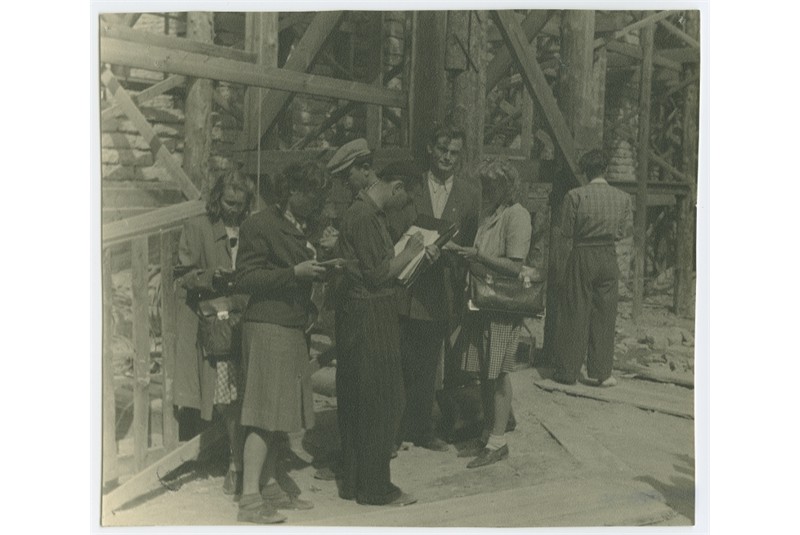
For example, in 1968 Mart Port and urban planners Malle Meelak and Hain Karu participated in a two-week-long study trip in GDR with a focus on renovation of historic town centres. They also attended a conference on urban planning with participants from all the countries sharing the Baltic coast – the Soviet Union was represented by the Estonian SSR. As Tallinn was the only Soviet capital with a medieval Gothic town core it was vital to learn from Germany where – to use Port's own phrase – there were such towns on every footstep ("Vanad linnad uuenevad" 1968). During this trip, Estonian architects visited Bautzen, Berlin, Gera, Jena, Leipzig, Stolpen and Weimar where local urban planners advised them about the preservation of medieval town cores, the removal of vehicles and transport from the old town, keeping larger new houses away from the centre, respecting the historical nets of streets, and also the emerging issue of mass tourism. Two years later in 1970 Port participated in a colloquium in another former Hansa town Rostock.
At that time Tallinn was preparing to renew its master plan and for Port the key take-aways from these trips were that every town has to evolve around its historic core – the denser the centre, the better it is. He also pointed out that any town which has access to water (sea, river etc.) should design its centre accordingly ("Vanad linnad uuenevad" 1968). It is interesting here Port's argumentation is similar to that of the critical urbanists of the time, such as Jane Jacobs in the US. However, in the same interview Port still claims that in order to accommodate future car traffic, it is nevertheless necessary to demolish old buildings in the centre to make room for high-rise buildings and more intensive urban life.
Mart Port emphasised the good practice of the German Democratic Republic to organise architectural competitions for major public buildings and urban planning commissions. Port complained that in Estonia, at that time, there was at best one competition per year and this was causing stagnation.
Here again, Port's habit of criticising – or even whining about – the Soviet context is problematic, because he himself was in the position to potentially improve the situation. It seems that Port had adversely accepted the status quo in which the price per square metre of construction was the supreme aspect of Soviet architecture. For example, he would ironically compare a Soviet architect to a writer who is commissioned to write a multi-volume novel, even though it is known that the printing house lacks two-thirds of the alphabet and that the letters a, c, and k can only be used 154 times, because more is simply not provided for – but the work must nevertheless be grandiose, up-to-date, progressive, and positive (Summatavet 2015).
On the other hand, he worryingly lamented that if the cost of buildings in the Soviet Union were to increase by even one percent, each year a city with a population of 100,000 would not be built (Stöör 2025). One gets the impression that he used the rationalisation principle both as a positive or negative argument according to his needs.
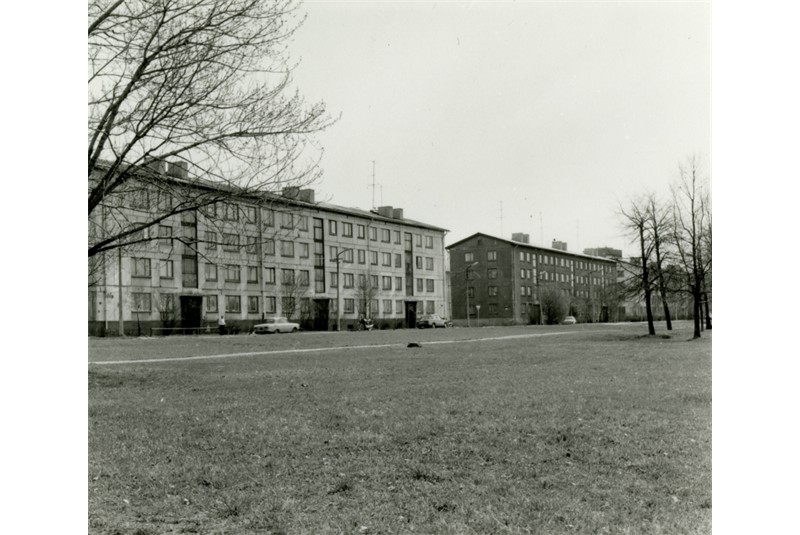
Drawing on his experience in East Germany, he fought vigorously, at least in words, for the preservation and reconstruction of Tallinn's old town and argued that it was a value that could not be put into money (Port 1967). In the same way, he berated the officials for having raised the idea of building prefabricated houses in the wooden district of Kadriorg (Nääriintervjuud. Mart Port 1971). On the other hand, it is hypocritical to stand up for two districts of Tallinn, while at the same time he orchestrated the design of all major standardised residential districts in Tallinn, in addition to Annelinn in Tartu, Männimäe and Paalalinn in Viljandi and was also one of the creators of the 1-317 series of standard apartments which engulfed the whole country and became the symbol of Soviet rule.
Apparently, even after the collapse of the Soviet Union, Port was heard praising the environment of the pre-fabricated districts at one of the summer events of the Union of Estonian Architects, saying something like: «There is a lot of light in these apartments, not like in the old town, where the living spaces are dark. The houses are quite far from each other, not sitting on top of each other like in today's new housing estates. You can get to the city from home by bus or tram, you don't have to have a car, there are shops nearby, you won't go hungry if your car tire is flat...» (Mutso 2011). As the author concluded, everything sounds correct, but for some reason Port himself preferred to live in the bourgeois Nõmme and Pirita suburbs of private houses.
Returning to the GDR's practice of organising open architectural competitions praised by Port, in 1973 Estonian architects Kalju Luts (head of the authors' collective), Mart Port, Lembit Aljaste and Vello Erman took part in an international competition to design the Grosser Dreesch community and shopping centre in Schwerin's new residential district ("Eesti arhitektide rahvusvaheline edu" 1973). Although the Estonian authors shared the first and second place with their colleagues from the German Democratic Republic, their project did not go ahead. The Grosser Dreesch is considered Northern Germany's largest prefabricated housing estate. Starting in 1971, apartments for a total of around 60,000 people were built on the empty field on the outskirts of the city. The competition called for the design of a district centre, including a department store, hotel, hospital, restaurants, cafés, beer halls, library and swimming pool. In order to do this in two months, the authors divided the work between them: Kalju Luts designed the commercial part, Vello Erman the hotel and youth club, Lembit Aljaste the cultural centre, and Mart Port put it all into an urban ensemble.
Port's close interaction with East German counterparts and learning from their accomplishments and mistakes is a good illustration of what was generally lacking in the architecture of the countries under Soviet rule during this period.
It took years for best practices to find a way into Estonian architecture. For local architects, international success was an important sign that the right thing was being done. It boosted their self-confidence and sense of mission. It also helped in disputes with local authorities and builders. One direct example was the construction of the Õismäe housing estate. Mart Port and Malle Meelak planned a pond in the middle of the new town, which the city's executive committee did not agree with – a park would do. Port collected all the views of ponds and fountains from his slides archive and made a powerful defence speech, which allegedly helped to realise the fundamental idea of the project (Mürk 1986). However, Port was unable to convince the city administration that the houses in Õismäe should be raised on see-through pilotis as popularised by Le Corbusier.
Besides GDR, Port made several trips to Yugoslavia (1961, 1975), Czechoslovakia (1958, 1963), Poland (1963) and Hungary (1963, 1975, 1988). The Soviet Estonia's intelligentsia's trips to the Eastern bloc countries must have been so frequent that it also happened that acquaintances from Tallinn unexpectedly met each other in another country. Thus, in one of his articles, the Estonian writer Egon Rannet tells the story of how he bumped into Mart Port during an interval in the Hungarian State Opera in Budapest (Rannet 1965).
As with Port's other journeys, he exemplified his aesthetic and technical experiences from the Eastern bloc in his writings. For example, in his 1973 essay "Man and City", he argued that one of the main reasons why Soviet Estonian housing architecture is so monotonous is that it is built only from precast concrete slabs, rather than monolithic concrete cast on site (Port 1973). He then gave several examples from his travels around the Soviet Union and the socialist countries (Armenia, East Germany, Hungary, Poland, Soviet Russia) arguing that new solutions could also be used in Estonia: «All these methods deserve to be studied and adopted in the building practice of our republic, otherwise we will fall further and further behind our neighbours every year». A few years later, the construction of the monolithic concrete Kuldne Kodu (Golden Home) terraced house designed by Toomas Rein began in Pärnu, which became one of the landmark apartment buildings of the Soviet period (Kalm 2008). Although the project was not directly connected with Mart Port nor the Eesti Projekt design institute, it was still inspired by the different types of contemporary housing seen elsewhere in Europe, and especially in Finland.
Finland – a special friendship
As in the case of many other Estonian architects, Port's very first trip abroad during the Soviet period was to Finland in 1957[4]. In two weeks Estonian architects experienced Helsinki's historic and new buildings, as well as the town of Hämeenlinna, Tampere (including its Lenin House Museum) and Turku. Port also visited Finland in 1964, 1967, 1968 and 1972 – in many cases as the tour leader of a group of Estonian architects. These trips to Finland initiated a widespread Finnish-inspired architectural language in Soviet Estonia. It was significant to get acquainted with the new residential areas and the building quality of Finnish public and private architecture. The examples of the Tapiola and Pihlajamäki housing estates played a substantial role in shaping the nature-oriented design of the new estates in Estonia (Metspalu 2019).
In this sense, trips to Finland were not only inspirational, but had an actual effect on the built environment. On the other hand, visiting Finland could also have a depressing effect as the quality of building materials and workmanship in the Soviet Union was hopelessly poor and took away the desire of the architects to work. For example, Raine Karp has described the confrontation between the two worlds as a deeply revolting experience (Karp 2025). Writing on the same subject in 1968, Mart Port was more diplomatic in his choice of words: «It is very instructive for us to become acquainted with the high culture of workmanship and the enviable precision of the Finnish builders, manufacturers of building materials and furnishings, which enables the most demanding intentions of architects to be realised without distraction» (Port 1968). Truth is probably somewhere in the middle. For example, architect Riina Raig, who besides Finland managed to travel to Bulgaria and India during the Soviet period, has said that "Finnish wisdom" (functionality, minimalism, clarity) was the easiest to apply (Raig 2025).
Architectural historian Karin Hallas-Murula, who has researched Estonian-Finnish architectural relations, has pointed out that during the late-Soviet period learning and borrowing from elsewhere was a positively valued aspect of the architectural field. In this context, copying or mirroring was not something to be ashamed of, but quite the contrary: to do what was done abroad was seen in itself as a guarantee of quality (Hallas-Murula 2005). Incidentally, such a collective view on architecture also meant that Mart Port and his generation (who dominated until the mid-1970s) adopted the attitude that architecture was an anonymous phenomenon – or at least that it was an inevitable aspect of the coming to terms with modernisation in the Soviet Union.
During the trips to Finland several Estonian architects made life-long friendships with Finnish colleagues who would later become their vital physical link and spiritual beacon for the remaining decades. It was customary that when Estonian architects had the option to travel to Finland, their Estonian colleagues who had previously been there would help to arrange meetings with local architects or cultural people. In this way, many Finnish architects started to visit Estonia regularly. As Port was a member of the Estonian SSR-Finland Friendship Society, he was also able to plan study trips for Estonian and Finnish architecture students to their neighbouring countries (Port 1968). Within the framework of this cooperation, an exhibition of Finnish post-war architecture was held in Tallinn in 1968, accompanied by a small catalogue (Soome arhitektuur 1968).
On a Moscow-organised trip to Finland in 1972, Estonian architects visited Alvar Aalto's studio together with colleagues from other Soviet republics. Although Aalto was at work, architect Ülo Stöör, who was also on the tour, said that the great Finn made it clear that he would only receive old friends. As Stöör watched twenty or more architects working in the open studio, translating Aalto's visionary sketches into architectural drawings, he was reminded of Mart Port's earlier words: «Our young architects just don't know how many opportunities they have to excel in competitions and as project authors, but in a foreign office you are a nameless collaborator» (Stöör 2015).
This is yet another example of Port's double-speak, because at the same time he would accuse the Soviet Estonian architectural scene for organising only a few competitions a year. Port's criticism of the anonymity of the twenty people working in the Aalto office is surprising, since his own design institute employed 600 people and ultimately all the active Estonian architects were divided between five large design offices. When Port lost his position as the head of SEAA in 1979, he was precisely accused of having undermined the identity of the architect as an intellectual profession. On the other hand, there was some truth in Port's reasoning, as internal design competitions were common in Estonian design institutes and, as a director, Port participated on an equal footing with his colleagues (Stöör 2025). Architects who worked at Eesti Projekt have said that Port would often propose his own solution for each new project, but if a subordinate architect came up with an even better idea, he supported it. Not all the architects at Eesti Projekt were as talented as he was, so it is likely that Port indeed co-authored more than a hundred projects (Kalm 2012).
Elsewhere in Europe
In 1958 Mart Port spent fifteen days in Belgium as a USSR delegate to the Brussels World's Fair. Somewhat surprisingly, Mart Port did not write about the experience in the Estonian press. Given the political and cultural context of the extravagant event, it was bound to leave an unforgettable and mixed impression on visitors from Soviet Estonia. It was the first major world's fair after the Second World War and the occasion attracted some 41.5 million visitors, making it the second largest World's Fair after the 1900 Exposition Universelle et Internationale de Paris. It was also the first opportunity for the politically divided Europe to learn about the technological and cultural developments in the socialist camp. At the time, Europe's old imperial powers were struggling with the independence aspirations of their colonies. Decolonisation was also supported by vocal home-grown critics. The ideological stakes of EXPO'58 couldn't be higher. Looking at the articles published in the Estonian press about the World Exhibition, the wealth experienced in Belgium truly disturbed the authors, who saw behind it the slave labour of millions of Africans and the illegal appropriation of natural resources (Peterson 1958). Port fiercely criticised such wealth built on injustice when writing about the United Kingdom.
Understandably Port could not write at the time that Russia and Estonia were in a similar colonial relationship. EXPO'58 also had the added significance that the expat Estonians, Latvians and Lithuanian who had fled the Soviet occupation, made themselves visible to the Belgian public through protests and public appearances, to show the free world «what a crime the Soviet Union committed when it strangled a small country» ("Eestlased tuhamägede all" 1958). During the Second World War 70 000 people emigrated from Estonia, many of them from the technical and cultural elite. As the Stalinist years had a devastating effect on the country, it has been pointed out that even in the 1960s Estonian cultural life was more active in exile than at home. For example, in 1965 more Estonian-language literature was published abroad than in Soviet Estonia (Hasselblatt 2016). However, the expat cultural life was almost entirely separate from that of the homeland and, moreover, fragmented all over the world. Against this backdrop, the Soviet authorities naturally tried to prevent and play down cultural encounters between Estonia and "non-Estonia".
At the same time, however, expat Estonians made a very big thing of foreign trips by "home" Estonians. For example, when Port was in Sweden for two weeks in 1959, the local Estonian-language newspaper manifested: «After a long break, a group of tourists from occupied Estonia is now in Sweden, about 5 people, including architects Edgar Velbri and Mart Port (born 1921). They stayed at the Kristineberg Hotel, are currently touring Sweden and will return to Stockholm at the end of this week» ("Turiste Eestist Stockholmis" 1959). The newspaper's rather aggressive and accusatory form of expression suggests a division within the émigré Estonian community. There were those who were in favour of cutting off all communication with occupied Estonia and those who were in favour of a more moderate attitude. When Port was back in Sweden seven years later, another Estonian newspaper reported, «One of the best-known architects of the younger generation from occupied Estonia is in Sweden, and he came to see Swedish hotels in order to get acquainted with the architecture of modern hotels». In Tallinn, a new hotel of Western standards is to be built ("Arhitekt tuli hotelle vaatama" 1966). The hotel is question is the Viru hotel in Tallinn, designed by Mart Port and Henno Sepmann which opened in 1972 (Nupponen 2007).
Architectural history to date has not identified any direct references to Swedish architecture in the Viru Hotel. It is clear that the building spoke a similar modernist architectural language to that of the city centres of Brasilia, Rotterdam or, as a closer example, Arne Jacobsen's SAS Royal Hotel in Copenhagen (1960). On the other hand, there can be no doubt that Port was affected by the demolition of historic Swedish town centres, which had escaped the war entirely, and their replacement by new high-rise buildings. Such action may have had the short-term and ostensible effect of densifying and activating city centres, and it is interesting to wonder whether Port saw this process as a genuinely socialist clever urban planning or as a trap set by the capitalists. As historians have later shown, this devastating process, driven by consumerist ideology, was covertly and secretly supported by Swedish banks and corporations (Johansson 2011). Whatever was Port's view, both he and Tallinn's chief architect Dmitri Bruns must have found it useful to place a gigantic building with a strict geometry right next to Tallinn's Old Town. This decision set the future direction of the city.
From this perspective, it is rather paradoxical that when Port visited Italy in 1961, he criticised the 1958 Pirelli Tower in Milan, designed by Giò Ponti and Pier Luigi Nervi (Port 1963). Without a bad word to say about the building's architecture or the quality of its construction, he found that «towering above the surrounding old houses, it is one of the outstanding rocks on which modern Western architecture rests». In his article, Port used the metaphor that while in the middle of the ocean, a few cliff tops (the most prominent representatives of the culture) rise up, deep beneath the water at the bottom of the ocean, the underclass and the poor are hidden. Using Pirelli Tower as a parable for the whole Western world, he concluded that capitalist architecture relies on individual phenomena, such as new skyscrapers, large corporate administrative and industrial buildings, luxury hotels, bank houses, single-family homes and housing complexes for the wealthier classes. Port boasted that in the Soviet Union things were the other way round: «In our view, the first priority must be to build a large number of the most necessary, economical buildings of a satisfactory standard for the broadest sections of the population. Throughout the year, day and night, every twenty minutes, a giant Soviet construction machine churns out a new 80-apartment, five-storey building». By the end of the 1960s, the "ocean" in Tallinn must have been taken care of enough to start building a spectacular hotel exclusively for tourists and "socialist consumerism".
As this article was published in a propaganda newspaper for Estonians abroad, it is understandable why Port, like other Soviet authors writing about Italy, used such figurative language in his article, trying to construct a reductive image of the capitalist West and its societal fundamentals, and contrasting it with a positive Soviet society (Kõvamees 2011). It is known that Mart Port shared his Italian travel impressions with students and lecturers of the Civil Engineering Department of Tallinn Polytechnic Institute (Sellik 1961). He illustrated his presentation of contemporary Italian architecture with a wealth of photographic material. Such slideshow presentations to family members, friends and colleagues were common during the Soviet period and it can be assumed that the content of the presentation varied according to the audience.
In England through the eyes of an Architect
Literary scholars have found that travel books ranked second only to novels among the literary genres read during the Soviet period (Kõvamees 2011). Travel books were read as a pastime and also for self-improvement, as the information they provided was very graphic and emotional. In 1961, when Mart Port spent fifteen days in England with a Soviet delegation at the UIA Congress, he used his impressions of the trip to publish a small-format but densely text-filled 218-page travel book with a print-run of 12 000 (Port 1966). In the Estonian context, this is an exceptional book, as no architect before or since has published a book on a single journey.
From an architectural point of view, the book is of particular interest for the first-hand experience Port shares of England's post-war new towns like Coventry and Stevenage. He wrote with particular enthusiasm about Coventry and the way it had created a pedestrian-friendly and car-avoiding environment in the city centre. It was in England that Port first encountered the explosion of private car ownership sweeping the western world, and he devoted a whole chapter of his book to the subject. Port's attitude to cars was critical, but as with many other issues he took it as inevitable and rejoiced in the fact that while in capitalist countries cities had to be retrofitted to accommodate car traffic, in the Soviet Union they knew how to plan for such things twenty-five and fifty years in advance.
Port took the view that linking historic city centres and new towns with wide highways was unavoidable, but that ideally cars and people should be separated – as he later did in Lasnamäe. The theme of car congestion was echoed in his later articles, which painted the western cities in even darker tones (Port 1965a). He claimed, for example, that in West Germany, about 40,000 people were killed in traffic every year. Although the actual number of fatalities was not much better at 16,494 (Road traffic accidents 2025), such an exaggeration in speaking of the evils of the West seemed to be his habit. When Port gave a presentation at the 12th Congress of the International Union of Architects in Madrid in 1975, he focused on the then still unbuilt Lasnamäe housing estate project, «where special attention is given to the protection of the environment and the isolation of motor traffic from residential areas and the main pedestrian routes» (Port 1975).
However, leaving aside the issue of new towns, it is a highly opinionated piece of writing, typical of the era, and it requires a lot of patience from the reader to get through the ideologically dense text. In his fleeting touristic glimpse, he draws fundamental conclusions about English society and capitalism more generally. Throughout, the book depicts the bottlenecks of capitalist society, the struggle of working people (the "real English people") to cope with low wages and high prices. Against all this, the reader is given a sense of how good life is for the working man in the Soviet Union. Added to this is the separate theme of the morally stunted West (film industry, pornography) and the view that capitalist culture is interested in the sick psyche and makes everything for money. In keeping with the genre, he is negatively condescending towards religion, expressing the Soviet view that religion stifled clear thinking (Kõvamees 2011).
Conclusion
If so far in Estonian architectural history it has been common knowledge that Port was a rationalist and a pragmatist, a good architect and an excellent writer, but a cynic who grew bitter when he could no longer do better, then analysing his trips abroad and the writings based on them adds another aspect. The Iron Curtain was by no means as impenetrable as it is sometimes presented. Port, like hundreds of other Estonian architects and engineers, travelled the world and brought that knowledge back to Estonia. Port was particularly active in doing so, holding positions of power in several institutions. In addition, he strove to make his views known to the wider public. We can assume that many good things happened in Estonian architecture thanks to Port’s foreign travels, but on the other hand, it must also be admitted that Port developed a rather inflexible image of both Western life and the Soviet system at an early age, which he tended to repeat in his architectural writings for the rest of his life. The problem is that, writing from such a high position, his opinions also tended to construct reality.
[1] «Pravda» was the official newspaper of the Central Committee of the Communist Party of the Soviet Union and was one of the most influential papers in the country with a circulation of 11 million.
[2] People’s Architect of the USSR was an honorary title granted to architects of the Soviet Union. The title was bestowed upon architects who had achieved significant results in Soviet architecture’s development either applying their expertise and creativity to the urban planning or to the design of important building compounds for civil, industrial or rural use (Johnson 2011). Altogether forty-five people were awarded the title. The Soviet Union singled out four honoured professions: artists (including performing arts and literature), teachers, doctors and architects. As these titles were granted by the government, honorees were afforded certain privileges (e.g., possibility to travel or acquire a car). Members of the creative intelligentsia were conferred upon four tides: Honored Artist, Honored Figure of the Arts, People’s Artist of the Republic and the People’s Artist of the Soviet Union. On republican level there were dozens of other honorary titles such as Honorary Social Care Worker or Honorary Forestry Worker. Yet, the most prestigious award was People’s Artist, Teacher, Doctor or Architect of the Soviet Union, which could be conferred only by the all-union government. A total of 1006 people were awarded the title of People's Artist of the USSR – including nineteen from Estonian SSR.
[3] His faith in numbers is well expressed in an article on the synthesis of the arts, where he justifies the necessity of monumental art through the effectiveness of art’s visibility. Based on the number of members of the Artists’ Union, adding to this the amount of amateur artists, and making assumptions about the annual productivity of artists, Port suggested that in twenty years in Soviet Estonia, 40,000 to 50,000 original artworks were created, 12,000 of which were seen about 15% of the population in public exhibitions, with each viewer looking at one work for 30 seconds. Port called for more effective engagement that only publicly visible monumental art could offer (Port 1964).
[4] Architect Voldemar Tippel was able to to film the trip. Tippel’s family has made the film available on Youtube: https://www.youtube.com/watch?v=KUlNi4wU_ww (last accessed 31 March 2025).
"Arhitektide Liidus" (At the Association of Architects) (1964) – Sirp ja Vasar, 17 April.
"Arhitektide Liidus" (At the Association of Architects) (1965) – Sirp ja Vasar, 29 October. ↩
"Arhitektide Liidus" (At the Association of Architects) (1972) – Sirp ja Vasar, 8 December. ↩ ↩
"Arhitektide Liidus" (At the Association of Architects) (1984) – Sirp ja Vasar, 25 May. ↩
"Arhitekt tuli hotelle vaatama" (The architect came to see the hotels) (1966) – Eesti Päevaleht, 13 October. ↩
BELOGOLOVSKY V. (2014) – "Re-examining Soviet Modernism". In: U. Lukševics, L. Leitāne-Šmīdberga, Z. Jauja, I. Veinbergs and M. Rusiņš (eds.), Un-written: Exhibition of Latvia at the 14th International Architecture Exhibition – La Biennale di Venezia. NRJA, Riga. ↩
"Eestlased tuhamägede all" (Estonians under the mountains of ash) (1958) – Vaba eestlane, 12 November. ↩
Estonian Academy of Arts Archive. Mart Port's personal file, 1955–1989. ↩
"Demobiliseeritud punasõdurid jäävad Eestisse" (Demobilised Red Army soldiers remain in Estonia) (1960) – Meie Kodu, 19 May. ↩
DRĖMAITĖ M. and MACIUIKA, J. V. (eds.) (2020) – Lithuanian Architects Assess the Soviet Era: The 1992 Oral History Tapes. LAPAS, Vilnius. ↩
"Eesti arhitektide rahvusvaheline edu" (International success for Estonian architects) (1973) – Kodumaa, 26 December. ↩
GORSUCH A. (2006) – "Time Traveller. Soviet Tourists to Eastern Europe". In: A. Gorsuch and D. Koenker (eds.), Turizm. The Russian and East European tourist under capitalism and socialism. Cornell University Press, London. ↩
HALLAS-MURULA K. (2005) – Soome-Eesti: sajand arhitektuurisuhteid [Finland-Estonia: a century of architectural relations]. Estonian Museum of Architecture, Tallinn. ↩
HASSELBLATT C. (2016) – Eesti kirjanduse ajalugu (History of Estonian literature). Tartu University Press, Tartu. ↩
JAGODIN K. (2014) – Bringing the West Home. The Encounter With Western Countries and the Representation of the Experience of Estonian Architects in 1950s-1970s. [PDF] MA Architectural History Report. Bartlett School of Architecture, UCL. ↩ ↩ ↩ ↩ ↩
JAGODIN K. (2025) – e-mail correspondence with the author, 10 March, in the author's possession. ↩
JOHANSSON B. O. H. (2011) – "The post-war destruction of Swedish cities". Building Research & Information, 39 (4), pp. 412-429. ↩
JOHNSON O. (2011) – "The Stalin Prize and the Soviet Artist: Status Symbol or Stigma?" Slavic Review, 70 (4), pp. 819-843. ↩
KALM M. (2008) – "Exploring the Soviet 'Golden Home' Project: the 'Reworking Modern Architecture' workshop in Pärnu". Docomomo Journal 39, pp. 44-45. ↩
KALM M. (2012) – "Mart Pordi Kalevipoja mõõtu jälg" [Mart Port's footprint the size of Kalevipoeg]. Sirp, 10 February. ↩ ↩ ↩ ↩
KARP R. (2025) – Conversation with the author, 19 March. Notes in the author's possession. ↩ ↩ ↩
"Kes? Kus? Mis?" (Who? Where? What?) (1962) – Kodumaa, 21 February. ↩
"Kes? Kus? Mis?" (Who? Where? What?) (1962b) – Kodumaa, 28 February. ↩
KÕVAMEES A. (2011) – "Itaalia konstrueerimine nõukogude reisikirjas" (The construction of Italy in Soviet travel literature). Methis 5 (7), pp. 149-159. ↩ ↩ ↩
KURG A. (2009) – "Architects of the Tallinn School and the critique of Soviet modernism in Estonia". The Journal of Architecture, 14 (1), pp. 85-108. ↩
LEIVAT L. (2016) – "25 years ago, the KGB closed shop in Estonia and took its written record to Russia". Eesti Elu, 4 March. [https://eestielu.ca/25-years-ago-the-kgb-closed-shop-in-estonia-and-took-its-written-record-to-russia/] (last accessed 10 March 2025). ↩
LEWIN M. (2005) – The Soviet Century. Verso, London and New York. ↩
METSPALU P. (2019) – "Pragmaatiline planeerimine Eesti moodi" (Pragmatic planning the Estonian way). Sirp, 8 November. ↩ ↩
MÜRK K. (1986) – "Meie soov? Näha uusrajooni sellisena, nagu oleme selle kujundanud" (Our wish? To see the new district as we designed it). Rahva Hääl, 8 November. ↩
MUTSO M. (2011) – "Kas 'mägedel' on tulevikku?" (Is there a future for the "mountains"?). Sirp, 11 November. ↩
"Nääriintervjuud. Mart Port" (New Year's interviews. Mart Port) (1971) – Sirp ja Vasar, 1 January. ↩
NOOR KOLLEEG (1978) – "Mart Port, Rahvaarhitekt" (Mart Port, People's Architect). Sirp ja Vasar, 24 December. ↩
NUPPONEN S. (2007) – Viru hotell ja tema aeg (The Viru Hotel and its time). Eesti Ekspressi Kirjastus, Tallinn. ↩
OJARI T. (1999) – "Mõtlemine suurtes kategooriates. Malle Meelak ja Tallinna mäed" (Thinking in big categories. Malle Meelak and the mountains of Tallinn). Sirp, 21 May. ↩
OJARI T. (2012) – "Loorberitega ja ilma: Mart Port 90" (With or without laurels: Mart Port 90). Sirp, 6 January. ↩ ↩ ↩
"Oli ja on" (Was and is) (1971a) – Sirp ja Vasar. ↩
"Oli ja on" (Was and is) (1974a) – Sirp ja Vasar, 1 November.
"Oli ja on" (Was and is) (1974b) – Sirp ja Vasar, 20 December. ↩ ↩
"Oli ja on" (Was and is) (1975a) – Sirp ja Vasar, 21 February. ↩
"Oli ja on" (Was and is) (1975b) – Sirp ja Vasar, 5 December. ↩
PAGEL O. (2016) – "Eesti NSV turistid Soomes aastail 1955–1980" (Tourists from the Estonian SSR in Finland 1955-1980). Tuna 3, pp. 79-94. ↩
PAULUS K. (2004) – "Visionääriga Virus" (With a visionary at Viru). Eesti Ekspress, 22 April. ↩
PETERSON A. (1958) – "Muljeid maailmanäituselt. Inimene ja progress" (Impressions from the World Expo. Man and progress). Koit, 23 September. ↩
PORT M. (1958) – "Erinevad keeled, erinevad tõekspidamised, ühised eesmärgid" (Different languages, different beliefs, common goals). Sirp ja Vasar, 8 August. ↩ ↩
PORT M. (1961) – "Mõtteid masinatega toodetavast arhitektuurist" (Reflections on machine-produced architecture). Sirp ja Vasar, 3 February. ↩ ↩
PORT M. (1963) – "Ookeani põhjast ja mandritest" (Ocean floors and continents). Kodumaa, 16 October. ↩ ↩
PORT M. (1964) – "Kas ei tuleks tõsta kasutegurit?" (Shouldn't efficiency be increased?). Sirp ja Vasar, 17 April. ↩ ↩
PORT M. (1965a) – "Linn. Auto. Inimene" (City, car, man). Sirp ja Vasar, 23 April. ↩
PORT M. (1965b) – "Vastamist vajavad küsimused" (Questions awaiting answers). Sirp ja Vasar, 26 November. ↩
PORT M. (1966) – "Arhitekti pilguga Inglismaal" (In England through an architect's eyes). Eesti Raamat, Tallinn. ↩ ↩
PORT M. (1967) – "Vanad purjed ja uued tuuled ehk mis saab siis, kui kümne vürtsipoe kokkuehitamisega ühte kaubamaja ei saa…" (Old sails and new winds, or what happens when you can't build a department store by combining ten spice shops...). Sirp ja Vasar, 10 February. ↩
PORT M. (1968) – "Huvipakkuv näitus" (An interesting exhibition). Kodumaa, 12 June. ↩ ↩ ↩
PORT M. (1973) – "Inimene ja linn" (Man and the city). Sirp ja Vasar, 7 December. ↩
PORT M. (1975) – "Ülemaailmselt arhitektide kongressilt Madriidis" (From the world architects' congress in Madrid). Kodumaa, 4 June. ↩ ↩
PORT M. (1983) – Architecture in the Estonian SSR. Perioodika, Tallinn. ↩
PORT M. (1985) – "Kas seal on alati hea, kus meid ei ole?" (Is it always better where we are not?). Kodumaa, 20 November. ↩ ↩
RAIG R. (2025) – Opening speech at the exhibition "Architect's Gaze. Bringing the West Home. How was the West brought home?" Estonian Museum of Architecture, 29 March 2025. Notes in the author's possession. ↩
RANNET E. (1965) – "Elust, teatrielust ja eluteatrist (meil ja mujal)" (On life and the theatre of life (here and elsewhere)). Sirp ja Vasar, 28 May. ↩
RAUDSEPP V. (1972) – "Juubelijuttu Mart Pordiga" (A jubilee story with Mart Port). Kodumaa, 12 January. ↩
"Road traffic accidents" (2025) – Statistisches Bundesamt. [https://www.destatis.de/EN/Themes/Society-Environment/Traffic-Accidents/Tables/liste-traffic-accidents.html#265472] (last accessed 31 March 2025). ↩
SELLIK H. (1961) – "Reisimuljeid Itaaliast" (Travel impressions from Italy). Õhtuleht, 22 March. ↩
Soome arhitektuur (Finnish architecture) (1968) – Finnish Architecture Museum, Tallinn and Simeliusen Perillisten Kirjapaino, Helsinki. ↩
STÖÖR Ü. (2015) – Ühe arhitekti mälestused III (Memoirs of an architect III). Ilmamaa, Tartu. ↩
STÖÖR Ü. (2025) – Conversation with the author, 30 March 2025. Notes in the author's possession. ↩ ↩ ↩
SUMMATAVET M. (2015) – "Peep Jänes. Pooleldi nagu essee" (Peep Jänes. Almost like an essay). In: M. Väljas and M. Karu (eds.) Arhitekt Peep Jänes. Museum of Estonian Architecture, Tallinn. ↩
TRAPEEŻ A. (1991) – "Leonhard Lapini mälestusi nõukogude eesti arhitektuurist" (Leonhard Lapin's memories of Soviet Estonian architecture). Sirp, 25 October. ↩
"Turiste Eestist Stockholmis" (Estonian tourists in Stockholm) (1959) – Teataja, 20 June. ↩
"Vanad linnad uuenevad" (Old cities being renewed) (1968) – Sirp ja Vasar, 23 August. ↩ ↩ ↩
VEENRE T. (2012) – "See eest on meil demokraatia!" (But we have democracy!). Eesti Päevaleht, 7 January. ↩
VODARSKY Y.E. (1993) – "The Impact of Moscow on the Development of Russia". In: T. Barker and A. Sutcliffe (eds.), Megalopolis: The Giant City in History. Palgrave Macmillan, London, pp. 86-95. ↩
YURCHAK A. (2005) – Everything Was Forever, Until It Was No More: The Last Soviet Generation. Princeton University Press, Princeton. ↩