Thomas Bisiani
On 2 October 2008, the retrospective exhibition entitled BluMare. Ernesto N. Rogers, architetto a Trieste opens. An exploration of the projects developed by Rogers for his city between the 1930s and the 1960s. Displayed among transparent panels and cubic plinths – evoking the layout of the MASP in São Paulo – are objects, original drawings, unpublished documents, and a curious loan from the Civic Scientific Museums: the taxidermied body of a dolphin specimen (Tursiops truncatus) suspended from the ceiling. The exhibition layout also includes the reconstruction, through a series of models, of the III Mostra del Mare held in Trieste in 1935. Specially designed theatrical devices reproduce the environments and visions of the exhibition whose artistic direction Rogers himself had curated seventy years earlier, not far away, at the Maritime Station along the Rive. With this initiative, curated by Giovanni Fraziano and Luciano Semerani, Stazione Rogers is inaugurated.
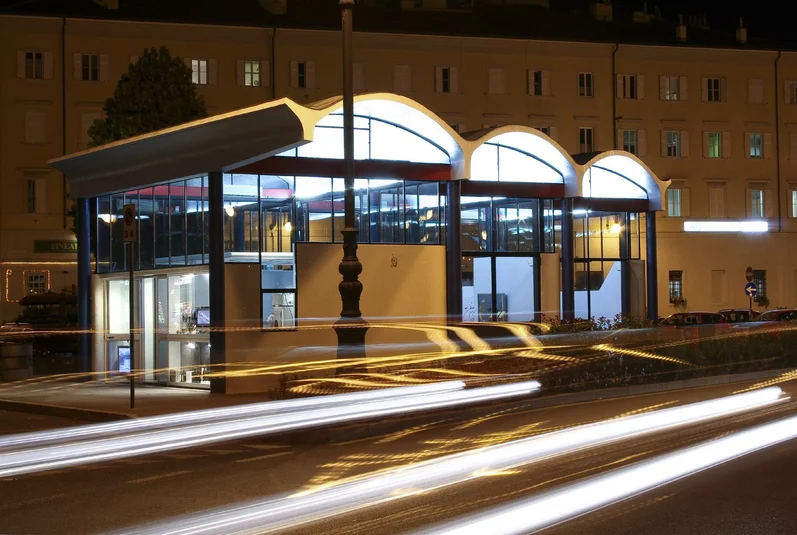
The location is not incidental: Stazione Rogers itself constitutes an integral part of the exhibition. Described as a «small jewel of modern architecture» (Semerani 2017, p. 69) and the result of a collective work by BBPR, it is a former service station designed between 1952 and 1953 for the Aquila refinery. After years of abandonment, in 2006 the Municipality of Trieste launched a call for tenders to assign its management. Luciano Semerani and Gigetta Tamaro, with their studio, emerged as the winners, proposing a restoration carried out with «affectionate respect for the formal conception of the work» (Semerani 2017, p. 69), but also a radically new destination for the former workshop spaces, intended to become a cultural and knowledge-dissemination centre.
The naming of the Station after Rogers is not intended solely as a tribute to the architect, the city's distinguished son and an internationally esteemed Master, but above all seeks to acknowledge the value of the intellectual, as well as the esteem and the bond he maintained with Trieste's cultural milieu. In this sense, Rogers represents a point of reference for a tradition of open thought: a mode of action grounded in the principles of a new humanism which, alongside continuity – understood as the vertical and transparent stratification of time, outside a linear becoming – pursues the orthodoxy of heterodoxy, a case-by-case approach characterised by great freedom in cultural references, yet also by appropriateness as a criterion of balance and a tool for controlling choices. Stazione Rogers operates in the same spirit, simultaneously as an architectural intervention on the material level and as a cultural initiative, chaired since 2008 by Gigetta Tamaro, with passion but also with «political intelligence» (Semerani 2023, p. 88).
From a genealogical perspective, the initiative of Stazione Rogers contributes to composing an ideal triptych of experiences, promoted in particular by Luciano Semerani. This trajectory originates with the Architecture Gallery of the Fondazione Masieri, conceived as an example of a place devoted to the dissemination of architectural design through a programme of exhibitions that began in 1987. This was followed by a parallel editorial initiative, closely connected to the Gallery's exhibition activity yet autonomous in its contents: «Phalaris», a journal «invented» (Bocchi 1995, p. 111) by Semerani himself, with Giovanni Fraziano serving as editor-in-chief. These precedents are significant not so much in order to certify the pedigree of Stazione Rogers, but rather to understand a cultural and scientific attitude toward the transmission of architecture, which can be distinguished into two branches.
On the one hand, Semerani asserts his opposition to an architecture that is overly generic and to flattened cultural positions or those seeking convenient equilibria. This reflects an idea of cultural practice based on making selections, even positioning oneself in conflictual terms with the establishment and the star system, yet without slipping into doctrinal or ideological stances. Such reflection is pursued through a continuous questioning of the meaning of things, by means of forms of debate prompted by heterogeneous positions and polemical stimuli, whose objective and civic dimension are intended to be both dual and divergent, in the effort to foster a conscious public opinion and responsible schools of architecture.
On the other hand, in order to sustain these positions, it is indispensable to seek a form of autonomy. Evidence of this can be found in the occupation of the spaces of the Fondazione Masieri in Venice, which at the time were largely unused, and in the search for private funding that subsequently supported the publication and distribution of the twenty issues of «Phalaris».
An experimental architecture magazine, therefore, transformed in form and substance into a newspaper, and an architecture gallery which, through its progressive accumulation of materials and models, would later constitute the original core of what is today the Projects Archive of the IUAV University of Venice.
Two critical and formative spaces that, through their respective forms, assume different characteristics. The first takes shape as an editorial space, strongly tied to contemporaneity, to the here and now, with a vocation for dissemination, offered in the ephemeral form of a newspaper published between 1989 and 1992, as a place of experimentation and originality, where one could freely take positions on issues of architecture and the city in an unencumbered manner and without excessive caution.
The second, by contrast, the space of the archive, is characterised by its intrinsic longevity. Founded in 1987, it today assumes the physical form of a significant institutional infrastructure2 for research and scientific training, consisting of more than eighty archival fonds, collections and miscellanies, which sustain an ongoing exhibition activity and the promotion of conferences, lectures and publications. An archive understood as a form of knowledge and interpretation of the past, a presupposed and necessary act to nourish the architect's transformative capacity, in which critique and action are moments of the same act that leads to «a certain way of manipulating the materials of history within the creative process» (Marras 2018, p. 7).
From these two experiences, a set of typical characteristics can be identified, also recognisable in the Stazione Rogers project, linked on the one hand to the critical selection of contents, authors, and projects hosted in various forms, and on the other to the intention of establishing as direct and unmediated a relationship as possible between the public or visitors and the guests involved and the materials presented. What emerges is a tendency toward an anti-academic dimension, not so much as a rejection of the relationship with the university institution, but rather in logical and methodological opposition to that cultural and pedagogical model which reserves exclusively for the university the production and transmission of knowledge.
From this perspective, in 2008 Stazione Rogers assigns itself the mandate of bringing into play, «in a place not intended for this purpose, a former service station, the excellences that exist in Trieste in the scientific and literary fields together with the world of architecture and the arts» (Tamaro 2015, p. 11).
An initial supporter of the proposal is the Chamber of Commerce, which in particular makes it possible to finance the restoration works on the building owned by the Municipality, which is made available under concession. The cultural project is also supported by the Faculty of Architecture, at the time of recent establishment (1998), and by the location of the Station, in close proximity to a ramified network of sites that constitute the humanistic hub of the University of Trieste.
The cultural objective is the creation of a place of encounter between different fields of knowledge – scientific, literary, architectural and artistic – by placing the disciplines in dialogue and enabling the overcoming of forms of isolation within their respective institutional frameworks.
Within this framework, however, Stazione Rogers also claims a peculiar and apparently contradictory role, identifying itself in particular as an initial point of contact and exchange between architecture and the sciences. A relationship certainly linked to a specific character of the place, to that Trieste as a city of science, built around institutions such as the International Centre for Theoretical Physics – ICTP, the International School for Advanced Studies – SISSA, or the Elettra Synchrotron research centre. Yet this relationship and interest reflect Stazione Rogers' orientation toward an unconventional science, manifested in a series of personal relationships, such as that between Semerani and the physicist Budinich, founder in 1964 of the ICTP, who maintained «the ambiguity of scientific language, the proceeding by leaps and flashes, by no means regular or sequential, let alone mechanical, of discoveries, intuitions and theories» (Semerani 1995, p. 29). This relationship exemplifies a way of understanding, for Stazione Rogers, scientific research and architecture as instruments for knowledge of the world, also reflected in the wording of the association founded by Semerani and Tamaro as early as 1999 and named after Ernesto Nathan Rogers «for the advancement of architecture and the sciences»3.
It is therefore not surprising that the first cycle of these Dialoghi tra le discipline promoted by the Station was, in 2009, Scienza che passione, which brought together distinguished scientists and biologists such as Margherita Hack and Arturo Falaschi. With this format, a sort of cultural circle also emerged, capable of bringing together thoughts and approaches from different disciplinary fields, with the aim of enabling an advancement of knowledge starting from concrete experiences. An epistemology of practice linked to an ethics of making as a form of knowledge.
The cycle of the incontri della passione, which then continued in subsequent years as a recurring format (2009–2013), saw the participation of leading figures from the fields of culture, science and architecture. These were meetings in which space was deliberately given to passionate voices, driven by a strong sense of urgency concerning the fate of humanity and the planet.
Among the protagonists were the writer Paolo Rumiz, the astrophysicist Filippo Giorgi, the geneticist Mauro Giacca, as well as psychoanalysts and scholars engaged with issues concerning the human condition and the environment. Naturally, across the various cycles there were also representatives of Italian architectural culture, including Antonella Gallo, Benno Albrecht and Pippo Ciorra4.
From the architectural point of view, particular attention was devoted to the unpublished outcomes of a series of research projects on the architectural compositions of figures such as the Americans Frank O. Gehry and Peter Eisenman, the Slovenian Jože Plečnik, the Serbian Bogdan Bogdanović, the Brazilian-born Lina Bo Bardi, and the Greek Dimitris Pikionis. These investigations testify to Stazione Rogers' interest in those figures, works and schools that distance themselves from the academic tradition, with specific reference to the years of Luciano Semerani's coordination of the Doctorate in Architectural Composition in Venice and to the research carried out, among others, by Susanna Pisciella, Andrea Iorio and Tommaso Brighenti5.
Stazione Rogers has thus collaborated with significant cultural and academic institutions, including the University of Trieste, the Revoltella Museum, the Tartini Conservatory and the IUAV University of Venice. Exhibitions have been organised on architectural and artistic themes, such as those devoted to Cubo-Futurismo russo, to Miela Reina6, to the unpublished drawings of Ernesto N. Rogers, and to those produced in the prisoner-of-war camp by Lodovico Barbiano di Belgiojoso. Likewise, a number of discussions have taken place involving figures such as the film director Giorgio Pressburger or the philosopher and pupil of Enzo Paci, Pier Aldo Rovatti.
In total, Stazione Rogers has proposed seven thematic cycles, in addition to Scienza, Mano, Gioco, Dono, Cultura, and Gaia (presented twice), each of which explored fundamental aspects of human experience, from the value of manual making to reflection on social relationships. Seven cycles which Gigetta Tamaro (2015, p. 11) symbolically associates with the seven basic emotional systems (seeking, desire, play, care, anger, fear, panic) identified by neurobiologists Lucy Biven and Jaak Panksepp, and which together represent an ideal collective brain at the service of the community.
Until her passing in 2016, Gigetta Tamaro was the soul of Stazione Rogers, a «distributor of culture» (Semerani 2017, p. 69), promoting in particular, in the final period, a series of meetings oriented toward investigating the relationship between architecture, culture, politics, science and economics, whose conclusion she would not live to see. This interdisciplinary approach recalls, by analogy, the «double central spread» (Fraziano 2022, p. 11) of the issues of «Phalaris», populated in this case by unusual contributions from theatre, cinema, poetry and the arts.
From 2017, the presidency of Stazione Rogers passed to Giovanni Fraziano, who has continued its cultural activities with continuity, in keeping with the trajectory of dialogues between disciplines7. During this new phase, the relationship with the University of Trieste was consolidated, which became directly involved in the initiatives through an agreement identifying the Station as the university's centre for humanistic dissemination. New formats followed, such as the Rogers Preview and the Rogers Shorts, short and nocturnal narratives scheduled on Tuesdays, strictly at 10 p.m., which distinguish themselves from conventional ex cathedra lectures, recalling instead the reasons for and the pleasure of storytelling.
Luciano Semerani has continued to participate as a central figure in the initiatives. Worth recalling is his intervention entitled Chi è Giotto?!, a polemical intervention at a distance addressing the exclusion of Rogers and the architects of his school from the exhibition on Bruno Zevi organised at the MAXXI in 2018, as well as the presentation of Il ragazzo dell'IUAV, a «not "scientific"» autobiography (Bordogna 2020, p. 107), which was the last event held at the Station before the lockdown. Likewise, the retrospective Luciano Semerani: pitture, curated by Francesco Semerani8 and Giovanni Fraziano in the summer of 2021, during which Semerani announced the «sequel» (Fraziano 2022, p. 160) to his autobiography, later published posthumously under the title Stupor Mundi.
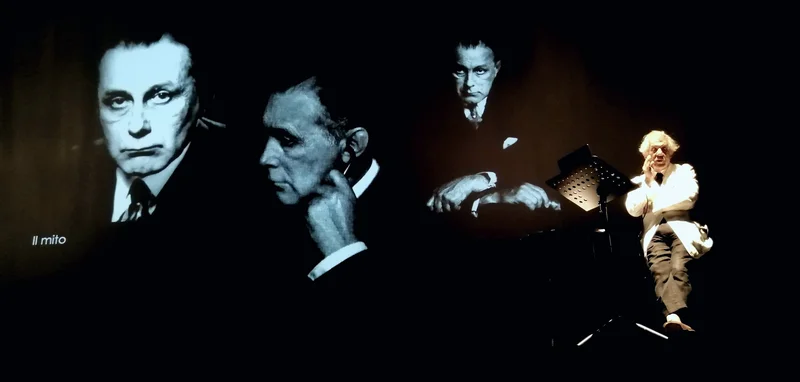
The dialogues of Stazione Rogers thus began to take on a new dimension when, in December 2018, under the label Rogers Eventi, Le poème de l'angle droit – per voce e immagini was presented. A project by Giuseppina Scavuzzo and Debora Antonini, which proposed as an autonomous work, through the reading of an actor and the images of a videomaker, the text by Le Corbusier, based on the principle that poetry, thanks to its capacity to resist the wear of time, clearly exemplifies how «nothing is transmissible but thought» (Le Corbusier 2008 [orig. ed. 1966], p. 9)9.
In recent years, Stazione Rogers has therefore begun to develop new forms for its contents, which have found a particular synthesis in the annual thematic projects Dante Hub (2021), Abitare Hub (2022), Community Hub (2023) and Inclusive Design Hub (2024), conceived and realised under the scientific direction of Giovanni Fraziano.
The Hubs, like the cicli della passione, address the complexity of the phenomena posed by contemporaneity, but also set themselves the objective of offering an experience, that is, direct knowledge, through engaging contact with a specific portion of reality.
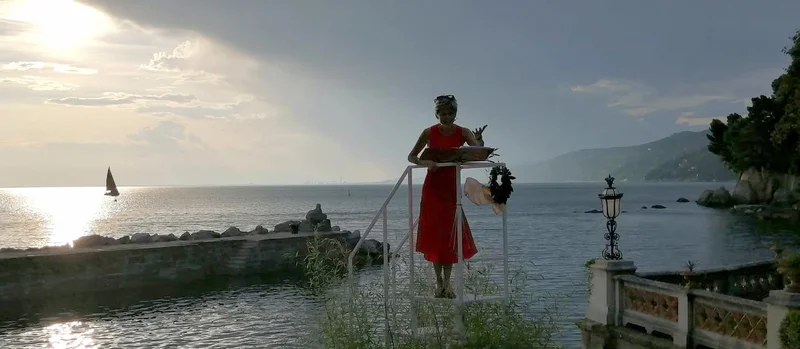
The elements of novelty characterising the Hubs are multiple and structural, beginning with the dislocation and the forms assumed by the events, which no longer take place solely at Stazione Rogers but are often held extra moenia. Adriano Venudo delivered a lecture-concert mixed with live musical performances in the park of the National Museum of Miramare Castle. Streaming events took place, between science and poetry, from the International Centre for Theoretical Physics – ICTP. A train journey, from Nova Gorica to Ljubljana via Jesenice, toward the "other modernity" of Jože Plečnik, featured lectures given in the carriages, including by the architect-artist Raj Pertot. A dialogue between a physicist and a lyric poet was held with the scholar of Russian language and literature Margherita De Michiel at the Center of Space Technologies Noordung in Vitanje, as well as a visit to the villa of Tito Macro, with tastings, in the UNESCO archaeological area of Aquileia.
A distinctive feature of many events has become the integration of theatrical performances, often authored and performed by Sara Alzetta10. This is the case with Between the Wall of Science, an attempt carried out in the classrooms of the International School for Advanced Studies – SISSA to break down the walls between scientific culture and humanistic culture. Likewise, the walks – understood as lessons in situ – aim to offer a direct and unmediated experience of authors and architectural works, in the very places where the meetings take place.
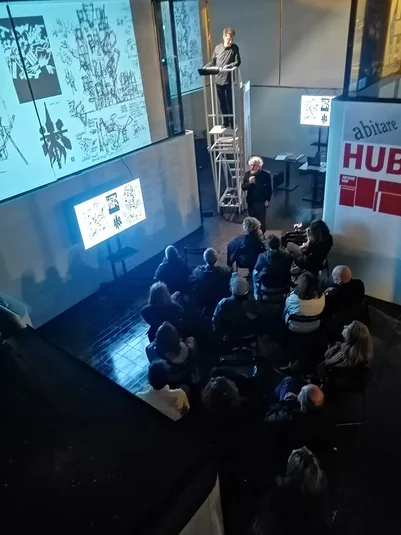
The major difference with respect to academic training lies both in Stazione Rogers' intention to offer a condition of a free zone located at the institutional boundaries of fields of knowledge, and in the proposal of lecture-performances in the here and now. This occurred, for example, during the press conference presenting the Abitare Hub project, when the actor Adriano Giraldi recited John Hejduk's Sentenze sulla casa. Or in Metafisica di una pompa di benzina, written and performed by Sara Alzetta, accompanied by disturbance and stones by the photographer Mario Sillani Djerrahian, which retraced the reasoned history of Stazione Rogers itself. Explorations within the realm of dialogues between disciplines currently continue along different trajectories, such as Dialoghi tra intelligenze artificiali e naturali, conducted in a phygital format with several digital humanists, including Lella Varesano and Giulio Lughi. Another example is the recent Conversazione su Adolf Loos, yet another dialogue by Giovanni Fraziano but «out of time and out of place» (Teatro Miela 2024), which on this occasion assumed, on a stage, the scale of a full theatrical production within the framework of the programme L'arte ac/cade a teatro.
Recently, Andreas Kofler11 (2024, pp. 30–97) identified eight international examples of houses of architecture. Eight cases among which, alongside Arc en rêve in Bordeaux, the Teatro dell'architettura in Mendrisio and the Galerija Dessa in Ljubljana, Stazione Rogers is also included.
It may come as a surprise that such a small and, above all, liminal reality forms part of this shortlist; nevertheless, comparison with these prestigious institutions of architectural culture makes explicit at least two aspects that distinguish the profile of Stazione Rogers from other experiences.
The first concerns a pedagogical research pursued through the continuous experimentation of forms for the transmission of architecture, and more generally of thought, which are effective because they are engaging. These are forms that do not settle into the liturgy of the exhibition-conference, but instead tend to take shape as events or performances, whether theatrical, artistic, musical or multimedia. What emerges is a cultural experience capable of overcoming the model of the passive recipient and accessible to a broad category of the public.
The second aspect concerns the ongoing exploration of interaction between disciplines12. This is an intention that Stazione Rogers has set for itself from the outset, and that it has been pursuing for almost twenty years13. Such an orientation may appear excessively broad and may seem to exceed the theme of the dissemination of architectural culture. In reality, through this choice Stazione Rogers takes on the responsibility of compensating for a structural weakness of the academic dimension. This dimension is characterised by a model based on the separation of fields of knowledge, which is a manifestation of a positivist ordering of knowledge and which today shows clear signs of obsolescence.
Within this framework, architecture is understood as the engine of an alternative scientific model to the dominant one, in accordance with the invitation that Ernesto Nathan Rogers addressed to his students when he told them that «one must translate every discipline into architecture» (Maffioletti 2009, p. 197).
2 At present, the scientific coordinator of the Projects Archive is Giovanni Marras. ↩
3 The wording appears not only in applications for contributions and funding submitted to public bodies and institutions, but also in the colophon of the volume L. Semerani (ed.), Gli incontri di Gaia e gli altri incontri. Stazione Rogers, Trieste. ↩
4 Antonella Gallo, Benno Albrecht and Pippo Ciorra took part in particular in the meetings of the two cycles Gaia che passione. ↩
5 Susanna Pisciella and Andrea Iorio participated in the meetings entitled Architettura e identità culturali, while Tommaso Brighenti took part in Vie e territori. Percezione e interpretazioni. ↩
6 Miela Reina is one of the most important figures of Triestine art of the second half of the twentieth century. Together with her, Gigetta Tamaro realised Il concerto, the exhibition design for the International Festival of Electronic Music at Palazzo Costanzi in Trieste in 1969. ↩
7 The activities of Stazione Rogers are also made possible thanks to the work of Laura Forcessini, who has played the important role of coordinator since the outset, and Gianni Peteani, who supports event logistics and communication. ↩
8 Francesco Semerani took part in the founding of Stazione Rogers as Works Supervisor for the restoration. The project was a finalist for the Gold Medal for Italian Architecture 2009. ↩
9 «Rien n'est transmissible que la pensée», Le Corbusier, Messina B. (ed.) (2008), Mise au point, LetteraVentidue, Siracusa. Éditions Forces Vives (orig. ed. 1966). ↩
10 In the first chapter of Stupor Mundi (2023, p. 9), Luciano Semerani recalls Sara Alzetta and mentions her parents among the various figures hosted at the studio in Via San Giorgio in Trieste. ↩
11 Andreas Kofler is curator and deputy artistic director of the Swiss Architecture Museum – S AM in Basel. ↩
12 Subsequent to the drafting of this essay, on 10 October 2025, Giovanni Fraziano was appointed Honorary President of Stazione Rogers, and Giuseppina Scavuzzo, Adriano Venudo and Thomas Bisiani joined the Board of Directors, respectively in the roles of President, Vice President and Board Member. ↩
13 Recently (10 and 11 May 2024) Stazione Rogers hosted the fourth meeting of RTDA and RTDB researchers in Architectural and Urban Composition, on the theme of interdisciplinarity. Bisiani T., Venudo A. (eds.) (2024) – Seminario 3. Interdisciplinarità. Caratteri della ricerca in composizione architettonica. Maggioli, Santarcangelo di Romagna. ↩
BISIANI T., VENUDO A. (eds.) (2024) – Seminario 3. Interdisciplinarità. Caratteri della ricerca in composizione architettonica. Maggioli, Santarcangelo di Romagna.
BOCCHI R. (1995) – "Phalaris e altre storie. Intervista con Luciano Semerani". Architettura Intersezioni, 1, 111-112. ↩
BORDOGNA E. (2020) – "Il ragazzo dello Iuav". FAMagazine, [e-journal] 51, 104-107. ↩
FRAZIANO G. (ed.) (2022) – L'artista, il toro, il tiranno. EUT, Trieste. ↩ ↩
KOFLER A. (2024) – "Sguardi oltre il confine. 8 casi studio internazionali". Turris Babel, 135, 30-97. ↩
LE CORBUSIER, MESSINA B. (ed.) (2008) – Mise au point, LetteraVentidue, Siracusa. Éditions Forces Vives. (Orig. ed. 1966). ↩
MAFFIOLETTI S. (ed.) (2009) – Il pentagramma di Rogers. Lezioni universitarie di Ernesto N. Rogers. Il Poligrafo, Padua. ↩
MARRAS G. (2018) – Invenzione della continuità. Ernesto Nathan Rogers tra avanguardia e tradizione. CLEAN, Naples. ↩
SEMERANI L. (1995) – "Con tutto rispetto". Architettura Intersezioni, 1, 28-33. ↩
SEMERANI L. (2017) – "Stazione Rogers". Firenze Architettura, 1, 64-71. ↩ ↩ ↩
SEMERANI L. (2023) – Stupor Mundi. EUT, Trieste. ↩
TAMARO G. (2015) – "I cicli della passione e l'attività di Stazione Rogers". In: L. Semerani (ed.), Gli incontri di Gaia e gli altri incontri. Stazione Rogers, Trieste. ↩ ↩
TEATRO MIELA (2024) – Conversazione su Adolf Loos. [online] Available at: <https://www.miela.it/spettacoli/conversazione-su-adolf-loos/> [last accessed 22 June 2025]. ↩