
Elisa Boeri, Luca Cardani, Claudia Tinazzi
Abstract
MANTOVARCHITETTURA, a cultural project of the Mantova Campus of the Politecnico di Milano, brings together history, design, and contemporary architecture in order to establish a dialogue between past and present. Since 2012, it has hosted internationally renowned architects and scholars, integrating teaching, research, and the University's "third mission" (public engagement and knowledge transfer). Through lectures and events, workshops, and an "Architectural Parade," it actively involves both students and citizens, transforming architectural education into a critical, participatory, experience-based practice.
Keywords
Architectural Festival — Pedagogy — Architectural criticism — Workshop
As every poet, the architect must be prophet and interpreter of the society in which he lives: to forge a new artistic measure within the law imposed by history. (Rogers, 1958, p. 84)
With the epigraphic words to this text, delivered in Winterthur in June 1944, Ernesto Nathan Rogers (1909–1969) laid the foundations for a broader discourse in which history and design advance in a compact manner toward the construction of a shared theoretical framework.
Five years later, during a lecture at the Architectural Association School (October 1949), Rogers crystallized this premise, asserting that the innovative capacity of the design act «will be all the greater the more [the architect] has sought to consider the complexity of phenomena in their historical formation» (Rogers, 1958, p. 87).1
Theoretical knowledge and "practical mastery" are therefore the two poles within which Rogers's pedagogical line moved — both in the classrooms of the Politecnico di Milano, where in 1952-53 he would be appointed to teach the course Caratteri stilistici e costruttivi dei monumenti (together with the attainment, in the same year, of libera docenza in architectural composition), and in the cultural training ground of Casabella-Continuità, the journal he directed from December 1953 to January 1965.
History and design, together with a sustained interest in contemporary architecture capable of engaging critically with its own past, became central to the initiative. This ambition, through the vision of Federico Bucci — Vice-Rector of the Mantova Campus from 2012 to 2023, and by the faculty involved in the campus's two degree programmes2 — the driving force behind an extraordinary cultural operation: MantovArchitettura.
The official definition presents it as an international event devoted to architecture, urbanism, and landscape: a scientific and cultural project of the Mantova Campus of the Politecnico di Milano, developed since 2012 within the UNESCO Chair in Architectural Preservation and Planning in World Heritage Cities, and held every year in symbolic, historical sites across the city of Mantova. Unofficially, MantovArchitettura has been — and remains — a courageous experiment that has boldly integrated international culture, teaching, and an attempt to respond to issues perceived as urgent, both in theory and in practice.
Its objective, never concealed since the first edition, is «to ensure that history can be revitalised through contemporary design».3 Thus, year after year from 2012 onward, architects, historians, and theorists of the so-called "related disciplines" have taken turns on the MantovArchitettura stages — initially in the monumental setting of the Temple of San Sebastiano and later, with tenacity, in pursuit of consolidating the bond between the Politecnico and the city of Mantova, in the various venues that the Municipality, the Province, and Mantuan associations have made available to students, architects, and enthusiasts.
The first guests to cross the threshold of the Tempio Albertiano reaffirmed the event's intention to bring to Mantova the great names of architecture: Grafton Architects (25 September 2012), Peter Eisenman (27 September 2012), Antoine Picon (23 October 2012), and Gilles Clément (23 November 2012) sketched an initial abstract framework of the diversified interests — contemporary architecture, theory, criticism, and landscape — on which the first edition proposed to focus.
The following year the experiment was repeated, testing an extension of the event's timeframe between April and October 2013. In seven months, two Pritzker Prize laureates arrived in Mantova: the Japanese Tadao Ando (10 April 2013) and the Portuguese Eduardo Souto de Moura (10 October 2013), alongside Aurelio Galfetti (30 May 2013) and the Australian Sean Godsell (10 July 2013). This was the year in which MantovArchitettura consolidated its relationship with the magazine Casabella, sealed by a lecture by its historical director Francesco Dal Co entitled "Le Corbusier and…" (15 May 2013), devoted to his years as a fellow at the Fondation Le Corbusier in Paris and to his personal rediscovery of the Swiss master. It was also the year that marked the beginning of an alliance with architect Eduardo Souto de Moura, who would become a central and charismatic figure of MantovArchitettura — able to interpret with precision that complex mechanism of theory, practice, and architectural criticism that underpins the festival's cultural project.
The subsequent year the festival "formula" was redefined, settling into a programme concentrated within a clearly delineated period — thirty-two events in the month of May alone — and an alliance with the Portuguese School that became increasingly solid. João Luís Carrilho da Graça (9 May 2014) and Gonzalo Byrne (29 May 2014) took part in this edition, together with architects of the calibre of Alberto Campo Baeza (15 May 2014) and the Swiss duo Miller & Maranta (22 May 2014).
Once stabilised in these modalities, MantovArchitettura soon became an annual gathering where architects, theorists, critics, faculty, and students reflect on the themes of design in historical contexts, on memory, and on the care of such memories. Between 2015 and 2025, MantovArchitettura hosted a steady flow of distinguished guests, many of whom became regular contributors. Alongside Eduardo Souto de Moura, figures such as Carrilho da Graça, João Mendes Ribeiro, Cristián Undurraga, Andrew Berman, Martin Corullon, Elisa Valero, Marcio and Gabriel Kogan, Paulo David, Ana Tostões, and Philippe Prost returned on multiple occasions, assuming a central role in the educational programme as visiting critics and visiting professors. In addition, over the years MantovArchitettura has featured Rafael Moneo, Anthony Vidler, Mario Botta, Mauro Galantino, Smiljan Radić, José Ignacio Linazasoro, Pierre-Louis Faloci, Liu Yuyang, Ricardo Bak Gordon, Guillermo Vázquez Consuegra, Diébédo Francis Kéré, Niall McLaughlin, and Anupama Kundoo, among many others. Together, these voices have shaped a programme that maps the rich landscape of an intellectually grounded contemporary architecture: one that continues to engage enduring, archetypal questions while remaining attentive to the constant oscillation between present, past, and future on which MantovArchitettura is founded.
As Federico Bucci, the project's originator and guiding figure, has often recalled, since 2012 each edition has been dedicated «to our finest masters, who taught us to listen to the 'subtle noise' of architecture, and to our students, without whom preserving its memory and imagining its future would be meaningless» (Bucci, 2015, pp. 3-4).
First of all, let us open the gates a little and begin to imagine how to help the young to think […] we must enchant the young! […] Young people are eager to learn. One must know how to accompany them.4
Over time, MantovArchitettura has progressively defined its role within the teaching carried out at the Mantova Campus. In doing so, it has reshaped — indeed, in certain respects reversed — the project's initial perspective. It is no longer conceived merely as a city-oriented festival that hosts and disseminates high-quality contemporary architecture to a broad and heterogeneous public. Rather, it has become an innovative, and at times non-conventional, pedagogical framework through which students learn architecture and further develop themes introduced in courses and design studios over the semester or academic year. In this way, the relationship between teaching and direct experience becomes increasingly robust, fostering meaningful and enduring learning processes. Here, "innovation" does not lie primarily in the medium, but in a critical rethinking of how architectural knowledge is produced and transmitted today.
This maturation of the format's primary objectives — shared by the faculty engaged in teaching at the Mantova Campus, who have always participated collectively in constructing the dense calendar of lectures/events5 — has enabled a subtle, silent yet substantial transformation from "cultural container" to a possible "integrated pedagogical device" capable of activating learning processes that, in the very etymology of the term6, lead students to grasp the deeper meanings and values of making architecture, appropriating them — making them their own for the future. It is not, therefore, an "extra" event experienced at the margins of curricular programmes; rather, it is a multidisciplinary programme conceived as an integral part of students' educational pathway. An experience that enriches and amplifies academic content. It thus fosters a productive coexistence between two core dimensions of academic life — teaching and the "third mission" — which are typically pursued within separate spheres but are here deliberately brought into dialogue and tested for their mutual complementarity.
The small, informal School of Architecture in Mantova has thus recognised in MantovArchitettura — thanks to sustained faculty commitment and to the successive editions that have progressively sharpened the initiative's self-awareness — a privileged arena in which to test the relevance of its teaching. Whether delivered through monographic courses or design studios, the curriculum is continually confronted with contemporary realities. This occurs within a productive interplay between the disciplinary foundations of architecture and its history and the direct encounter with leading protagonists of contemporary practice. It is also in this way that theory meets practice, giving rise to a form of active and participatory teaching in which knowledge becomes experience and experience becomes an instrument of understanding. It is a precise idea of pedagogy that unhesitatingly unites education, research, dissemination, and civic commitment — one that seeks to teach architecture through architecture, and in which young future architects are called to recognise the critical value of their educational path, becoming active participants in their cultural growth even before their professional growth.
The specific articulation of this educational idea has progressively engaged, with curatorial responsibility, faculty and researchers in proposing lectures, seminars, and study days capable of intercepting and substantiating themes consistent with their teaching programmes, by virtue of the necessary continuity that does not disorient but, on the contrary, consolidates in students the furrow already traced or the interest just instilled. The coherence pursued between academic contents and cultural proposals thus represents a strategic value within the educational process, generating fertile ground for critical thought and design awareness.
Conceived as a shared academic calendar, concentrated in May, at the end of the semester, the programme's encounters are framed as classrooms open to the city. They have become fertile occasions for lively dialogue, sometimes building on long-standing personal and scholarly relationships and sometimes generating new connections that may become part of the School's future legacy. Throughout, the initiative aims to dismantle the distance often perceived — especially by students — in cultural programmes that rigidly separate the stage from the audience.
The desire to make students protagonists, enabling direct and dialogical contact with leading figures of international architectural culture, has guided modalities that often integrate more conventional lecture moments with discussions on ongoing design projects and educational research, enabling a concrete and continuous exchange between masters and students. Remembering E. N. Rogers's words:
I reject the idea of the lectern as a pulpit from which an authoritative truth is dispensed. I see my role, rather, as participating — responsibly and fully — in the life of the school, aligning myself with my assistants and with all students through an ongoing, reciprocal dialogue. […] This dialogue allows me to renew myself, in other words, to continue learning. And there is no sustenance more invigorating than that which comes from the young.7
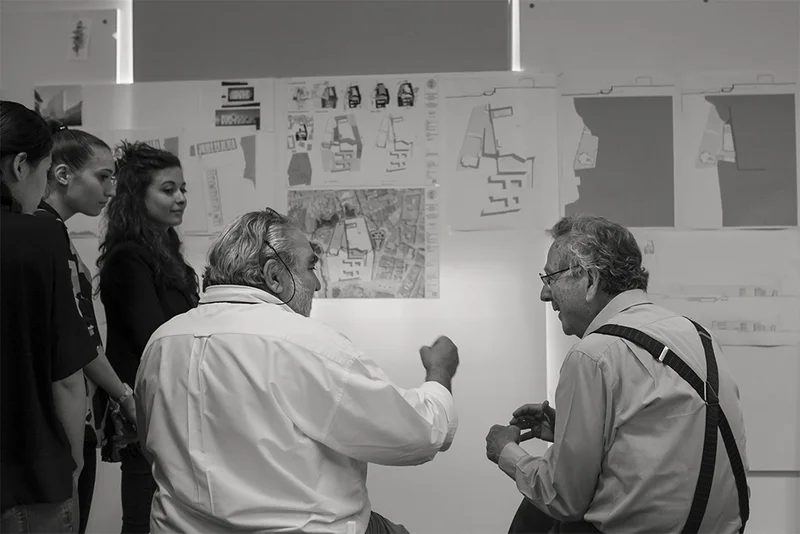
Within this approach, knowledge is never unilateral; it is nourished by reciprocity and confrontation, within a profoundly collective idea of teaching. In this "Mantuan" formula, Politecnico faculty and guest architects from all over the world have often been able to share — side by side — with students in the Bachelor's degree in Architectural Design or in the Master in Architectural Design and History the animated worktables populated by drawings and models, during the customary end-of-semester "critiques." In response to these genuine formative occasions, through a tailored approach, the teaching calendar, in this month dedicated to architecture, has developed the habit of "cutting to measure" intensive periods of studio-based teaching, in the shared idea of once again placing at the centre the everyday occasions of confrontation that foster students' growth.
What emerges, then, is a pedagogy in continual renewal: a mode of teaching that treats every occasion as a formative moment and that helps to build a strong, self-aware identity, firmly grounded in the culture of the project, while opening onto new and vast horizons:
The task of the School must be to indicate vast horizons and to show the many possible roads, not in an agnostic sense, but by fostering the responsibility of free choice, suited to each individual. (Rogers, 1964, p. 4)8
Since 2023 the calendar of events has been enriched by the inclusion of the MantovArchitettura Workshop in the programme: a curricular teaching activity with an outward-facing outcome in the event of the Architectural Parade.
The meaning of this additional proposal is grounded in the festival's idea of completing, among themselves, the university's three missions — teaching, research, and third mission9 — with a mix of actions whose outcome flows into public engagement, transferring knowledge toward society and thereby strengthening the University's civic role.
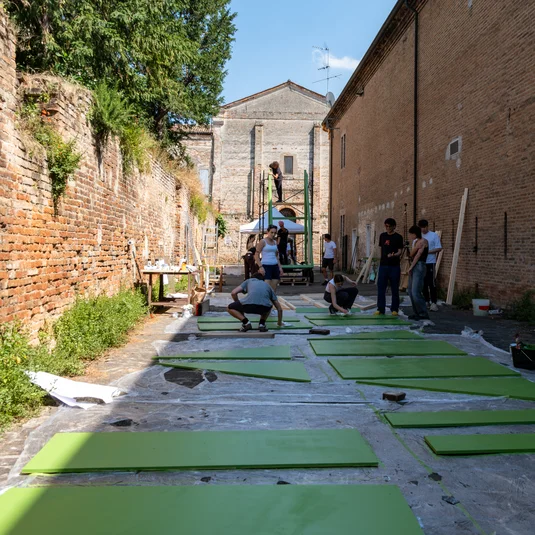
From a pedagogical standpoint, the workshop, addressed to students in the final year of the Bachelor's degree in Architectural Design at the Politecnico di Milano and recently opened to other universities as well10, aims to provide an ethical and aesthetic education in architecture and building, combining history, design, and criticism through the challenge of constructing a small theme-based work. The teaching activity focuses on the study, design, and construction of itinerant micro-architectures representative of the theme investigated each year by the MantovArchitettura edition, thus interpreting — through the project of an artwork — the meanings gathered and narrated by the lectures, exhibitions, and seminars that take place during the month of May.
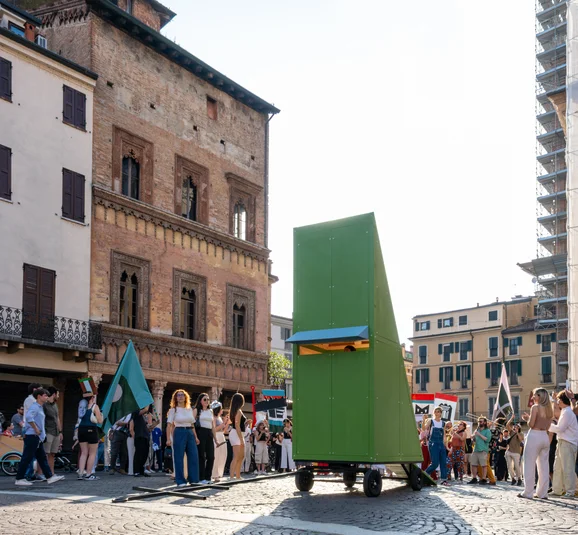
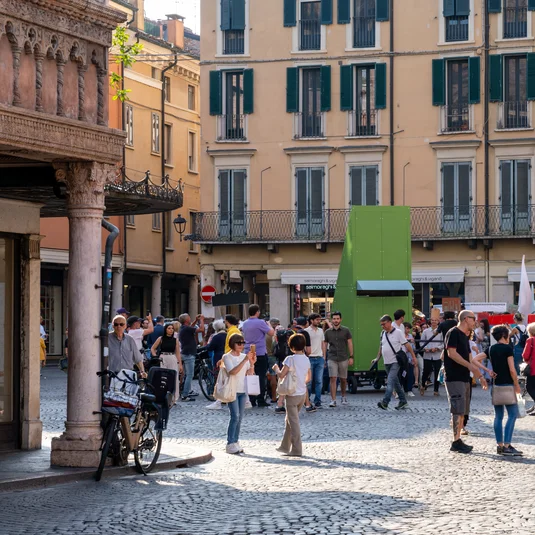
These architectural objects appear in the festival's final event — the architectural parade — a theatrical action through the streets of Mantova's historic centre, where the micro-architectures, accompanied by a crowd, overlay the existing city through a paratactic and poly-scenic structure, constructing a series of places for an urban open theatre.
The parade involves all members of the School in their diverse roles — above all students, but also teaching, technical, and administrative staff — to step outside the campus walls and present itself to the city, establishing a dialogue with society and urban places through the staging of a celebration of architecture and its teaching.
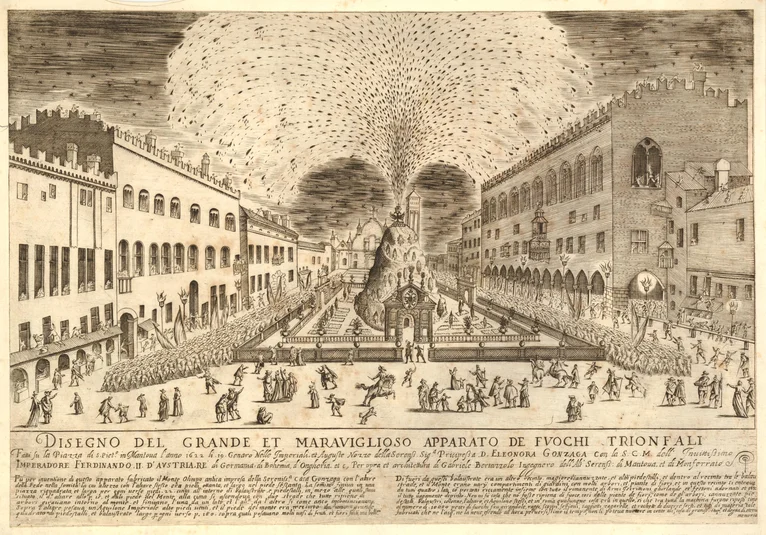
Echoing the long Mantuan tradition of spectacular setups11, the experience of celebrating the festival thus becomes a ritual critical exercise that repeats itself while renewing and updating over time, through which to investigate the meanings of the city and to experience that relationship between architecture and life so powerfully expressed by the words of Aldo Rossi, one of the School of Mantova's "long distance" Masters, for whom:
Architecture is the fixed stage of human events; laden with the feelings of generations, with public events, with private tragedies, with new and ancient facts. (Rossi, 1966, p. 11)12
The workshop therefore sets itself the goal of developing, through the restitution of a work, the critical capacities of students first and of the citizens involved in the parade thereafter, relying on architecture's power to provoke emotions and sensations linked to the theme that substantiates architectural form. This pouring of the work into individuals thus produces a perturbing estrangement that activates:
all potentially critical roles, roles that arise from the clash between an un-codified and wandering subject and a rigorously defined context. […] starting from the partly casual and partly predetermined intersection of objects and subjects, obstinate provocative agents of the urban unconscious. (Vidler, 1996, p. 230)13
quoting Anthony Vidler's words, one of MantovArchitettura's celebrated guests14, to describe the vagabond architecture of John Hejduk's work, in which this experiment in architectural pedagogy finds historical and theoretical reference.
By undertaking to translate the festival's architectural themes into built and theatrical form, the workshop project and the parade thus attempt to represent the vital bond between architectural history and design, in the ancient and ever-new form of the rite of theatricalising the city, where the mirroring between architecture and citizens, objects and subjects, masks and characters forces everyone to "interpret" the fundamental role of the critic in the search for truth.
If, therefore, MantovArchitettura is a container of experiences, readings, and architectural criticism between history and design, the eponymous workshop and its outcome in the "parade" represent an attempt to transfer criticism into the practice of architecture, producing forms that can once again interrogate us.
In architecture, history and design are two sides of the same coin in the desire for form. By competing with each other, they generate the work, which in turn provokes criticism, which, as Roland Barthes reminds us:
is only a moment within that history into which we enter and which leads us to unity, to truth. (Barthes, 1965, pp. 63-64)15
such that:
The critic is nothing but a commentator, yet fully so (and that is sufficient to render his position dangerous): on the one hand, he is a transmitter, he leads back to a past matter […]; and on the other hand, he is an operator, he redistributes the elements of the work so as to give it a certain intelligibility, that is, a certain distance. (Barthes, 1965, pp. 62-63)16
Perhaps here lies the meaning that the MantovArchitettura cultural project has taken on over time, and the sense that it should continue to build, constantly reinventing itself while remaining the same but never identical to itself.
1 This essay is the result of a collaborative effort by the authors, who share its content as the outcome of a common discussion. However, the section "Between New Ideas and Reconsiderations: The Early Years of MantovArchitettura" was written by Elisa Boeri (Politecnico di Milano, DABC); the section "Teaching Beyond the Classroom: MantovArchitettura as an Integrated Pedagogical Device" by Claudia Tinazzi (Politecnico di Milano, DABC); and the section "Experimenting with Criticism in the Practice of the Design Workshop" by Luca Cardani (Politecnico di Milano, DABC). ↩
2 The Mantova Campus hosts the Bachelor's degree in Architectural Design and the second-level Master in Architectural Design and History. ↩
3 This quotation is drawn from a statement made by Vice-Rector Federico Bucci to the Order of Architects of Verona on 6 May 2017, at the opening of the Verona sessions of MantovArchitettura. ↩
4 Interview with Alberto Manzi on "active schooling", 15 November 1960. ↩
5 Since the very first edition, the curation of MantovArchitettura, while firmly directed by Federico Bucci, has been entrusted to "the Mantova Campus of the Politecnico di Milano" and therefore to the entire community of faculty, researchers, doctoral students, and staff of the Campus. ↩
6 From the Latin verb "apprendere", derived from "ad-prehendere", composed of "ad" (towards) and "prehendere" (to grasp, to take). Etymologically, "learning" thus means "the act of grasping or taking something with the mind", that is, acquiring new knowledge or skills. ↩
7 Ernesto Nathan Rogers, Elogio dell'architettura (lecture delivered at the Politecnico di Milano on 4 April 1963), in Marina Montuori (ed.), 10 maestri dell'architettura italiana. Lezioni di progettazione, Electa, Milan 1994, p. 221. ↩
8 Ernesto Nathan Rogers, "Elogio dell'architettura", in Casabella-Continuità, no. 287, 1964, p. 4. ↩
9 The "third mission" encompasses all activities through which knowledge produced by universities is transformed and made accessible to society and the economic system. ↩
10 In 2025, the University of Florence took part in the workshop through its Department of Architecture, designing and building a micro-architecture that was presented during the parade on the theme "Architecture and Conflict", coordinated by faculty members Francesca Mugnai, Gabriele Bartocci, and Giuseppe Cosentino. ↩
11 Cf. Gabriele Bertazzolo, Breve descrittione dei fuochi trionfali fatti in Mantova per le nozze di Eleonora Gonzaga coll'imperatore Ferdinando II, Mantova 1622. ↩
12 Aldo Rossi, L'architettura della città, Marsilio, Venice, 1966. Città Studi, 1995, p. 11. ↩
13 Anthony Vidler, The Architectural Uncanny. Essays in the Modern Unhomely, MIT, Cambridge – London, 1992 (Italian transl. Il perturbante dell'architettura. Saggi sul disagio nell'età contemporanea, Giulio Einaudi editore, Turin, 1996, p. 230). ↩
14 Anthony Vidler's lecture at the 2020 edition of MantovArchitettura (Monday, 29 June 2020) is collected in the journal ADHJournal: cf. Anthony Vidler, "Architecture and Representation: Etching, Engraving, Painting", edited by Elena Fioretto and Fabio Marino, ADHJournal. Heritage cities and destruction, no. 1, May 2024. ↩
15 Roland Barthes, Criticism and Truth, Einaudi, Turin 1965, pp. 63-64. ↩
16 Ibid., pp. 62-63. ↩
BARTHES R. (1965) – Criticism and Truth. Einaudi, Turin. ↩¹ ↩²
BOULLÉE E-L. (2007) – Architettura. Saggio sull'arte, A. Ferlenga (ed.), Einaudi, Torino.
BUCCI F. (2015) – MANTOVARCHITETTURA/UNO. Corraini, Mantova, 4-5. ↩
BUCCI F. (2021) – "Judging or understanding? The sense of history". In: E. Faroldi, M.P. Vettori (eds.), Teaching Architecture. Two Schools in Dialogue, LetteraVentidue Edizioni, Siracusa.
CARDANI L. (ed.) (2021) – Mantova Cattedra Unesco. Ricerche e progetti per le città patrimonio dell'umanità. Franco Angeli, Milan.
FERRARI M. and TINAZZI C. (2015) – MANTOVARCHITETTURA/UNO. Corraini, Mantova.
FERRARI M. and TINAZZI C. (2016) – MANTOVARCHITETTURA/DUE. Corraini, Mantova.
ROGERS E. N. (1958) – Esperienza dell'Architettura. Einaudi, Turin. ↩¹ ↩²
ROGERS E. N. (1964) – "Elogio dell'Architettura". Casabella, 287 (maggio). ↩
ROSSI A. (1966) – L'architettura della città. Marsilio, Venice. ↩
SPINELLI L. (ed.) (2020) – Spaces of Memory. Commentaries on 21st Century Buildings. Franco Angeli, Milan.
SPINELLI L. (ed.) (2021) – Layers of Contemporary Architecture. Franco Angeli, Milan.
VIDLER A. (1992) – The Architectural Uncanny. Essays in the Modern Unhomely, MIT, Cambridge – London. Italian version (1996) – Il perturbante dell'architettura. Saggi sul disagio nell'età contemporanea, Giulio Einaudi editore, Turin. ↩
https://www.mantovarchitettura.polimi.it
https://www.unescochair.mantova.polimi.it
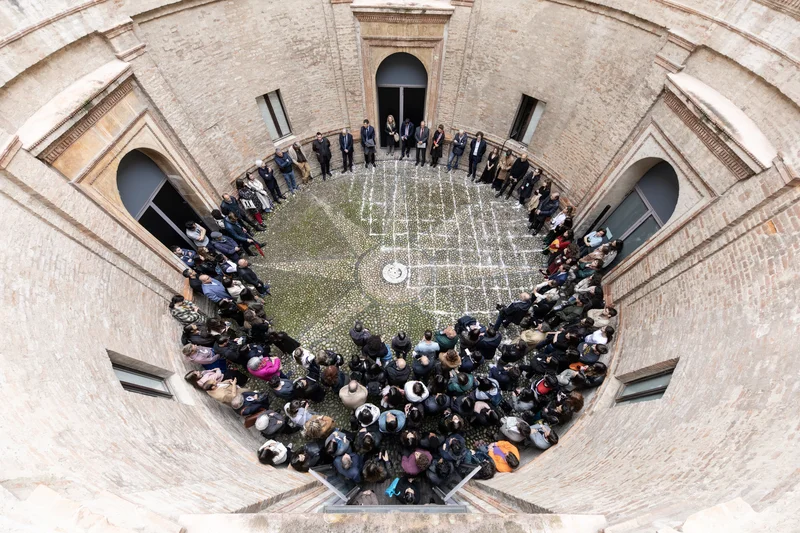
Fig. 1 – Inauguration of MantovArchitettura 2023 at Casa del Mantegna with an installation by Elisa Valero Ramos, 2023.
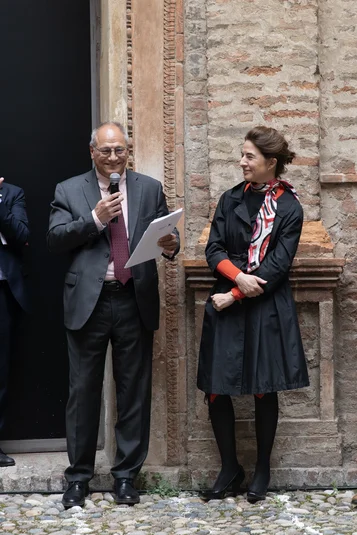
Fig. 2 – Federico Bucci and Elisa Valero Ramos at the opening of the exhibition at Casa del Mantegna, 2023.
Fig. 3 – Lecture by Kengo Kuma at Teatro Bibiena, 2018.
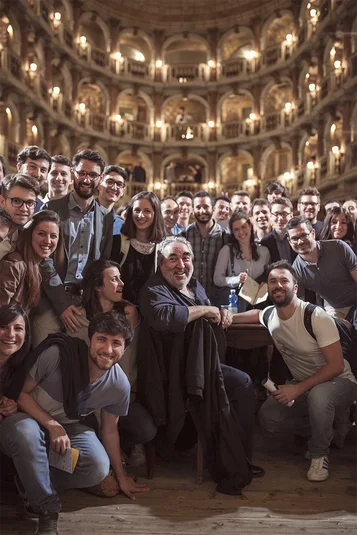
Fig. 4 – Eduardo Souto de Moura with students after his lecture at Teatro Bibiena, 2015.
Fig. 5 – Rafael Moneo and Eduardo Souto de Moura during the critique of student projects at the "Final Workshop: Old and New", 2015.
Fig. 6 – The workshop and Architectural Parade's reference to Mantuan history. Drawing of the Grande et Maraviglioso Apparato De Fuochi Trionfali, staged in Piazza S. Pietro in Mantova for the wedding of Eleonora Gonzaga and Emperor Ferdinand II of Austria, 1622.
Fig. 7 – The construction of "The Silent Observer", the micro-architecture built by students of the "MantovArchitettura Workshop 2024 – Architecture of Making", inside the Mantova Campus, 2024.
Fig. 8 – "The Silent Observer", the micro-architecture built by students of the "MantovArchitettura Workshop 2024 – Architecture of Making", during the architectural parade in front of Casa del Mercante, Piazza delle Erbe, Mantova, 2024.
Fig. 9 – "The Silent Observer", the micro-architecture built by students of the "MantovArchitettura Workshop 2024 – Architecture of Making", during the architectural parade in front of the Basilica di Sant'Andrea, Piazza Mantegna, Mantova, 2024.