Still on
Architecture and the City
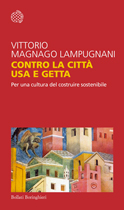
Contro la città usa e getta is the title of the recent book by Vittorio Magnago Lampugnani, published in Italian by Bollati Boringhieri as translation from German of Gegen Wegwerfarchitektur. The subtitle, in the two editions, is different: Dichter, Dauerhafter, Weniger Bauen – more dense, more durable, less built – that becomes Per una cultura del costruire sostenibile. The same thing is stated in two different ways or, perhaps better, complementary: following the author, “sustainable building” today must primarily mean building less, using less soil, and therefore concentrating on density. It also involves constructing buildings that can withstand the test of time because they are “well built”. The emblematic title of Lampugnani’s book appears to aim at establishing a dialogue, after more than fifteen years, with Vittorio Gregotti’s 2008 book Contro la fine dell’architettura. If in that little book, Vittorio Gregotti questioned the need for a rethinking of the disciplinary status of our discipline in the age of the image, under penalty of its liquefaction, here Vittorio Lampugnani discusses the topic related to The Architecture of the City – to quote Aldo Rossi – or, in other words, with Camillo Sitte, on the Art of Building Cities, against the prevailing consumerism, also become “architectural”. This book offers many arguments for reflection. I will focus here, in this small text, on two issues that I consider fundamental: that of the non-constative attitude regarding the state of our discipline and our work and that of the possible and necessary role, today, of the urban project.
On the first topic, Lampugnani takes a firm stand against the aggressive consumerism that, form the market field, arrived to cast its shadow and its negative influence also on the architecture and the city that, as point of accumulation, in the physical space, of the long time of history, had been answering to different laws for more than two-thousand years, starting with that of longue durée.
Far from a widespread ‘aesthetics of observation’ – estetica della constatazione to use Gregotti’s words again – the entire book is concerned with defining the “countermeasures” to this condition, reaffirming that Architecture has to be an optimistic discipline in its pro-jacere, modifying reality by looking at the construction of the future. Moreover, the book is courageous in its invasion of a field that, in the age of specialism, seems to be exclusive prerogative of technology. The book did it with depth, dispelling some recurring misunderstandings. The instruments deployed by Lampugnani are interesting in their dual nature. On one hand, there are data that come from reality and from all the fields of knowledge that observe it. These data, correctly analysed, demonstrate how much the construction sector consume resources and energy, how much waste the cities produce but reveal also how much banal – and misleading – is to talk of “easy” solutions as, for instance, that of pervasively replacing the construction in concrete or steel with the wooden. The data analysis reveals that operations that are called “sustainable” are often supported by an idea of architecture, against its millenary history, as a mere market product – one among others – to be sold thorough cynical marketing actions. On the other hand, it is more interesting that Lampugnani uses his deep knowledge of history of architecture to demonstrate that the aura of novelty, with which some postures would like to qualify themselves, doesn’t represent at all a real innovation if it is true that the term sustainability appeared for the first time more than three hundred years ago, coined by Hans Carl von Carlowitz. In the same way, “common sense” rules, related to disposition of the buildings on the ground and orientation of the cities, were well-known – and largely applied – at least at time of Vitruvius and of his De Architectura. It is to say: before the advent of dominance of technique on thought and of the closure of specialism in the narrow boundaries described in the book: limits that divide rather than ‘compose’ disciplines that are today often unable of a capability of a synthetic thinking that is that of which architecture and city need.
A second topic in the book, very relevant, is that of the need of the Urban Project, again questioning a “commonplace”. Certainly, there was a season in which the urban project has been related to an intermediate scale between architecture and urbanism, fixing some formal elements of the city construction or of its parts at a typo-morphological level. This is not the place to discuss this interpretation and what it has produced, even in this case, in the balance of power between the disciplines. I believe that today a good definition of Urban Project is that outlined in Vittorio Magnago Lampugnani’s book. The urban project is in the city – nothing more needs to be built – and it is for the city in the sense that has to care of it: as the philosopher Nicola Emery reminded us in his Progettare, costruire, curare. Per una deontologia dell’architettura, quoting Plato’s La Repubblica.
From Theory to practice, Lampugnani defines the fundamental “pillars” of this “culture of sustainable building” announced in its book’s subtitle. Conversion, Adaption, Enlargement, Densification are the possible new categories of Modification that cannot however renounce, as an indispensable prerequisite, to express a critical judgement on reality: and, thus, Knowing, Respecting, Rediscovering, Appreciating are the indispensable categories of Knowledge because, as Lampugnani well argues, not everything is reusable if without through a recognition of value.
In the end, I would like to refer to what Vittorio Magnago Lampugnani states to end his book. It is an appeal to beauty because, he says «if it is true that today we cannot more realize buildings that are only beautiful […] without beauty, also of architecture, we cannot live».
Federica Visconti
Author: Vittorio Magnago Lampugnani
Title: Contro la città usa e getta
Subtitle: Per una cultura del costruire sostenibile
Language: Italian
Publisher: Bollati Boringhieri
Characteristics: 173 pages, black and white
ISBN: 9788833943534
Year: 2024