The Required
Knowledge by and about Ernesto Nathan Rogers
Often, especially in the university context of northern Italy but not only, when even today we talk about the roots of our culture of architectural design in the twentieth century, the figures of Giuseppe Samonà and Ernesto Nathan Rogers are evoked. The first for having founded an innovative and anti-academic school, the IUAV, of international scope but capable of investing in a laboratory key both on the expressive and material palimpsest of Venice and its territory and on the research of the most poetic modernity, in this case that of Le Corbusier, not entirely distant from Mediterranean classicism. The second for having culturally refounded a magazine like «Casabella», which in the post-war period could be said to be as fundamental in terms of cultural weight as a school, and for having cultivated the relationship with the Northern European modernity of the CIAM through a critical review carried out on the reasons of the context, of the city, of history, paradoxically the only way to preserve an idea of modernity that was not that of the internationalist mannerism of the Modern Movement.
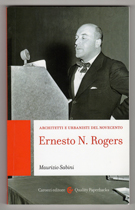
It would therefore seem difficult to rely on the short text, the biographical summary but above all on the cultural, theoretical, professional exegesis capable of restoring such complex personalities and bearers of extraordinary contents as in the intentions of the series of Architects and Urban Planners of the Twentieth Century published by Carocci Editore. In reality, this small-format 130-page book dedicated to Rogers, written by Maurizio Sabini, a teaching architect whose critical training derives not by chance from the IUAV and from his participation in the first Italian Doctorate in Architectural Composition (1983), seems to dispel any doubts in how it develops an effective critical-narrative path according to an interesting but not easy double register of interlocution: one aimed at the young student, therefore of first approach, and one for those who already have greater cognitive experience but love to compare it with new keys of interpretation. In fact, if we were to adopt the reference of the double historical movement according to Marc Bloch for whom the present is illuminated by the past as much as the past can be by the present, Sabini’s work goes well beyond a renewed recognition of the figure of Rogers through his writings, projects, works and in general his rich and articulated experience of cultural and ethical significance, as it attempts to arouse his theoretical potential – never fully realized by that master through a unitary outcome whose reasons are explained in the introduction – according to a hypothetical framework of first scientific systematicity, which could be titled Architecture according to Ernesto N. Rogers. With a certain amount of courage that comes from his familiarity with this phase of Italian architecture (moreover, Sabini is at his second publication dedicated to the architect from Trieste), but also from the freedom and critical distance that academic exile sometimes allows, in this case through teaching at various universities in the American context, today at Drury University, Sabini prefigures the structure of an impossible Rogerian treatise that evidently must not follow, in his words, «a chronological thread, but a logical one». In short, more as an architect than as a historian, and therefore with all that interpretative intentionality «that wants to contribute to better defining Rogers’ message for an architecture as a critical artistic practice, a synthesis of utility and beauty, all the more necessary in its social value the more it is founded on ethical principles».
The index of the volume, as is right in every work that is the result of a serious editorial project, already says a lot about this intention to organize the vast and heterogeneous material available according to a critical and meta-theoretical systematics. In succession: starting from a concept of twentieth-century modernity, for those like Rogers who have experienced it in terms of evolution and articulated historical reality; then crossing the dimension of a humanism that invests the question of the human subject as a reaction to the phase of productivist alienation and the tragedies of war and the holocaust; then following the game of an interpretative instrumentation that manages to combine the geographical, cultural, historical peculiarities with the most advanced principles of modernist modeling, in particular that of the Masters of the Modern Movement; no less, it faces the difficult path of a contextualism that tries to define its epistemological significance within the architectural project; here is a further chapter where the revision of the relationship between utility and beauty is addressed, aimed at decanting the functionalist ideology; up to the dimension of a reciprocity between ethical and aesthetic dimensions as an indispensable prerequisite for an architecture of meaning as well as of civil function. A path dotted with narrative deus ex machina, featuring a significant amount of architecture conceived, described, designed, and created, can be entirely described in disciplinary terms. However, behind this lies a broader critical and philosophical interest, which, especially concerning the notion of environment cultivated by Rogers, involves the value of experience in aesthetic data according to Dewey – and Focillon – leading up to that phenomenological conception of environment associated with Husserl and, more specifically, with the Milanese School of Antonio Banfi and Enzo Paci. On the other hand, the development of the book’s thematic nuclei certainly does not fail to involve numerous other personalities of the cultural context crossed and in many ways conditioned by the figure of Rogers, with the many references on the one hand to the architects of the Modern Movement and on the other to the critical peculiarity of Italian architecture through the contributions of Pagano, of Persico, and in other ways in the post-war period of Olivetti, all however united by a questioning of the ethical meaning of architecture. Not only that, the author inserts between the pages some affinities of thought of the contemporary age that in some way put the reader to the analogical test on Rogerian thought, as in the case of Pope Francis’ of Laudato si’, on the care of our common home in relation to the environmental theme, so central to Rogerian thought, with respect to which Sabini comments with a «Rogers would have signed».
This argumentative montage, which, despite the rigor of references and sources, may not please the historian of reconstructive orthodoxy but certainly captivates the architect reader and stimulates a comparison on current events, lacks only one thematic area that perhaps deserves a further chapter. That of Rogers the teacher, that is, a role certainly always interpreted through the exemplary nature of his works, writings, magazines, but in the last years of his life also directly experienced within the university, in that Polytechnic of Milan where the young collaborators of the «Casabella» laboratory, including Rossi, Canella, Gregotti, Semerani, Tentori and others, achieved their first maturity and perhaps also cultural emancipation with respect to the Master. It is no coincidence that Francesco Tentori, the first coordinator of the Composition Doctorate at IUAV, recommended that «the starting point for a doctorate should be the knowledge [...] of those who taught composition in Italy from 1930 to 1960», as was then done through the long seminar in the spring of 1984 dedicated to ten masters of Italian architecture which became the subtitle of the volume Lezioni di progettazione which collects the proceedings (Electa 1988). A teaching where Rogers resumed and applied many aspects of his critical and dialectical thinking without which, moreover, he would never have been able to distinguish himself for his renowned maieutic ability as recalled by Guido Canella, one of his closest assistants in the 60s, who judged him «among the few teachers who never discouraged the ambition of his students».
But among the many reflections that the book also raises in relation to our future, the one that could contain them all is perhaps the quote by Rogers taken from his Esperienza dell’architettura (1958) that Sabini appropriately places at the beginning of the introduction: «I am not a philosopher, I am not a man of letters, I am an architect who reads texts (and poets), writes but essentially designs and verifies himself on the building site». So, in conclusion, to a student who asks me what this book can be useful for today, I would answer that in the near future in which artificial intelligence technology will be pervasive and bearer of unpredictable risks even in the field of architectural and urban design, the search for a renewed humanism for the figure of the architect that distinguishes Rogers’ research constitutes an alternative model of indispensable relevance. Moreover, an antidote at least necessary, if not sufficient, against the disappearance of architecture (and of the architect).
Carlo Quintelli
Author: Maurizio Sabini
Title: Ernesto N. Rogers
Language: Italian
Publisher: Carocci Editore
Characteristics: 152 pages
ISBN: 9788829027248
Year: 2024