Two complementary quotations by E.N. Rogers provide the background for the editorial that introduces this issue: Architec-tour. Memory and Invention of the European Built Environment aims to open reflection, among other things but not exclusively, on the importance of travel as a formative act both at a general personal level and at a particular architectural level."[…] forming architecture presupposes the formation of men."
Ernesto N. Rogers 1961"No work of architecture can be conveyed through words, nor do photographs barely capture the experience of those who have participated in the spaces by physically inhabiting them"
Ernesto N. Rogers 1955
But the current theme is Travel,
and particularly formative travel. It is but a short step to recalling
specific cultural experiences, the Grand
Tours, which originated in seventeenth-century England as
journeys reserved for young British aristocrats with the aim of
completing their education through direct exposure to European art,
history, and culture, mainly Italian.
Following the model of the Grand Tour,
the Prix de Rome was
established and developed, as an award that European academies granted
to the most deserving architecture students with the objective of
analysing and studying Italian architecture. This tradition, more or
less institutionalised, has remained inherent in the architect’s
education and has touched many authors, who have seen their poetics
deviate, if not change completely (certainly enriched), upon returning
from a journey. This happened to Frank Lloyd Wright after his
infatuation with Japan (which he visited repeatedly from 1905 to 1922),
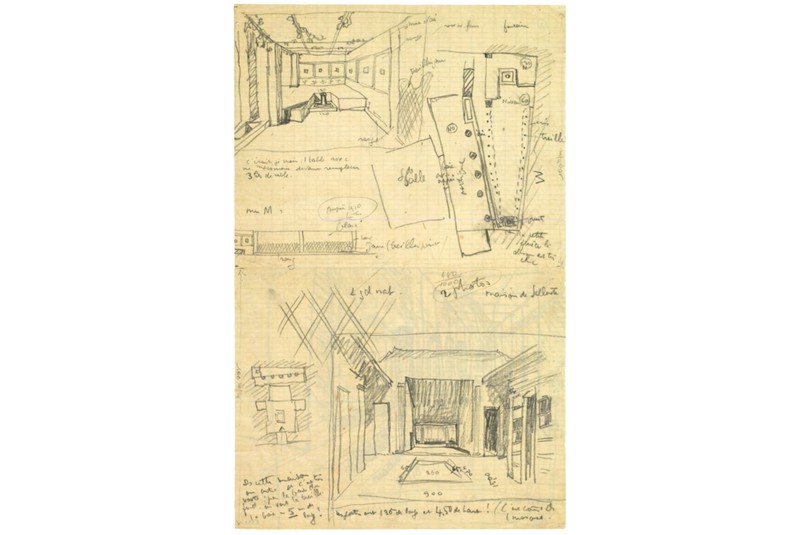
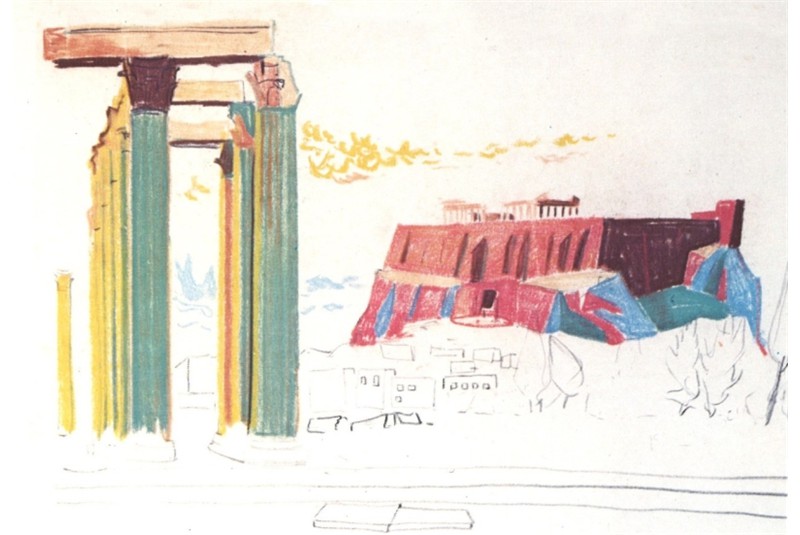
to Le Corbusier after his “Voyage d’Orient” into the
Balkans, Turkey and Greece (1910-11), or again to Louis Kahn after his
journey to the Mediterranean and particularly to Italy as a guest of
the American Academy in Rome (1950-51). On this occasion, Kahn paid
tribute to Italian architecture, writing to his studio: «I
am definitively realizing that the architecture of Italy will remain
the source of inspiration for future works, those who do not see it
this way should look at it once more. Our things seem small in
comparison: here all pure forms have been experimented with in all
variants of architecture. One must understand how the architecture of
Italy relates to what we know about building and needs.» (Kahn 1950).
To emphasise this idea, we could, in an improvised manner, attempt to draw a work by Le Corbusier, such as the Chapel at Ronchamp, and observe how it resembles the original «no more than a daughter resembles her mother» (the quotation is a paraphrase of a concept expressed by Luciano Semerani 2000).
We could suggest that memory insinuates between reality and its recollection, transforming into architectural invention. This is one of the few forms of architectural invention, for the peace of mind of those who are convinced that absolute invention exists in architecture[1].
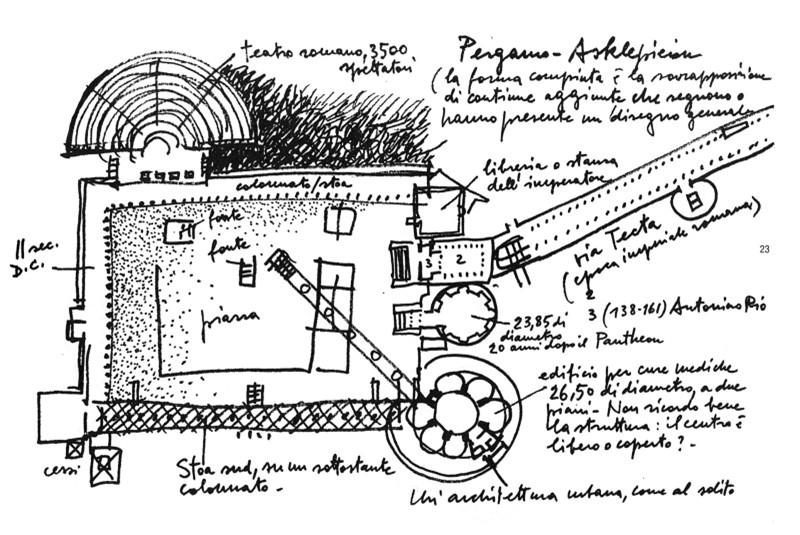
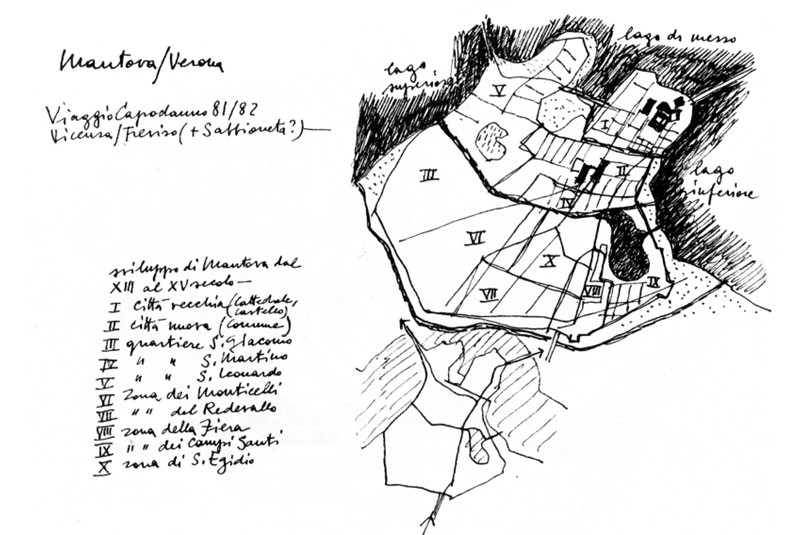
The contemporary architect, inherently equipped with a strong critical capacity (whose development remains, now more than ever, the main focus for each school of architecture), must study and comprehend architecture by analysing it within the existing socio-cultural and contextual complexity. This is a difficult operation to perform at a distance because architecture can only be fully understood by living it, perceiving it with all the senses, including smell (Dewey docet). Such bodily experience does not translate well into modern dematerialisation and virtualisation. Walking through spaces, perceiving proportions, observing how light interacts with materials and feeling the acoustics of an environment are characteristics that can only be understood through physical presence.Travel is an experience (of architecture as Rogers would say) of study, analysis, and deepening accomplished personally with the most disparate techniques, including redrawing: it can also induce preliminary preparation, as Carlo Aymonino did for his numerous travels, starting from the essential information provided by the Touring Guides (the book too is an encounter), he then filled notebooks with drawings, noting the distinctive features of a city’s structure and the distinctive characteristics of its monuments (even those remained unbuilt). An even more interesting aspect of this process is the fusion, along the thread of analogy, with current reflections on design problems. So that alongside the redrawing of the façade of the central Tempietto for the sanctuary of Caravaggio by Pellegrino Pellegrini, Aymonino writes «The city needs different squares», while under the sketch of the plan of the Asklepeion of Pergamon «the completed form is the superimposition of continuous additions that follow or have present a general design», he writes «An urban architecture as usual» (Aymonino 2000).
So much so that one of the chapters of the collection of drawings is emblematically titled “Traveling as Studying”.
In the digital era, characterized by immediate access to images and information from around the world, it might seem that physical travel has lost importance, as Juhani Pallasmaa 2007 has rightly pointed out. Travel continues to be a moment of discovery and transformation, in which the architect can develop a deeper understanding not only of architecture, but especially of himself in relation to architecture and of his own approach to design.
As I emphasised at the beginning of this essay, if it is true that we are what we encounter, it is also true that we are not only what we have encountered. I would therefore say that we are the result of the interaction between what we encounter and our capacity to metabolise it creatively. Encounters supply the raw material, but the architect – like everyone else – is also the active process that transforms these inputs into something new and personal.
Some years ago, while studying the figure of Luigi Vietti (Dell'Aira, Prandi 2022) I came across an experience profoundly linked to formative travel in the rationalist era.
Luigi Vietti, fresh from graduation, departed in 1932 from Chiasso station, stopping in Zurich, Stuttgart, Frankfurt, Hannover, Hamburg, Copenhagen, Stockholm and Oslo. He visited architectures, dialogued with their respective authors, confronted himself with Giedion, developing the conviction that modern architecture drew its origin from Mediterranean architecture..
[1] On this aspect cf.: Morfologia della Composizione architettonica e reinterpretazione come percorso dell'invenzione (Prandi 2004).
AYMONINO C. (2000) – Carlo Aymonino disegni 1972-1997, Federico Motta, Milano. ↩
DELL'AIRA P. V., PRANDI E. (2022) – Luigi Vietti. Scritti di architettura e di urbanistica (1932-1935), Altralinea edizioni, Florence. ↩
DE MAIO F., TOSON C. (2022) – Il viaggio dell'architetto. Editoriale di Engramma n. 196 "La Rivista di Engramma" n. 196, novembre, pp. 7-14.
PALLASMAA J. (2007) – The eyes of a Skin. Architecture and the senses, John Wiley and Son, London. ↩
BONAITI M. (a cura di) (2002) – Architettura è. Louis I. Kahn, gli scritti, Milan, Electa. ↩
PRANDI E. (2004) – Morfologia della Composizione architettonica e reinterpretazione come percorso dell'invenzione, in Ibidem (a cura di), ETEROARCHITETTURA, Quaderni del Festival n. 1, MUP Editore, Parma. ↩
ROGERS E.N. (1955) – Il metodo di Le Corbusier e la forma della Chapelle de Ronchamp, in Casabella-Continuità N° 207 1955. Ora in Esperienza dell'architettura, Einaudi, 1958, p. 170. ↩
ROGERS E.N. (1961) – Gli elementi del fenomeno architettonico, Laterza, Bari 1961, (Guida, Naples 1990, p. 22). ↩
ROGERS E.N. (1963) – Elogio dell'architettura, (Discorso tenuto al Politecnico di Milano, 4 aprile 1963), now in AA.VV., Montuori M. (a cura di), 10 maestri dell'architettura italiana. Lezioni di progettazione, Electa, Milan 1988, pp. 221-224.
SEMERANI L. (2000) – La città futura, in Cittàemilia. Sperimentazioni architettoniche per un'idea di città, edited by Carlo Quintelli, Abitare Segesta Cataloghi, Milan, p. 122. ↩