Reviews
The degree zero of the art of building
Author: Elvio Manganaro
Title: ][][][][][][
Title note: The National Library Service OPAC SBN catalog has inventoried the book with the title [Architecture as an object of language] specifying that it is the title of the foreword.
Language: English (translated by Antonella Bergamin)
Publisher: EUT, Trieste
Format: 12.8 × 18.4 cm, black and white, 95 pages
ISBN: 978-88-551-1536-0 (print) / 978-88-551-1537-7 (online)
Year: 2024
When an architecture loses its utilitas it returns to its asemic genesis. It is a fragment in the landscape, a meaningless two-dimensional sign on the earth's surface. The final state coincides with its beginning. A tear of wall in the land is the promise of a space on par with a line on a sheet of paper in search of meaning.
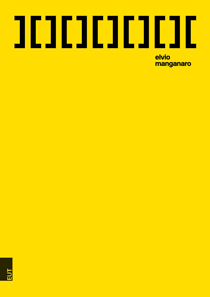
Elvio Manganaro's book narrates the same promise, the spatial power of two-dimensional traces in their zero degree. Before and after architecture there is no language: all signs are abstract, meanings zeroed out, like the square brackets shown on the book's cover. For the author, the title is unnecessary. The characters on the front ][][][][][][ are a fragment of a "muratoriana" composition contained within the book: they are traces of an embryonic city, or of a built past like the footprints on the ground of ancient Ostia, Timgad and Olympia seen from above. Texts and images are intentionally unconnected, and the use of English, phonetically distant from the author as indicated in the foreword,1 emphasises the casual composition of the book. The representations are different in nature (didactic exercises, photographs or two-dimensional drawings) dealing with architecture as an object of language.
The book consists of forty-eight paragraphs grouped into eight thematic chapters, which the reader discovers only at the end: the composition is certainly arbitrary. The author uses asemic writing and concrete poetry as tools to investigate architectural signs understood as textual elements on the edge of disciplinary context.
Manganaro's volume suggests two possible levels of reading that merge and blur as we advance through the text. The first is the pedagogical one through which the author narrates between the lines a didactic method reaffirming the belonging of architecture within the domain of the arts. In this regard, the reworking of a project of the GRAU studio (Gruppo Romano Architetti Urbanisti), on page eighty-two of the book, is no accident since the same group posed the problem of architecture as art in the terms of "unity of the multiple".2 Manganaro reminds architectural novices that the art of building is an exercise in the sensibility of composing that is acquired by educating sight and manual-digital doing. Only in this way is it possible to sediment what Alessandro Anselmi (ex GRAU member) called the Formation of Taste: that is, that conditioned reflex that allows the tennis player to hit the ball without looking and the architect to possess, in a similar way, a spatial-figurative instinct.3 The book educates, therefore, in the reading of images and composition by placing on the same level the pictorial – that is, the informal such as the photo of a time-scarred drawing board (pp. 48-49), apparently a painting by Emilio Vedova –, and the linear, a register of more defined geometric forms such as the muratoriana representations (pp. 44-45) that harken back to the paintings of Capogrossi.
The second level of reading suggested by Manganaro's book is a reflection at the edge of the boundaries of the discipline, an invitation to meditate on the meaning of doing architecture today.
If the architectural sign becomes a figurative unit in itself, which can be composed and reassembled by an artificial intelligence or a subject (no longer the interpreter of a personal language), is a degree zero architecture possible in today's society?
Is it possible to practice, as in concrete poetry, opacity in architecture by combating its reduction to an art of space and crystallizing the meanings and signifiers of construction elements?
Venturing toward the disciplinary limit is Manganaro's challenge who, as he states in a recent text, invites us not to stop "considering architecture as an open field of experimentation".4 The book is thus a clear demonstration of this approach but also an object that appears as a self-signifying entity, a true "work of art".5
Alessandro Brunelli
Notes
↩ 1. "This is due to the need to assign the proposed themes a phonetic substance that is as far as possible from the voice of the author". Manganaro E. (2024) – [Architecture as an object of language], EUT, Trieste, p. 6.
↩ 2. GRAU (1981) – Isti mirant stella. Architetture 1964-1980, Kappa, Roma, p. 9.
↩ 3. Cf. Anselmi A. (1997) – "L'insegnamento ai primi anni della scuola di architettura. Una didattica per la formazione del gusto". In: Altarelli L. et al. – Forme della composizione, Kappa, Roma. Anselmi A. (2019) "Arte e figure della modernità". In: Brunelli A. – Intuizioni sulla forma architettonica. Alessandro Anselmi dopo il GRAU, Quodlibet, Macerata.
↩ 4. Manganaro E. (2025) – "I libri di architettura mi annoiano (con 7 postille)". In: Bisiani T., Venudo A. (eds.), Seminario tre, Maggioli, Santarcangelo di Romagna, p. 75.
↩ 5. Celant G. (2008) – Artmix. Flussi tra arte, architettura, cinema, design, moda, musica e televisione, Feltrinelli, Milano (2021), p. 26.