Enrico Prandi
There is a question that runs silently through the entire history of modern architecture, and which is rarely posed directly: what survives transmission of the discipline? Not how architecture is taught, not through which channels its culture spreads, but what remains of the project, of critical thought, of disciplinary intention, when knowledge leaves the classroom and entrusts itself to a medium other than the lecture, the book, the hand drawing.
This question is more urgent today than ever, not because it is new – every generation has had to confront the transformation of its own communication tools – but because the speed and radical nature of the mutation underway are unprecedented. The data collected by Riccardo Rapparini (2024) state this with almost disarming clarity: 99% of Italian architecture students use the Internet to find information, 68% rely on social networks, while only 42% integrate printed materials such as books and journals. This is not a generational preference or a passing habit but, as has been observed, "a genuine anthropological mutation."
We might say that this issue of FAM is born directly from the classroom, from the dialogue and debate with the students to whom we have decided to hand down disciplinary knowledge as expressed in the ability to design. It therefore arises from the intention of fully understanding this mutation: not as nostalgic lament, nor as uncritical celebration of the new, but as the opening of a theoretical problem that directly affects the status of the architectural discipline. If the medium is the message, as Marshall McLuhan (1964) taught us, then radically changing the media through which architecture is transmitted means changing, at least in part, architecture itself. It means modifying what is perceived as relevant, what is memorable, what builds cultural authority, what shapes the taste and imagination of those who design.
The call for papers that generated this issue asked for national and international experiences capable of transmitting design culture outside traditional academic channels, with the aim of constructing a geography. The contributions received responded with a variety and richness that confirmed, and in some cases exceeded, expectations. Leaving the detailed analysis of the individual contributions to Riccardo Rapparini's specific editorial, some cross-cutting considerations are summarised here.
Among the devices of extra-academic transmission, large events such as biennials, triennials and, more recently, festivals occupy a peculiar place. They are not schools in the proper sense, but events, with all that this word implies in terms of concentration, exceptionality, and the ritual construction of a collective occasion. Thus, more than twenty years ago, the Festival of Architecture of Parma – the first of its kind in Italy – arose from a precise intuition: that the university should not limit itself to producing knowledge for itself, but should become a protagonist of the cultural life of the city and territory in which it is rooted. Its intellectual genealogy is made explicit by the Rogersian model of the Utopia of Reality, the idea that university research must break down its own institutional boundaries in order to offer itself to verification in the field. It is no coincidence that the Festival was born within the walls of the University of Parma, yet from the outset took shape as an independent body, capable of collaborating with local institutions while maintaining its own programmatic autonomy. As an alternative to the system of Urban Centres – which have often paid the price of political subservience, becoming mere instruments of consensus – the Festival has, from its origin, represented an attempt to hold together critical rigour and openness to a non-specialist public.
What distinguishes the Festival of Architecture of Parma from many other similar events – and their proliferation in subsequent years has been considerable, up to the centralised institutionalisation carried out by the Ministry of Cultural Heritage – is the choice to build an integrated system over time, rather than limiting itself to a happening. Each edition has had a strong thematic identity and has been accompanied by publications (FAEdizioni), by a scientific journal (FAMagazine), and by international workshops and calls for papers. The event therefore does not exhaust itself in the moment but, on the contrary, generates an archive, produces knowledge, and builds community.
This distinction – between event and cultural project, between happening and system – is perhaps the most important to emerge from the contributions gathered in this issue. A festival that limits itself to celebration, however spectacular, transmits nothing durable: it produces emotion, perhaps recognisability, but does not sediment disciplinary culture. A festival conceived as a structured critical device – with its own editorial line, with a memory of previous editions, with the capacity to connect university research and a broader public – can become something different: a permanent laboratory for the elaboration and transmission of architectural knowledge.
The opposite risk is equally real: that of self-referentiality, of an event that speaks to insiders while pretending to address the city. The question that the Parma Festival – like any analogous device – has had to confront continuously is whether its public was truly broad, or whether, beyond declarations of intent, it essentially reproduced academic circuits in a more theatrical form. There is no definitive answer to this question. But the very fact that the question remains open is a guarantee against complacency.
Returning to the initial data, the numbers do not describe merely a change in cultural consumption habits but describe a transformation of the cognitive structure of learning, and, more deeply, a mutation in the very idea of what knowledge is and how it is acquired.
McLuhan observed that every medium does not simply transport content: it modifies the sensory and cognitive structure of those who use it, changing the relationship between figure and ground, between sequentiality and simultaneity, between depth and surface. Television, however different from the book, was still a linear, narrative medium, capable of sustaining complex arguments over time. By contrast, social networks are built on radically different logics, insofar as the algorithm rewards immediate engagement, fluency, visual recognisability, emotional simplification. For architecture, this transformation has specific and partly paradoxical consequences. On the one hand, never before have images of architecture been so accessible, so widespread, so globally shared. A project built in Porto or Seoul is immediately visible to a student in Parma. Digital historical archives have made accessible an amount of documentation that previous generations would have considered unthinkable.
On the other hand, however, this abundance comes with the loss of depth, of slowness, of the capacity to sustain complex arguments over time. The image of architecture on social media – inevitably decontextualised, extracted from its relationship with place, with time, with programme – tends to reduce the project to an object of visual consumption. The concrete risk is that deep scrolling replaces the project with its surface: that aesthetic recognisability takes the place of critical understanding. This is not a matter of demonising the tool, but of recognising its structural tendencies.
There is also a question of cultural authority. In the twentieth-century paradigm that I have summarised in the article Multimedia Experiments in the Transmission of Architecture. Six Italian Television Programmes between Public Pedagogy and Disciplinary Culture in this issue, criticism had a precise and important role, namely that of selecting, interpreting, hierarchising, insofar as its authors – Rogers, Zevi, Argan, Tafuri – built canons that were debatable, partial, even traversed by theoretical and political tensions if you will, but which existed as points of orientation (let us always remember Baudelaire's definition). The digital has dispersed that function into millions of micro-narratives, each with its own small audience, but none with the authority necessary to construct a shared horizon.
There is a structural difference, and not merely a quantitative one, between television in the 1960s and the internet as we know it today; a difference that affects not only the content transmitted, but the very nature of the relationship between medium, knowledge and recipient.
The television of Rogers', Zevi's, and Bakema's programmes was an intentional medium. Every piece of content was the result of a chain of conscious editorial decisions: who speaks, to whom, with what objective, within which cultural frame. The scarcity of the medium – few channels, few hours of programming, a centralised editorial direction – imposed a selection. That selection was certainly debatable, certainly traversed by dynamics of cultural power and exclusion; but it had one precious consequence: content reached the public already filtered, already interpreted, already inserted into an explicit frame of reference. The viewer could disagree, could ignore it, could change channel. But could not confuse that content with the neutral, unmediated reality of things: they knew – or could know – that they were watching a point of view, a choice, a proposal.
The internet overturns this structure radically. It is not simply that there is more content, or that it is less selected: it is that the medium is architecturally constructed to simulate neutrality. The algorithmic feed does not present itself as an editorial proposal – it presents itself as the world. The platform has no signature, no editor-in-chief, no declared cultural line. What appears on the screen seems to emerge spontaneously from reality, as if reality itself were speaking, rather than an opaque system of selection and amplification driven by commercial logics. The result is paradoxical: a medium that produces enormously more content than 1960s television, but delivers it to the recipient devoid of the epistemic frame that would make critical evaluation possible.
For a general audience, this problem is serious. For architecture students, it is potentially devastating — and for reasons that concern the specificity of the discipline.
Architecture is, among the design disciplines, the one in which the relationship with the image is at once most constitutive and most ambiguous. Constitutive, because the project is thought through images (or rather, through "figures", Rella 2004), is communicated through images (Evans 1997), is evaluated through images (Colomina 1994). Ambiguous, because the architectural image is always a reduction: it extracts the building from its context, fixes it in a moment, privileges certain aspects (form, light, photographic staging) at the expense of others (matter, time, use, relationship with place). The great architectural photographers were aware that they were constructing an interpretation that relied on a representational and textual critical apparatus that completed the narrative. What happens today on social networks is structurally different: the architectural image published on Instagram or Pinterest is extracted from any critical apparatus, stripped of scale, of geographical context, of client, and above all, of relationship with place – that is, of critical depth. What remains is only the surface, often glossy: and that surface is of extraordinary photographic quality, which tends to obscure everything that is not visible in the image – which is, almost always, the most important part of architecture.
What is thus produced could be called an effect of disciplinary cultural flattening: architecture is progressively reduced to what is photographable, and photography becomes the implicit criterion for evaluating the project. A building that functions poorly but photographs well thrives in the digital ecosystem. A building that resolves a complex problem in an extraordinary way – in terms of relationship with context, management of uses, durability over time – but offers no spectacular images, tends to disappear. This is not a superficial aesthetic problem: it is an epistemic distortion that affects the formation of taste, the construction of the canon, and the very definition of what counts as quality architecture.
Cultural flattening is the offspring of mediocracy (Deneault 2015). The algorithm thus becomes the mediocratic machine par excellence, insofar as it selects not the best of architecture but the most recognisable, the most shareable, the most immediately pleasing. This is precisely mediocratic logic applied to visual culture – not the triumph of the ugly, but the triumph of the mediocre-beautiful, of the stylistically domesticated.
Education must function as an antidote to this. If mediocracy works through progressive conformism – through the slow erosion of the capacity for judgement – then the pedagogical response must be to build in students (the first interlocutors) the critical capacity to distinguish good from bad, beautiful from ugly, possible from impossible. This is exactly the opposite of mediocracy: it is the formation of judgement as an act of cultural resistance.
There is also a second level to the problem, concerning not only the reception of images but the construction of professional identity. The internet – and social networks in particular – has created the conditions for the circulation of architectural models at unprecedented speed and pervasiveness. Styles spread globally and become homologated. Successful formal solutions are replicated and amplified by the algorithm, which rewards recognisability. The result is a paradoxical global uniformity of the contemporary architectural landscape: never before have projects produced in profoundly different geographical and cultural contexts resembled one another so much, because all are nourished by the same feeds, look at the same images, are formed through the same digital references. Architecture – which is by its nature rooted in place, in time, in local culture – is subject to a pressure toward de-localisation, toward a sort of digital international style that does not even have the ideological coherence of the twentieth-century international style: it has only the logic of the algorithm.
Faced with this scenario, the most obvious pedagogical response – but perhaps also the most mistaken – is to return to the book and the frontal lecture as if the world had not changed: an understandable but ultimately useless response, because it leaves the student alone in front of a medium they will continue to frequent outside the university, without having provided them with the tools to navigate it critically.
The more difficult – and more necessary – response is instead of the opposite nature: to bring the internet into teaching, not to indulge its logics, but to make them visible and therefore open to criticism. It means building, as an explicit competence of architectural education, what could be called the capacity for critical judgement of the image: in other words, the capacity to ask, in front of any architectural image, whether it possesses that metaphorical depth, that virtual third dimension capable of placing it among the architectures worth attention.
This capacity is not innate, nor is it acquired through mere exposure. It is built through a deliberate and progressive exercise, whose fundamental tools are the comparison between images and reality (travel, direct visits to built architecture), the critical analysis of sources, the reading of texts not as an alternative to the image, but as its necessary counterpoint. And it requires that the School, understood in its full sense, as a place for the formation of judgement and not only for the transmission of techniques, take explicit responsibility for this task: helping students distinguish good from bad, beautiful from ugly, possible from impossible. Not in a dogmatic sense, as the imposition of a fixed canon, but as a continuous and argued exercise of critical judgement, which is, in the end, the fundamental competence of any mature intellectual practice.
In this sense, the question of the extra-academic transmissibility of architecture in the digital age cannot be separated from the question of academic education: the two dimensions condition each other reciprocally. A rich and critical extra-academic architectural culture – made up of festivals, journals, structured editorial platforms, more or less independent cultural centres – can offer students models alternative to the algorithmic drift of social networks, concrete examples of how disciplinary knowledge can be transmitted with both rigour and openness. But this offer can only be received and valued by students who have already developed, within the school, the capacity to distinguish a cultural project from a mere happening, an argued critique from an opinion, an interpreted image from a consumed image.
The medium, then, is not only the message: it is also – or perhaps above all, in the age of digital mutation – the stakes of a pedagogical battle that cannot be postponed.
The distinction that emerges most clearly from the contributions gathered in this issue is not between analogue and digital, nor between traditional and innovative. It is between spontaneous production and structured cultural project. Between the instinctive reaction to the possibilities offered by a medium and the conscious construction of a device capable of lasting, of sedimenting, of building a critical community.
In the field of digital scientific journals, FAMagazine represents a case of particular interest precisely because its trajectory is inseparable from that of the Festival of Architecture of Parma, of which it is historically and programmatically the scientific organ. Born in 2010 as a tool for disseminating the Festival's contributions, the journal has progressively built its own autonomy in the direction of an international scientific standing, not without tensions – it has required an adaptation of contents and formats that has at times put pressure on its original critical vocation in the face of the demands of global academic canons – but this has allowed the journal to build a lasting and recognisable presence in the international landscape.
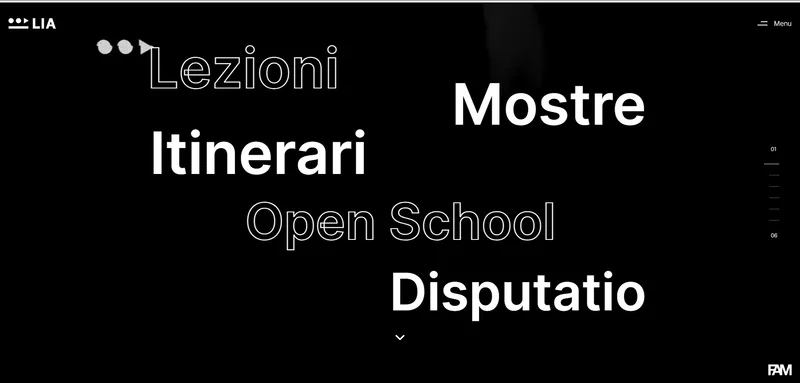
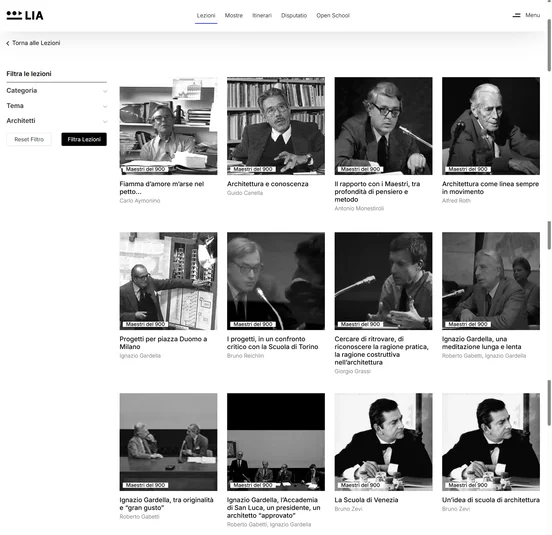
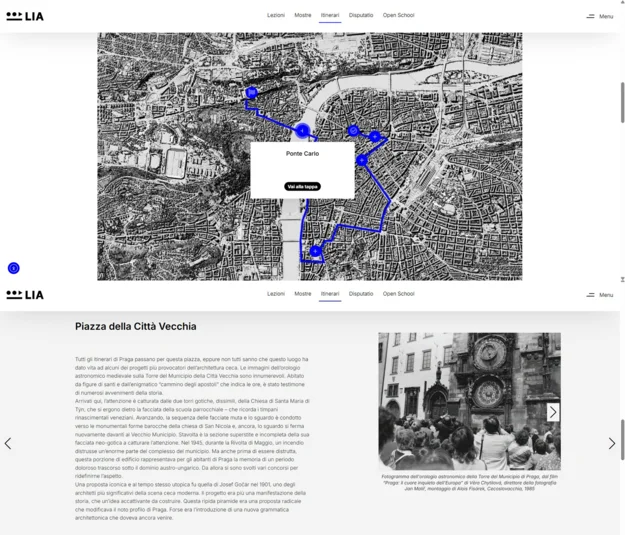
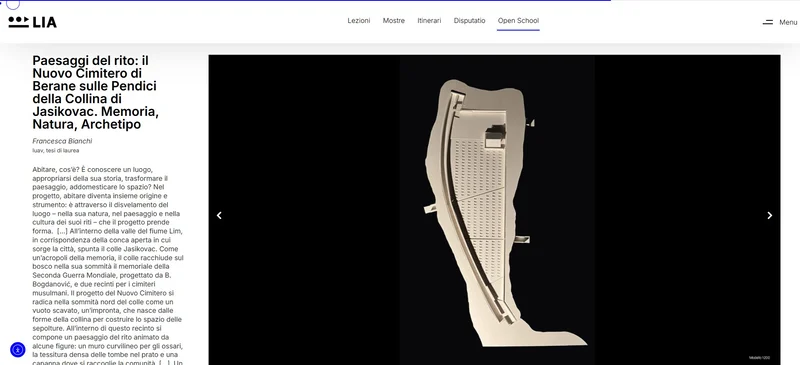
More recent, but equally significant, is the birth of the LIA Platform (Lezioni Italiane di Architettura): a digital tool designed to connect university research, architectural heritage and a broad public through thematic itineraries. LIA is not a journal, not an archive, not a social networking platform, but a hybrid device that seeks to embody precisely that function of mediation between specialist knowledge and the general public which the twentieth-century paradigm entrusted to television and to large-scale events.
Before presenting the individual contributions in their specificity, it is useful to identify some cross-cutting tensions that run through them and which constitute, in a sense, the true theoretical object of this issue. These are not contradictions to be resolved, but productive polarities to be held in tension.
Authority and democratisation. The first tension concerns the relationship between cultural authority and the democratisation of access. The twentieth-century television paradigm was strongly hierarchical: Rogers spoke while the public listened. This was not a flaw, but a necessary condition for the existence of a recognisable critical voice. The digital has dissolved that hierarchy, opening space to a plurality of voices that the previous system could never have accommodated. But it has also dissolved the possibility of a shared critical authority. The contributions on the use of Instagram in architectural pedagogy show with precision the costs of this democratisation: aesthetic recognisability as a surrogate for critical thought, algorithmic visibility as a measure of value.
Event and duration. The second tension concerns the relationship between the exceptionality of the event and the construction of something that lasts over time. Festivals are subject to a spectacular drift that can empty them of critical content, turning them into showcases. The question is not whether to hold events, but how to build events that sediment: that leave behind archives, publications, communities, practices. The model of the Festival of Architecture of Parma suggests that the answer lies in the construction of an integrated system, where the event is a moment within a longer process, not an end in itself.
Image and understanding. The third tension concerns the relationship between the architectural image and the critical understanding of the project. Many contributions – from those on social media to those on the history of television, from those on the use of cinema to those critiquing media stereotypes – converge on one point: the risk that the proliferation of architectural images produces not more knowledge but less, because the decontextualised image triggers recognition but inhibits understanding. The contribution on the use of artificial intelligence from a pedagogical perspective addresses this question directly: how to transform the "bulimic intake of naive images" into critical and "intentional" understanding. The proposal of a conscious use of AI and of open collaborative models – on the model of Wikipedia, which we initially accepted with reservations but which to this day proves superior to many other experiences – as tools for building shared architectural knowledge is one of the most stimulating hypotheses in this issue, precisely because it reverses the sign of technology: not a cause of dispersion, but a potential instrument of critical reorganisation.
Specialism and a broader public. The fourth tension concerns the relationship between the scientific rigour necessary to the discipline and the capacity to speak to a public still in training or non-specialist. This tension – which the historical contributions on RAI show was already present in the 1950s and 1960s, in the oscillation between domestic entertainment programmes and documentaries of civic engagement – reappears in new forms in the digital context. Specialist portals and webzines risk being accessible only to those already trained, while social networks are accessible to everyone but tend to simplify, trivialise, or worse, mystify. Between these two poles, there is space for devices capable of being rigorous and accessible at once, which however require a conscious work of translation – not simplification, but the organisation of knowledge as critical mediation.
The transmissibility of architecture is today a field of forces in conflict, traversed by tensions that cannot be synthesised into a single formula. The medium has changed, or is changing, the message, even if we do not yet know precisely in which direction, nor at what speed.
What we do know, thanks to the contributions gathered here, is that the most interesting responses do not come from those who choose a single pole of the tension – neither from the nostalgic of the twentieth-century television paradigm, nor from the uncritical enthusiast of digital possibilities – but from those who accept to remain within the tension itself; from those who build structured cultural projects within the new media without giving up critical depth; from those who use the event (necessarily finite) to build duration; from those who translate specialist knowledge without trivialising it; from those who keep alive the question of cultural authority in an age that tends to dissolve every hierarchy.
McLuhan indeed said that the medium is the message, but he also added that the critical response to the medium – the awareness of how it works, the capacity to use it without being used by it – is the only form of freedom available in the "electric age", to use McLuhan's own term. This freedom is never guaranteed but must be won every time, in every cultural project, in every editorial choice, in every festival, in every digital platform that decides to be something more than an aggregator of content.
Some contributions in this issue show that this achievement is possible – not easily, not without contradictions – but it is precisely this possibility that is worth defending.
McLuhan, M. (1964) – Understanding Media: The Extensions of Man, McGraw-Hill, New York, 1964. ↩
Guerzoni, G. (2008) – Effetto Festival. L'impatto economico dei festival di approfondimento culturale, Fondazione Carispe, La Spezia, 2008.
Deneault, A. (2015) – La médiocratie. Translated by Roberto Boi. Vicenza: Neri Pozza. ↩
Rapparini, R. (2024) – Per una scuola fuori dalla scuola. Fenomeni, strumenti e prospettive della trasmissibilità extra-accademica. University of Parma, Department of Engineering and Architecture, PhD in Architectural and Urban Composition, Supervisor Prof. Enrico Prandi, University of Parma. ↩
Rella, F. (2004) – Pensare per figure. Freud, Platone, Kafka, il postumano. Rome: Fazi. ↩
Evans, R. (1997) – Translations from Drawing to Building and Other Essays. London: Architectural Association. ↩
Colomina, B. (1994) – Privacy and Publicity: Modern Architecture as Mass Media. Cambridge (MA): MIT Press. ↩
Fig. 1 – LIA platform, Lezioni Italiane di Architettura, homepage.
Fig. 2 – LIA platform, Lezioni Italiane di Architettura, Lezioni section.
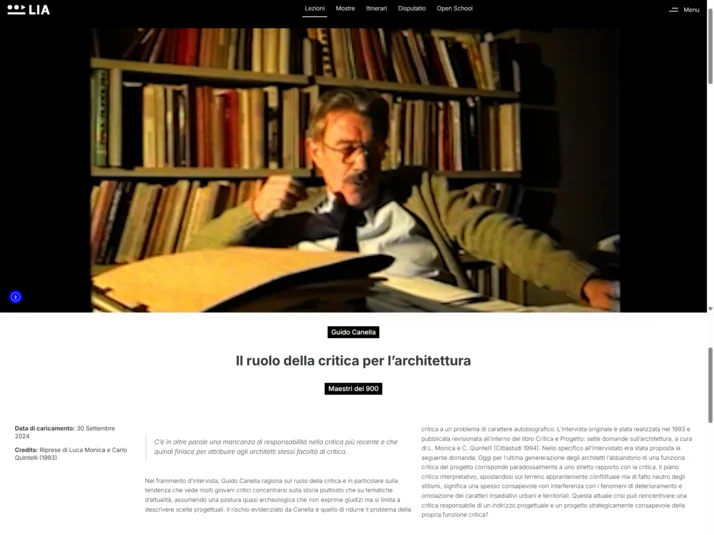
Fig. 3 – LIA platform, Lezioni Italiane di Architettura, Lezioni section. Specifically: Il ruolo della critica a partire da Zevi e Persico by Guido Canella. Available at: https://www.liaplatform.it/lezione/il-ruolo-della-critica-per-larchitettura/
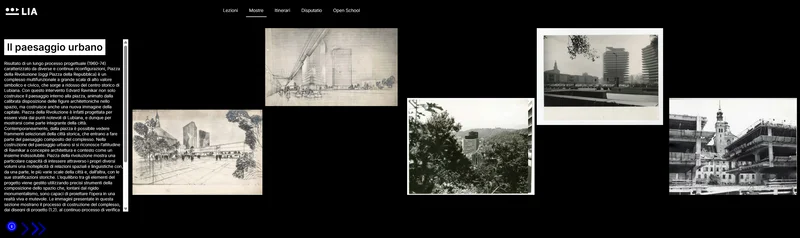
Fig. 4 – LIA platform, Lezioni Italiane di Architettura, Mostre section.
Fig. 5 – LIA platform, Lezioni Italiane di Architettura, Itinerari section.
Fig. 6 – LIA platform, Lezioni Italiane di Architettura, Open School section.