Reviews
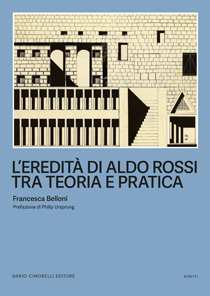
A Detective Story about Architecture, for Architecture
Author: Francesca Belloni
Title: L'eredità di Aldo Rossi tra teoria e pratica
Language: Italian, with a preface by Philip Ursprung in English
Publisher: Dario Cimorelli Editore
Format: 17 × 24 cm, 224 pages, paperback with flaps
ISBN: 9791255611394
Year: 2025
The extensive scholarship devoted to Aldo Rossi (1931–1997) has never ceased, neither during his lifetime nor after his untimely death, and in recent decades has been further sustained by the Fondazione Aldo Rossi. Within this context, Francesca Belloni addresses a previously unexplored question: how the theoretical principles Rossi formulated throughout his career, and enacted in his projects, have been received and reinterpreted by subsequent architects. This is a particularly complex undertaking, not only because of its relative chronological proximity, but also because of its geographical scope and its repercussions on contemporary architecture. As a perceptive scholar of Rossi (Belloni 2017; Belloni 2020), Belloni constructs her book by assembling "pieces" and "parts", weaving connections across different historical periods and geographical contexts, and then recomposes these fragments into a dense collage in which theory and practice are held in a productive equilibrium.
Although entirely centred on architecture, the book unfolds as a detective story. From the outset, the 'crime' is identified, yet its perpetrators and methods are disclosed only gradually, as in a thriller. It thus suggests an almost new literary genre for architecture, one that eludes the conventional categories of the historical or theoretical essay and finds resonance in contemporary publishing, as evidenced by Park Books' recent launch of the Gumshoe series (Fromonot 2025).
The 'crime' in question is that committed against Rossi's theoretical and practical legacy – a veritable "betrayal", in Belloni's words. This betrayal began in the 1970s with figures who knew Rossi personally, sometimes even as friends, and continues in more recent years through architects who encountered him only indirectly, through his writings and buildings. Belloni's use of the term "betrayal" is a deliberate rhetorical move that lends pathos to her architectural crime story. Yet it carries no negative connotation; instead, it echoes Walter Benjamin's understanding of "translation" as a necessary transformation of a legacy – an act that inevitably entails revision, adaptation, and reinterpretation.
The architectural detective story opens with Architettura per i musei (1968). This choice reveals not only Belloni's deep familiarity with Rossi's work, but also a conscious critical gesture – the book's first unexpected move. Rather than starting from Rossi's most canonical texts, such as L'architettura della città (1966), or the article and subsequent lecture entitled L'architettura analoga (1975), which nonetheless appear among the book's "pieces", Belloni turns to a less frequently cited yet theoretically pivotal text, published in the volume Teoria della progettazione architettonica. From this starting point, she reconstructs key Rossian principles: the reciprocal relationship between "urban facts" and "theories"; the distinction between "theory of composition" and "theory of design"; and the idea of a collection of "museum pieces" as a methodological device. This reconstruction serves as a necessary preamble to her central hypothesis. Rossi's legacy has been so thoroughly "ruminated" – to use one of Rossi's own terms – that in certain cases it has been transfigured to the point of becoming almost unrecognisable. According to Belloni, this constitutes the 'crime'. It is the transformation enacted by several architects, mainly Swiss or professionally connected to Switzerland, who appropriated Rossi's legacy, infused it with their own references, and combined it with personal experience to produce, continuing the literary metaphor, a kind of Frankenstein.
The perpetrators are introduced across the book's chapters under evocative titles. The narrative begins with Rossi's teaching in Zurich and his transmission, through design, of the centrality of history, urban analysis, and typological study. It then turns to examine the various 'crimes' committed against Rossian concepts such as "analogy", "autonomy", and "typology". Fabio Reinhart and Miroslav Šik's Analoge Architektur emancipates itself from the architecture of the city in order to foreground the atmosphere of place. Kristian Kerez, Quintus Miller, and Paola Maranta reinterpret Rossian attention to the locus through a "contextual gaze", developed by Kerez through abstraction and by Miller & Maranta through a renewed realism. Valerio Olgiati shifts from collective memory to a personal exaltation of "non-referential architecture", detached from history and tradition. Pier Vittorio Aureli reformulates autonomy as a "rejection of authorial creativity" and as non-figurative architecture. OFFICE Kersten Geers David Van Severen and Christ & Gantenbein – along with Christopher C. M. Lee and Andreas Lechner – transform Rossian typology into an architecture "without content" (for OFFICE) and into a renewed conception of "design" (for Christ & Gantenbein). Adam Caruso and Eduardo Souto de Moura reinterpret Rossi's referential practice within their own projects. The "collage" architects extend Rossi's collages into mannerist exercises, while Herzog & de Meuron rework his typological-morphological analysis into a practice infused with artistic references and Swiss minimalism, establishing not yet another theory but a new architectural praxis.
All are traitors, according to Belloni's Benjaminian reading – herself included. And yet it is hard to escape the impression that these very traitors are also the most refined interpreters of Rossian thought. It is a critical thought that traced a trajectory without ever circumscribing its possible outcomes, "because, if we know what we wanted to say, we do not know whether we only said that", as Rossi liked to quote from André Gide. This idea resonates with one of the conceptual premises underlying Rossi's formation: the openness of the work (Eco 1962). It is as though each of Rossi's writings, drawings, projects, or buildings concealed a "figure in the carpet" (James 1896), which successive theorists, historians, critics, and architects have unearthed and "ruminated" in different ways. Was this not precisely what Rossi hoped for when, in the introduction to L'architettura della città, he wrote that his "draft of a theory" "must be carried forward" (Rossi 1966: 17)? Seen from this perspective, Belloni's architectural detective story reveals not only the "betrayals" but, above all, the multiple "figures in the carpet". These betrayals appear not as negations of Rossi's thought, but as its most intimate condition of vitality: the very means through which his ideas continue to operate over time and ensure their transmission.
The book guides the reader with firmness and clarity. It explains the criteria behind the selection of architects, engages rigorously with hermeneutical questions, and does not shy away from taking a position. Ultimately, this detective story is not devoted solely to Rossi's legacy, but to contemporary architecture itself and to its dramatic search, amid the multiple crises it currently faces, for a renewed articulation between theory and practice. It is therefore a significant contribution to contemporary debate: a book about architecture, but above all, for architecture (Borasi 2015).
Beatrice Lampariello
Bibliography
Belloni F., Bonicalzi R. (2017) – Aldo Rossi. La scuola di Fagnano Olona e altre storie. Accademia University Press, Torino.
Belloni F. (2020) – "Colpa dell'Aldo? Aldo is your Fault?". In: M. Bovati, M. Caja, M. Landsberger, A. Lorenzi, Aldo Rossi. Perspectives from the World. Il Poligrafo, Milano, pp. 149–155.
Borasi G. (2015) – "For Architecture". In: R. Gigliotti, Displayed Spaces. New Means of Architecture Presentation through Exhibitions. Spector Books, Leipzig, pp. 29–49.
Eco U. (1962) – Opera aperta. Bompiani, Milano.
Fromonot F. (2025) – The House of Doctor Koolhaas. Park Books, Zurich.
James H. (1896) – "The Figure in the Carpet". In Cosmopolis, January 1896.
Rossi A. (1966) – L'architettura della città. Marsilio Editori, Padova.
Rossi A. (1968) – "Architettura per i musei". In: G. Canella et al., Teoria della progettazione architettonica. Dedalo, Bari, pp. 122–137.
Rossi A. (1975) – "L'arquitectura analoga". In 2C. Construcción de la ciudad, 2, pp. 8–11.