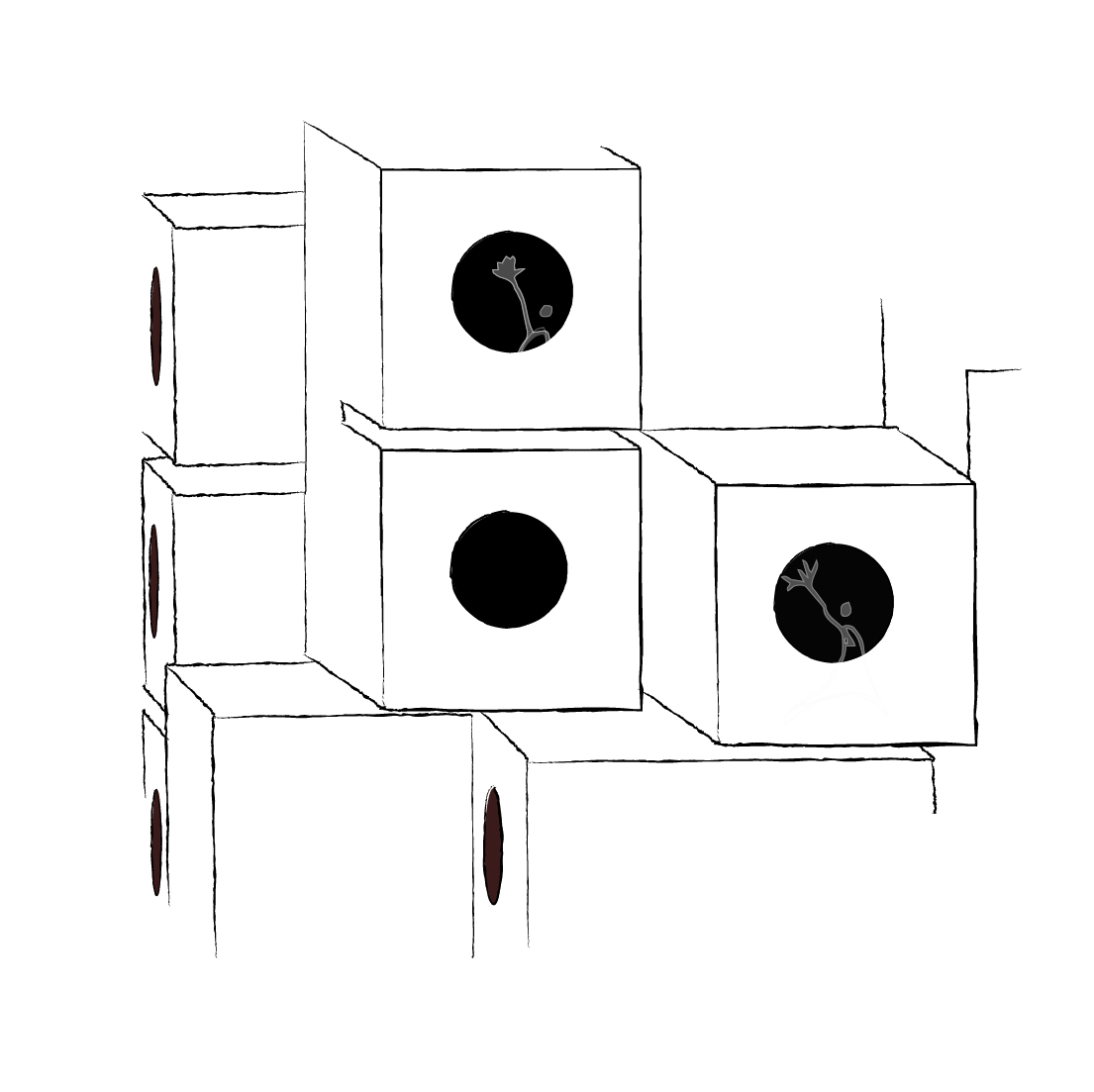
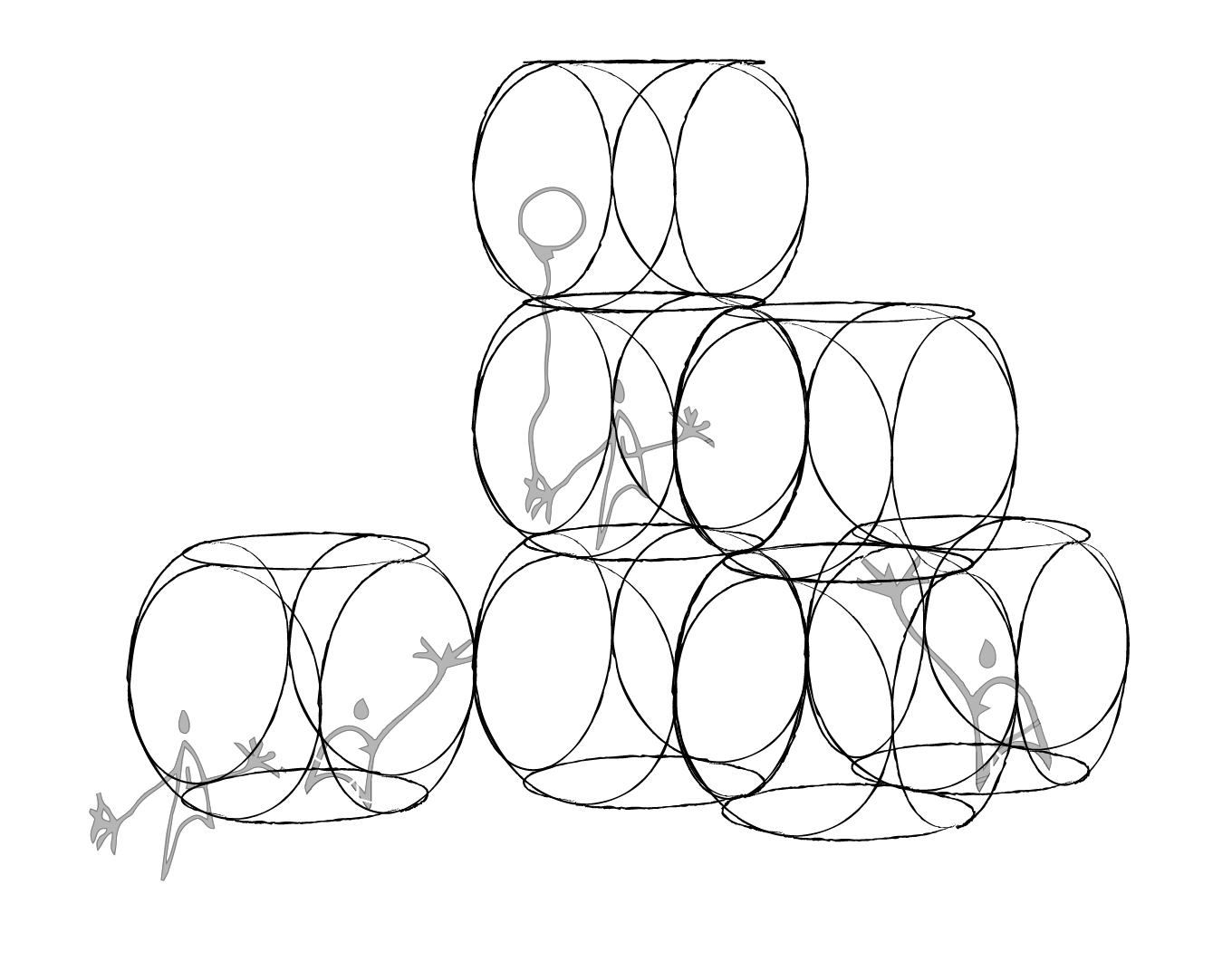
Fig.
2 - Yona Friedman, Mobile Architecture. Sketch.
The period
of social withdrawal that forced each person, in a different way, into
persistent social distancing and to inhabit a delimited, circumscribed,
measured space led to precise considerations of the relationship
between man, space and living environment and of the meaning of death.
What would happen if contemporary humans, nomadic inhabitants of the
world, accustomed to considering one’s personal home as a
place in which to take refuge, were forced to live exclusively in the
contraction of their own domestic space? This paper attempts to show
that the months of social withdrawal have been the staging of a reality
that, lacking in physical, social, recreational relationships has led
man to renounce his own corporeality and to inhabit a place made of
connections and exclusively virtual relationships. A world made of
non-real, simulated space, of cyberspace that for architects like
Marcos Novak could be the occasion for new poetic shapes and other
rules for architecture. Non-gravitational, non-perspective,
non-Euclidean rules. He writes about liquid architecture that pulsates
and breathes and about cyberspace as the place in which complex
information, inputs, simulations and metadata are programmed
and processed to generate the outputs in the virtual reality.
Cyberspace becomes for Novak a habitat ‘for and of the
imagination’ (Novak 1991). What will be the consequences?
Will capsules, micro-architectures, technological caverns that
incorporate, fossilize, immobilize the human body be inhabited? Will
the inevitable end for architecture be announced? Will blocks of
meta-data be designed? Will there be a return to a primitive man? Novak
(2001) writes about ‘transarchitecture’, about
‘interactive media interspaces’ and about
‘telepresence’. What will be the destiny of humans?
Will they disincarnate, will they get lost in the network? A network
made of likes, of smoothness as Byung-Chul Han (2015) writes. On such
premises, two reflections have been achieved: the first one on the
meaning of contemporary living which seems to induce men to look
towards the past; the second one, on the meaning of contemporary
architecture during a period when technology and science seem to
dominate over humans. Looking at the past for dwelling in the
‘house of a prophet’ as is written by Kahlil Gibran
(1923) or in the ‘house of the future’ (Bachelard
1957). For imagining a ‘shell’ like the one
described by Walter Benjamin (1982). For wanting an
‘anonymous house’ (Rogers 1958) or to understand it
as a ‘social right’ (Ponti 1957). For inhabiting
the ‘Bolling tower’ of Carl Gustav Jung (1961) or a
house ‘as a metaphor of a body’ (Augè
1994). A ‘home for everyday life’ (Rossi 1981) or a
house for the ‘events’ (Tschumi 1994). Namely, a
house to ‘dwell’ wrote Heidegger (D'Urso 2009). For
Baudrillard (1988) humans live in the era of the disappearance of art
and in the era of a society consumed by ephemeral values. Paul Virilio
(2002) in Discorso sull’orrore dell’arte recognizes
a progressive and precise desire to eliminate the art techniques and
old means of expression, in favour of a typology of art defined by the
author as ‘the art of the motor’. This theorization
is the transposition of the clash between men and the general and
disarming confidence in technology, machines, dis-values linked to
speed and hyper-technique. Why speed? If time is money, then speed is
the power to make money. Humans are moving towards a sort of
divinization of techno-science assuming that it is necessary and
inevitable. What are the consequences? The gradual disappearance of
perception, physicality and corporeality for humans in favour of
automaton. But not all human perceptions are contemplated in
cyberspace. And the question becomes more complex when the design of it
takes place through stochastic algorithms or when the algorithmic
process is iterated on the basis of random parameters. Greg Lynn FORM
at the 2012 Biennale Interieur held in Belgium proposed the RV
prototype house. He showed a rotating prototype, transposition of an
ever-changing space without any relationship with the specificities of
a context. The FOA studio designed the Virtual House in 1997. A ribbon
wrapped around itself. For which site? Anywhere. A virtual house which
shifts «constantly between a lining and a wrapping condition
- a quality that seems suited to the cyborg's - partiality, irony,
intimacy, and perversity» writes Alejandro Zaera (1998, p.
40). The Asymptote studio directed by Hani Rashid and Lise Anne Couture
designed the Virtual Guggenheim Museum in 2004 demonstrating that the
imagination could also transcend the materiality. The virtual walls of
the museum change their shape according to the simulated
‘movements’ of the ‘visitor’. A
really stimulating virtual space for the human mind. What are the
constants of such architectures? Virtual or real objects without any
physical sensory involvement of humans. In these experimentations,
suggested only by a mathematical matrix of non-Euclidean space, the
organism's physicality is forgotten. They are the result of metadata
contained and managed by algorithms. They are surrogate and abstract
models of a world devoid of diversity and imperfection. An artificial
nature that generates a forgery and therefore a counterfeit aesthetic.
Yet, Donna Haraway writes that the cyborg, hybrid between machine and
organism, between social reality and fiction, makes humans free from
‘all forms of addiction’. The cyborg breaks the
dualisms: machine-organism, nature-artifice, body-psyche,
material-shape. This process of de-naturalization is opposed to what
Gillo Dorfles (1968) sought when he wrote that artifice object could
become a natural object. The apocalyptic telos of abstract
individualism (Haraway 1995) is contrasted by an aesthetic and
sociological telos necessary to maintain ‘the creative and
experiential capacity of humanity’. One theory bases itself
on a de-naturalization process of the automaton, the other one, on the
organism, on the human being and their own capacity of naturalization.
Because, Heidegger recalls, if there is a device capable of
remembering, of creating, of elaborating better than humans, man will
probably gradually lose their own ability to do it, namely, to carry
out all those activities for which a mechanical system would work
better. And, if it is true that social, historical, cultural,
environmental and therefore also technological factors intervene in
corporeality because the body is a complex organic system bigger than
the sum of its components, one wonders whether, similarly, in the
cyborg, the sum of the terms cyber and organism, is still included the
corporeity of the human being. In this scenario of general
anesthetization of human feelings, it is probable that we theorize
about the end for man, for art and architecture. Paul Virilio (1980)
wrote about the aesthetics of disappearance. Once again it is a
cancellation. Similarly, to what happens in art for which the
avant-gardes seem to want to cancel previous artistic techniques as if
they wanted to eliminate history, the virtual space seems to want to
remove the real one. For Allan Kaprow, the word art should even be
deleted from the dictionary. Martin Heidegger (1976) puts himself in an
intermediate position by stating that the action of revealing the
truth, Wahrheit, also takes place through technique, as well as through
the creation of artwork. The occurrence happens through the action of
‘being there’. Where is the place of the particle
‘there’ in cyberspace? For cyborg architecture the
technology is the end to itself. The material space of architecture is
destined to be reduced until it disappears in favour of the virtual
space of the network. And, the Coronavirus seems to have forced us to
do so. But, the months of lockdown, months of virtual connection, have
shown that communication between human beings is not exclusively verbal
or visual. What was missing was the perception of one's own body in
relation to the body of others. The philosopher Massimo Cacciari (2004)
writes that if the body is the first-place humans inhabit, how could
the human being not look for other real places? And that although the
soul may not have a fixed abode, an a-oikos because it is nomadic,
dynamis, and intellectual energy, it is still necessary to have places
to inhabit. Changeable and unstable but physical places. They are
essential in order not to lose the human capacity to imagine, to plan,
to get excited, to create. For Paul Virilio (2002) it would be
necessary to restore value to the body and therefore to the
architecture. There is no architecture without a human being. There is
no Christianity without incarnation. There is no art without its
medium. What is the antidote? Virilio identifies a way out in the
accident. Every time a new technological product or a new technique is
invented, the corresponding accident is also conceived. The invention
of the ship coincided with its shipwreck. The incident of art with its
representation. For Virilio, the accident makes it possible to regain
value. Could Covid-19, therefore, be the accident of virtualization?
Bibliography
AUGÈ M. (1994) – Ville e tenute. Etnologia della
casa di campagna, Elèuthera, Milan.
BACHELARD G. (1957) – La
poetica dello spazio, Edizioni
Dedalo, Bari.
BAJ E. e VIRILIO P. (2002) – Discorso sull’orrore
dell’arte, Elèuthera, Milan.
BAUDRILLARD J. (1988) – La
sparizione dell’arte,
Abscondita, Milan.
BENJAMIN W. (1982) – Parigi
capitale del XIX secolo, Einaudi,
Turin.
CACCIARI M. (2004) – “Nomadi in
prigione”. In: A. Bonomi e A. Abruzzese (edited by), La
città infinta, Mondadori, Milan.
CUOMO A. (2015) – La
fine (senza fine)
dell’architettura. Verso un philosofical design,
Deleyva
Editore, Rome.
D’URSO S. (2009) – Il senso dell’abitare
contemporaneo, Maggioli, Santarcangelo di Romagna.
DORFLES G. (1968) – Artificio
e natura, Einaudi, Turin.
GIBRAN K. (1923) – Il
profeta, Feltrinelli, Milan.
HAN B.-C. (2015) – La
salvezza del bello, Figure nottetempo,
Milan.
HARAWAY D. (1995) – Manifesto
Cyborg. Donne, tecnologie e
biopolitiche del corpo, Feltrinelli, Milan.
HEIDEGGER M. (1976) – “Costruire, abitare,
pensare”. In: G. Vattimo (edited by), Saggi e discorsi,
Mursia, Milan.
JUNG C.-G. (1961) – Ricordi,
sogni, riflessioni, Rizzoli,
Milan.
NOVAK M. (1991) – “Liquid Architecture”.
In: M. Benedikt (edited by), Cyberspace:
First Steps, The MIT Press,
Cambridge.
NOVAK M. (2001) – “Liquid, Trans, Invisible: The
Ascent and Speciation of the Digital in Architecture. A Story from
Digital”. In: P. Cachola Schmalk, Digital/Real Blobmeister:
First Built Projects, Birkhäuser Publications,
Frankfurt.
PONTI G. (1957) – Amate
l’architettura, Rizzoli,
Milan.
ROGERS E.-N. (1958) – Esperienza
dell’architettura,
Einaudi, Milan.
ROSSI A. (1981) – Autobiografia
scientifica, Il saggiatore,
Milan.
TSCHUMI B. (1994) – Event-Cities.
Praxis, The MIT Press,
Cambridge.
ZAERA A. (1998) – “La reformulatión del
suelo/Reformulating the Ground”. Quaderns, 220.
VIRILIO P. (1980) – Estetica
della sparizione, Feltrinelli,
Milan