Repopulating abandoned villages. New housing strategies for
the pandemic
Enrico Bascherini
Fig.
1 - Colletta di Castelbianco (Savona), the dryers.
Fig.
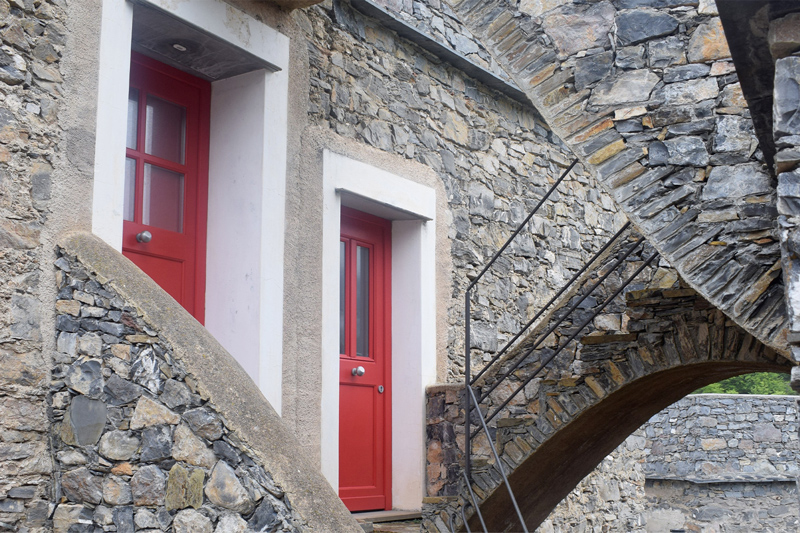
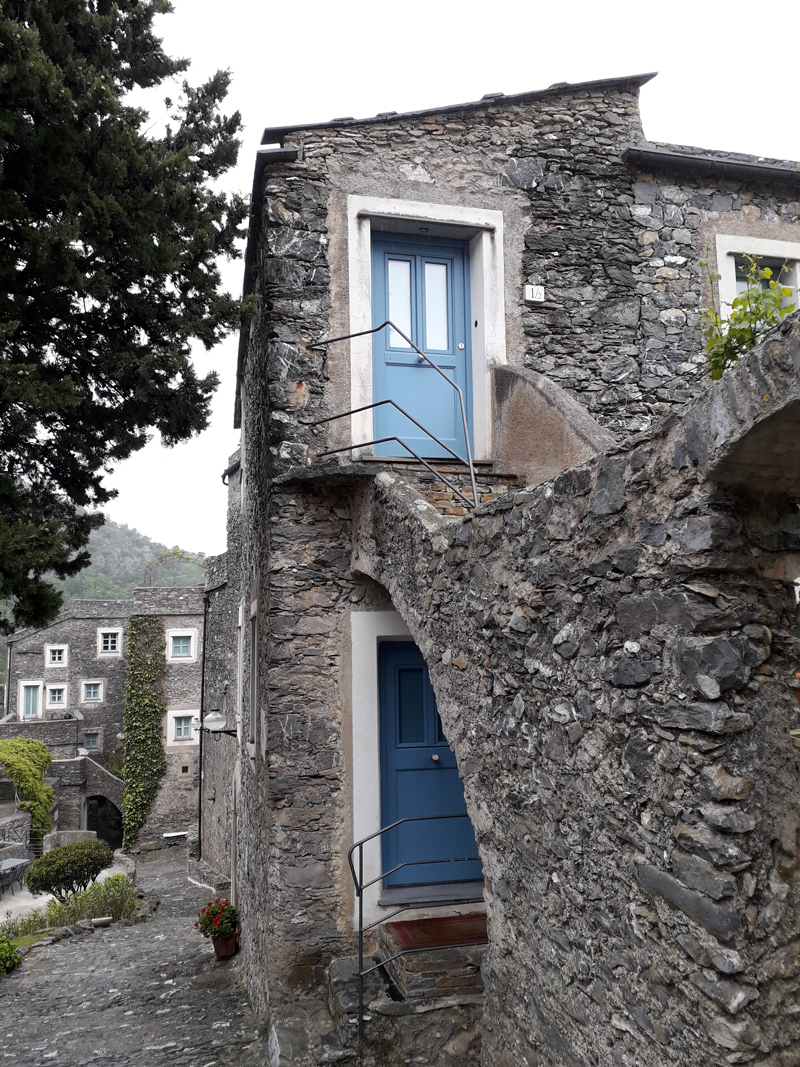
2 - Colletta di Castelbianco (Savona), the rampant stairs of the housing units.
Fig.
3-4 - Colletta di Castelbianco (Savona).
Today
science demands that we practise social distancing, which essentially
means the cancellation of human relations, living in a condition of
physical isolation and limiting movement from place to place. Such
restrictions cannot fail to have an effect on our living spaces and the
places we share, on our towns and our cities.
Even though – in Italy at least – with the
loosening of these restriction we appear to forget the difficulties we
have recently suffered, the issues that have emerged in the sphere of
lifestyle as a way of combating the pandemic find no answers in science.
Among the countless hypotheses around finding a cure and preventing the
coronavirus from spreading and hence a new way of living, the issue of
abandoned villages appears to have taken hold not only among experts in
the field, architects and town planners, but also among sociologists,
anthropologists, economists and ordinary people: «Like the
earthquake, the coronavirus is an accelerator, in the sense that it
brings to the surface critical situations which already
existed» (Properzi 2020). A recent article by a well-known
paesologo reflects on the idea of repopulating the villages and
landscapes, «regenerating a strategy for inland areas,
because the pandemic has objectively opened up a space for major public
intervention. Looking after small villages [...] is not a gift but a
service given to Italy» (Arminio 2020). The question we must
ask ourselves concerns living in villages or small towns, in other
words whether this could be a model for a way of life that offers
protection, or merely an experimental retreat, even an act of bucolic
revenge by those who have always been against cities and their
lifestyle. Leading voices in architecture suggest that large cities
should adopt villages as genuine outposts for the flight from the city;
a shallow response which triggered an intense debate and led to the
retraction of results of numerous studies on the true state of policy
in the SNAI (National Strategy for Inland Areas) or associations such
as UNCEM (National Union of Mountain Communities) and ANCSA. The system
of abandoned villages is backed by experiments with solid results for
«community welfare micro-projects» (Carrosio 2020),
which could provide a starting point for the evaluation of an effective
and concrete reappropriation of such places. In such cases, it is not
so much a matter of repopulation but of staying
«Staying has nothing to do with conservation, but requires
the ability to relate past and present, to redeem lost but inhabitable
streets which modern life has missed, bringing them back to life and
the present. What was seen yesterday as backwardness may no longer be
so. Unproductive and abandoned mountain areas today offer new resources
and new opportunities for life» (Teti 2020).
Today the debate seems to centre on the epidemiological aspects, but in
the issue of village living appears to many people as banal and
little-understood:
«Beyond the widespread wishful thinking that runs through
this kind of intervention – which rarely considers questions
of resources, policies, tools [...] – or the cities which
'help' inland areas, as if they were empty shells lacking community,
plans and desires, and their only assets were nature and
history» (De Rossi 2020).
It is inevitable that the size of settlement, the concentration of
society, the space for interaction and relations between towns
generally give rise to more questions than answers:
«Is it really housing density itself that is a problem, or
could it be the density of physical relations (considered as the amount
of close physical contact between people) and the ways in which this is
experienced? If the problem were physical-relational density,
there would be no need to encourage residential dispersion, which would
not necessarily reduce physical-relational density»
(Chiodelli 2020).
It is no accident that there are villages like Orticoli, Attigliano and
Sillano di Garfagnana, which have had no cases of Covid-19; small,
isolated villages, self-sufficient communities which managed to achieve
social distancing not on an individual level, but as communities. The
dichotomy of isolation/protection versus isolation/abandonment is
ethically and scientifically dubious: on the one hand the word
isolation can easily be understood as protection, but it can also have
a facet of abandonment. The debate therefore centres on a renewed
interest in human settlements which have always constituted a way of
living in their own space – i.e. villages, small towns and
inland areas – «as a new frontier»
(Tantillo 2020).
We are at a momentous point in time, in which philosophies based on the
recuperation of inland areas may ride the wave of the country's
interest. «We'll have no recipes, no best practices, no
established routes to follow. In the small villages we'll only have
three things: creativity, the agility that characterises small
projects, and the desire to do it» (Dall’Ara 2020)
and we can also claim that «the mountains themselves are
[...] the main reservoirs for sustainable development, the so-called
green economy» (Tarpino 2019).
Isolation evidently means protection; and new technologies allow us to
stay at home and work remotely; indeed, to isolate ourselves from
others. But this model of living certainly cannot wholly and instantly
replace the current system in terms of industry, trade and
relationships. In fact, if we look at Italian experiences of
living in solitude, the existential gap becomes quite clear. One of the
first redevelopments of abandoned villages, Colletta di Castelbianco
near Albenga represents both the best and the worst of possible
outcomes. Colletta di Castelbianco is a medieval village whose origins
can be traced back to the early Middle Ages, with buildings from the
13th and 14th century in the village centre. Development during the
15th century can be seen along the access roads and the main street;
buildings from this period tend to have just two storeys, or three in
exceptional cases. After the 1887 earthquake, the population of the
village began to fall, a gradual decline which concluded with
definitive abandonment in the 20th century. One of the few remaining
fortified villages in Ligura, Colletta constitutes a hugely valuable
open-air textbook on urban planning and architecture. The intervention
in Colletta in the early 1980s allowed architect Giancarlo De Carlo to
repair a rift with the past by recovering the urban environment with
the addition of low-impact building techniques. The aim of the project
was to restore the village and make it inhabitable once more. De Carlo
was many years ahead of his time with his idea of living in extreme
isolation. The question to be asked here is one that De Carlo always
asked himself: who are these new residents the village aims to
attract?
«It all comes from an idea of business [...] so the work was
done to bring cable to the village and also fibre optics, focusing on
the idea of remote working. And it worked, although in the end the
foreigners fell more in love with the stones and the history of the
place than the technological possibilities» (Ricotta 2016).
The idea of living in a remote place in close contact with nature and a
slow pace of life, a place of balance between urban space and human
space. Once again De Carlo was farsighted: today, 30 years later, there
are countless individuals and families seeking to find a simple,
comfortable life for long periods of holiday time, not necessarily
linked to the seasons, but able to meet today's criteria for health and
safety. The current way of living, not only in legislative terns but
also spatially, led De Carlo to design larger rooms and different
connections between them. The installation of utilities was done with
the least possible impact, including under-floor and wall heating. In
the case of Colletta the project was an almost philological
reconstruction of the entire village; Giancarlo De Carlo succeeded in
interpreting the topographical accretion, typological aspects, lexical
nuances and the architectural vocabulary of the lesser elements. The
result is the work of a single planner, and based on a well-defined
standard; even today there is an appointed "architect" in the village,
who is entrusted with any further intervention. In effect this role,
initially played by De Carlo, is currently occupied by Ole Wig, who
provides general guidance on the aesthetic impact of any work carried
out in the village and checks the suitability of necessary
interventions. All interventions bear a clear, unambiguous signature,
i.e. the search for an architectural language whose purpose is
stylistic restoration; the reborn village is a reconstruction that
leaves no room for new additions, and the result is a snapshot of an
idealised time, when the village was at the height of its splendour.
Ultimately it could still be called a dead village, precisely because
interactions between humans and space are controlled, and therefore
could be called the sought-after result of an anthropological outcome.
Initially, the entire village was intended as a model for modern living
far from the city, but over time this system of living in solitude,
even in a highly globalised era, gave way to the usual multi-property
hotel complex. Colletto is simultaneously a positive and a negative
example which may convey a provisional and non-exhaustive conclusion.
Today we are experiencing new and unexpected collective reflection;
shaken by exceptional events, today's society is asking questions about
the issue of everyday space, but also about collective space, and
whether it really corresponds to a model which meets our needs. The
repopulation of abandoned villages and sparsely-populated areas cannot
be a conclusive response to health issues. If anything, during this
crisis we need to grasp additional values in life that we had perhaps
lost at the individual level. In our collective rediscovery of the
meaning of community, it is possible and desirable that the village
model is seen as a life choice for social and financial reasons, but
certainly not a replacement for the city. The example discussed above
shows that specialisation on a single function for its own sake cannot
be an adequate motive to declare completely positive results. A
striking example is Civita di Bagnoregio,
«a medieval village that has miraculously escaped the passing
of time [...] in a momentous phase during which the village underwent a
radical transformation [...] with beautification and spectacularisation
of the village [...] for the use and consumption of the tourist
industry» (Attili 2018).
The inhabitants of Colletta themselves are very far from living a
rounded social and family life; the presence of adult family groups,
the lack of children, the sporadic nature of residence all point to the
fact that repopulating a village is very different from living in it.
Today Colletta di Castelbianco seeks in every possible way to maintain
social tension (by rediscovering and replanting olives and chestnuts),
but it is not a complete village in terms of services, development and
underlying local economy. Italy's villages can be a partial response to
the emergency and change and, as in the densely-populated city, the
most important thing is to
«learn to live with uncertainty and change: change and crisis
are part of the evolutionary process of complex systems; one of the key
ways of maintaining and increasing resilience is actually to live with
the phenomena that change» (Colucci 2015).
A provisional conclusion cannot fail to highlight the only partial
successes of this kind of «realised utopia» (Anele
2020); abandoned villages and small towns really can be a valid
alternative to cities and a clear response to the current emergency,
but we should not fall into the linguistic and urbanistic trap between
living in solitude and living in isolation, to avoid confusing a
village with an industrial building converted into an isolation
facility.
Bibliography
ARMINIO F., (2020), – “Contro il coronavirus
torniamo nei
piccoli borghi”, in
https://www.fanpage.it/cultura/franco-arminio-contro-il-coronavirus-torniamo-nei-piccoli-borghi/
CARROSIO G., (2020) – “Aree interne e coronavirus:
quali
lezioni?”, in
https://www.pandorarivista.it/articoli/aree-interne-e-coronavirus-quali-lezioni/?fbclid=IwAR2V_k9XZbZzfu4vI59Q1BEE6EHHDyRCP8G-ZGXzsIs3THOCVYVahRS9MTc
CHIODELLI F., (2020), – “Città, piccoli
centri e
pandemia”, in
https://ilmanifesto.it/citta-piccoli-centri-e-pandemia/?fbclid=IwAR2-aJb6dfhF3D-fg88OpTl4yBq4wEJ70rrhD8-d_rOCimibEIlngCBDlgA
DALL'ARA G., (2020), – “Il modello di sviluppo dei
borghi deve essere originale, sostenibile e compatibile”,in
http://www.ethea.org/i-borghi-e-il-dopo-pandemia-tra-luoghi-comuni-e-opportunita/
DE ROSSI A., MASCINO L., (2020), –
“Sull’importanza
di spazio e territorio nel progetto delle aree interne”,in
https://agcult.it/a/17940/2020-04-30/riflessioni-sull-importanza-di-spazio-e-territorio-nel-progetto-delle-aree-interne?fbclid=IwAR1BLr81FkB4kU4p4TMPwm7u7XR88IsMfIg7LvogyHPNS8_JP5Q-W_o-0sM
PROPERZI P., (2020), – “La ripartenza passa dalle
aree
interne? Le opportunità per il post –
epidemia”,in
http://www.inu.it/news/la-ripartenza-passa-dalle-aree-interne-le-opportunita-per-il-post-ndash-epidemia/
RICOTTA V., (2016), – “Intervista su Colletta di
Castelbianco” a cura di Federica Pelosi, in il Secolo XIV, 12
Settembre.
TANTILLO F., (2020), – “Il Paese remoto, dopo la
pandemia” in,
http://www.istitutoeuroarabo.it/DM/il-paese-remoto-dopo-la-pandemia/
TETI V., (2020), – “Riabitare i paesi. Un
“manifesto” per i borghi in abbandono e in via di
spopolamento”, in
http://www.istitutoeuroarabo.it/DM/riabitare-i-paesi-un-manifesto-per-i-borghi-in-abbandono-e-in-via-di-spopolamento/