The design poetics of Francesco Fichera through the
project of the De Felice Institute in
Catania.
Recounting his work through traditional representation and
digital communication.
Graziana D'Agostino
Fig.
1 - Top: Master plan for the renovation and expansion of the city of
Catania by Bernardo Gentile Cusa (1988);
bottom: current view from above.
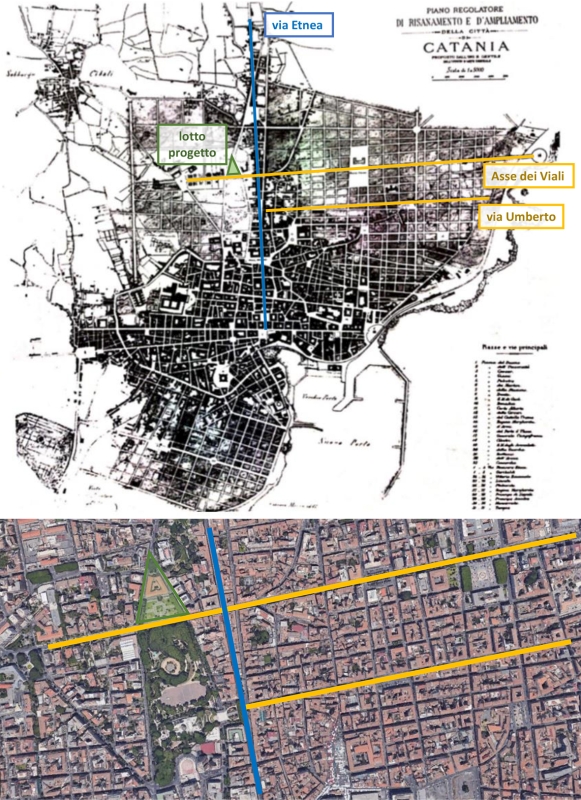
Fig.
2 - Francesco Fichera, De Felice Institute. Left: perspective of the
entrance; right: project drawing of the courtyard clock (F. Fichera
Fund - MuRa).

Fig.
3 - Francesco Fichera, De Felice Institute. Preliminary and final
designs of the aula magna
(F. Fichera Fund - MuRa)
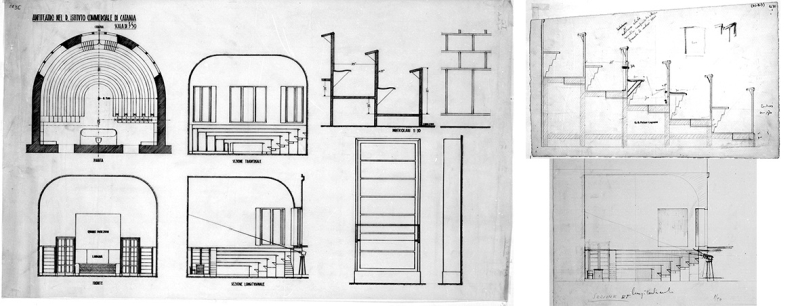
Fig.
4 - Left: general plan; right: ground floor plan and rough
compositional genesis (triangular plot and medians in green, building
axis of symmetry in orange, bisectors and chamfers of the corners at
the base in blue, and elements delimiting the empty/full boundary in
red).
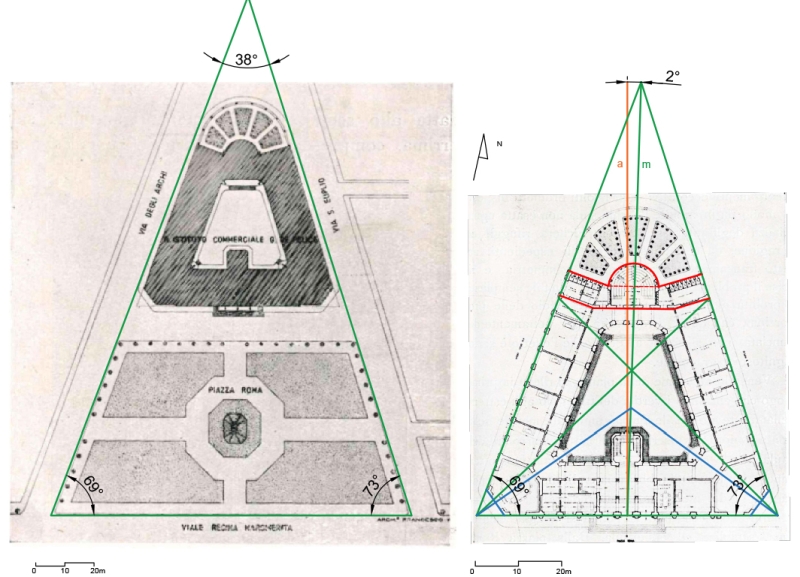
Fig.
5 - Francesco Fichera, De Felice Institute. Perspective of the corner
solution between the south and east elevations (F. Fichera Fund - MuRa).
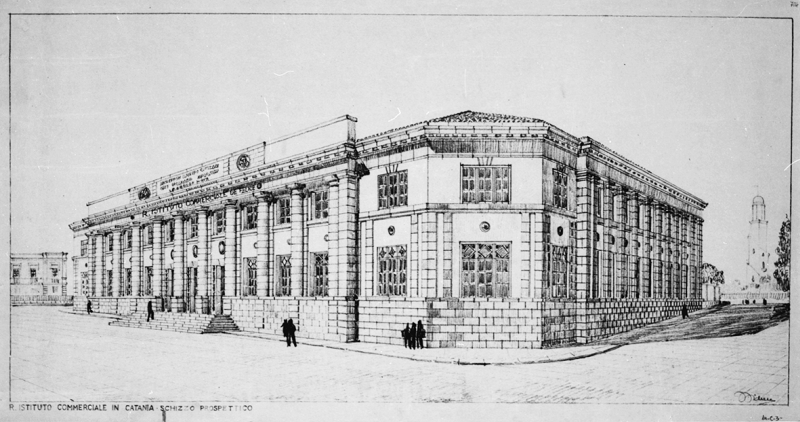
Fig.
6 - Geometrical analysis of the south elevation.
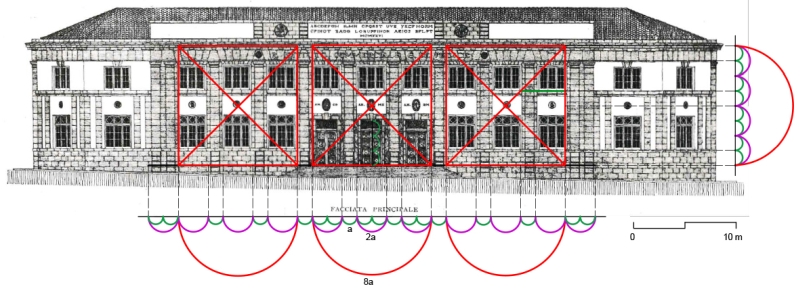
Fig.
7 - Geometrical analysis of the ground floor plan.
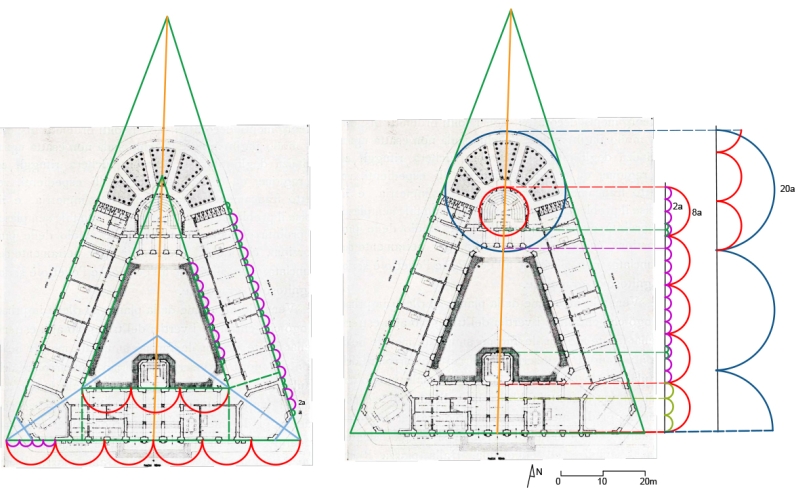
Fig.
8 - Digital drawing of the south elevation, superimposed on the
orthophoto taken from the photogrammetric survey.
(reconstruction by Di Salvo C., Murabito R., Russo E., and
Spampinato M.)
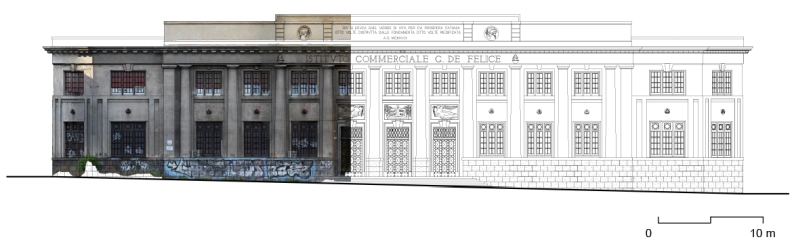
Fig.
9 - Virtual tour. Top: external view from Piazza Roma; bottom: entrance
hall.
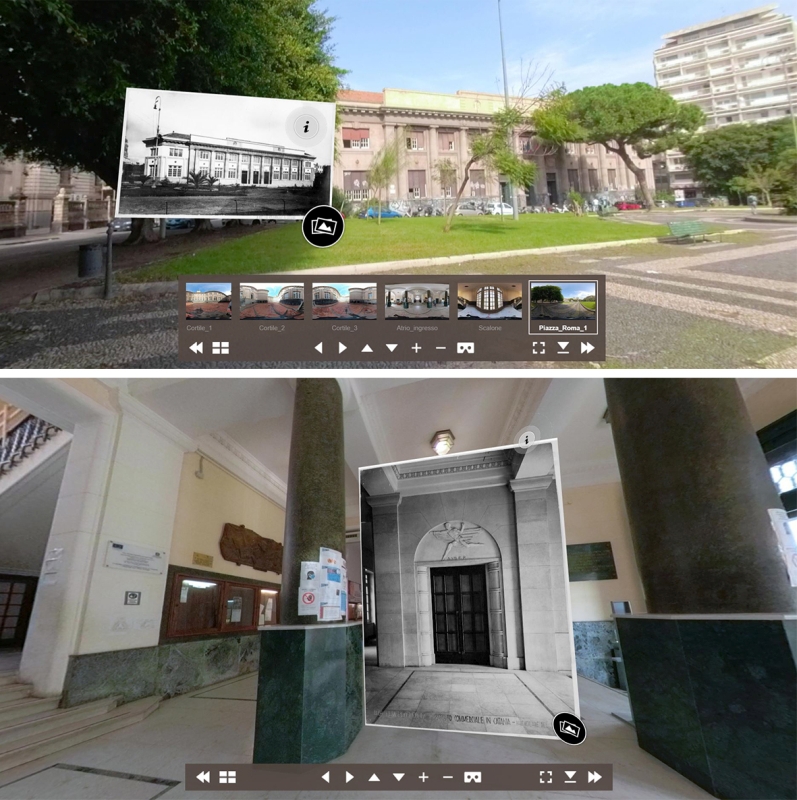
Fig.
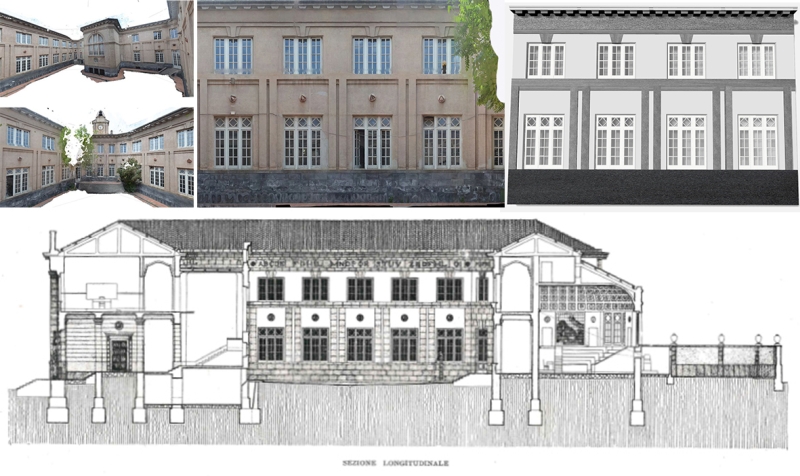
10 - Top: photogrammetric model, orthophoto, and 3D model of the
courtyard elevation (modelling by Di Gaetano F., Pirrello G., and
Miceli D.); bottom: longitudinal section of the courtyard (Fichera
1928).
Local identity can be understood, experienced, and expressed
through
the architecture, planimetric solutions, and spatiality of the
buildings that characterize the city. This is also achieved through the
visual perception of the inhabitants and the analytical perception of
those who study them for the relationships between solids and voids,
the implied geometries of individual projects, and the recognition of
architectural styles. This paper explores and illustrates the important
relationship between the design drawings conserved in archives and the
digital tools available to support their representation, knowledge,
fruition, and communication in cultural spheres. The study is part of a
research project that aims to reveal and appreciate the early 20th
century architecture that enriches the city of Catania with a stylistic
and formal identity of high cultural value.
Architectural archives represent unique and significant
sources for
understanding and transmitting the design principals of the historical
period and the architect, as well as emphasising the importance of the
figurative value of architectural design (Palestini 2016, 2017, 2019).
This paper investigates the irreplaceable traditional
approaches to
design expression and the digital techniques for its communication
through detailed analysis of a project by Sicilian architect, Francesco
Fichera[1]
(1881-1950), who
designed the “G. De Felice” Technical and
Commercial
Institute in 1926. The study is part of the research, teaching and
dissemination activities conducted at the MuRA museum[2]
in Catania (Galizia et alii 2019). The museum exhibits and preserves
the original projects of the architect that contributed to the design
and form of the architectural and urban identity of the territory. It
is the very nature of this documentation that prompts the need to study
and analyse the design poetics of the time and place, as well as the
need to harness new languages and digital tools to collect and narrate
the precious documentary heritage, associating architecture with its
prevailing design thought.
The methodological approach adopted consists mainly of two
phases:
- Historical and archival investigation: understanding and
analysis
of project drawings to highlight the importance of traditional drawing
in the conceptual and final design phases.
- Digital representation and communication: graphic
enrichment of
heritage documentation and narration through virtual, immersive, and
interactive explorations.
The possibility of comparing archive documentation (period
photos,
eidotypes, and technical drawings) with the realised architecture in
its current state spurns the need to communicate and render the design
principals appreciable through a virtual simulation experience using
360° panoramic images. Therefore, an immersive experience of
fruition and knowledge of one of the most emblematic and characteristic
public buildings designed by the architect from Catania is proposed.
Catania in the early 20th century: urban
planning and Fichera
The urban environment of Catania is the result of its
connection
with the two natural backdrops that characterise and enrich the area:
the sea to the east and to the north, Mount Etna, the volcano from
which lava flowed into the western part of the city in 1669. In 1833,
Sebastiano Ittar provided designs of the northward expansion of the
city along the north-south axis of the present-day Via Etnea,
highlighting the expansion of the historic centre outside the walls.
Towards the end of the 19th century, the urban
layout
changed with the addition of two expansion axes, Via Umberto and Asse
dei Viali, crossing Via Etnea orthogonally north of the ancient walls.
In 1888, the new urban development plan of the city[3]
aimed at developments inspired by 18th-century notions of a modern
city. The first public buildings of a social nature began to flourish
along the new Asse dei Viali in the early 20th
century;
among these was the ‘De Felice’ institute. Forming
a scenic
backdrop to the trapezoidal Piazza Roma, it is set inside a context
characterised by large green spaces and neoclassical and modern
architecture (Fig. 1). The project was entrusted to the architect
Francesco Fichera, a great protagonist of Sicilian architectural
culture in the first half of the 20th century,
who realised
numerous residential and public works. His design poetics is
characterised by the continuous relationship between functionality and
aesthetics, ranging from Rationalism to Eclecticism, Liberty, and
Déco. Especially in the public buildings he designed[4],
he managed to combine present and past and negotiate representative and
symbolic requirements with the new culture of the period. This was
achieved through the contemporary use of classical stylistic elements
and the search for significant design solutions that give plasticity
and three-dimensional spatiality to the buildings, while respecting the
linguistic continuity between tradition and modernity (Galizia 2002;
Guarrera 2017).
The Fichera Fund and the project archive
drawings of the
‘G. De Felice’ Institute (1926): analytical
reinterpretation and design genesis
The MuRa museum exhibits, archives, and preserves the
Francesco Fichera Project Archive Fund, donated to the DAU[5]
by his heirs in 1976. The architect’s large body of work in
Sicily gave rise to a heritage of original documents in the archive
consisting of about 1600 drawings made with different techniques or in
heliographic copy. Among the drawings, it is possible to admire
preliminary sketches for the project in question, drafts from different
conceptual phases, and final graphic designs. They are all orthogonal
or perspective representations ranging from detailed drawings to
broader urban contexts, highlighting the important role of design in
the conception phase. Figures 2 and 3 show how Fichera uses traditional
graphic representation codes to emphasise the importance of design both
in the conceptual phase and in the final rendering of the project,
enriching the representations with graphic details and notes that offer
greater comprehension of his work. The integrated use of different
scales of representation, perspective projections, and shadows allow
the designer to better communicate the three-dimensional articulation
underlying his work. The prevalence of the technical elaboration based
on the Monge projection method, which is still of undisputed importance
today, is supplemented with 2D three-dimensional representations that
provide information on the use of the materials envisaged for the
project in addition to the geometric aspect. This allowed the architect
to expand the graphic language code used to communicate the project at
a time when the graphic design was not yet influenced by the new forms
of digital representation.
The architectural choices adopted for the institute summarise
the architect’s modus operandi and
the historical period in which he worked. Here, more than in other
projects, Fichera finds himself making use of the design flair that
distinguishes him, especially in corner solutions, having to design the
building within an irregular triangular lot.
«L’irregolarità non è
d’altra parte
così sentita che possa vantaggiosamente sfruttarsi per
trarne un
motivo pittoresco» (Fichera 1928) and for this reason, he
decides
to disguise this dissymmetry by constructing an apsidal rear elevation.
This feature is skilfully implemented to conceal the offset between the
symmetry axis a of the building and the median m
of
the irregular triangle of the lot, as can be seen from the analysis of
the implied geometries applied to the design drawing of the ground
floor plan (Fig.4).
Despite this, the architect does not forego defining the
project
through proportional ratios and gives further plasticity and movement
to the north elevation, creating a play of volumes defined by the
superimposition of planes and surfaces of different thicknesses that
disconnect the wall mass. Fichera also smooths the two side wings of
the planimetric layout with two cuts that are orthogonal to the
bisectors of the triangle, giving perceptive continuity to the reading
of the wall envelope. With clear reference to the Viennese culture of
Otto Wagner, the architect manages to harmoniously relate to the
triangular plot and organises the system of classrooms on two floors,
along a corridor facing the trapezoidal courtyard, concentric to the
perimeter of the building. The apse on the rear elevation, the annular
distribution system, and the polygonal rooms at the two corners of the
main elevation are, in fact, an obvious reference to the plan of the
Postparkasse building by the Austrian designer. These devices, together
with the two-tone lava stone on white background decoration of the
elevations and the overlapping surfaces that compose them, exalt the
perceptive values of the intentional breaking of the volumetric
compactness, which is well illustrated in the perspective view in
figure 5 (Guarrera 2020; Messina 2020).
In attempting to reconstruct the compositional genesis of the
building in plan and elevation through traditional drawings, one cannot
fail to emphasise the obvious reference to Marcello
Piacentini’s
Courthouse in Messina. The tripartite openings of the elevations are
certainly reminiscent of the compositions of the Viennese secession
architects, and the use of Doric half-columns and half-pilasters
reminiscent of the Italian neoclassical tradition. Fichera develops the
representative role in the main elevation, endowing it with the same
number of columns and tripartite scheme of openings as the elevation of
Piacentini’s Courthouse. Unlike the Courthouse, however, he
interrupts the giant order used along the two lateral elevations and
lends a simpler geometry to the corner solutions that are set slightly
back from the planes of the elevations (Rocca 1988).
The a posteriori graphic analysis
carried conducted on
Fichera’s traditional design drawings once again highlights
the
importance of the role of drawing in the conceptual and control phase
of the project (Vernizzi 2018). The search for geometric genesis
highlights the desire for a design harmony between the parts, achieved
through regulating paths underlying the compositional form (Figs. 6-7).
The positioning of the structural and decorative elements is defined by
a modular grid that marks the relationship between solid and void. The
regulating aspect is given by the width of the Doric columns and the
frame superimposed on the masonry (a), which define the solid section
and lend rhythm to the architectural composition. The tripartite
entrance openings are defined by the same module (2a x 3a), as is the
height of the building (8a) and the proportioning of the other openings
and elements that make up the façade layout (Fig.6). The
same
modularity is found in the compositional definition of the l
planimetric plant. As can be seen in Fig. 7, the depth of the corridor,
the stairwell, the courtyard, the diameters of the apse of the north
elevation (8a), and the circumference of the lot closing (20a) are all
based on the same modular genesis, similar to the openings of the side
elevations and the inner courtyard.
The advantage of analysing the original plans from the
archives and
publications in architectural journals of the time together with
digital representations obtained from the survey of the realised work
as it stands, represents an opportunity for graphical enrichment for a
better understanding of the architect’s design process and
the
importance of the graphic tools used.
New forms of digital communication: the role of
drawing,
surveying, and 3D modelling in understanding and using architectural
design
The early 20th-century designs and
period photographs
that bear witness to the realisation of the project in those years,
together with the study of the designer’s expressive poetics,
stimulate broad reflection on the role of digital drawings in the
documentation of valuable historical architecture. In recent years,
information and communication technologies (ICT) have been applied to
the apprehension and dissemination of archive projects through
different forms of representation. It has allowed the digitisation and
preservation of archival heritage and dissemination and accessibility
to a greater number of users (Galizia et alii 2020; Guccione 2009b;
Santagati et alii 2020).
In order to document Fichera’s compositional poetics
and
render the substantial body of graphic design representations of the
institute clear and interactive, a photo acquisition campaign was
implemented with a dual role:
- A multi-image photogrammetric survey to convey the
three-dimensional spatiality of the building and the possible
variations between design and actual state.
- The acquisition of 360° panoramic photos for the
creation of
a virtual tour including interactive elements for viewing archive
drawings and period photos, enabling the enjoyment of the architectural
work, even from a distance.
Figure 8 shows the digital reconstruction of the
institute’s
main elevation viewed through the orthophoto obtained from the
photogrammetric survey and the 2D CAD representation of the elevation.
Comparison with the project drawing in figure 6 evidence the loss of
the dual tones of the façade designed and realised by the
architect, while the architectural design harmony remains unchanged.
The relationship between the two representations is crucial for the
apprehension of the historic building, also in terms of potential
restoration work aimed at returning the architecture to the city as it
was conceived by its designer.
Being one of Fichera’s most important building
designs now on
display at the MuRa museum in Catania, we opted for appreciation and
dissemination methods that could be integrated into the
museum’s
repertoire. The virtual tour was conceived and designed around the most
significant areas of the building–the relationship with the
context, the courtyard, the entrance hall, the monumental staircase,
the lecture hall, and the library–and ensuring user
interaction
with the multimedia elements that narrate the building as it stands
(Fig. 9). The interaction with the architecture takes place from the
same photographic perspectives of the period photographs and
Fichera’s project drawings, in a continuous dialogue between
the
realised work and archive documents. This places visitors and students
at the centre of the path between the architectural project and the
construction, allowing them to appreciate the variations between the
building in its current state, its initial state, and the project
drawings. The multimedia elements available during the virtual tour
include photogrammetric models, orthophotos, archive project drawings,
and 3D reconstructions (Fig. 10) (Vernizzi 2017). For example, the 3D
rendering of the courtyard façade allowed the interpretation
of
Fichera’s design choices, of his attention to the laws of
perception applied through the implementation of two tones, which is
currently hidden by inappropriate restoration work.
The digital representations and innovative tools allow the
collection of data and processed information that are central to the
appreciation and communication of the existing heritage within a single
virtual environment. From this perspective, the survey and the 2D and
3D digital representation become interpretative and communicative tools
of the architectural heritage, within a path of understanding
architectural spatiality and education on the importance of archive
documents. VR techniques project designs beyond conventional museum
displays and allow connection with the underlying architecture of the
city. Today, digital representation technologies provide a valuable
contribution to the communication of Fichera’s poetics and
render
the precious collections of project drawings usable in innovative and
alternative ways. They form a path from the traditional drawings
evoking the original design techniques of the time to digital
representations that transcend the flatness of the design sheets.
Notes
[1]
Born in Catania in 1881, he
graduated from the Royal School of Application in Rome in 1905 and, in
1909, he obtained a Diploma in Architecture at the Academy of Fine Arts
in Palermo. From 1913 he held the chair of Ornate Design and Elementary
Architecture at the first unit of the Faculty of Engineering in Catania.
[2]
The Museum of
Representation since 2015 is part of the Museum System of the
University of Catania pertaining to the Department of Civil Engineering
and Architecture of the University of Catania. The scientific director
of the MuRa is Professor of Architecture, Mariateresa Galizia. The
research is part of the PIA.CE.RI Plan funding. - MUARCH UNICT 2020-22
intradepartmental project line 2. The author would like to thank the
Museum of Representation for allowing the drawings and images from the
Francesco Fichera Fund to be consulted and published.
[3]
'Master Plan for the Rehabilitation and Expansion of the City of
Catania', drafted by Bernardo Gentile Cusa.
[4]
Among the public works
designed in Catania: the Electric Company Building (1913), the Post
Office (1919), the 'Archimede' Technical Industrial Institute (1917),
the Courthouse (1936).
[5]
Department of Architecture
and Urban Planning. Currently Department of Civil Engineering and
Architecture, University of Catania.
References
FICHERA F. (1928) – “Progetto
per il Regio Istituto Commerciale “Giuseppe De
Felice” in Catania”. L’Architettura
Italiana, a. XXIII, n. 9, 97-101.
GAIANI, M. (2018) – “La rappresentazione
dell’architettura: sapere e saper fare”. MeTis
8(2), 13-49.
GALIZIA, M. (2002) – L’ambiente
urbano di Catania nel ‘900: le architetture degli
“anni ‘20”. Gangemi, Rome.
GALIZIA M., D’AGOSTINO G., GAROZZO R., LA RUSSA
F.M., SEMINARA
G., SANTAGATI C. (2019) – “Novel cultural
experiences for
the communication of museum collections: the Francesco Fichera projects
fund at Museo della Rappresentazione in Catania”.
DisegnareCon,
volume 12, n.23, 8.1-8.11.
GALIZIA M., D’AGOSTINO G., GAROZZO R., LA RUSSA F.M.
(2020)
– “Connessioni tra museo/archivi e
città: strategie
digitali per la valorizzazione e comunicazione del fondo Fichera del
Museo della Rappresentazione”. In: Arena A., Arena M.,
Brandolino
R.G., Colistra D., Ginex G., Mediati D., Nucifora S., Raffa P. (a cura
di), Connettere. Un disegno per annodare e tessere. Atti del
42° Convegno Internazionale dei Docenti delle Discipline della
Rappresentazione, 2224-2241. Reggio Calabria e Messina,
16-17-18 Settembre 2021. GAROFALO, V. (2014) – Unbuilt:
quattro progetti di Alberto Sartoris: ridisegno e lettura grafica.
Aracne, Roma.
GUCCIONE M. (2009a) – Archivi e musei di
architettura: atti della giornata di studio MAXXI Museo nazionale delle
arti del XXI secolo. Gangemi Editore, Rome.
GUCCIONE M. (ed) (2009b) – Documentare il
contemporaneo. Archivi e Musei di Architettura. Gangemi
Editore, Rome.
GUARRERA F. (2017) – Francesco Fichera:
la modernità nella tradizione dell’architettura.
LetteraVentidue, Siracusa.
GUARRERA F. (2021) – Francesco Fichera.
La storia come
repertorio di “forme utili”. Invenzione e
composizione nel
progetto d’architettura. Clean, Naples.
LEONE R. (1931) – “L’Istituto
Commerciale G. De
Felice in Catania”. L’Architettura
Italiana, a. XXVI,
n. 3, 36-39.
LUIGINI, A., PANCIROLI, C. (2018) – Ambienti
digitali per l’educazione all’arte e al patrimonio.
FrancoAngeli, Milan.
MESSINA, B. (2020) – Città e
memoria in Fichera. LetteraVentidue, Siracusa.
PALESTINI C. (2016) – “Le ragioni del
disegno come
strumento di analisi e comunicazione per gli archivi di architettura
del Novecento”. In: Bertocci, Bini (edited by), Le
Ragioni del disegno. Pensiero, forma e modello nella gestione della
complessità. Gangemi Editore, Roma.
PALESTINI C. (2017) – “Le frontiere del
disegno per gli
Archivi di Architettura”. In: A. Di Luggo, P. Giordano, R.
Florio, L.M. Papa, A. Rossi, O. Zerlenga, S. Barba, M. Campi, A.
Cirafici (edited by), Territori e frontiere della
rappresentazione. Atti del 39° Convegno
Internazionale dei Docenti delle Discipline della Rappresentazione, 209-220.
Naples, 14-15-16 September 2017.
PALESTINI C. (2019) – “Digital Exploration
in Archival
Heritage. Research for the Knowledge, Use and Communication of
Architecture Archives Through Digital Representation”. In: A.
Luigini (edited by), Proceedings of the 1st International
and Interdisciplinary Conference on Digital Environments for Education,
Arts and Heritage. Springer International Publishing.
PRANDI E. (2019a) – “Luigi Vietti. Prime
indagini
d’archivio su un Maestro dimenticato”. FAMagazine,
[e-journal] 48-49, 10-26.
PRANDI E. (2019b) – “Il progetto di
architettura,
città, paesaggio nell’esperienza di Luigi
Vietti”.
VIII Forum ProArch. Il progetto di architettura come intersezione di
saperi per una nozione rinnovata di patrimonio, pp. 1528-1533. Napoli.
SANTAGATI C., D’AGOSTINO G., GAROZZO R., LA RUSSA
F.M.,
GALIZIA M. (2020) – “Participatory approach for the
enhancement of architectural archives funds: the experience at museo
della rappresentazione in catania”. Int. Arch. Photogramm.
Remote
Sens. Spatial Inf. Sci., XLIII-B5-2020, 99-106.
VERNIZZI C. (2005) – “Codici del disegno
di progetto.
Considerazioni sull’innovazione dei modi di rappresentazione
determinata dalle mutate necessità operative”, Teoria
e pratica del costruire: saperi, strumenti, modelli. Esperienze
didattiche e di ricerca a confronto, 371-380. Ravenna,
27-28-29 October 2005.
VERNIZZI C. (2017) – “Il disegno
tridimensionale di
architettura, tra tradizione e innovazione, come espressione di
creatività e strumento di prefigurazione e comunicazione
dell’idea progettuale”. In: A. Di Luggo, P.
Giordano, R.
Florio, L.M. Papa, A. Rossi, O. Zerlenga, S. Barba, M. Campi, A.
Cirafici (edited by), Territori e frontiere della
rappresentazione. Atti del 39° Convegno
Internazionale dei Docenti delle Discipline della Rappresentazione, 13-20.
Naples, 14-15-16 September 2017.
VERNIZZI C. (2018) – “Lo studio
geometrico”. In: P. Basso (edited by), L’Anfiteatro
di Acquileia. Ricerche d’archivio e nuove indagini di scavo,
197-284. SAP Società Archeologica srl.
RIGAGLIA S. (2021) – Il Visual
Storytelling dell’iter progettuale del Palazzo di Giustizia
di Catania. Thesis, Dipartimento di Ingegneria Civile e
Architettura, University of Catania.
RIZZO C., (2021) – Il cine-teatro Olimpia
a Catania: dalla ricostruzione della memoria alla fruizione virtuale.
Thesis, Dipartimento di Ingegneria Civile e Architettura, University of
Catania.
ROCCA A., (1988) – L’arte del
ventennio a Catania. Il Decò, il ‘900, il
Razionale. Magma, La terra del sole, Catania.