Rural modern. Themes and contexts
Cristina Pallini
Fig.
1 - Gaetano Ciocca, rural house in prefabricated elements built near
Garlasco (source: Quadrante 16, June 1935, pp. 10-11)
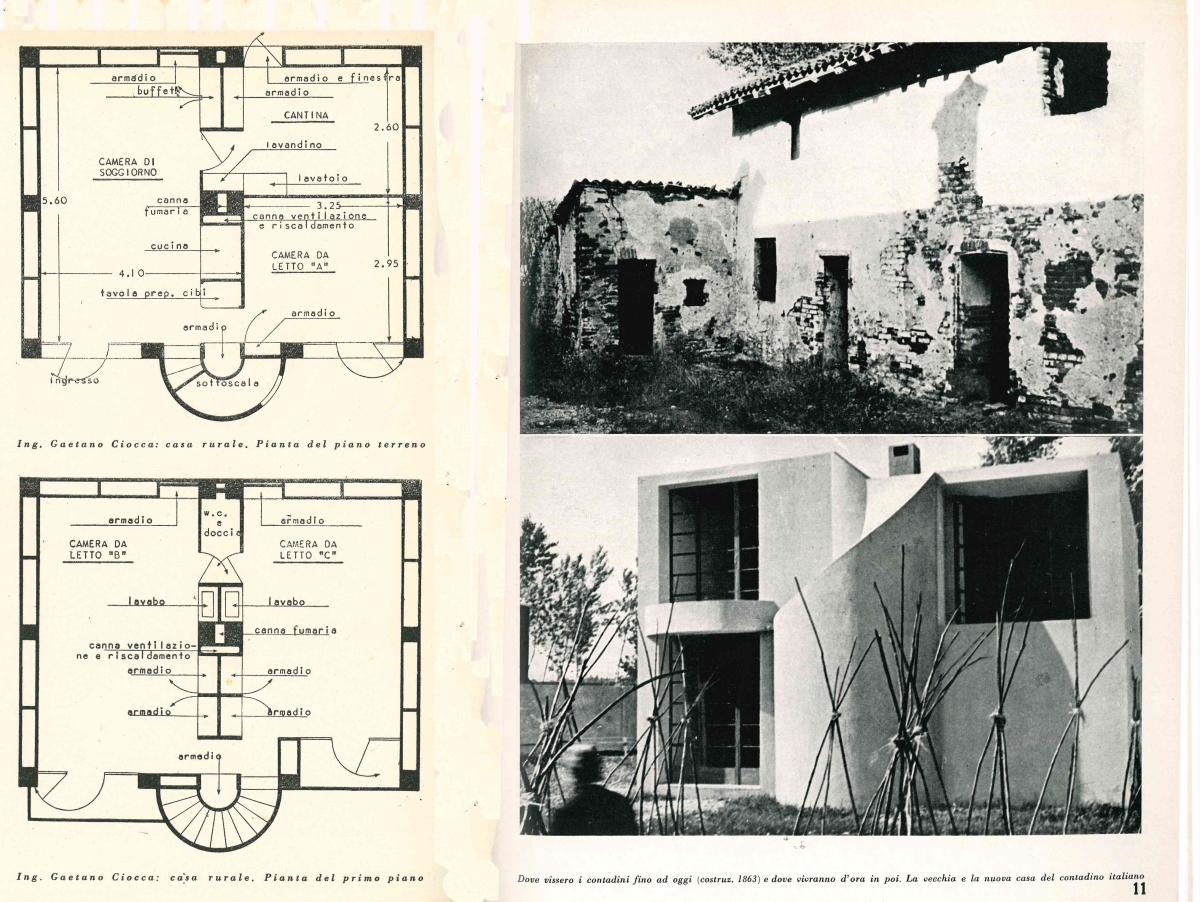
Fig.
2 - Gaetano Ciocca, the central trough of the model pigsty at Cascina
Capannelle, 1938 (source: Schnapp 2004, p. 98).
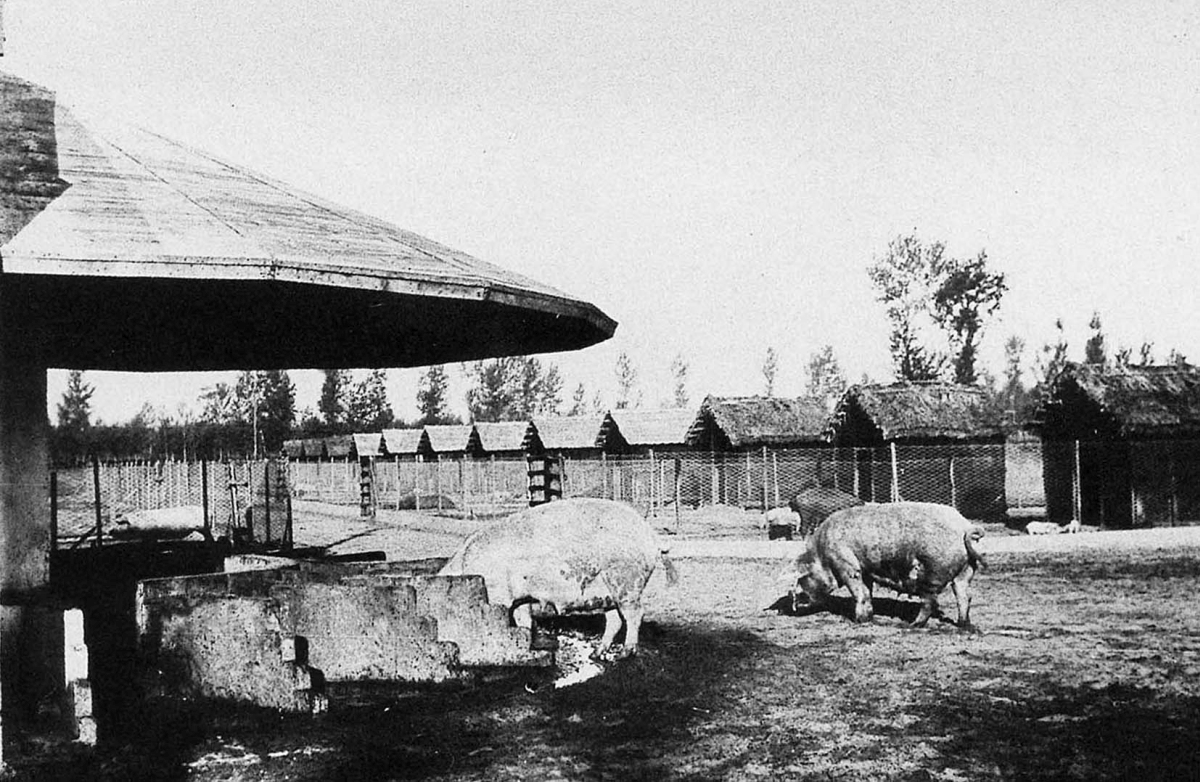
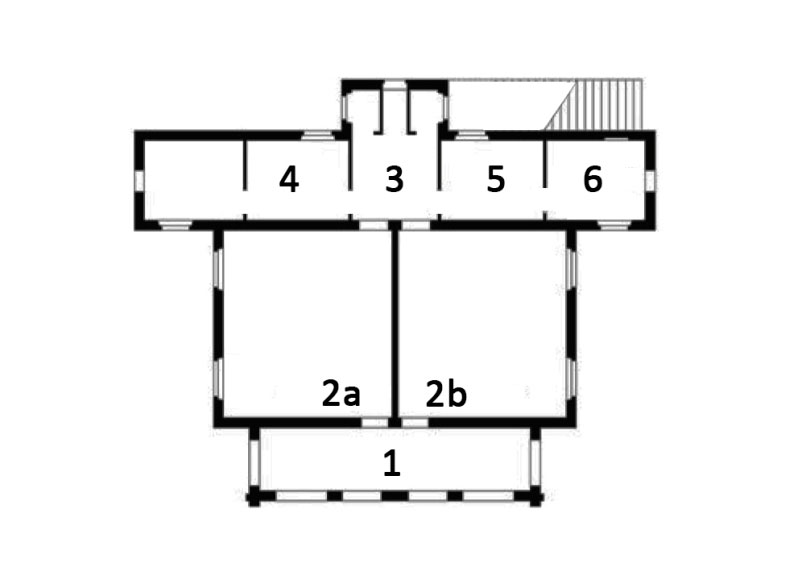
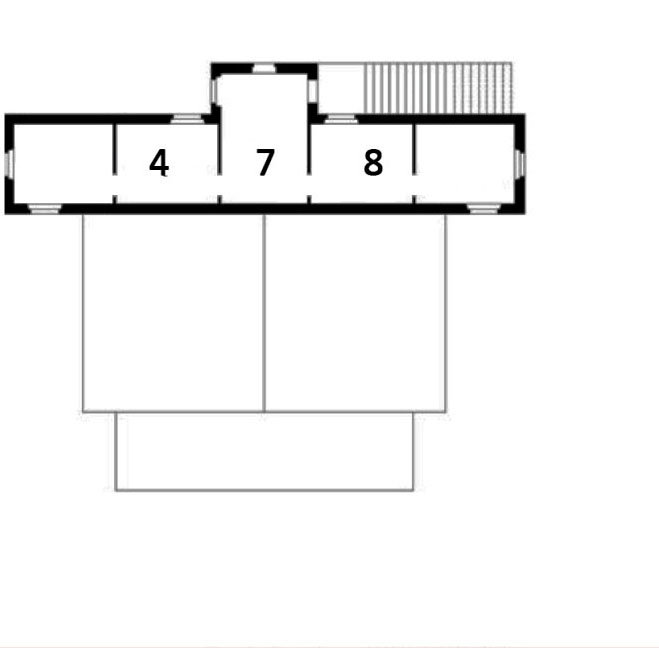
Fig.
3 - The rural school at Casal delle Palme with teacher's quarters
(1922). Ground and first floor plan (source: drawing by E.
Margione).
Legend: 1. Portico; 2a. Schoolroom; 2b. Kindergarten classroom; 3.
Changing room and toilets; 4. Kitchen; 5. Pantry; 6. Administration; 7.
Entrance hall; 8. Living room.
Fig.
4 - The rural school at Casal delle Palme seen from the Appian Way
(photo by C. Pallini, May 2022)
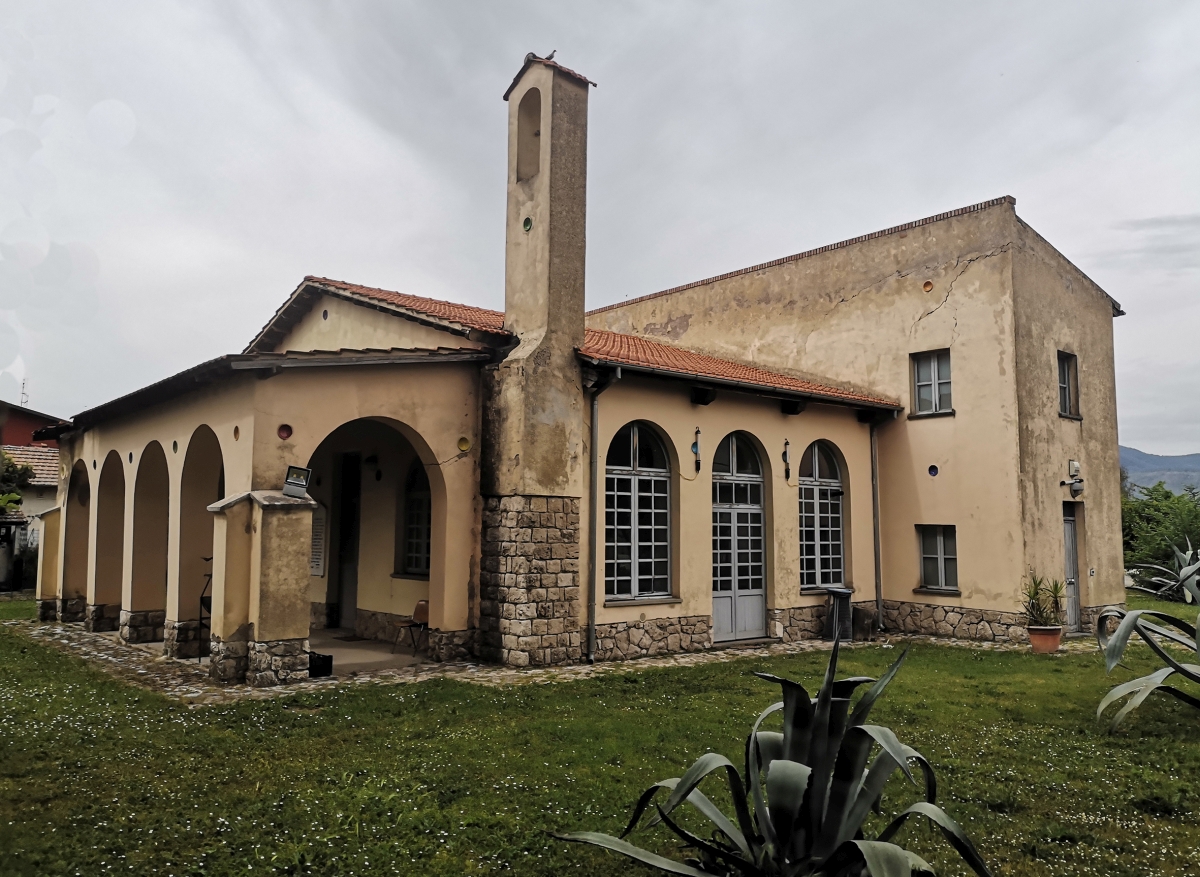
Fig.
5 - Giovanni Pellegrini, model of the central core of Baracca village
(today al-Farzugah) in Cyrenaica located along the coastal road about
50 km from Benghazi, 1938 (Archive of IsIAO, Istituto Italiano per
l’Africa e l’Oriente, Rome). This nucleus included
the church, the Casa del Fascio, the town hall, the school, the post
office and a pharmaceutical dispensary; it was to serve about 1,500
settlers from the farms scattered in the surrounding area producing
wheat, grapes and olives.
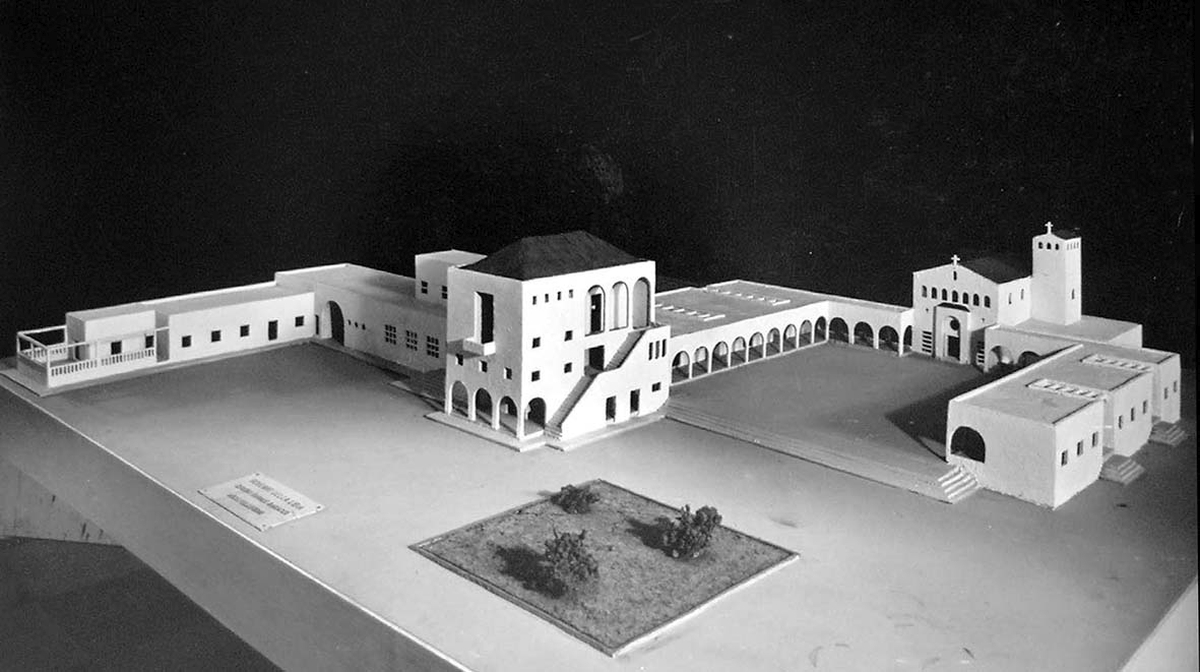
Fig.
6 - Giovanni Pellegrini, Casa del Fascio at Baracca, 1938 (photo by V.
Capresi, 2009).
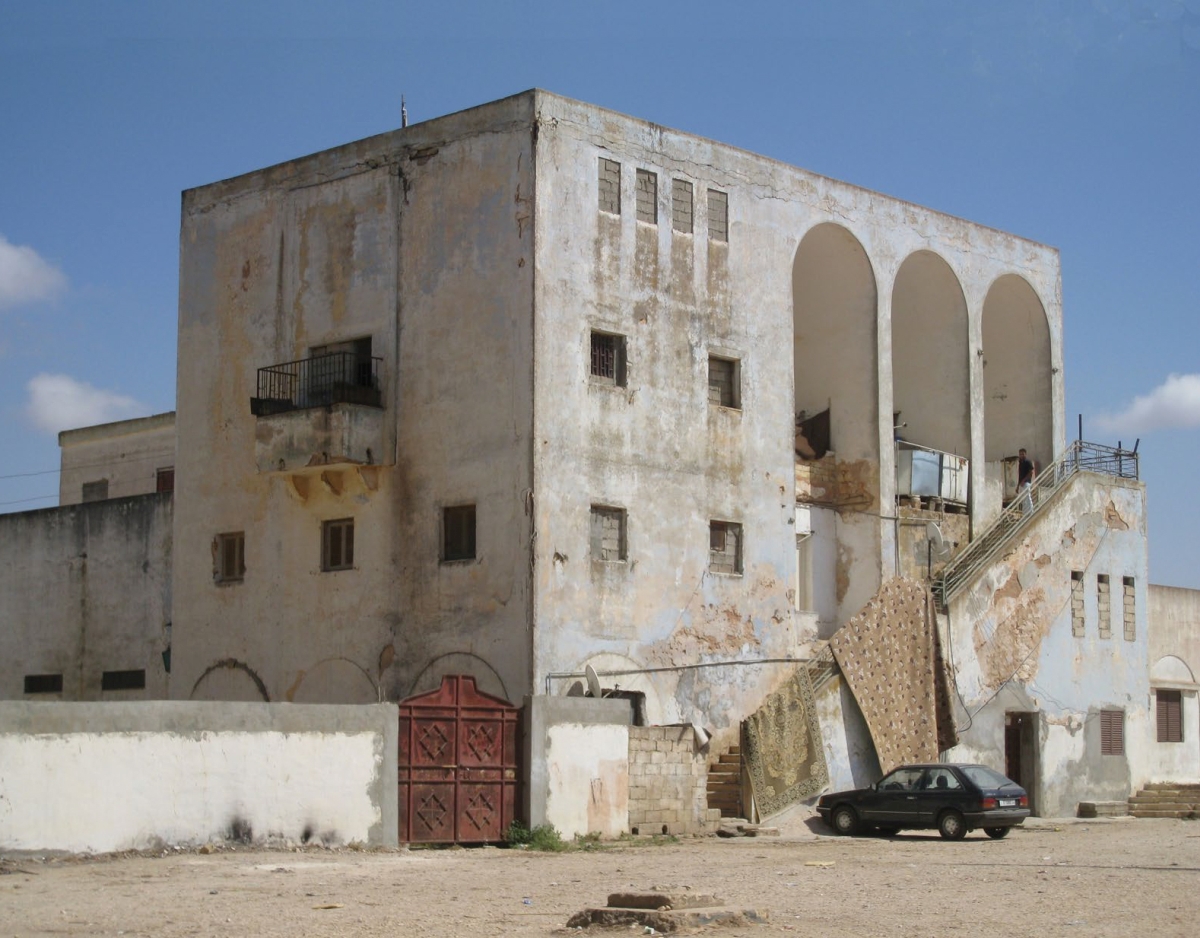
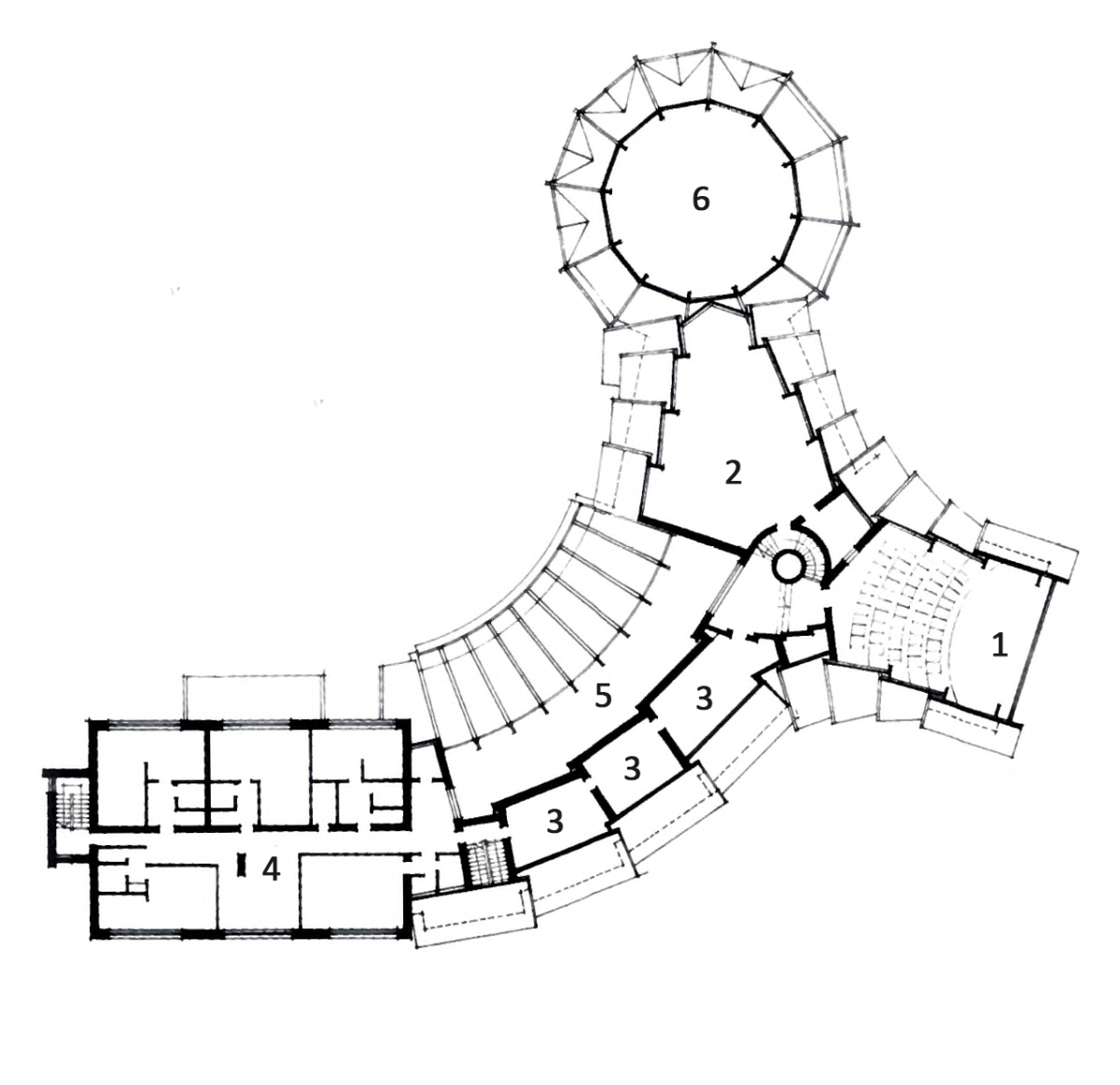
Fig.
7 - Stanislovas Kalinka, plan of the heath centre at Juknaičiai
(Lithuania), 1978.
Legend: 1. Music room; 2. Disco; 3. Space for art exhibitions; 4. Rest
rooms for visitors from other villages; 5. Winter Garden; 6. Swimming
Pool.
Fig.
8 - Resting at the miradouro in the agricultural colony of Martim Rei,
ca. 1944 (source: Guerreiro 2018).
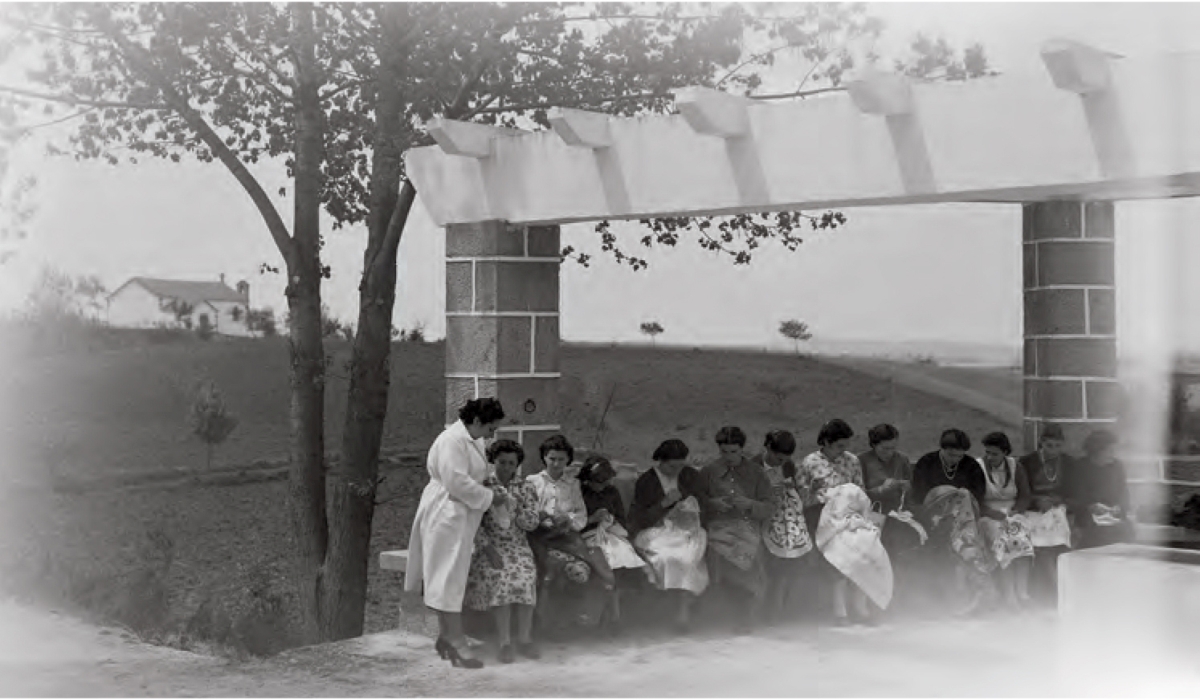
Fig.
8 - A section of the Druskininkai riverfront (Lithuania).
Legend: 1. Sanatorium built on the site of Tsar Nicholas I's residence;
2. Balneotherapy Centre, Vsevolod Ulitko, 1954; 3-4. Hydrotherapy
Centre and water tower, Romualdas and Aušra
Šilinskas, 1976-1981 (source: drawing by C. Pallini, 2023).
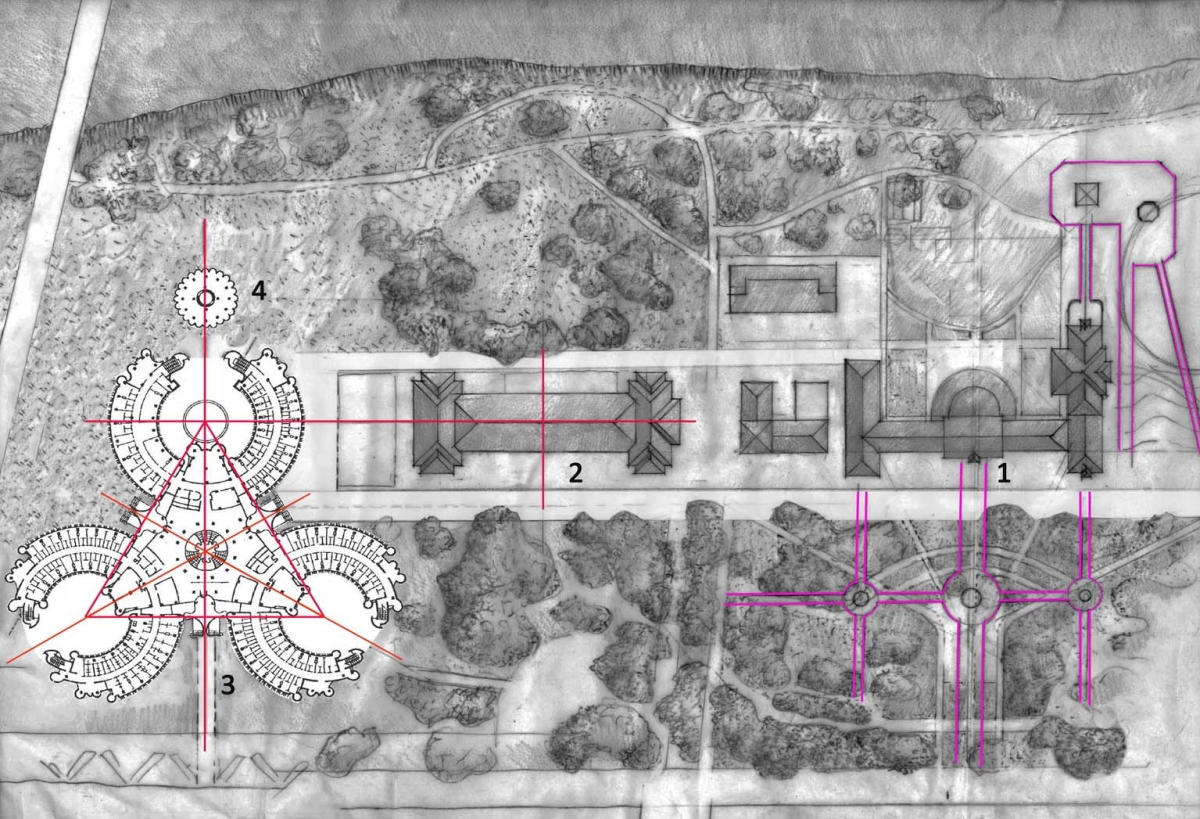
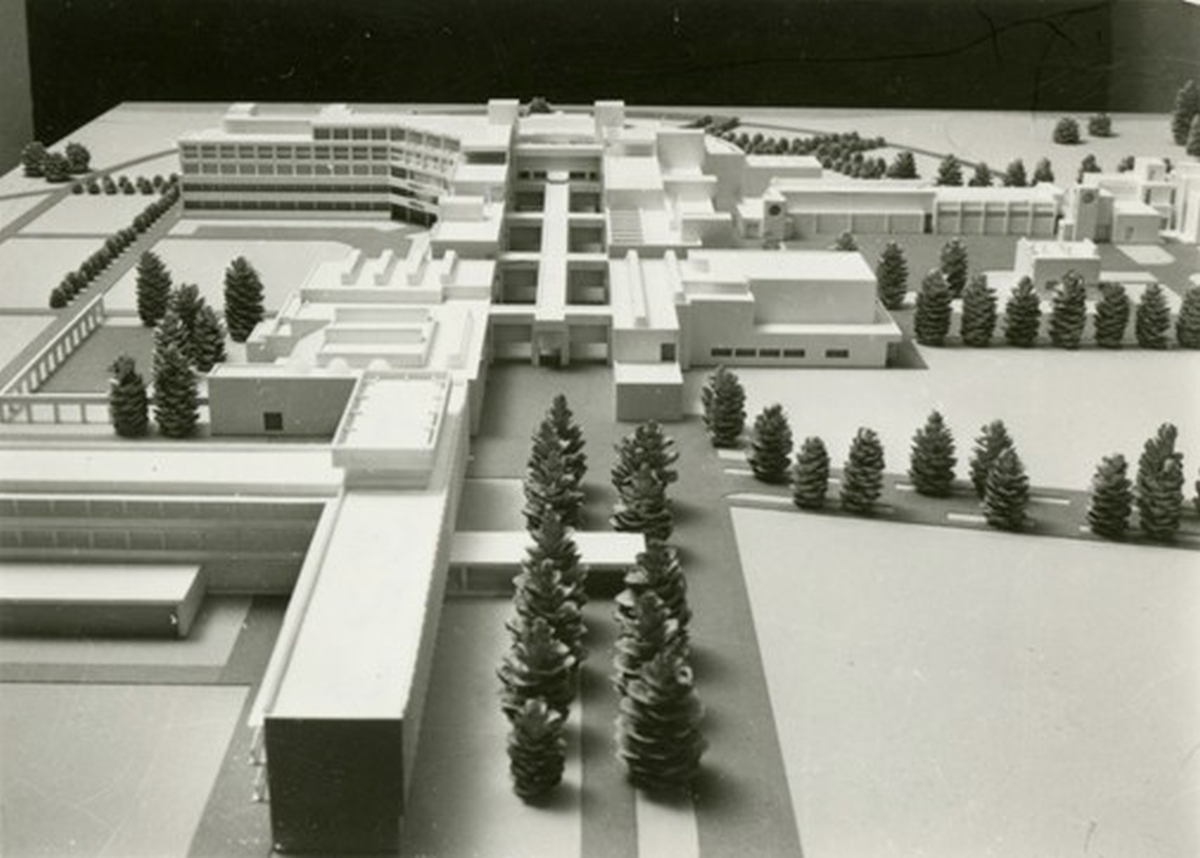
Fig.
10 - Kalju Vanaselja and Ell Väärtõnou
(first phase 1966-1970) and Vilen Künnapu (second phase,
1976-1988), model of the Tervis Sanatorium in Pärnu (Estonia).
(source: Eesti Arhitektuurimuuseum).
If, as Eric Swyngedouw argues (1999), modernity was basically
a geographical project, one wonders to what extent rural modernisation
is necessarily also characterised by a technical landscape, a direct
outcome of the synergy between settlement strategies, political will,
scientific knowledge, and technological innovations. A confirmation
seems to come from rural modernisation schemes framed into
nation-building processes, a common testing ground for experts from
various disciplines: agronomists, geographers and hydraulic engineers,
physicians and sociologists, architects and town planners, artists, and
landscape architects.
According to Le Corbusier, the era of roads
was to favour a return to the land, especially where new villages would
foster better living conditions for farmers (Le Corbusier 1934a, 25;
1934b). His village radieuse was to provide
scattered farms with basic services, aggregated in line across the main
road to rationalise the handling and storage of agricultural products
(Simone 2018). In the same years, Giuseppe Pagano was extolling the
various traditions of rural Italy as an immense «dictionary
of man's constructive logic» shorn of celebratory intentions.
Addressing a world in which necessity prevailed, Italians would finally
distance themselves «from a time chronologically defined by
stylistic attributes» and find their own path towards modern
architecture (Pagano 1935). This dictionary finally
materialised in the section on rural architecture at the 6th
Milan Triennale (Pagano and Daniel 1936).
In the now numerous studies on the export of Western models to
other contexts, adjectives such as other, hybrid
or border modernism often recur. According to
Maiken Umbach and Bernd Hüppauf (2005), by looking beyond the
cornerstones of European architectural rationalism, some concrete
experiences of many quality architects have come to the fore, showing
the continuity of vernacular traditions. This enduring presence is even
more relevant in processes of inner colonisation (Sabatino 2010;
Chyutin and Chyutin 2016; Dremaité 2017; Lejeune 2021; Sezer
2022). In his monograph on the villages of Franco's Spain,
Jean-François Lejeune quotes Mies van der Rohe about the
historical development of architecture. In a 1926 lecture, Mies
outlined two fundamental areas of intervention: buildings animated by
spiritual atmospheres and those integrated into the landscape and more
responsive to concrete needs (Lejeune 2021, p. 15).
Taken as a whole, the settlements entrenched in rural
modernisation schemes raise a series of questions. Firstly, one wonders
what their novel features really were, and whether the underpinning
models of social organisation found full architectural expression. A
common feature laid undoubtedly in the relationship between the
rationalising order introduced by town planning (also for a better
circulation) and the position of the main public buildings. In the
Italian case, they overlooked public spaces conceived to enhance new
behaviours patterns, on political rallies as well as in everyday life
(Falasca Zamponi 2003). A modern day (Lupano and
Vaccari 2009, p. 10) was in fact marked by working in the fields, but
also by going to the post office, to the Casa del Fascio and the Opera
Nazionale Dopolavoro (Workers’ Club).
The concrete needs of the rural world did trigger many
inventions, such as Gaetano Ciocca’s prefabricated rural
house, model pigsty, and the concrete road between the farmsteads and
centres of the Pavia countryside (Meriggi 2002, Schnapp 2004). [Figg.
1-2].
In many cases, as in the rural schools of the Roman
countryside, the symbolic-iconological dimension resurfaced
prominently. Built in the 1920s, these schools were equipped with a
structure for the bell and decorated with ceramic bowls: both features
that made them look like miniature churches (Morpurgo 1921, 364;
Bonfante, Lombardini, Margione, Monica 2019: Cantatore 2021). [Figg.
3-4]
In the villages for Italian settlers in Libya, vertical
elements signalled the presence of a church, market, and fountain to
those driving along the new coastal road (Gresleri 2007). [Figg. 5-6]
Equally emblematic of a return to the symbolic dimension is the sovkhoz
of Juknaičiai in Lithuania, with its gabled-roofed health centre and
monastery-like retirement home. [Fig. 7]
Despite the specificities of each individual case study,
village design necessarily addressed new imagined communities (Anderson
1983). From this point of view, the identity traits of the new rural
settlements were often entrusted to an orchestration of space capable
of bringing the collective dimension into representation. [Fig. 8]
While in Italy buildings and public spaces emerged simultaneously as
the manifesto of a functional and cultural programme, in Greece public
space consisted of left vacant while waiting for funds to build a
school and a church.
Le Corbusier's studies demonstrate once and for all that rural
modernisation posed new themes of architecture. Many ventured into
these themes: from academics with a solid theoretical profile to
technocrats with no artistic culture, from local professionals to
employees of large planning offices. In Maoist China, for example,
simple technicians drew up the necessary plans to realise collectively
discussed projects. In the face of this plurality, it may seem
reductive to merely distinguish textbook solutions from authentically
original works, without going into the merits of individual case
studies.
Contexts
For a better understanding of similarities and differences,
the contributions in this issue are associated in relation to contexts,
starting with Italy and the new settlements built in the Agro Pontino
followed by two essays on Greece, selected as the 1933 CIAM venue while
refugee settlement was still in progress. The article on Portugal
dwells on the exploration of the rural hinterland by architects who,
alongside geographers and anthropologists, worked along the lines
advocated by Giuseppe Pagano. The Albanian case straddles Italian
events and collectivisation: in the Soviet Union of the 1920s,
Lithuania and Latvia after the Second World War. The last two
contributions expand the discussion to the United States and the
People's Republic of China.
The international resonance of the Agro Pontino venture, ever
since the outset, has given rise to a long tradition of studies by
scholars from various disciplines (Mariani 1976, Nuti, Martinelli 1981,
Ghirardo 1989, Besana, Carli, Devoti, Prisco 2002; Pellegrini 2005,
Caprotti 2007, Pennacchi 2008). Francesca Bonfante and Luca Monica
focus on the planning problems posed by the construction of new
settlements in the redeemed countryside, while framing the hierarchy
between farm, village, and town within the corporate structure of the
Fascist state, according to which all settlements were to be tiered by
size and functions. In the 1950s, this approach gave way to a new
relationship between town and countryside, with new architectural
interpretations marking different points of balance between rationalism
and the picturesque. Emanuela Margione goes into the new building types
experimented in the new towns and villages of the 1930s. The Casa del
Balilla, Casa del Fascio (House of the Fascist Party), Opera Nazionale
Dopolavoro, and the new welfare institutions – such as the
Casa della Madre e del Bambino or the Casa del Contadino –
may all be considered ante litteram complex
buildings. Aleksa Korolija deals with piezometric towers, technical
artefacts standing on the edge of town and country, and giving
monumental expression to the presence of water as a key modernising
element: from that of the water table raised in the tank-towers, to
that pumped from the marsh and channelled into the sea.
Vilma Hastaoglou-Martinidis and Cristina Pallini concentrate
on the emergency measures implemented by the Greek government with the
help of international institutions – such as the League of
Nations – to deal with the arrival of refugees from Asia
Minor. The difficult balance between the mass of destitute people, the
available resources, and limited time, paved the way for new
prefabrication methods and standard solutions, also for village
layouts. Athens hosted the 4th CIAM at a
critical time when the boundary between architecture and mere
construction was blurring, and present problems were overshadowing any
glory of the past. Luisa Ferro presents the Athenian scene in the early
1930s. The housing problem, added to the difficult management of urban
expansion, led Dimitris Pikionis to reassess the value of tradition and
advocate the architectural quality of the new neighbourhoods.
The Pontine Plain and northern Greece may help us highlight
some fundamental differences, such as the significance of internal
colonisation – and of the regions concerned – in
the nation-building process. Other differences concern the sequence of
land transformation interventions, the number of settlers and new
settlements in relation to the total national population and, above
all, the role of architecture and town planning in the process.
Helena Maia and Alexandra Cardoso take as their starting point
the early-20th-century rediscovery of the
Portuguese hinterland, a common experience for architects, agronomists,
geographers, and anthropologists which laid the basis for the
establishment of seven rural colonies, and of the Junta de
Colonização Interna within the Ministry of
Agriculture. The time span between the late 1920s and the late 1950s
was long enough to experiment with different alternatives concerning
the settlements layout and the kind and architectural characterisation
of collective endowments. The farmhouse, however, remained a central
theme: quite distinct as it was from the houses for technicians and
administrators in residence.
The fifteen years between the first Italian landings (1914)
and the military occupation of Albania in 1939 were dense with studies
and projects: on the physical geography and resources of the country,
its communication routes and main cities, the ethnic composition of the
population. Several key institutions were established in the region of
Vlora: the Agrarian Office (1916), the Agronomic Observatory, the
Babizza Piccola experimental estate and the first Agrarian School
(1927) (Gresleri 1993). In 1939, Albania had still a feudal rural
economy and a population of peasants and labourers. Federica Pompejano
traces the country's transition to the socialist model, based on the
mechanisation of agriculture and the collectivisation of land. The
attempt to eliminate the gap between town and country involved the
adoption of new settlement models: the newly built socialist
agricultural centres and cooperative settlements that integrated
existing villages with newly founded ones.
The three contributions on Eastern Bloc countries cover a time
span from the 1920s to the collapse of the Soviet Union in 1991.
Maurizio Meriggi discusses the dialectic between old and new
(from the title of Sergei Ejzenštejn's film) in the
transition between the New Economic Policy (1921-1928) and the First
Five-Year Plan (1928-1932), arguing that in the early years of rural
collectivisation collective buildings and housing met the canons of
constructivist architecture.
Marija Drėmaitė discusses Soviet Lithuania (1940-1990) by
relating spatial planning to new architectural problems. While the
design of farmers' residences could rely on a series of precedents, the
overall configuration of collective farms and their provision of
services posed new problems. Over time, the presence of the
administrative centre became increasingly important and functionally
complex, with solutions which revived forms and styles of local
architectural traditions in the wake of post-modernism. In Latvia, too,
administrative centres went beyond standardisation. Yuliia Batkova and
Laine Nameda Lazda examine the case of Nakotne, a special one both for
the articulation of the overall layout, functional density and
architectural configuration of the sports and cultural centre.
Addressing new problems of architecture related to rural
collectivisation, one cannot overlook the large sanatoriums for kolkhoz
and sovkhoz workers built in the main holiday resorts of the Baltic
republics (Dremaite 2017). Conceived as mass hotels in exceptionally
scenic locations, Soviet sanatoriums catalysed new behavioural
patterns. During their holidays, workers had access to free medical
care and state-of-the-art health treatments, alternating rest with
recreational activities and gaining self-awareness in a new society.
Indeed, Tijana Vujošević (2017) claims that public
healthcare was decisive in the construction of the Soviet new man.
After the productivism of the early years, a representative ethos
emerged, within which public baths, as well as sanatoria, encapsulated
the social order as microcosms of collective intimacy for physical and
spiritual transformation. [Figg. 9-10]
The last two contributions focus on the United States and
China. During the 1930s, the southern Great Plains of the United States
were devastated by a series of sandstorms caused by decades of
inappropriate agricultural techniques. This ecological disaster forced
farmers to migrate; just as Greek Orthodox refugees had to leave Asia
Minor to face an uncertain future in the countryside of northern
Greece, so American farmers, deprived of the means of subsistence, were
forced to move west. The problem of mass resettlement emerges in its
cyclical nature.
Filippo De Dominicis examines the interventions promoted by
the Farm Security Administration, including projects by Vernon DeMars,
Garrett Eckbo, and Fran Violich. With the demand for spaces capable of
stabilising closer relations, the difficulty of finding a balance
between American settlement culture and the principles of new
architecture affirmed by Le Corbusier came dramatically to the fore.
The case of China presents clear analogies with the
experiences of the Soviet republics: the first three decades of the
People's Republic (1949-1979) were in fact characterised by a
collectivist and planned economy, in the context of which the
countryside underwent a veritable metamorphosis: forests were cleared,
lakes drained, and slopes terraced. Anna-Paola Pola reconstructs the
story of the village of Dazhai during that thirty-year period.
Completely rebuilt by its inhabitants, Dazhai became an example for
hundreds of collectivised villages, which reinterpreted the ideas and
models of the party with the available means. The modernity of the new
villages was expressed in their regular and compact layout
vis-à-vis a landscape shaped by man.
Editorial Note
This issue builds on the MODSCAPES project (Modernist Reinventions of
the Rural Landscape) funded under the HERA call Uses of the Past (grant
5087-00420A). MODSCAPES covered the three-year period 2016-2019 and, in
addition to Politecnico di Milano, involved the Université libre
de Bruxelles (Project Leader), the Cooperativa de Ensino Superior
Artistica do Porto CESAP, the Eesti Maulikool (Estonian University of
Life Science), and the Technische Universität TU Berlin, with the
participation of DOCOMOMO International, CIVILSCAPES (Bonn), ECLAS
European Council of Landscape Architecture Schools (Vienna).
The centrality of the Pontine case in the project also depended on
additional funding from the Deutscher Akademischer Austauschdienst DAAD
obtained by TU Berlin and Politecnico di Milano for the joint seminar
Rethinking the Rural Landscape (Pontinia 28 April - 6 May 2018).
MODSCAPES involved 22 senior researchers, 6 PhD students and 4 research
fellows and ended with the exhibition Enter the Modern Landscape (Bozar
Brussels 29.11.2019 - 12.01.2020)
After the closure of the project, the course Composition and reality:
investigating the tools, coordinated by Elvio Manganaro and Henrique
Pessoa Alves at the AUIC School of the Politecnico di Milano (a.y.
2020-2021), included the Thematic Seminar Rural Modern, a testing
ground for architectural design coordinated by C. Pallini.
Bibliografia
ANDERSON B. (1983) – Imagined Communities.
Verso, London-New York.
BESANA R., CARLI C.F., DEVOTI L. e PRISCO L. (eds) (2002)
– Metafisica Costruita. Le città di
fondazione degli anni Trenta dall’Italia
all’Oltremare. TCI, Milan.
BONFANTE F., LOMBARDINI N., MARGIONE E. e MONICA L. (2019)
– “Modernist Schools in the New Rural Landscape of
the Pontine Plain”. In S. Della Torre, M. Bocciarelli (eds), Buildings
for Education. A Multidisciplinary Overview of the Design of School
Buildings. Springer, Berlin.
CANTATORE L. (2021) – “Dai
‘covili umani’ alla ‘casa della scuola,
Passeggiata tra le scuole storiche di Roma capitale”. In F.
Pesci, F. Pirani and G. Raimondi (eds), Roma. Nascita di una
capitale 1870-1915. De Luca, Rome.
CAPROTTI F. (2007) – Mussolini’s
Cities. Internal Colonisation in Italy, 1930-1939.
Cambria Press, Youngstown (NY).
CHYUTIN M. and CHYUTIN B. (2016) – Architecture
and Utopia. The Israeli Experiment.
Routledge, London and New York.
DE CASTRO GUERREIRO F. (2018) –
“Colónias agrícolas
construídas pela Junta de Colonização
Interna entre 1936 e 1960: Do desenho do território ao
desenho da casa - Diversidade, circunstância e
experimentação”. In R.C. Agarez (ed.), Habitação:
Cem Anos de Políticas Públicas de
Habitação em Portugal (1918-2018).
Instituto da Habitação e da
Reabilitação Urbana, Lisbon.
DRÉMAITE M. (2017) – Baltic
Modernism. Architecture and Housing in Soviet
Lithuania. DOM, Berlin.
FALASCA ZAMPONI S. (2003) – Lo spettacolo
del Fascismo. Rubettino, Soveria Mannelli.
GHIRARDO D. (1989) – Building New
Communities. New Deal America and Fascist Italy. Princeton
University Press, Princeton.
GRESLERI G. (1993) – “Albania: una
dimensione sospesa tra opere pubbliche e rifondazione delle
città”. In G. Gresleri, P.G. Massarenti, S.
Zagnoni (eds.), Architettura italiana d’oltremare.
Marsilio, Venice.
GRESLERI G. (2007) – “Ordine e destino
della città fondata”. In P. Culotta, G. Gresleri,
G. Gresleri (eds), Città di fondazione e
plantatio ecclesiae. Editrice Compositori, Bologna.
LE CORBUSIER (1934a) – “Misure
d’insieme”. Quadrante, 13,
18-25.
LE CORBUSIER (1934b) – “La Ferme radieuse.
Le village radieuse”. In N. Bezard (ed.), Reorganisation
agraire L’Homme Réel, 4, 54-59.
LEJEUNE J.F. (2021) – The Modern Village
in Franco’s Spain. DOM, Berlin.
LUPANO M. and VACCARI A. (eds) (2009) – Una
giornata moderna. Moda e stili nell’Italia fascista,
Damiani, Bologna.
MARIANI R. (1976) – Fascismo e
città nuove. Feltrinelli, Milan.
MERIGGI M. (2002) – “La città
futura della Valle Padana Superiore nei Progetti di Gaetano
Ciocca”. In C. Pallini and P. Posocco (eds), Città
e campagne del Ticino, idee di architettura per costruire nuovo
paesaggio. Clup, Milano.
MORPURGO V. (1921) – “Gli edifici
scolastici e la minerva”. Architettura e arti
decorative, I (IV), 357-374.
NUTI L. and MARTINELLI R. (1981) – Le
città di strapaese: la politica di fondazione nel ventennio.
F. Angeli, Milan.
PAGANO G. (1935) – “Architettura
nazionale”. Casabella, 85, 2-7.
PAGANO G. and DANIEL G. (1936) – Architettura
rurale italiana. Quaderni della Triennale. Hoepli, Milan.
PELLEGRINI G. (ed.) (2005) – Città
di Fondazione italiane 1928-1942. Novecento, Latina.
PENNACCHI A. (2008) – Fascio e martello:
viaggio per le città del duce. Laterza, Bari.
SABATINO M. (2010) – Pride in Modesty. Modernist
Architecture and the Vernacular Tradition in Italy.
University of Toronto Press, Toronto.
SEZER, Ö (2022) – Forming the
Modern Turkish Village. Nation Building and Modernization in Rural
Turkey during the Early Republic. Transcript Publishing,
New Rockfort.
SCHNAPP J.T. (2004) – Building Fascism
Communism Liberal Democracy. Stanford University Press,
Stanford.
SIMONE S. (ed.) (2018) –La Fattoria
Radiosa e il Centro Cooperativo. Armillaria, Rome.
SWYNGEDOUW E. (1999) – “Modernity and Hybridity:
Nature, Regeneracionismo, and the Production of the Spanish Waterscape,
1890-1930”. Annals of the Association of American
Geographers, vol. 89, n. 3, 443-465.
UMBACH M. and HÜPPAUF B. (eds) (2005) – Vernacular
Modernism. Heimat, Globalization, and the Built Environent.
Stanford University Press, Stanford.
VUJOSEVIC T. (2017) – Modernism and the
making of the Soviet new man. Manchester University Press,
Manchester.