Not a monument to satisfy artistic ambition, but a space to be handed over to the citizens so that they can take possession of it personally and as a community[1].
Vittoriano Viganò and the sculptor Nino Franchina suggest and express through the project the tension, dialogue, and complementarity between the sculptural and architectural contributions within the context of the project admitted to the second phase for the “Concorso nazionale per il Monumento alla Resistenza di Cuneo” in 1962-63, mentioned here in the epigraph. The ethically and firmly oriented choice to define a space for both the individual and a community of people represents the will and premise of the project, elaborated below, for a monument-memorial for the unfinished work of art.
The dual condition of incompleteness and abandonment invites consideration of the former Istituto minorile Marchiondi-Spagliardi by Vittoriano Viganò as an emblematic case of the unfinished. It is an “open” work, both in terms of the interpretative possibilities of those spaces not yet realized according to the project and initial intentions and in terms of the value it conveys through its civic mandate. However, it currently awaits overcoming the state of stagnation and neglect in which it finds itself.
The imperative of security is reflected primarily in the system of load-bearing structures, with exposed reinforced concrete, both on the exterior and interior. A rigid alternation of pillars and unshuttered beams covers the entire ground, conveying values of simplicity and primitiveness that psychiatrists consider stimulating for the structuring of personality. [...] directing not so much towards compensating for the lack of a family, but rather, vigorously encouraging the misplaced boy to become a citizen (Zevi 1971, p. 42).
This is how Bruno Zevi describes the new Institute for underaged and troubled boys, highlighting its innovative values translated into an urban experience that actively welcomes and shapes the inhabitants of this “city of boys”: «From this comes the urban sense of the complex, its human scale, its artistic allure, all determined by the intention to spur freedom» (Zevi 1971, p. 42).
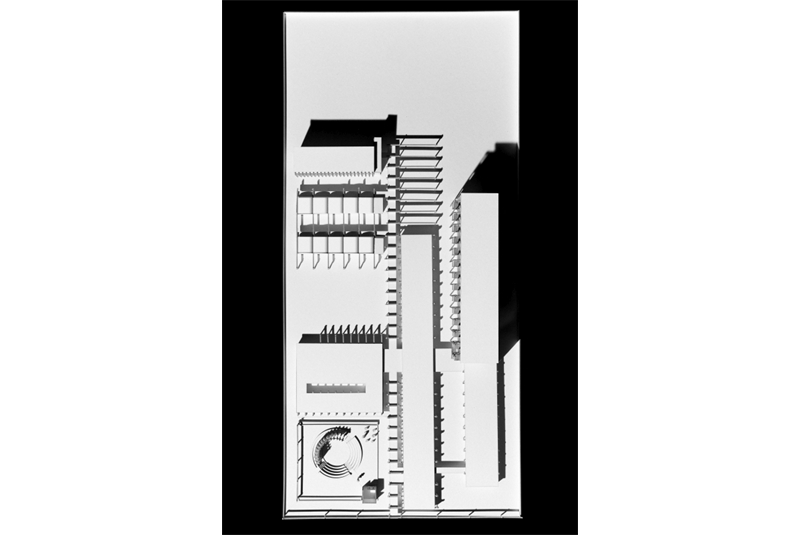
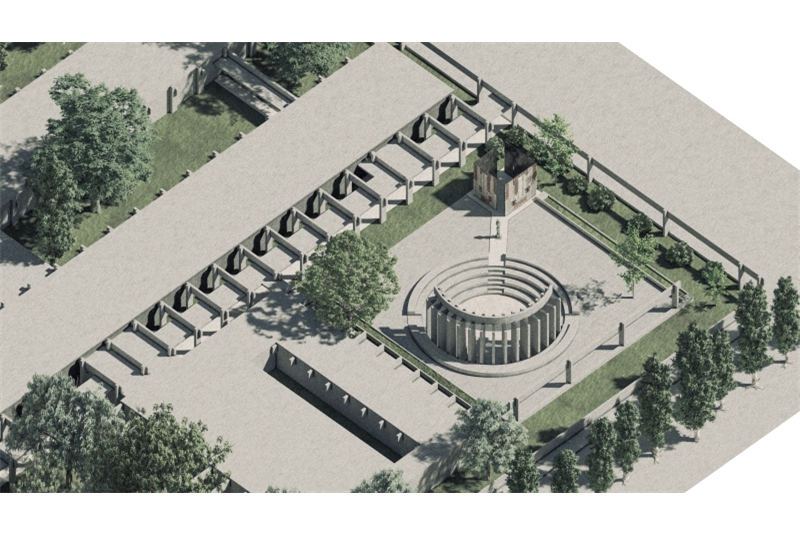
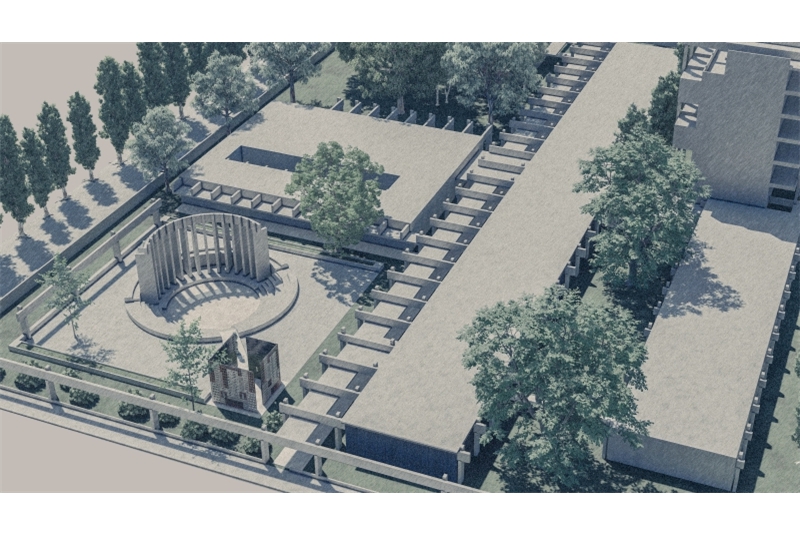
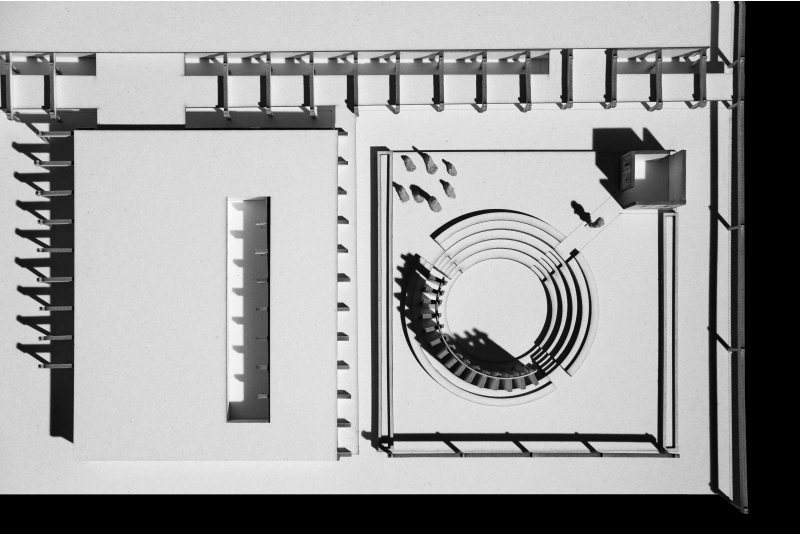
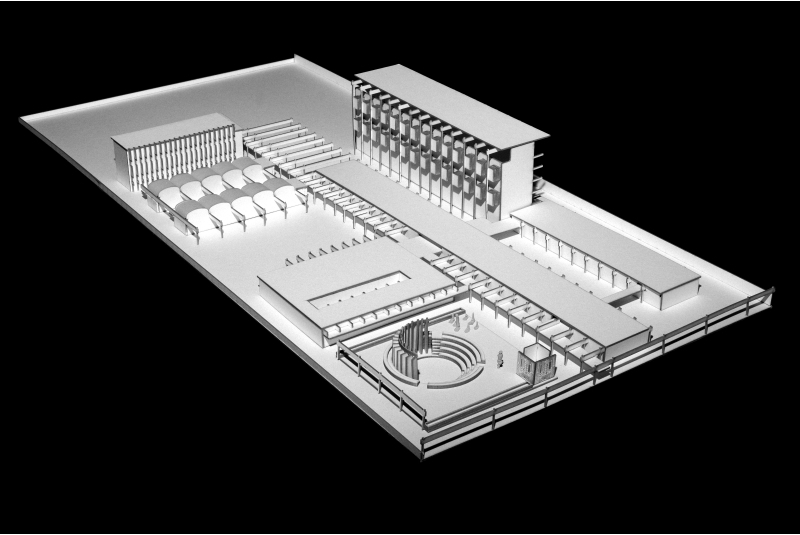
The project for a memorial-monument draws from these premises the intention to configure itself as a symbolic exaltation and evocative expression of those parts of the Institute that were never realized: the church, the gym-theater, the centers of interest, group accommodations, the school administration, and the workshops. In this perspective, it aims to reinterpret especially the unfinished space of the chapel, located adjacent to the southeast entrance of the complex, through the exploration of new relationships between the fragments of the work and its use by the community that now inhabits these abandoned places. The resulting attempt is to define extra-places that accommodate both the active role of the observer who lives these spaces and their contemplative act directed towards a sculptural presence scattered in the still open areas of the site.
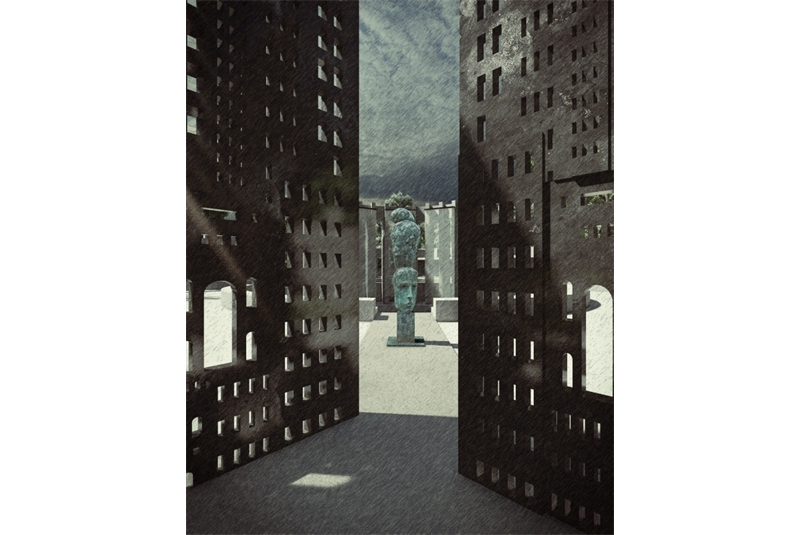
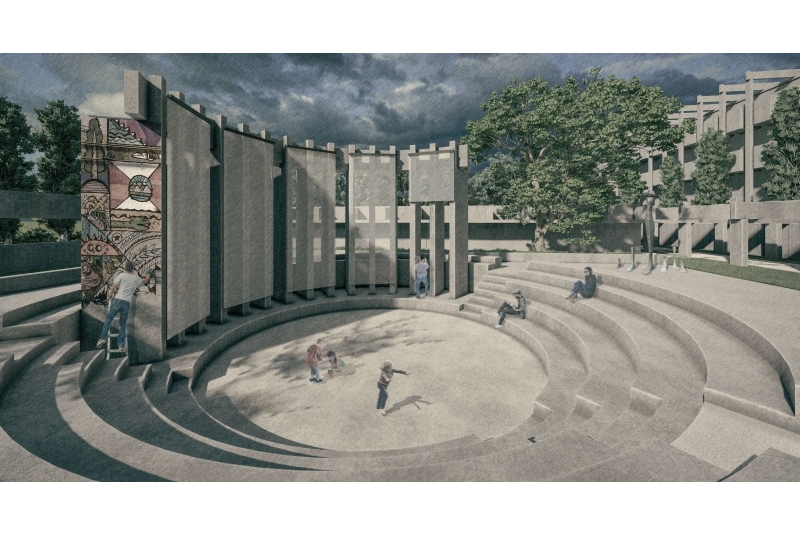
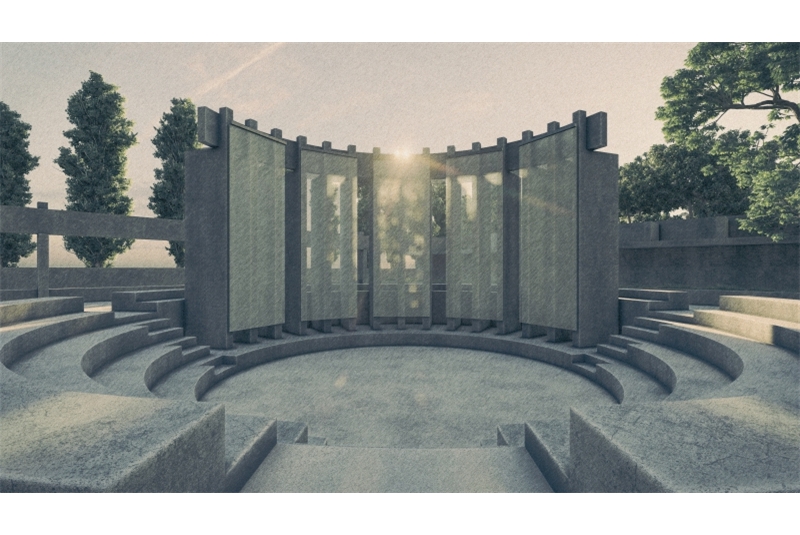
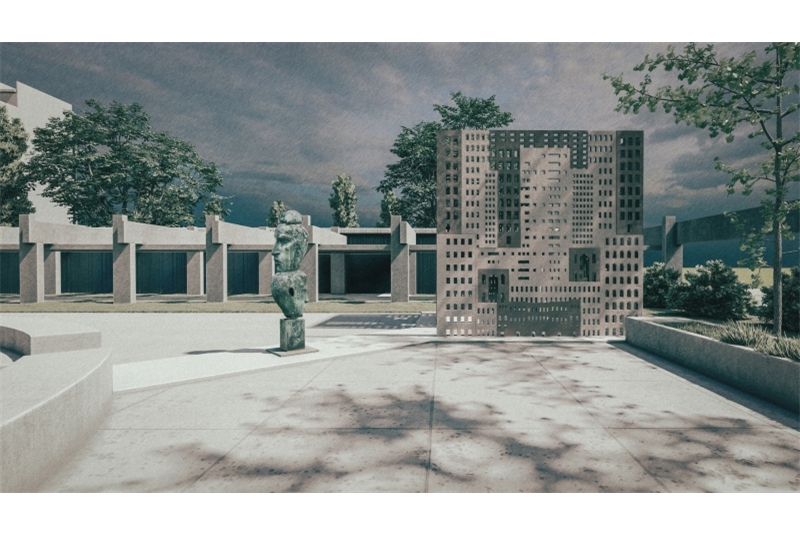
The memorial-monument thus becomes an urban square: a traversable and accessible sculpture by Paolo Delle Monache defines the entrance. From these propylaea people enter in the small outdoor theater located at a lower elevation than the foundation of the never-realized chapel of the Institute. This evokes its memory, framing a portion of the sky, shifting the line of the horizon. The bronze works (Tempio, 2003; Tra memoria e oblio, 2004) recall the suspended time inherent in the unfinished work, placed on the axes between the complex and the outdoor theater. The widespread presence of terracotta works (Soffio, Animula, Sole, Vertigine, Stelle, Infinito, Luna, Orizzonte, Tramonto, 2021) throughout the Marchiondi area, like stumbling stones, allows and invites an infinite possibility of addition.
The outdoor theater with the propylaea and sculptures defines a new urban space that is able to welcome the young people who currently live the modern ruins of the Marchiondi. The pillars define the stage area become supports for screens for evening video projections.
New shrubs, perennial herbs, and fruit trees join the spontaneous vegetation that prevails throughout the complex area, following the same iterative plastic process. A horizontal forest of expanding sculptures, both in form and imagination, emerges – a hortus conclusus – for isolation: echoing the disorienting overwhelm that renews itself, similar to the dream world of the Sacro Bosco in Bomarzo.
Five points for an extra-place
The project is characterized by five fundamental points:
Imagining the Marchiondi Institute as the miniature equivalent of an abandoned city, we hypothesized that Time, the great sculptor (and architect), would return to redesign it through vegetation and the composition of a forest. Through this open work we aim to suggest a reality in progress, something alive that expands, involving the grafting of plants over time and the cultivation of a botanical garden. In other words, the scents and sensations of nature: the creation of a forest composed of spices, flowers, plants, and new trees. The goal is to teach people who will enjoy this area to know and care for them, hopefully interacting with a Faculty of Biology or Agriculture.
We have identified some of my sculptures to create a pathway in the area of the Institute. Tra memoria e oblio, Temple, and a group of large faces with closed and open eyes form the thread of Arianna to follow within the park, aspiring to be a contemporary echo of the Sacred Grove of Bomarzo.
The titles of these works are crucial for grasping their meaning. I consider the title of one of my works (or an exhibition) a dialogue with the observer, a key to interpret my work that connect it with the viewer. You cannot clap with one hand alone. The work and the spectator are the two hands. It is not a coincidence that one of these works is titled Tempio.
The Temple was once a space of the sky, an imaginary space marked by the augure with his wand, the lituus. Within this imaginary space, the augure would interpret the arabesques drawn by the birds, foreseeing, predicting, and wishing for the future based on whether the patterns unfolded on a section deemed favorable or unfavorable. A corresponding identical space on earth was delineated, consecrated, or in other words, set apart (as it is known that sacro means separate) from the rest. Within this space, the activity of con-templating, or gazing longingly at the sky, took place.
All this is to say that we have sought to delineate an intimate space of silence and contemplation, an observation of the sky suggested and evoked by the sculptures that encircle some areas and characterize others. We have also considered placing an additional sculptural presence at the entrance –a city as an open book to traverse, marking the beginning and end of the journey. A kind of threshold filter, a limen to denote the extramoenia and the intramoenia.
When, many years ago, I encountered the term non-luogo, I thought there must be non-humans there, with non-desires, non-sense, non-love. The “non-place” is indeed a passage where it is impossible to establish a connection. I write this because our idea of a memorial-monument is the exact opposite: an extra-place, a place where one goes to stay and think, to experience extraordinary thoughts.
The question we asked ourselves was: What is truly missing for each of us in contemporary times? Our answer and the essence of the concept for the memorial-monument is: a place that separates us from the calm chaos (which envelops us in a continuously hyperconnected present) and gives us a pause of silence and intimacy with ourselves, in contact with nature, with the binocular sculptures[2] and with a masterpiece of architecture such as the Marchiondi Institute.
The idea, in a nutshell, is to boldly enter into a place like the Marchiondi Institute area with the goal of planting trees (it is scientifically proven that a forest enhances a person's well-being). Where and what to do? Certainly, introduce trees with a logical criterion, but also:
- Alternate abandoned areas and cultivated zones to create a
contrast between free nature and “educated” nature.
- Entrust a selected and prepared area to children, providing them with
a 100x100 cm plot of land to plant seeds and teach them how to
cultivate, aiming to impart the real meaning of the word
“Culture.”
- Develop a system for collecting rainwater to self-sustain and
irrigate the plants, educating on not wasting this fundamental and
precious resource.
The concept of the open work also involves communication with the visitors. Video projections with introductory and explanatory texts can be projected on the ground, on the sculptures, or on the walls, depending on the case, to provide the visitor with various directions and peculiarities of this space. These are evolving phrases, not fixed, which may also contain fragments of this same concept to narrate the meaning of the extra-place.
Furthermore, additional signage could be placed, created by a sequence of embedded pebbles on the ground, to be followed like Hansel and Gretel's breadcrumbs, indicating the path from one sculpture to another – the thread of Ariadne to be followed within the space.
* The first introductory paragraph has been written by Maurizio Villata, and the second, titled “Five Points for an Extra-Place,” by Paolo Delle Monache..
Notes
[1] The project relating to the national competition for the Monumento alla Resistenza a Cuneo by Vittoriano Viganò and Nino Franchina, sculptor, admitted to the second degree as showed in «L’architettura. Cronache e storia» (1963), p. 815.
[2] Binocular sculptures: with my research, I aim to create a sculpture to place in front of the eyes like binoculars, allowing people to see something that exists but is not visible or perceptible to the naked eye. It is not a simple game, and not everyone can achieve it. Peering into a sculpture requires an effort similar to finding silence within oneself. Binoculars can also be artifacts not necessarily satisfying or aesthetically pleasing externally, but inside, you may find the sea, a star, or a distant landscape. With my work, I seek to suggest that sculpture does not end with its outline but is a projection beyond form: a launching pad for reflection. Sculpture is both binoculars and a compass to orient oneself, giving meaning to what surrounds us. «Art teaches nothing except the sense of life, » Henry Miller.
Bibliography
MENZIETTI G. (2017) – “Istituto Marchiondi Spagliardi. Vittoriano Viganò, Milano 1954-1957”. In: Id., Amabili resti d’architettura. Frammenti e rovine della tarda modernità italiana. Quodlibet Studio, Macerata, pp. 40-45.
GRAF F. e TEDESCHI L. (2009) – L’Istituto Marchiondi Spagliardi di Vittoriano Viganò. Mendrisio Academy Press, Mendrisio.
DEZZI BARDESCHI M. (2004) – “L’istituto Marchiondi di Vittoriano Viganò: paradigma del Moderno”. In: Id., Restauro: due punti e da capo. Franco Angeli, Milan, pp. 168-175.
STOCCHI A. (1999) – Vittoriano Viganò. Etica brutalista. Testo e immagine, Turin.
ZEVI B. (1958) – “I ragazzi non scappano. Il nuovo Marchiondi di Milano-Baggio. Capolavoro del Brutalismo di Viganò”. L’Espresso, 2 marzo. Ora in Id., Cronache di Architettura, III. Laterza, Bari, 1971.
ZEVI B. (1971) – L’Istituto Marchiondi di Milano-Baggio. Capolavoro del brutalismo di Viganò. In: Id., Cronache di Architettura, III. Laterza, Bari.
AA.VV. Redaz. (1963) – “Concorso nazionale per il Monumento alla Resistenza a Cuneo. I dieci progetti ammessi al 2° grado”. L’architettura. Cronache e storia, 90 (aprile), 810-823.
PEDIO R. (1959) – “‘Brutalismo’ in funzione di libertà. Il nuovo Istituto Marchiondi a Milano, architetto Vittoriano Viganò”. L’architettura. Cronache e storia, 40 (febbraio), 683-689.
VIGANÒ V. (1956) – “Un istituto per trecento ragazzi”. Domus, 318 (may), 4.
VIGANÒ V. (1955) – “Institution a Milan”. L’Architecture d’Aujourd’hui, 63, 101.
VIGANÒ V. (1955) – “L’internato per ragazzi difficili”. Comunità, 57 (february), 64-70.