Introduction
Although less interested in teaching the Congolese, Belgium had accepted for health needs the training of medical personnel with FOMULAC in 1926, then agricultural training with CADULAC, in 1932. These institutions, run by Catholics, eventually expanded and the need arose to create other schools, including the School of Indigenous Medical Assistants (AMI) (Malengreau 2010). The ever-increasing need eventually necessitated the expansion and relocation of institutions giving university education to the new Capital (since 1923), Leopoldville, which was under construction.
In 1949, the Belgian Congo benefited from a major development program called the ten-year plan. It comes with a significant policy change. The exploitation colony becomes a settlement colony. But the policy of segregation is strongly encouraged. The urban plan drawn up by Georges Ricquier consecrates this segregation with a neutral zone supposed to keep the natives at more than 500 meters. Several indigenous cities are designed by the Office of African Cities for blacks who needed permission to cross the Neutral Zone.
With its ideas of decolonization, the Church had an opportunity to give the new university a humanistic aspect. The church and the administration will create Lovanium, latin name inspired by the Catholic University of Louvain. The objective was to create an African university from which a local culture would emerge (Lacroix 1972, p.47). It was the start of a unique project, the oldest university in Sub-Saharan Africa (Ndaywell 2010).
The article examines how the architecture and urban planning proposed for this project built on an uninhabited site reflects decolonization and even indigenization: it was question of removing the characteristic elements of the dominating culture for those adapted to the dominated culture. Three examples are given: the auditoriums, the church and the university clinics.
A local architect with “connaissance du terrain”
On the 29th of July 1950, the Board of Directors of Lovanium decided
to ask architect Marcel Boulengier to draw a general plan for the
construction of a new University. The Belgian architect Marcel Philippe
Boulengier (1909-1976) was the son of a construction contractor who
graduated as an architect from l’Académie des Beaux-Arts,
Mons, Belgium in June 1930. After his military service he started
working as an independent architect from 1932 till 1938. He entered the
Army in 1939 and emigrated to Congo with his wife and two children to
work as an urbanist-architect for la force publique. In 1950
he left the Army to start his own Bureau d’Architecture
in Binza (Kinshasa) – one of the first to set up his own
independent firm in the colony – to work on the ambitious project
of the new University Campus, including a new university hospital.
Boulengier had created within the Belgian colonial community a solid reputation as an architect and urbanist when he realised in only two years (1947 – 1948) an impressive Ecole militaire des cadets et sous-officiers at Kananga (former Luluabourg). Several members of the Board, in particular Joseph Van Wing[1] and Pierre Ryckmans[2] were impressed by his technical and organizational talent and his ‘connaissance du terrain’. (Ndaywel 2010). In de 50s and 60s, M. Boulengier was a highly valued architect and involved in many projects of great interest[3].
The tropical lay-out avoiding segregation
At first, the objective of the Board of Lovanium was to transform and enlarge the existing University Centre of Kisantu into a more comprehensive university complex. However, due to the observations made among others by the architect about size, environment and building requirements, it was obvious that a completely new construction site had to be found. Two Jesuits from the nearby mission of Kimuenza, Pol Meulenyzer and Pol De Vuyst, suggested to prospect the site of Mont Alba (Kimuenza), a hill nicely situated about twelve kilometers from the centre of Kinshasa (Gillon 1988, p.81). The site was located on a sloping terrain, quieter and less polluted then the otherwise overcrowded and dirty parts of the metropole.
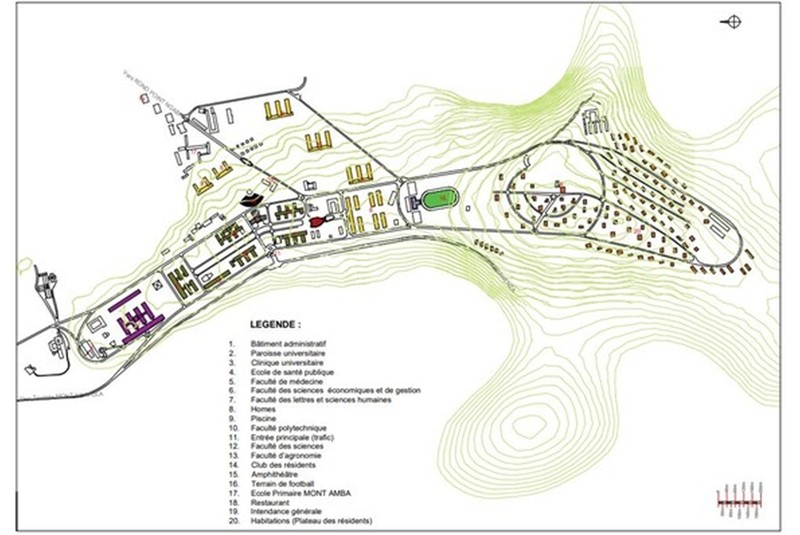
It took M. Boulengier a few months of very intensive work in order to present his first general lay-out plan on the 3th of August 1951. After careful examination of the plan, several detailed adjustments were made, especially to the conception of the residential neighborhood in order to avoid segregation (Ndaywell 2010, p.123)
There were many within the colonial administration and the Belgian government that were not in favor of this idea (Kestergat 1985). The question of higher education in the colonies was problematic. Many colonials were opposed to it, either for fear of seeing the Black supplant the European in the various jobs of the colony, or by the false idea they have of the intellectual capacities of the native (Malengreau 2010, p.65) . The final lay-out, presented by M. Boulengier in 1951, is based on an ancient but even so very modern principle: universitas docentium et studentium (Ndaywel 2010), a community of teachers and students, people who work and live together with scientific study as their common interest and where distinction between race, ethnicity, gender, religion, etc can be overcome.
In this conception, students, staff and teachers form a living community of learning, teaching and research, e.g. students and staff, even the Rector Magnificus, shared the same swimming pool and restaurant (Tandt 2003).
Along the ridge of Mont Alba, the different sections were aligned along a clear major axis that followed the wedge-shaped line of the plateau:
- the academic buildings are located in the northern part and are surrounded with lots of open space and planted vegetation;
- the large medical complex is situated at the far north with on the one hand the faculty of medicine and on the other the university clinics;
- the southern part is a more bushy environment, reserved for housing and recreational facilities for both staff and students;
- In the heart of the lay-out, a modernist church in the shape of a fish rises up and invites the community to advance from the living area to the working area.
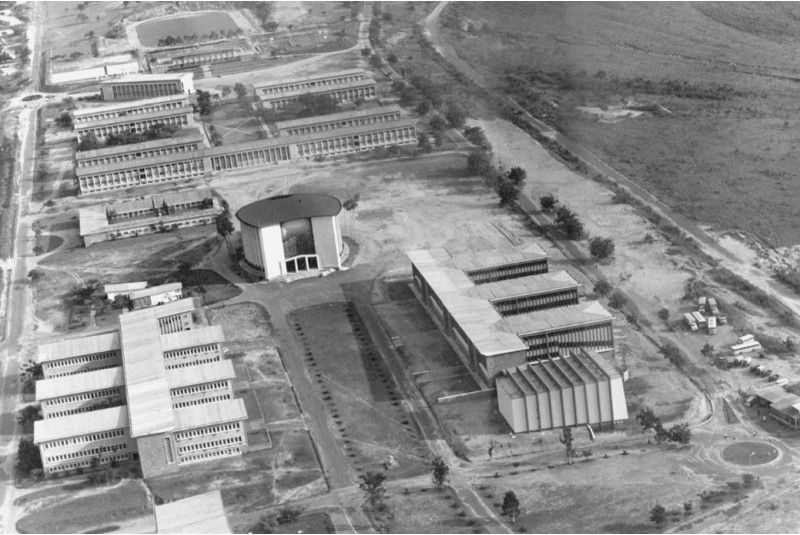
- In the vicinity of the church and facing the entrance stands a large administrative building (le Rectorat) that houses the academic hall (1200 people) and the central library.
Auditoriums, synthesis of tropical modernism
The work of a European architect in Congo in 1950 was indeed particulary challenging. He had to be prepared to dynamically adapt his plans, and involve local communities and techniques, as opposed to imposing a static master plan based on Western ideas. Many architects who build in Congo have choosen modernism adapted to tropical architecture as solution. The auditoriums with a selection of materials, colours, brutalistic language are a synthesis of what was the tropical architecture in Léopoldville in 1950’.
The architect managed not only the issue of occultation of the sun but also that of ventilation, both in the building of each faculty and in the distance between each wing and the different buildings.
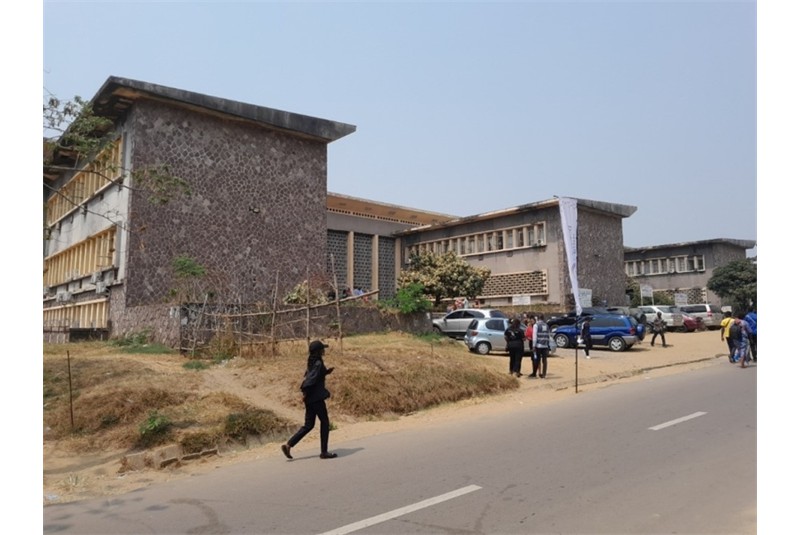
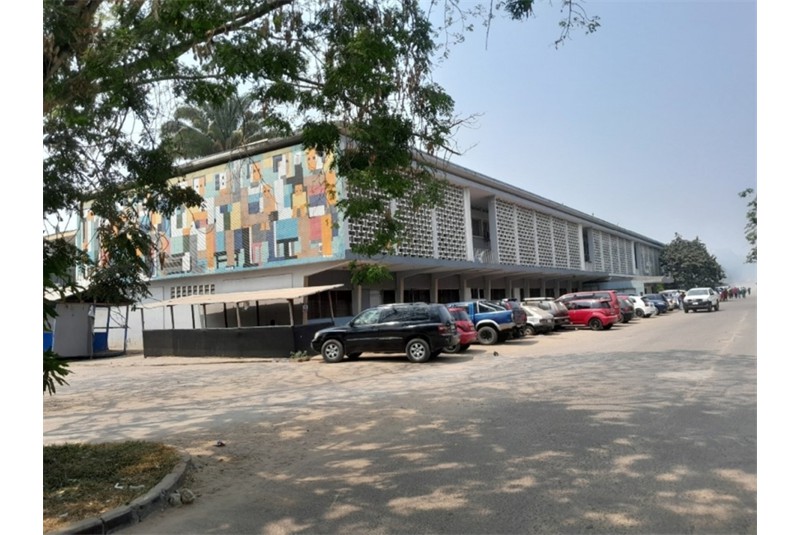
The auditoriums have an imposing architectural language with a rhythmic play of claustra curtains, quarry stone with protruding joints and ochre stucco. Claustra are widely used by Boulengier as a sun protection method and in an intelligent manner. Sometimes the ventilating effect of claustra becomes fumbled due to the fact that the material stores heat.
Furthermore, the little holes might restrict the view of the outside world and could thus enhance claustrophobic feeling. The use of claustra and brise soleil by Boulengier shows his technical mastership. A constant fresh breeze is created through the practice of natural aeration and transverse ventilation. Vents and windows are placed on two sides and in the right constellation, influx low, outflow high.
Claustras are sculpturally designed in a vernacular way and executed in precast concrete. Boulengier deliberately looked for one African formal language, using the brise-soleils as a sculptural design. His modernism does not appear ornamentless.
Tropical architecture was an appropriate architectural response because it took up solutions known for millennia in the tropics using modernist language. The hybrid result could appeal to both Europeans and natives and be part of a dual architectural tradition.
Notre-Dame de la Sagesse Church
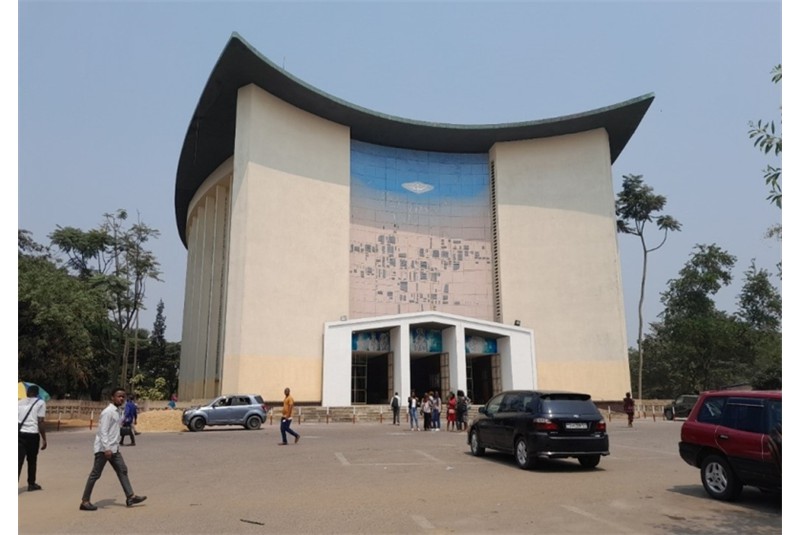
Marcel Boulengier is asked to design the centrally located church in 1956, one year after Le Corbusier finishes off his chapel in Ronchamp. Boulengier draws a plan based on the form of a fish – an old Christian symbol – with a curved sloping roof and the sacristy hidden in the tail fins of the fish. The choice of constructing an oval church as a place of encounter around an altar is a bold one, nearly ten years before the Catholic Church decides to bring the altar forward, away from the choir. Dequeker Paul explained this by the the politics of inculturation, gothic and roman styles being too European (Dequeker 1984).
When designing the church, M Boulengier choose to drop all concrete piles, detaching them from the roof slab. A metal framework, resting on top of the piles, supports this inclined roof slab. A large open space of 4m high between the church ceiling and the underside of the roof slab serves for free influx of air currents (and light) through the vent openings of the claustra. This space can be reached by a ladder made of steel bars in the bell tower. A concrete gallery of 3 m wide allows the parish caretaker to walk around the inside perimeter of the church and to replace the square elements of the ceiling and the lights that illuminate the inside of the church as little stars. Quite a remarkable constructive idea in 1957.
The northern facade of the church is decorated by a large relief in aluchromie (..), representing an abstract aerial view of a cité populaire (Matonge). It’s a monumental sculpture made by the award-winning Belgian artist Paul van Gysegem[4] who wanted to emphasize that this place has been designed to welcome the whole population. The design in aluchromie was originally in different shades of ocher and sand. Its abstract lining and playful geometrical forms reflects in a way the whole lay-out of the campus. It has recently been painted, giving the dove figure a more prominent role.
The entrance of the church is a stylisch three-part structure with an angular pediment, wrought-iron bronze-coloured doors and three aluchromic plates in blueish tones by Paul van Gysegem and Roland Monteyne representing Notre Dame de la Sagesse and biblical figures. The same angular canopy has been used by the architect to decorate other buildings, in particular the university clinics[5]. The poetica of the architectural language thats shapes this church, with its curved forms, its meticulous design of claustra and vents, its elegant colonnades (inside and outside), is impressive to anyone visiting this place for worshipping, meeting and singing. Today, the Bantu liturgy fills the building with its colorful and warm offices, where sung and danced prayers alternate. And indeed, the famous choral of Notre Dame de la Sagesse has been able to enjoy the excellent acoustics of this building for more than 70 years and establish its beauty worldwide.
The indoor of the church is illuminated by a delicate play of patterns. Incoming sunlight is filtered by small stained glas windows and by stone curtains of claustra, thus creating a very pleasant indoor climate. Even when the outside temperature soars above 30°C, the inside stays cool.
This is partly due to the metal framework that holds up the roof creating a large ventilated area between the roof and the ceiling. Students and staff, whose homes and villas are situated in the southern part, approach the Campus from the rear of the church, which tail vins slightly sink into the ground to open up towards the faculty buildings. In a way, the architectural lay-out invides those who live on the Campus to walk past this spiritual meeting place in their search for more wisdom.
The university clinics
Building a hospital is a complex matter. Firstly, because it provides medical, nursing and paramedical care, the diversity of which has to follow the extraordinary development of medical sciences and the application of cutting-edge technologies to the hospital world. And secondly, because it should take into account new insights in human sciences and cultural and psychological phenomena. Marcel Boulengier gained an ‘indisputable reputation’ as an expert in the organisation of hospitals by the way he designed the university clinic in Kinshasa and the E.M.I.[6].
Boulengier’s expertise was based on the fact that in a tropical environment one had to rethink completely the architectural models for building and organising a hospital, still currently used in Europe and the USA during the 50s. The main reason for this must be found in the way Boulengier, in collaboration with prof. med. Gérard Van der Schueren, adapted his design to specific local needs (population, climate and medical needs)[7].
The constructing of the clinics was first given to Otraco. They had the finances, the technical abilities and the man power. But the Board of Lovanium rejected the initial plans made by the engineers of Otraco (de Broyer, Buissé, Delire) and asked Boulengier in 1956 (Board meeting 18.08.56, Archives UCL) to study and (re)design this complex building.
Before defining the new plans, the team formed by Gillon (architects, doctors, engineers) thought long and hard about the new program needs to be integrated into the works, namely:
- human values: availability, benevolence, sense of welcome and collegiality;
- academic values: excellence, creation of knowledge (research), education and professional training;
- a more holistic and interdisciplinary approach, necessary in the Congo because of the dominant presence of polypathology;
- the creation of a calm and pleasant indoor climate (heat, light, etc) in interaction with outside courtyards.
When Mgr Gillon was invited by the Americans, Boulengier and Van der Schueren accompanied him to visit heath care projects in the USA (Archives KULeuven). Once returned, the main architectural concept was clearly defined and was a revolutionary one: the idea of placing architecture at the service of the patient. The hospital had to fit around the objectives and characteristics of the 3 H: High technicality, Hospital hygiene, Humanization. The architect’s watchword was the creation of a friendly and warm space in which all patients and staff, whether white or black, could feel good. Alongside care, the hospital provides a series of other functions (administrative, technical, and logistical) and hotel services, involving the presence of a multitude of professionals. The synergy between all, with the common objective of excellence in the service of the suffering human person, determines the quality of this type of social and non-commercial organization that is the hospital.
The new university clinics were constructed in several stages during 1958 – 1965 but the overall conceptual site strategy was marked from the beginning by Boulengier’s design. Utilizing the existing topography, the architect designed footbridges and outside stairs thus connecting the three different levels and allowing interaction with the large courtyards.
Very innovative is the long overarching frontal structure that serves as a visual barrier between the more public program and the more private, in-patient facilities. This creates a gradual progression from the entrance with its playful canopies to the more formal volumes at the interior of the site.
Compared to the big block structures used in Europe in the 50s and 60s, these university clinics have a design that is open and more horizontally oriented. There is plenty exposure to filtered sunlight. Courtyards with bushy vegetation and outdoor pathways enhance the interaction with nature.
The organization chart of the university clinics allows the diversification of service areas and comfortable conversation areas, for patients waiting for consultation or exam results. This is perhaps the concrete physical image of this new understanding of hospital facilities, opposed to the compact labyrinthine system, dominant at that time, with tight undifferentiated corridors, and interior waiting areas, rarely equipped with a TV and where patients are concentrated, some-times without proper regard for necessary air renewal or a hygienic distance. Circulation and waiting areas are open to family visitors who, from the Congolese point of view, take on part of the care.
Conclusion
The University Campus of Kinshasa as it was designed by the architect Marcel Boulengier from 1951 onwards and was built under the mastership of Luc Gillon, represents a historical, cultural and architectural heritage of exceptional quality and it is hard to find, certainly in Africa, any other educational/medical complex that can equal its beauty and appearance. It combines la science de la haute technicité, la beauté de l’art architectural et la philosophie de l’humain of a modern humanistic approach in architecture. Furthermore, it reveals to architects, working today in Congo and in Belgium, a whole vector of opportunities when taking into consideration durability, heat protection and form vs function. Boulengier died 50 years ago, his work hasn’t.
Opened the 12th October 1954 with 33students (Nkondi 2022), the Campus of the University of Kinshasa (UNIKIN) has been the home of many thousands of Congolese students – too many nowadays considering the initial scale and lay-out – and has suffered a lot from the lack of maintenance. But for everyone working in or visiting this vast complex of buildings at, what is commonly known as la colline inspirée, it is obvious that this place is unique for its architectural lay-out, its technicality, its atmosphere and beauty.
The oldest university in Sub-Saharian Africa and that it has been attended by famous scholars, politicians and pioneers that shaped the RDC life probably contributed to the independence in 1960 as many feared. Other institutes will be erected in the 1960s but none of them will be as Lovanium, now the University of Kinshasa.
Notes
[1] Joseph Van Wing (1884 – 1970) was a Belgian Jesuit priest with a strong interest in education. In 1939 he was appointed superior of the Jesuits of the whole colonial region. From 1948 onwards he was a member of the Belgian colonial council and of the Conseil d’Administration de Lovanium. His competence was much appreciated and his opinions are listened to. In Le Congo Déraille (1951) he defended the principle of indigenous property against the economic interests of the colonial power. In 1970 his body is repatriated to Kisantu to be buried there in the cathedral Notre-Dame-des-Sept-Douleurs.
[2] Pierre Ryckmans (1891 - 1959) was a Belgian colonial official and governor-general of the Belgian Congo from 1934 to 1946.
[3] A clear reference to Boulengier’s fame is to be found in a lettre writen by Justin Bomboko, Ministre des Affaires Etrangères et du Commerce Extérieur to Paul Henri Spaak, 9 juin 1962 (In: PH Spaak, archives.eui.eu/files/documents/13446) where Boulengier is qualified as “technicien belge de grande valeur”. (Boulengier also designed the new office building of the Banque Nationale du Congo-Belge et Ruanda-Urundi (1957), the A.M.I. (1959), several residential houses (Parc Joly, former Parc Hembise) and participated as an architect in the construction of the Palais de la Nation (from 1957 onwards) with Lambrichs. In 1956, Houyoux-Diongre, architecte en chef, commends to assign five architects to construct the palaces of the colonial section of the World Expo 1958 in Brussels: Ricquier (Palais), Strebelle (Energie, Transports), Boulengier (Urbanisme et Habitation).
[4] Paul van Gysegem is a Belgian sculptor, painter, graphic artist and jazz musician. He designed the aluchromies, Walter De Buck produced them and they were set in place in 1963 by Van Gysegem and a bunch of Congolese craftsmen.
[5] It’s a pity that the Intendance Générale decided to build the fenced memorial for Mgr Tharcisse Tshibangu so close to the church, spoiling a bit the inspiring view from behind where the semi-raised huge plastered cross, tone on tone, has a dominant position. Perhaps the initial choice to put no cross on the front but only at the rear was not that well understood.
[6] Later, during the 60s, when new cliniques had to be build in Belgium (Saint-Luc Woluwé, ULiège, Mons) Marcel Boulengier was hired as an expert for the architectural organisation (Haxhe, 2001, pp 43-44, Woitrin, 1987).
[7] Gérard Van der Schueren was membre of the Board of Administration of Lovanium. The archives of Van der Schueren, containing 17 plans by Boulengier for the cliniques, are kept at the archives of KULeuven (B).
Bibliography
BOARD OF LOVANIUM – meeting 18.08.56, Archives UCL.
BOMBOKO J. (1962) – “Lettre du Ministre des Affaires Etrangères et du Commerce Extérieur Justin Bomboko au Ministre Paul Henri Spaak”, 9 giugno 1962, In: SPAAK P. H., Historical Archives of the European Union. [online] Disponibile a: <archives.eui.eu/files/documents/13446>.
DEQUEKER P. e MUDIJI M.G. (1984) – Églises tropicales. Éditions C.E.P., Kinshasa.
GILLON L. (1988) – Servir, en actes et en vérité. Duculot, Parigi.
HAXHE J-J. (2001) – Si Saint-Luc m’était conté… Plus de trente ans d’histoire. 1966-1996. Racine, Bruxelles.
KESTERGAT, J. (1985) – Quand le Zaïre s’appelait Congo. Paul Légrain, Bruxelles.
LACROIX B. (1972) – “Pouvoirs et structures de L’Université Lovanium”. Les cahiers du CEDAF, n. 2-3, Bruxelles.
MALENGREAU G. (2010) – “Lovanium: du centre universitaire à Kisantu à l’université de Kimuenza”. In: NDAYWEL È NZIEM I. (a cura di) Les Anneées Lovanium. L’Harmattan, vol. 1, Paris, pp. 93-295.
NDAYWEL I. (a cura di) (2010) – Les Années Lovanium: La première université francophone d’Afrique subsaharienne. L’Harmattan, 2 volumes, Paris.
NKONDI P. (2022) – Les infrastructures et l’aménagement du site universitaire. Inédit.
TANDT A. (2003) – De koloniale sectie op Expo 58. Masterproef UGent, fac ingenieurswetenschappen. Promotor: Mil De Kooning.
WOITRIN M. (1987) – Louvain-la-Neuve / Louvain-en- Woluwe, le grand dessein. Duculot, Paris/Gembloux.