Ambientism and Commotion
There is one character that unites the design experiences that will be briefly commented on below, elaborated for different places in Sub-Saharan Africa (Sudan, 2005-10; Ethiopia, 2010; Tanzania, 2023), over a nearly 20-year period; the character of “realism.”
It is not the purpose of this brief account to delve into the topic of realism in architecture[1] (Tafuri 1985) – or realism in Sub Saharan African architecture, exploring in general and historiographical terms the validity of a possible new interpretive category (D’Agostini 2013)[2] – or realism in the architecture of Sub-Saharan Africa – exploring in general and historiographical terms the validity of a new interpretive category –, but to reflect through which cognitive and interpretative paths, more or less unconsciously sedimented in the experiences of the Roman school and practicing a recognizable modus operandi, project responses were elaborated, responding to the reality of the places and the demands of the clients. That is, there has been an attempt to interpret the identity of the contexts by renewing the sources of inspiration with respect to the models offered during the different colonial phases (both late 19th-century and 20th-century modernist inspiration).
The most mature experiences proposed and carried out by modern Italian architects in Africa and the Mediterranean area took place between the 19th and 20th centuries, and in particular during the period of the Fascist twenty-year period and after World War II, when works and interventions were carried out in Libya, Egypt and Ethiopia: the publications and research of Ezio Godoli (Godoli 2008) and Benedetto Gravagnuolo (Godoli, Gravagnuolo, et al, 2008) are among the most comprehensive and investigate different personalities and events. On French experiences in North Africa, one of the most significant works is Casablanca Colonial Myth and Architecture Ventures (Cohen and Eleb 1998) of Jean Louis Cohen and Monique Eleb. Always fundamental remains the enlightening reading offered by Giuseppe De Rita during an interview a few years ago, in which he stated that Italian architecture in Africa is the child of Land Reclamation, that is, of the agricultural reclamation carried out during Fascism and executed by companies such as Salini, later applied to road infrastructure, all over the world, but present in those years especially in the countries of the enlarged Mediterranean and in Africa (Del Monaco 2021). That is, architecture as an additional service that refines and amplifies the provision of infrastructure interventions and modernization.
Florestano Di Fausto, known for his architectural interventions in Libya (McLaren 2005), reproposed in those distant lands actions and language akin to some proposals for the cities of the Pontine Plain and for the Francoist pueblos de colonización in Spain (Lejeune 2021). So, a set of programs and interventions in agriculture and land transformation, in Europe and Africa between World War I and World War II.
In that same articulated historical phase, Italy was debating what the national language of architecture should be. In parallel, prominent Roman architects engaged in that debate, and professors in the Faculty of Architecture, had major planning and design experiences in the wider Mediterranean and Africa: think of the urban works of Marcello Piacentini and Arturo Mezzedimi in Asmara (Tecle 2015) that of that generational cycle and represents the last Roman, born in 1937, to have experienced projects directly in the field, with continuity, in the extended Mediterranean and Africa. In particular, after World War II, development and international cooperation policies had a great deal of impact: think of the more than ten-year experience in Tunisia-just to mention a significant and structured case-by Pietro Barucci, Piero Maria Lugli, Plinio Marconi, Giuseppe Nicolosi, Ludovico Quaroni, Luigi Vagnetti. And, from the mid-1960s to the late 1970s Lucio Barbera’s professional actions with ProgRes in Egypt, Morocco, Togo,[3] who of that generational sequence represents the last Roman to have directly experienced in the field a design activity, with continuity, in the extended Mediterranean and in Africa.
It is important to clarify that with the concept of realism we do not intend here to allude to neorealism or to discomfort magic realism, that is, to that set of experiences that a part of Roman architectural culture shared in the postwar period with film and literary culture (Reichlin et al, 2001),[4] – but it is also inevitable that they remain active issues in the background. We refer, for this reading, to the experiences concerning the protagonists of the Roman School of Architecture, at a time when there was, in fact, a transition between Fascist culture, that is, the idea of architecture as an art of state and above all a representation of a political identity, to architecture as a profession of social relevance[5] also interested in ordinary architecture and so-called “minor architecture” and that in the school in Rome had an important tradition in the activities of the Artistic Association among the Culturists of Architecture (Aacar) in which Gustavo Giovannoni was one of the most active animators.
In the years of the founding of the School, which had also long been under study by the Aacar Commissions and by Giovannoni in particular, those options for the search for an architectural Italian-ness-which, with evident approximation, can be referred to at least three different declinations of the theme: historical/monumental, minor/ambientist and innovative/then even rational-were not yet all easily distinguishable. But Giovannoni tried to identify them, claiming only to himself the environmentalist option, which was instead certainly still cultivated, to varying degrees and with appropriate destination, by many of his colleagues, not excluding, as mentioned above, Piacentini. [...]: “to us Italians, who feel the architectural crisis more than others because of the greatness of our tradition, which we do not want and must not abandon, it is convenient to orient ourselves, towards the tendencies of simplicity [...] and here in the studies on past art appropriately prevail the researches on minor architecture [...] and here in the composition the modest and constructive themes [...]” A possible exemplification of this program is recognizable in Luigi Vietti’s graduation thesis-a hotel set in Cernobbio, a small rural village on the coast of Lake Como-which was awarded by Giovannoni in 1928, perhaps in controversy with the participation of some of the School’s students in the I Italian Exhibition of Rational Architecture (Pallottino, 2021).
Introducing Gustavo Giovannoni’s environmentalist option (ambientismo) and associating it with the social purposes of architecture, we do not intend to automatically establish a link between the category of realism and the category of the vernacular, the picturesque, regionalism, etc., that is, to attempt classifications according to predetermined historiographical schemes. Instead, we would like to highlight what methodological and operational tools developed in certain cultural contexts can be transferred and applied to different contexts, to different cultural morphologies. Introducing, therefore, what scholars of Africa such as Frobenius called emotion (commotion), an intuitive impulse with respect to the interpretation of reality, more similar to the instinctive condition of the child than the adult (Barbera 2014). More like a phenomenological and expressive interpretation than a rationalist one.
Beauty is in the eye of the beholder,” says Wölfflin. Decisive is the position from which I look at a picture, but also the lighting and the frame in which it is placed; and thirdly, the intimate predisposition of the person who produced it is decisive; calling him the “creator.” (...) The nineteenth century silenced this need in such a primitive way that it sometimes had even grotesque and barbaric effects. Consider the problem of the origin and individual “advances” of civilization. First of all, the Spencer-Tayor conception dominates. Everything was explained by a mental position determined by the worst tyranny of causality. It asked. “For what purpose, with what intent? And it was answered, “so that ... (...) Science discovered ‘the impulse to play’ as a remarkable phenomenon only insofar as it already occurs in the child, just naturally not originally aroused by education.” (...) man acquires two forms of life, that of “being” and that of play. In representing “his own part” is the origin of all civilization. And the part that the individual man, the people, a humanity bound by time or place must play is that which is written expressly for a man as an individual and for the very as a community. But that which “is written,” is revealed in the commotion [Ergriffernheit]. This is our narrow faculty of perception, which depends partly on the senses and intellect, partly on feeling and “paideuma” (Erlebte Erdteile, IV). To this distinction of the most important organs of vital synthesis perhaps corresponds an order of the surrounding world, which distinguishes a phenomenal sphere of facts and a phenomenal sphere of reality. (Frobenius 2013/1933).
In the course of his essay, Frobenius distinguishes and analyzes styles of popular poetry by distinguishing between the Styles of Romantic Realism (Ethiopian civilization), and those of Rationalistic Realism (Camitic civilization). We mention them here only to highlight how interesting a new approach for a critical theoretical investigation might be. Consider also the recent attempts (Santini 2020) sketched by some scholars to compare figures like Aby Warburg and Leo Frobenius, long neglected, both German and almost coeval. And both coeval with Gustavo Giovannoni, that is, of that cultural moment of transition between nineteenth and twentieth-century culture, very fertile and perhaps too simplistically considered and pigeonholed by twentieth-century historiography within “traditionalist” definitions.
Urban settlements, health services and infrastructure for research and historical heritage in Sudan, Ethiopia, Tanzania (2005-2023).
On closer inspection, the methodological and interpretive tools mentioned so far would allow an approach to the transformations in contemporary African city architecture (settlements and buildings) to be developed by reasoning about continuity and not neglecting the desire for modernity, which is present and legitimate. Keeping in mind that Africa, in the global framework, still represents an important reserve with its territories to preserve the balance between city and nature, urban and extra-urban areas, not yet being completely altered to the extent that has happened in some Asian countries, where conditions seem irreversible. Approach, the one outlined, not so far removed from the position of Diébédo Francis Kéré who, in commenting on the school built in his home village, the Gando Primary School, argues as follows: «I did a modern building that is not westernsed, and not a traditional African building,» and that his aim was “to create a building that responded the best to the need of the climate and the need of the people, using the most available material” (Block 2020). Different approach, however, from that promoted at different historical stages by French architects both in the suburbs of cities such as Paris and Marseille and in the former colonies, proposing a mass modernist architecture, among whose: «I did a modern building that is not westernised, and not a traditional African building,» and that its purpose was «to create a building that responded the best to the need of the climate and the need of the people, using the most available material» (Block 2020). Different approach, however, from that promoted at different historical stages by French architects both in the suburbs of cities such as Paris and Marseille and in the former colonies, proposing a mass modernist architecture, among the best examples of which are the works of Fernand Pouillon.
The experiences described below, on the other hand, focus on a demand for architecture aimed at improving the quality of life in small and medium-sized urban centers, social and health services in suburban areas, and places for research, study, and preservation of cultural heritage in prominent but relatively remote areas.
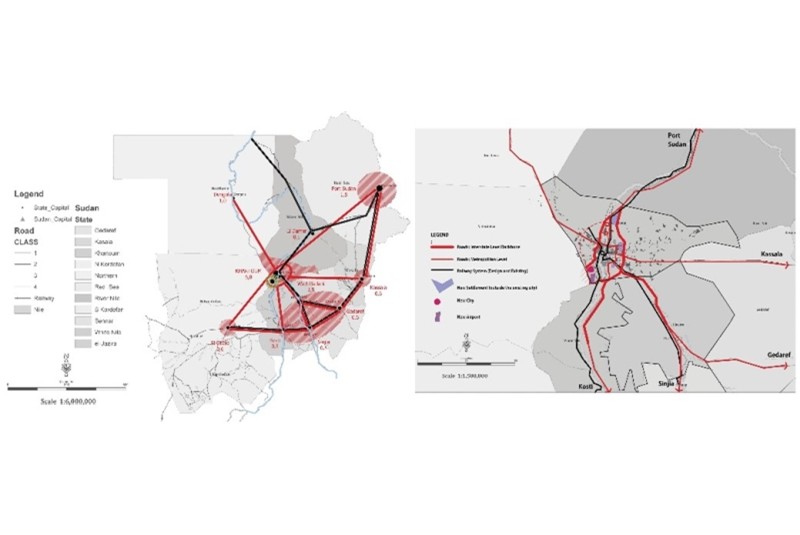
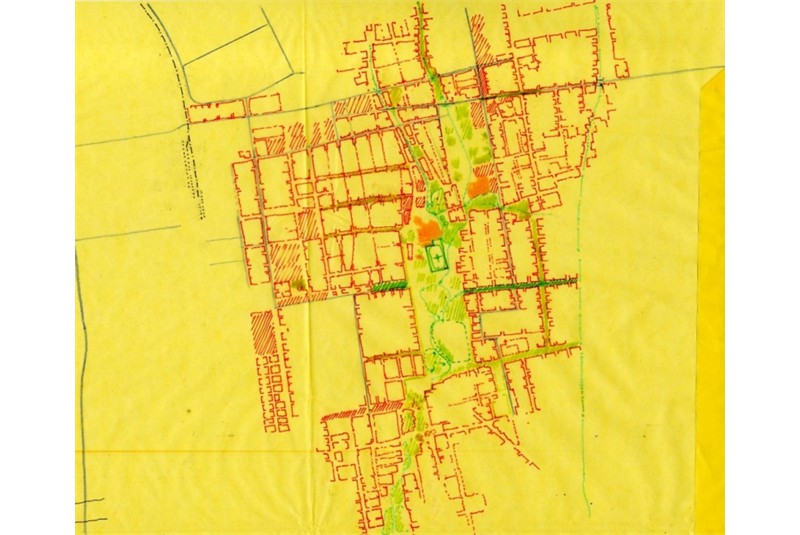
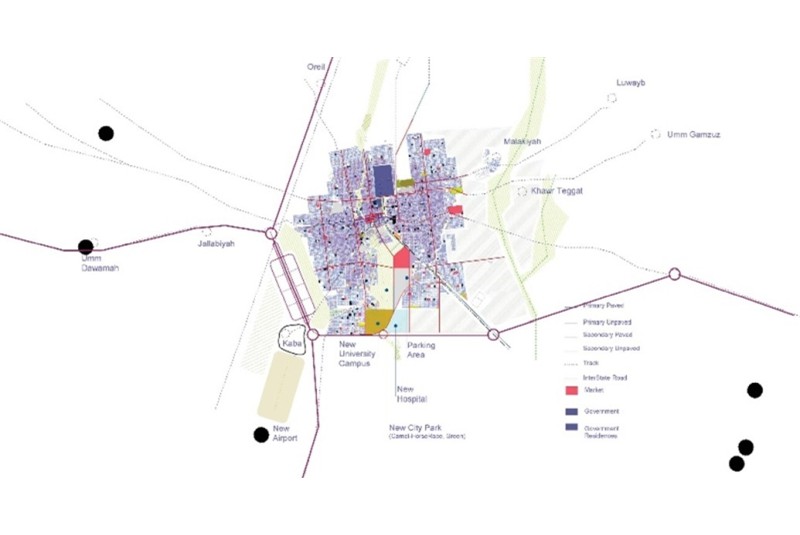
Regional Development Plan del Kordofan, KPP5 Khartoum Planning Project 2006-2010
In 2005, engineer Riccardo Raciti (Mefit Sudan[6]) contacted Lucio Barbera, dean of the Faculty of Architecture “Ludovico Quaroni” of Sapienza University, to start a research-consulting collaboration (today it would be called “third-party”), for the drafting of the Development Plan of North Kordofan and the main cities of the region, especially the capital city El Obeid. Between 2006 and 2010, then, the research agreement signed, an interdisciplinary team[7] of Sapienza contributed to the setting up of spatial planning tools, urban design, and training of local professionals, with the contribution of some research fellows funded by the convention. Over the years, the Mefit Sudan agency, with Sapienza’s contribution, also won the assignment for the Regional Development Plan of the White Nile region and participated in the call for proposals for the KPP5 Karthoum Planning Project: the grouping was the winner. The drawings presented here represent a summary of the complex consultancy work, which was interrupted by Sudanese national and international political events after the first phase of setting up. The missions carried out in the field, the confrontation and exchange with the local administrative and technical offices allowed to ascertain, the still essential role of the local population (partly nomadic and partly settled and agricultural) in the process of realization and management of residential settlements, what is more or less consciously and properly called self-construction[8]. Widespread technical and organizational capacities, therefore, should be preserved and regenerated and supplemented with the minimum technical instrumentation, which is essential to improve the average quality of the habitat and to establish in a broader geographical and cultural framework, Mefit Sudan appointed project manager Corrado Giannini, a Roman architect and designer of the design firm ProgRes-S.T.R directed by Lucio Barbera active in the Middle East and Africa during the 1960s and 1970s. Because of the serious charges, later dropped, brought against President Omar al-Bashir for his involvement in the Darfur crisis the work of Mefit-Centecs (Del Monaco 2023)[9], continued without the Sapienza contribution, and was later documented by Sudanese scholars in the paper Khartoum 2030 Towards an Environmentally Sensitive Vision for the Development of Greater Khartoum, Sudan (Hamid and Bahreldin 2014). In summary, it can be said, that the proposed interventions, although not completed under Sapienza’s supervision, due to the occurrence of external events, had as important precedents the work carried out in Togo by Barbera-Giannini with ProgRes in 1976 (and illustrated in this same volume), suggesting infrastructuring, stormwater and urban water governance, flooding and the introduction of some elementary basic rules for the construction of the foundations and ground floors of buildings, leaving the inhabitants to self-construct their own dwellings.
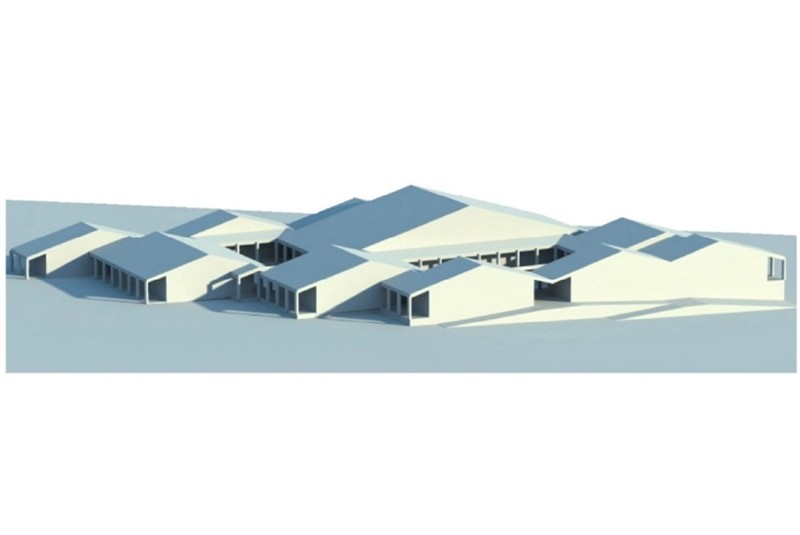
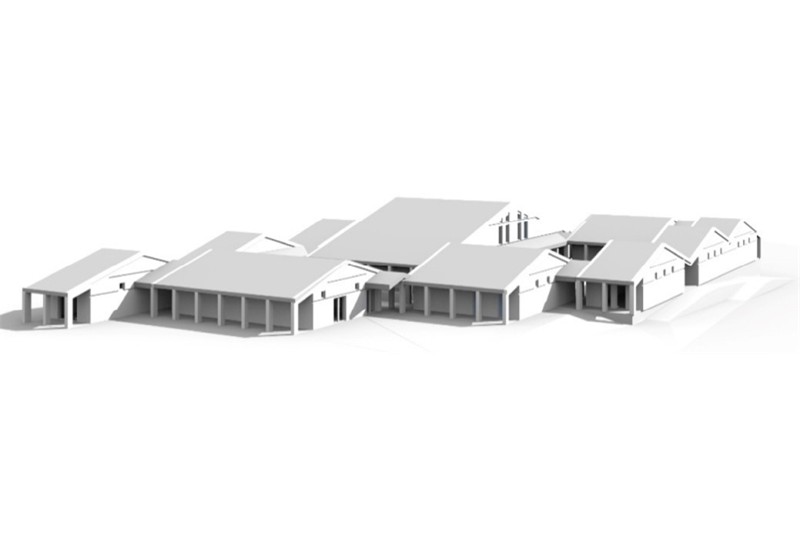
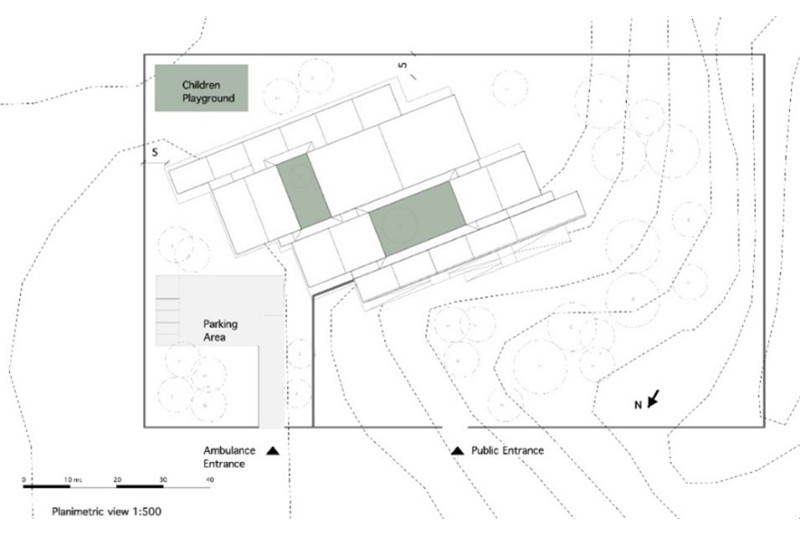
Health Operator Learning Center Adwa (Tigray), Ethiopia, 2010
This project, written by Lucio Barbera and Anna Irene Del Monaco, was prepared at the request of the Italian Red Cross, the Ethiopian Red Cross, and the Faculty of Medicine of Sapienza University of Rome (Sant’Andrea Hospital), whose reference was Professor Maurizio Simmaco. The project is a design study freely offered by the authors to the mentioned institutions. The initial requests from the institutions involved were for the design of a mother-child monitoring health center, taking into account the number of orphanages in the area and the related clinical problems, run mainly by religious and nongovernmental organizations.
During inspections and discussions with local institutions, the functional program was modified several times, and the final request-which from the outset attempted to retain a broad character of flexibility-became a learning center for health workers, with the addition of an outpatient clinic. The project had been accepted and approved by the local authorities, and the preliminary investigations for the project’s construction site had been completed when, suddenly, while on the ground already staking out the foundations, the program was suspended, possibly due to a lack of agreement between the local Red Cross and the various nongovernmental organizations in the area.
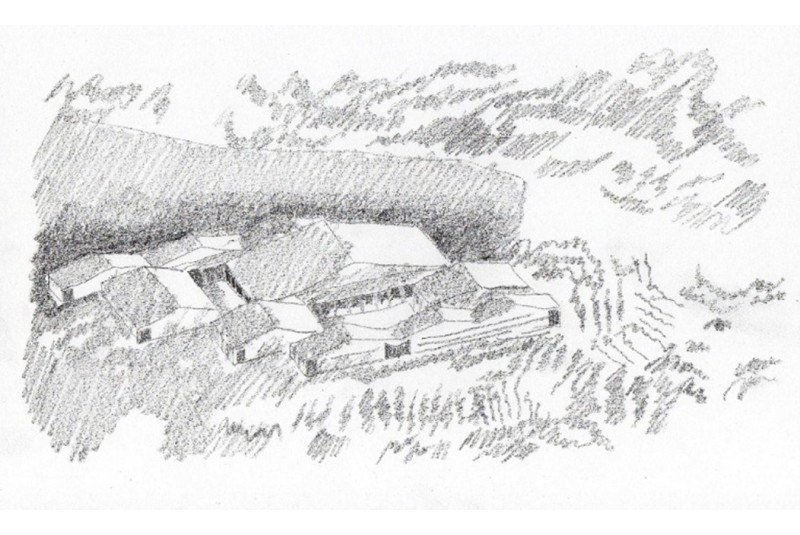
The proposed design idea considered the construction systems used locally, or that seemed to have produced the best outcomes, with the intention of trying to extract, from reality, elements of systematized and formalized architectural language to improve performance and aesthetic outcomes. Thus, it was important to interview local people and conduct site surveys among the buildings constructed in that same area by local workers. The design layout called for a sequence of courtyards connected by covered passageways and aggregated into pavilions that draw a sequence of open and closed rooms connected by semi-covered passageways. The buildings aggregated in the manner of train cars, of different heights, depending on their functions, float like volumes in tension – due to sloping roofs of different heights and variations in the planimetric pattern – on a barren terrain opening onto a valley, populated by bushes, rocks and a few scattered trees. The direct connection between the window design and structural elements was intended to minimize possible execution errors and lack of on-site control during execution, and to still achieve a formally controlled result in the event of any use of low-quality building systems.
The arcades are a key place in the project, marking the spatial rhythm, and repurposing the semi-public outdoor space most used by local people. In fact, these are designed for outdoor educational activities as well as transit and temporary resting. The size, position and design of the windows are conceived to facilitate natural ventilation – a key issue for climatic and hygiene reasons – and air circulation in the different pavilions that define the articulated building fabric and sequence of aggregated semi-open spaces.
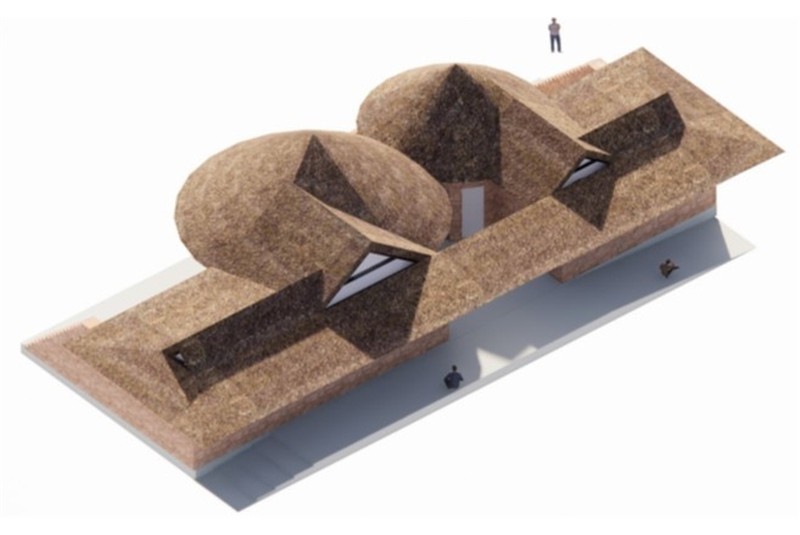
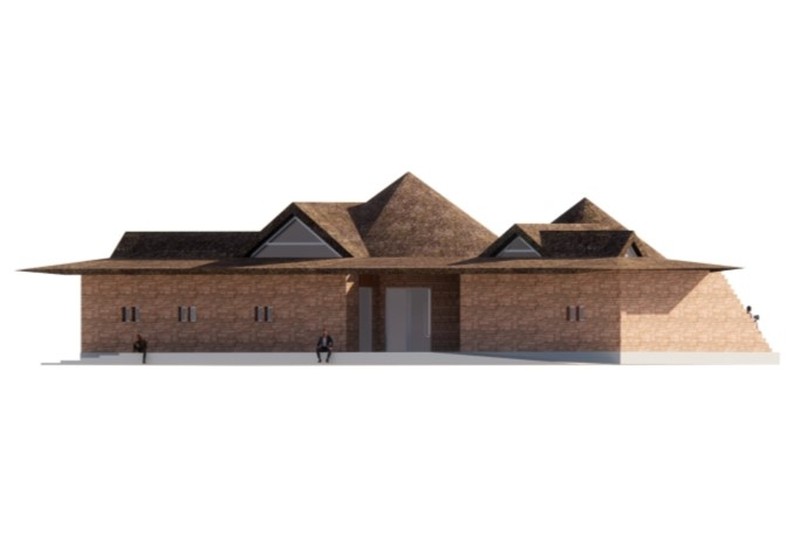
THOR Tanzania Human Origins Research – 2023
Thor is a Science Center to be built in Laetoli Archaeological Park, Tanzania, promoted by a consortium[10] of research founded by the Perugia School of Paleontology involving five Italian universities and several institutions in Tanzania, as well as the Ministry of Foreign Affairs[11]. There are pavilions in the park assigned to international missions, used for research, teaching, and storage activities.
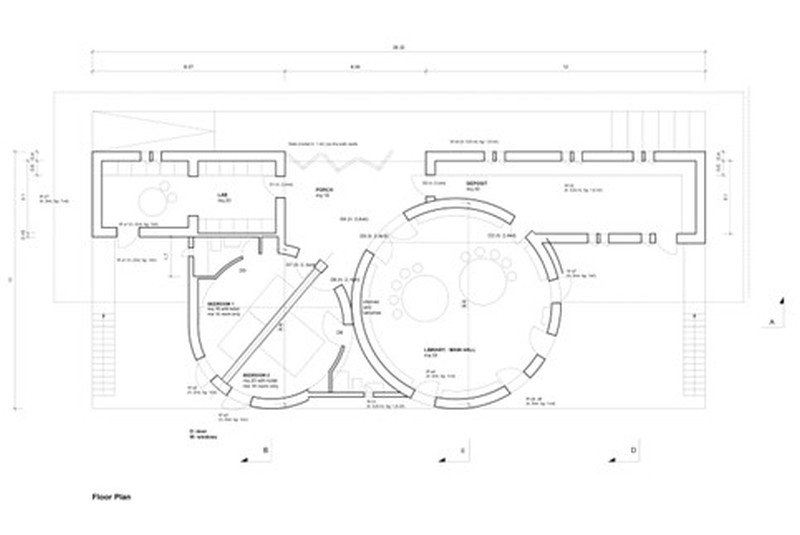
Laetoli Park management has set a peremptory condition: the new Science Park Thor must be “inspired” by local settlements and architecture (e.g., Maasai villages, etc.). The allotted lot, on which the new building should be constructed, has a corner overlooking the central gathering area of the camp, used as a kind of plaza. That of optimizing outdoor spaces as places for gathering and for outdoor activities (research, treatments, teaching), was a second design prompt expressed by the consortium. The requests would also correspond to long-term intentions of the park’s managers, who would seem to be oriented toward gradually replacing the buildings already constructed to implement what could be called a landscape renovation of the field, eliminating out-of-context buildings. Thus, the Thor center would be a test for a possible new type of model building, with a view to future replacements. The mission members’ requests included two bedrooms with bathrooms, a storage room, a dry technical room, and a large room intended for public events and education on whose walls a bookcase, displays, and shelves for temporary storage and display of artifacts could fit. The requests of the members of the mission included two bedrooms with bathroom, a storage room, a dry technical room, a large room intended for public events and teaching on whose walls there could be space for a bookcase, displays and shelves for archiving and the temporary display of the finds. The roofs are designed with a double-shell attic, which functions as an air chamber; they should be finished externally in straw, using a process, and finishing that is quite common in Tanzania and is also not unrelated to some oriental and northern European traditions (thatched roof). The roofs would also be accessible for inspections via two flights of stairs which delimit and indicate the perimeter of the lot, and which, among other things, allow the landscape to be seen. The external wall could be finished in local stone, with an internal counter wall and cavity to promote thermal efficiency.
The project was developed by conducting intermediate comparisons, especially for the functional aspects, with archaeological colleagues, who however interacted with interest and effectiveness also with respect to morphological and formal options submitted to them in the phase of setting up the initial project ideas. Furthermore, an intermediate version of the project was discussed with the director of the Laetoli park, an engineer with a doctorate in preservation and cultural heritage research, during a trip to Rome. The discussion with him, together with the archaeological managers, was fundamental to finalize the issues of technical feasibility and to define choices on the construction systems which led to the final draft of the documents sent for the cost estimate. The project idea, delivered to the park management by the Italian mission, in the form of a preliminary project, was then estimated locally. Last summer, the archaeological mission began raising funds for the creation of Thor.
Will the new Renaissances come from Africa?
In 2005, a conversation was held between Arnaldo Bruschi and Lucio Barbera, at the Department of History of Architecture of the Sapienza, in which Barbera intended to consult the great Roman historian and sensitive designer, in view of the organization of a possible conference on the identity of the Italian architecture. Bruschi’s opinion, going into the matter, was rather firm and paraphrased below: today it doesn’t make much sense to question the problem of the identity of Italian architecture, because it is very probable that the Renaissance will come from other places: Asia, Africa. What we know from history, Bruschi continued to explain, is that in some moments, in some places a koine forms and emerges: fifth-century Athens, Renaissance Italy, eighteenth-century France, nineteenth-century London, New York in the twentieth century. In Italy, in this historical phase, the political and economic conditions do not exist, Bruschi argued, almost proposing an anthropological interpretative key, for a new Renaissance to occur. It will be easier for some Italians to be called elsewhere in the coming years to contribute to other Renaissances, as happened to Leonardo and other artists, who in distant times traveled and applied their genius in other contexts.
Ideally continuing the reasoning of the Roman historian, we can add that it is difficult to predict whether in the future the success of some ways of doing architecture, such as the case of Francis Kéré and other good architects of all nationalities who have trained around the world , and that when they design they take into account the characteristics of the context, it will not depend so much on the emergence of a koinè specifically rooted in a place or if, as a result of global culture – now an irreversible reality – amplified by artificial communication (Esposito 2022), it will not be increasingly important renovate or preserve the specific identities of a cultural area, as Saverio Muratori would have said, and know how to read the reality of the architecture of cities, as Ludovico Quaroni would have said, and tell it and propose it again, albeit transfigured or re-imagined, according to renewed sensibilities.
Notes
[1] Read also M. González Pendás, Realism Under Construction: Manfredo Tafuri’s Other Road to Criticism, in Proceedings, Annual Meeting ACSA, 2011, pp. 11-20.
[2] D'Agostini (2013) – Realismo? Una questione controversa, Bollati Boringhieri 2013.
[3] Traces of this design activity can be found in the curricula, in the registers of works and in some publications (see Del Monaco 2021).
[4] “When Manfredo Tafuri was asked to write an essay on “Architecture and Realism,” he began his treatment of the theme by pointing out that “What I shall call here Realism ... is ... the fruit of a historic construction; (…) yet very real-debates about whether or not modern architecture lived up to the strict canons of socialist realism were, in any case, a bit casual, although entirely appropriate to the objects of his analysis, which, by and large, also coincide with the subject of this essay. Here, I will go no further than to indicate a few possible directions for study”. These interpretations are affected by the limited knowledge that even authoritative historians have of the early professional and study experiences of Tafuri and his Roman peers, in particular the AUA Architetti Urbanisti Associati Group (see L’ADC n. 20-21, 2021). Above all, for the fundamental idea of the social mission of Architecture.
[5] AUA Architetti Urbanisti Associati, “Architettura e Società. Problemi e prospettive attraverso uno studio della situazione romana” “Superfici”» n.5, aprile 1962, p.19. (Text signed by 8 of the 14 members of the group: Lucio Barbera, Sergio Bracco, Giorgio Piccinato, Vieri Quilici, Bernardo Rossi Doria, Stefano Ray, Manfredo Tafuri, Massimo Teodori).
[6] Mefit, was a design company founded by Riccardo Raciti, Vittorio Gigliotti, Paolo Portoghesi, very active in the Middle East and Africa during the Sixties; it won the competition and built the Mosque of Rome.
[7] The Faculty of Architecture “Ludovico Quaroni”, therefore, became the leader of an interdisciplinary research group in which it involved scholars from the Faculty of Economics, coordinated by the dean Attilio Celant (Economic Geography), Enrico Todisco (Demography), Francesca Gastaldi (Financial Sciences), Paolo Mellano (Cooperation and Development); the Faculty of Letters with Antonino Colajanni (Anthropology); the Faculty of Medicine with Maurizio Simmaco (Molecular Biology, with experience of hospital cooperation in Africa); the Faculty of Engineering with Eugenio Borgia and Alessandro Ranzo (Transport Engineering); the Faculty of Geology with Sirio Ciccacci. The group carried out between six and eight site visits in Sudan, collectively or in groups, official meetings with governments and local administration, developing maps, reports, plan schemes and training for groups of young local professionals selected by Mefit Sudan.
[8] The author discusses how self-construction can still be an essential possibility in some contexts, if reconsidered taking into account current knowledge and techniques, to resolve and regulate procedures that in any case occur spontaneously.
[9] Further details, including on the composition of the Mefit-Sudan working group in Khartoum, are published in (Del Monaco 2023).
[10] Sapienza University of Rome (Department of Environmental Biology, Giorgio Manzi), University of Perugia (Marco Cherin), University of Florence (Alessandro Riga), University of Pisa (Giovanni Boschian), University of Dar El Salam. The consortium also includes Italian Archaeological, Anthropological, Ethnographic Missions abroad MAECI.
[11] The writer, and therefore also the author of the project, was introduced to the aforementioned consortium by Professor Nicola Santopuoli, of the University of Bologna, who already collaborates with the same consortium for aspects concerning architectural restoration.
Bibliography
BARBERA L.V. (2023) – Scuola estiva 2023 - Città Future, 29 agosto - Città possibili. [online] Available at a: <https://www.youtube.com/watch?v=dpkBt-aSHGI&t=2401s>.
BARBERA L.V. (2014) – Foreword - The City in the Evolutionary Age. “L’architettura Delle città - The Journal of the Scientific Society Ludovico Quaroni”, (3-4-5).
BLOCK I. (2017) – Diébédo Francis Kéré says school that launched his career is “not a traditional African building”. Dezeen.
COHEN J-L. e ELEB M. (1998) – Casablanca. Myth and Architectural Ventures. The Monacelli Press 2002.
D'AGOSTINI F. (2013) – Realismo? Una questione controversa, Bollati Boringhieri Turin.
DEL MONACO A.I. (2021) – 1947-1991, Architetti italiani nel Mediterraneo. Istituzioni e Autori. Nuova Cultura, Conversazioni.
DEL MONACO A.I. (2023) – Urban majority: la soglia fra città e slum. L’esempio del Sudan, in M. Argenti, A.B. Menghini, F. Sarno. Do-it-Yourself / Do-it-Together. Architettura della cooperazione con l’Africa subsahariana, Edifir-Edizioni, Florence.
ESPOSITO E. (2022) – Comunicazione artificiale. Come gli algoritmi producono intelligenza sociale. Bocconi University Press.
FROEBENIUS L. (2013/1933) – Storia della civiltà africana. Adelphi, II Orientamento e realtà.
GODOLI E. (2008) – L’Orientalismo nell’Architettura Italiana tra Ottocento e Novecento. Maschietto Editore, 1999; GODOLI E., Architetti e ingegneri italiani in Egitto dal diciannovesimo al ventunesimo secolo. Maschietto Editore.
GODOLI E., GRAVAGNUOLO B. et alii (2008) – Risultati di una Ricerca PRIN 2005, Ezio, Godoli; Benedetto, Gravagnuolo; Giuliano, Gresleri; Ricci, Giuliana (a cura di), The Presence of Italian Architects in Mediterranean Countries, Maschietto editore.
HAMID G.M. e BAHRELDIN I.Z. (2014) – “Khartoum 2030 Towards An Environmentally-Sensitive Vision for the Development of Greater Khartoum, Sudan”. L’architettura delle città - The Journal of the Scientific Society Ludovico Quaroni, n. 3-4-5.
LEJEUNE J-F. (2019) – Built Utopias in the countryside: the rural and the modern in Franco’s Spain. TU Delf, Architecture and Built Environment.
MCLAREN B.L. (2005) – “The Architecture of Tourism in Italian Libya: The Creation of a Mediterranean Identity”. In: BEN-GHIAT e FULLER (edited by) Italian Colonialism. Italian and Italian American Studies. Palgrave Macmillan, New York.
PALLOTTINO E. (2019) – Filologia urbana in chiave ambientista: una prospettiva italiana nel primo quarto del Novecento. Gustavo Giovannoni e la teoria delle “espressioni semplici”. In: MOSCHINI e BONACCORSO (edited by), Gustavo Giovannoni e l’architetto integrale. Convegno internazionale, Accademia Nazionale di San Luca, p. 25.
REICHLIN B., SHUGAAR A. e BRANDEN W.J. (2001) – “Figures of Neorealism in Italian Architecture (Part1)”. Grey Room, n. 5.
SANTINI C. (2020) – “Comparing Aby Warburg and Leo Frobenius”. Journal of the History of Ideas, 10 august
TAFURI M. (1985) – “Architettura e realismo”. In: AA.VV, L’avventura delle idee nell’architettura: 1750-1980. Triennale di Milano, Palazzo della Triennale: Milan.
TECHLE MISGHINA B. (2015) – Asmara an Urban History. Nuova Cultura.