Anna Irene Del Monaco: In your curriculum vitae as an architect, as part of an intense professional activity that has taken place in the extended Mediterranean and in Africa since the mid-1960s, your experience in Togo around 1976 stands out. What was the occasion of the assignment? How did it unfold and how was the work in the field and from Rome set up?
Lucio Valerio Barbera: The events you refer to took place in the mid-1970s (1976-78). In those years I was a director of ProgReS - S.T.R. S.P.A, a planning company built around my resume, supported by a financial group specializing in construction and infrastructure design; a large engineering company, Technital S.p.a. of Verona, which is still active today, was part of that group, but it did not have specific architectural and urban planning expertise within it. But also, part of the same group was a company that dealt with economic planning, Technosynesis, headed by a valiant engineer, Giuliano Cannata, who often associated himself with us at ProgReS, depending on the assignments, and who used qualified consultants for his work because of consolidated experience, or young emerging personalities. Prominent among them in the mid-1970s was a young Neapolitan scholar, Enzo Caputo, of strong social sensitivity and undoubted intellectual audacity. He was a few years younger than me. He had married a young woman from the Sebregondi family about whom, at that time, some other young people roughly my age – I was then in my early forties – who were militating in alternative left-wing groups were better known.
Today referring to that era one would say they were revolutionaries, certainly extra-parliamentarians. Let’s say: they were very politically engaged intellectuals.
Or that “history” that lets not only politicians, strategists, leaders speak, but also myths, monuments, natural and human, their insoluble mystery, traditions, all placed on the same level, each worthy of attention because they are the fruit of human cares and fears and torment? Architects, we naturally hung for Herodotus, but the discussion did not have a conclusion; it lasted among us in the facts. Perhaps it still lasts. But we certainly began with the journey, understood as the supreme statement of ignorance and the will to knowledge – don’t laugh. Throughout our work we considered ourselves fortunate followers of Herodotus. Unworthy, incapable, untidy. Yes, you can laugh now. We can laugh together, come on.
AIDM: Ah, what are you saying, professor? As you were talking, I was reminded of the work of Leo Frobenius, the controversial and great German historian of African cultures; after all, in Italy his work had a “progressive” baptism; if I am not mistaken, his book “Monumenta Africana” was first published in Italy – in a very critical period, between 1943 and 1945 – by Nuove Edizioni Ivrea (by Adriano Olivetti, Luciano Foà and Bobi Bazlen). A publishing house that after the war, in 1946, was transformed into Edizioni Comunità. Frobenius, then, was a true emulator of Herodotus. We could say of him, Erodotus africanus. How many journeys did he undertake to learn about Africa? And how many books to illustrate, as you say, “its myths, its monuments, natural and human, its insoluble mystery”? It is the creative mystery of African civilizations – and of every true civilization – that Frobenius attributes not to a proceeding guided by nascent rationality toward superior human reason, but to a “dark and profound force” that he calls “moved knowledge,” paideuma. Ouch! Professor: you have set in motion the inexorable mechanism of my searches for coincidences. Now I was thinking of a phrase that Aby Warburg, the revolutionary German art critic, traced in his notes: “why does fate assign to creative man the spheres of eternal restlessness...?”
LVB: Frobenius, Erodotus Africanus you call him, I like that. Of course, in our – your and my – knowledge of Africa Frobenius has something to do with it; and how! Certainly, he will come forward on his own, in our dialogue. But now let us return with some order to the study and planning experience I had the opportunity to have with my group in Togo. For Togo. Let us be led by the hand, as we were then, by Enzo Caputo.
In the mid-1970s he had been chosen as a consultant – if I remember correctly – by a UN institution whose name I do not remember; and then – this seems certain to me – by the Directorate of Development Cooperation of the Italian Ministry of Foreign Affairs, which – according to its statutory purposes – had among its tasks, also that of promoting solidary but equal relations with African states, especially with those of more recent formation and weaker from the economic point of view. Togo was among them as a small and young independent country located in the middle of the northern coast of the Gulf of Guinea, on which Liberia, Côte d’Ivoire, Gana, Togo precisely, Benin, and Nigeria face each other in sequence from West to East. Enzo Caputo was supposed to liaise with the Togolese government and administrations by helping to outline the general directions of a development plan for the capital city of Lomé and its sea-facing province, the Maritime Province.
Enzo Caputo in that assignment represented, or called in the Technosynesis Study Society, which I have already mentioned. His initial consulting assignment was crucial, because it could have resulted in a full-fledged urban and land-use planning assignment for the Master Plan of Lomé, and, in prospect, of Togo’s other provincial capitals and their territory. For the time being, however, in order for Enzo Caputo’s commitment in Togo not to be in vain, it was necessary for the Italian study group that he officially represented and that scientifically supported his commitment, to produce development guidelines for Togo’s capital city; guidelines that were convincing, innovative and, above all, adapted to the fragilities of the economy and the specificities of the culture of a country that is not large, but very complex, such as Togo.
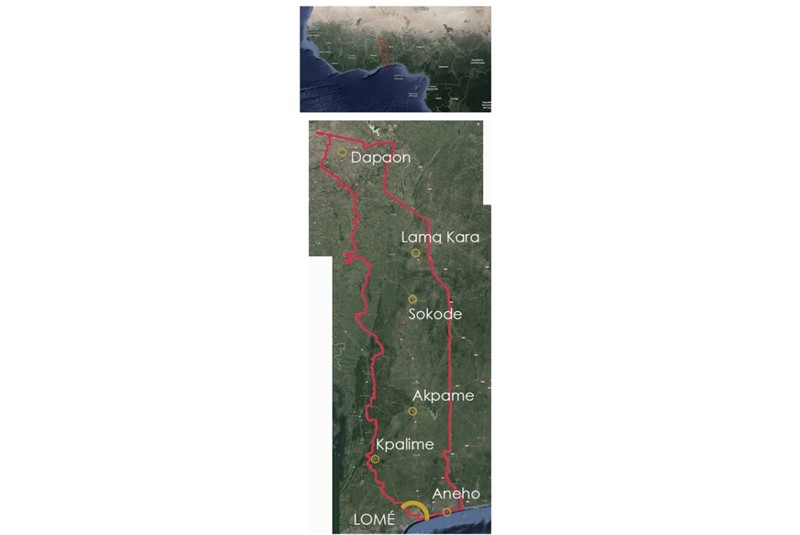
Togo, in fact, is a narrow strip of territory – width, on the East-West axis, averaging about eighty kilometers – maximum 130 – but more than 550 kilometers deep on the South-North axis. From the littoral palm groves of the coast, the territory of the Republic of Togo, pointing northward, penetrates all the climatic and ethnic belts that follow one another between the Ocean and the Sahel: from the coastal lagoon waters to the rainforest, to the savannah, almost at the edge of the semi-desert expanses that cross the continent from west to east. To study Togo by traversing it from south to north is, therefore, tantamount to drilling a “core drilling” – excuse the construction-site term – rather a “deep core drilling” representative of much of the characteristics of the vast African territory that stretches between the Atlantic and the Red Sea following, according to longitude, the southern edge of the Sahara, the Sahel, that is, that continental zone that by geographers, is also called Sudan, the great Sudan, far broader than the already very broad Nilotic state that takes this name . . and which we, you and I, unworthy followers of Herodotus, have been fortunate enough to know quite well....
But now back to Togo. The capital, Lomé, is on the sea, as are almost all the capitals in that part of the world, because from the sea the Europeans came, docked on the coast and immediately built their forts from which they ruled the requisitioning – we want to call it that – of natural goods and, above all, of men and women, of slaves. Local populations flocked around the European port and fort out of curiosity, interest or violent compulsion: Lagos, Porto Novo, Lomé, Accra, Abijian, from east to west, from Nigeria to Côte d’Ivoire, the major cities of the Guinean states lined the Atlantic coast insisting on colonialist port bases. Even Liberia’s capital, Monrovia, was founded on a Portuguese colonial base, Cabo Mesurado.
Lomé at the time of our work in Togo, had a population of about 300,000, but was growing at a rate of population increase that would bring it in about ten years to a million inhabitants in a country that had a couple of million in all at that time. Enzo Caputo’s initial assignment, obtained from Togo’s Ministry of Plan, if I remember correctly, was not to take an interest in the capital’s plan, but to help implement the 1976-80 five-year investment plan geared particularly to agricultural development. But I think Enzo Caputo understood well that without governing the massive growth of Lomé – which was draining the most fertile countryside of inhabitants – any development plan would be in vain. This realization, in my opinion, led him to emphasize to the local government – and perhaps to some international bodies – the need to immediately address the problem of the development of Togo’s capital and its region, perhaps the most interesting from the point of view of production and food, but also-in the future... perhaps-industrial.
Evidently, he convinced all the authorities; for the success of the city study he obtained from Technosynesis, the study company to which he was, or became, a permanent consultant, that he could “enlist” an architect-urbanist, whom he trusted.
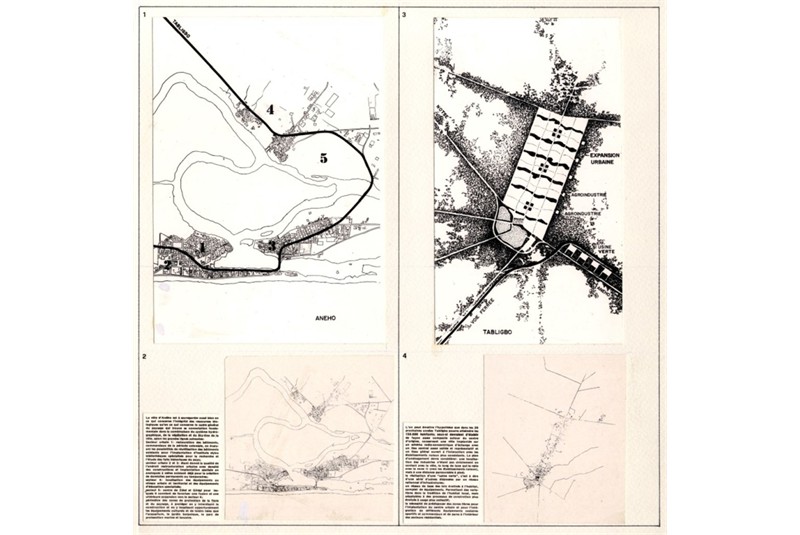
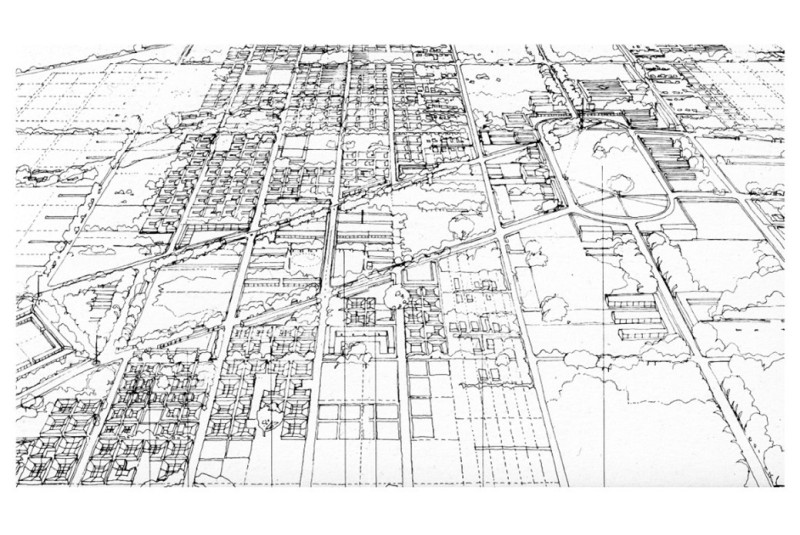
Techosynesis, as I told you, had no architects in its ranks. The work began with this hand-sketched drawing of mine (Fig. 1); it is a general idea sketched on one of the centers we were asked to study, Tabligbo, which was also subject to significant, though certainly minor, immigration from the innermost areas. The local government had been given a small but important budget with which to begin to do something about the masses arriving in the Maritime Region. Tabligbo, not far from Lomé was presented to us as an experimental sample. A classic Examination Theme, I would say. It was relatively easy to convince them of our idea: social housing was not to be built as it was then in France, or in Europe in general.
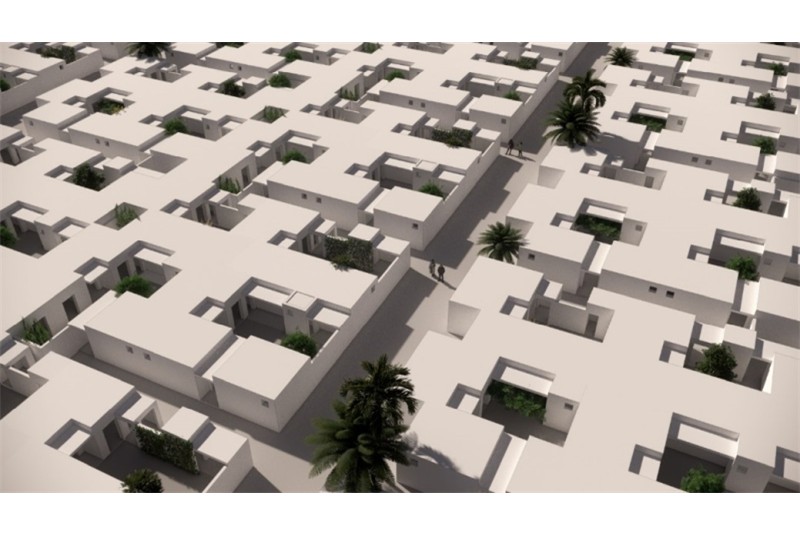
The limited affordability would have allowed only a few, very few families to be housed. Instead, if they had acquired vast land the land even in the Maritime Region (in those days it cost very little and there were still vast expanses of public land) and if they had then infrastructured it in an essential way (primarily a simple sewage system and drinking water distribution points), designed its settlement development simple, but complete and extendable over time, and, finally, had they helped the immigrants to self-build their dwellings according to their own uses, but with better materials and some more efficient techniques – especially for foundations and roofing – the initiative would have involved a large number of inhabitants, – the urban majority you would say quoting Abdoumaliq Simone – with significantly lower costs per dwelling. In addition, the new inhabitants, involved in defining their own living space, would have better overcome the impact of being uprooted from their place and relocated to an unfamiliar or completely unfamiliar environment.
In the Italian school of architecture, particularly in the Roman school, the direct participation of local cultures and knowledge in defining the living form of the city is still felt – I hope – as a fundamental need. After World War II, when the growth of cities had been accelerated not only by a rapid industrial upswing but also by migrations due to the dramatic outcome of wartime conflicts and brought with it harsh social conflicts, Giovannoni’s Environmntalism (Ambientismo) had already been grafted onto the social and cultural concern of Quaroni’s and De Carlo’s generation for respect for the identity roots of the communities to be settled or re-settled; an attention and respect that animated the basic and detailed choices of every project of those masters of ours and that today should return to dominate the thought and initiative of those of us architects who intend to deal with cities. And this is true by now – I am very convinced of this – not only for those who work in the less fortunate areas of the world, but also for those who work in areas like ours, which consider themselves more fortunate and stable, but which are nevertheless within the immense flow of changes that seem destined – by now – to inexorably overcome every boundary, even the most resistant. We see this every day.
But going back to Togo, Enzo Caputo, – on the basis of the working hypothesis I had drawn up with the ProgReS group for Tabligbo, a minor center in the Maritime region, accompanied by cost hypotheses for the necessary public interventions and a social and cultural approach of which Enzo Caputo himself had been the fundamental coordinator – was able to obtain not only the approval of our line as far as the Plan of the Maritime Region was concerned, but also the commission for the Master Plan of Lomé and of all the provincial capitals of Togo. So. basically ... we found ourselves planning ... all of Togo, from North to South, in all its different climatic, naturalistic, cultural situations.
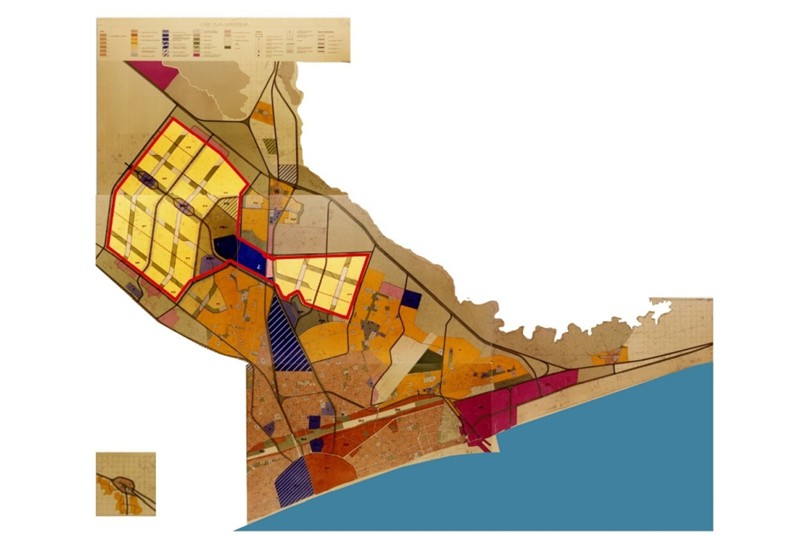
Lomé, considering its size, the speed of its growth and the fact that its actual urban body straddles the border between Togo and Ghana, represented, of course the most complex and articulated case. As always – as is also the case in Italy – I don’t think our plan has really been implemented. But looking on Google Maps at what has happened since then, I see that the growth of the city, at least in part, has happened according to what we had envisaged by convincing even the authorities – local and international – to choose the intervention program I have already told you about, based on effective, but very simple infrastructuring and substantial assistance to the self-building work of the new immigrants. We had soon realized that around Lomé, in the Northwest, there was a large expanse of public land, land requisitioned – in colonial times – to increase cocoa cultivation, but no longer – or never – used for this purpose. It was to be expected that most immigrants – most of the future urban majority you would say – would settle where there was great availability of public land, without having to bargain or clash with the interests of one or more local chiefs.
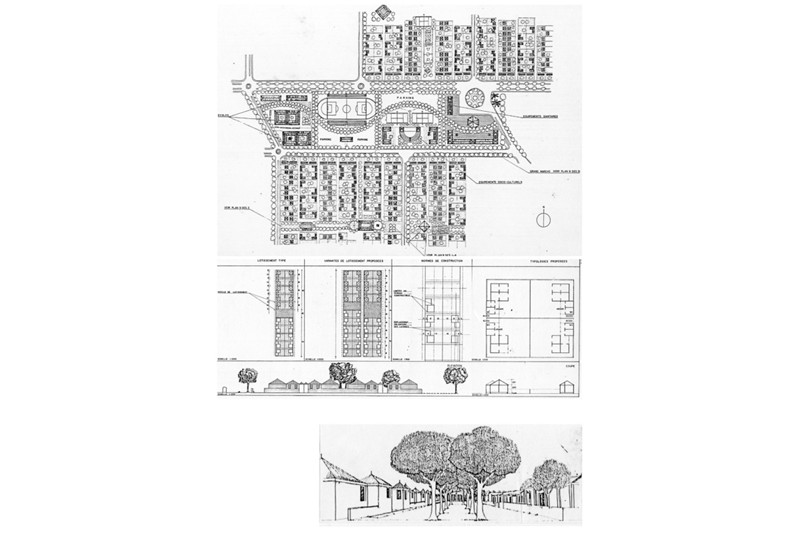
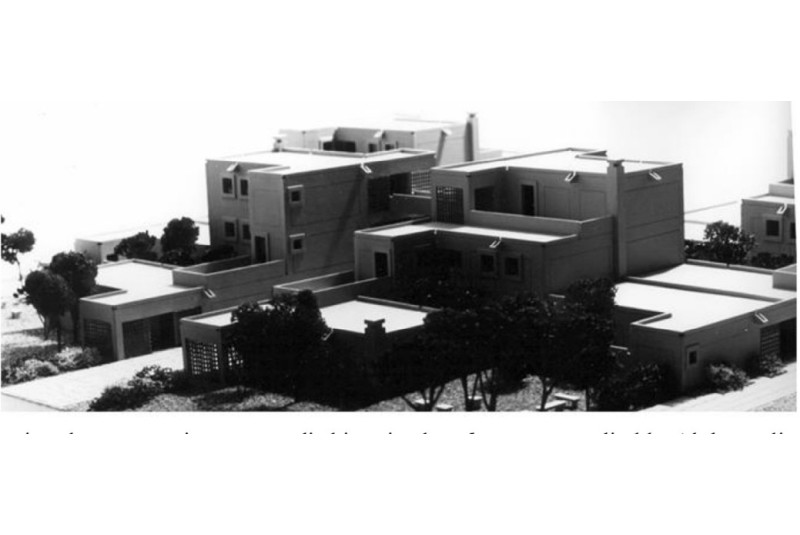
The essential infrastructure system of our Plan included a few roads, regularly spaced considering the average size of the courtyard-dwellings that represented the most common settlement type throughout the country. Essential sewer conduits were planned along the streets. Water was distributed by a system of fountains in public places regularly distributed throughout the settlement grid (as had been done in working-class neighborhoods in Morocco in the 1930s). But the most important part of the plan was the proposal to establish a technical assistance service for the future inhabitants, which would also provide them with building materials, especially those intended for an embryonic domestic plant system, and help them rationalize the traditional construction methods still the natural heritage of each group, each family. From the point of view of the footprint on the ground, this was a very simple settlement mesh (Fig. 3 a-b). This is a drawing by Luisa Anversa (Fig. 4), our regretted colleague and friend, also a student of Ludovico Quaroni, whom I involved in the work because of her valuable experience in the field of spontaneous typologies. Typological elements are hinted at in the drawing, but these are only to be understood as indications. The actual choices within each lot-courtyard-dwelling were left to the decisions and social culture of the new inhabitants-self-builders and the approach that the technical assistance protagonists would want to give to the new dwellings taking into account the needs of each group, ethnicity, community.
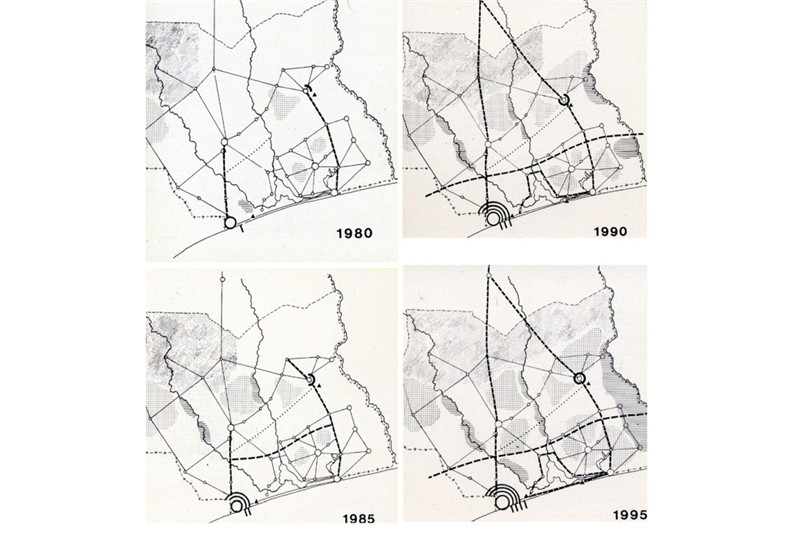
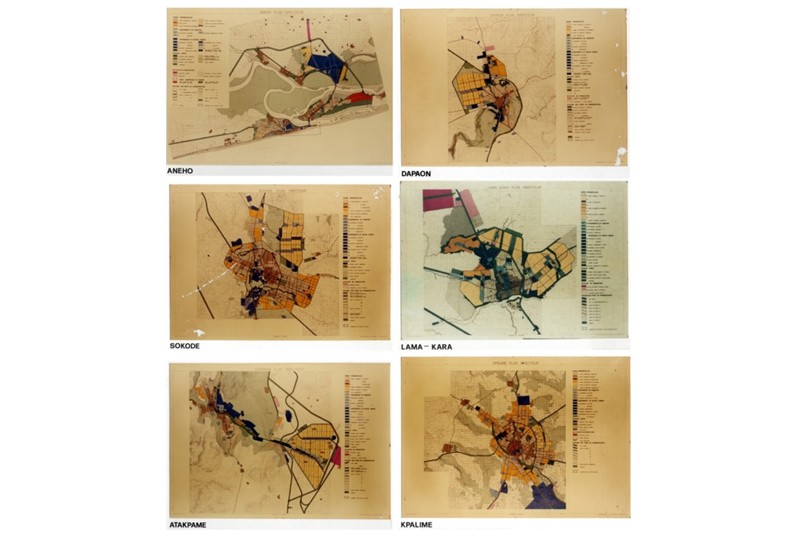
It was a job that involved us a lot; in addition to Lomé and the Maritime Region with its smaller centers, we studied and planned all the provincial capitals, as I already told you. As we went up from the Gulf of Guinea toward the Sahel, slowly but surely, everything changed. Along the sea, a large and thick coconut palm grove crowned the low dunes, defended against the sun and yielded precious fruit. In the outline of the Maritime Region Plan (which had 1990 as its maximum horizon for implementation) (Fig 2), one notices first the road parallel to the coast, linking Ghana to Benin, through the most beautiful and pleasant area of the former Slave Coast: the Togo coast, in fact. Along the beach under the very long palm groves stood palm leaf villages, fenced off, enclosed; the huts, inside were empty for much of the year. They were the villages of fishermen. On the coast of Guinea lived a special ethnic group of nomadic fishermen. In those days they traveled throughout the year the entire extent of the beaches of the Gulf of Guinea crossing almost all the states bordering the sea. They fish with a simple, manual system that is laborious and not very profitable, but of sure result: it is a system very similar to what on the southern coasts of Italy is called a Sciabica (African Saber). The fruit of the catch is collected on the beach, sorted by type of fish, and allocated in part to the local tribes, who in return keep the fishing villages under the palm groves intact during the months when the nomadic fishermen are absent. The part of the fish not ceded to the local kings is given to the women, who sort them further and either sun-dry them – the most efficient system was to lay them out on the asphalt of the roads – or smoke them over large, slow wood-burning braziers. With heavy baskets placed on their heads, finally, they transport it on foot or by poor means of transportation, northward... all the way to the farthest interior – all the way to the Sahel. It is an excellent fish. Protein, very good quality protein almost all the way to the Sahara.... On fishing days those beaches are a spectacle of crowds and fumes and colorful boats and resonant voices from everywhere. Sometimes large, unfortunate fish, giant stingrays that happened, despite themselves, to be in the nets of the African Saber (Sciabica), thrash about on the beach, dying, while excited children play at escaping from the sting of very poisonous ball-fish that some younger fisherman, laughing more than the children, pretend to throw at them.
But before the long and very crowded evening fish feast, more than once we followed the fishermen during fishing, which takes place from morning to late afternoon; divided into two teams they pull ashore the two ends of the large semicircular net cast out to sea early in the morning by means of long and heavy multi-oar boats hollowed out of large tree trunks. The pulling of the Sabre is done by two groups of athletic fishermen who begin without seeing each other; more than a kilometer of distance separates them; the net is very wide. But as the final sack of the net approaches the beach the two teams draw closer together until they meet to share the fruit of their common toil and participate, protagonists, in the evening feast. But during the fishing there is absolute calm and solitude all around. Only the beat of the ocean and the song of the fishermen, rhythmic as a submeasure of the beat of the sea, sounds. It is a two-step chant, as tight as the pulled and strong little passes with which, perfectly synchronized with each other, the fishermen slowly shorten the rope of the net and the lives of their unsuspecting and then desperate marine prey. When the tug gets harder, toward the end of the work, the rope is sinuously passed between two, three, four palm logs so that the friction of the wood brakes the rope itself in the moments – albeit necessary – of very brief catching of breath... Sorry, they seem like insignificant details. I told you. The work in Togo involved us greatly. Understanding a place, the people you work for – what I call the social principal – means not only studying the physical and human environment with the canonical tools and modalities of our profession, but also with direct experience of collective and domestic customs, family and public rituals, moments of celebration and mourning. I remember in Kpalimè – a minor town on the rainforest-covered mountain – a Sunday mass; the majority in that town was Catholic, the mass included the funeral of a person, I no longer remember whether man or woman. At the height of the funeral rite a sudden, unexpected explosion of trumpets, slide trombones and horns made our ears and the entire church vibrate with sound pressure; and under that ringing and bright blanket of modern brass, the collective singing – open vowels and clucks, rhythmic clapping of hands – and an irrepressible, perfect swaying of the hips, without any vanity, but with the awareness of all being part of a consonant community. Here: that collective strength, that cohesive trust in the expression of one’s own culture, strengthened – certainly not canceled – by the adoption of modern tools coming from a different culture, is perhaps not what we would like to see as a protagonist in self-construction – or rather: in self-determination – of the modern African city?
As I have already told you, the initial elaborations for the Maritime Region had produced a very convincing model which earned us not only the planning of the Lomè Plan, but almost simultaneously (I don’t remember the sequence of tasks) the planning of the whole of Togo.
The group, including architects-urban planners, geographers, economists and sociologists, was solid. Enzo Caputo represented it with great intelligence and ability to coordinate between the different disciplinary souls. The cities were very different from each other. The original layout of the city of Lomè was created by the Brazilian-Africans I have already told you about, who came to Togo when Lomè began its journey as a colonial capital (Fig. 5). The original layout of the other minor cities – sometimes very minor – included an interesting series of different origins: they were founded on small settlements, sometimes spontaneous, sometimes military – or rather, of territorial control – sometimes, in the North, as knot between two very ancient, traditional, historical itineraries I mean. And moving from one city to the other, from South to North, you went through the history of the ancient African cultures in the area.
For example: while in Lomè the Muslim quarter is very small, in Sokodè and Lama Kara, the main cities in the center of the country, everything changes; the Sokodè market, for example, sees together, in equivalent proportions, the Christian and animist part – managed mainly by laughing women, in bright clothes, uninhibited, rotund, loud, kindly mocking foreign visitors – and the Islamic part, managed exclusively by men in long white clothes, a turban, like cloth on the head, often a black beard, the slender figure of the nomadic shepherds of the Sahel with a hieratic and studied quality in the slow yet eloquent movements, the voice never too high.
Further north, urban life seemed to become rarefied, the settlements light and silent. In the thickets along the scarce waterways, you could see – without getting too close – the backs of small groups of elephants and you noticed the ambiguous, treacherous strolling of monitor lizards of the same lineage as those of the Nile. Under the Baobab trees, high termite nests. Light, silence. At that time everything seemed at peace. I cannot think about what is happening now in Africa, along the lines of what, as I was taught, I call “the great Sudan”. I do not want to think about it. We had a house in Lomè, large enough to also be used as an office. Domenico Menchilli, perhaps you have met him, is from Puglia like you, son of an important architect from Bari. He had a Californian wife. Domenico was our resident; an extraordinary architect, one of those rare ones, who instantly understands the place where he finds himself working and the people who live there, the natural language of things and architecture, therefore the culture of the environment that he wants to study. A younger, South African-Portuguese architect born in Joannesburg, Xico Meirelles, nephew of Giovanni Corsini, my Florentine architect friend, but born in Mozambique, went to help him; Xico is an African-European, therefore, who in Togo experienced the cultural complexity of Africa with the naturalness of someone who is already steeped in many cultures: the Italian one – the Corsini family of Florence – the Russian one – his grandmother, the Oulsufieff family of Moscow, – Portuguese – his father Meirelles. However, for the study of building materials available to self-builders, we were helped by a Neapolitan engineer who was passionate about the traditional construction systems of ancient African civilizations. He lived in Paris, scion of a family of builders whose company had built the Valtur tourist village in Capo Rizzuto that I had designed with Luisa Anversa and Claudio Maroni in the late Sixties. The company was called Caròla and his name was Fabrizio Caròla. We studied together the Nubian vaults already used by Hassan Fathi in his modern traditional villages in Egypt. I had already encountered those singular and highly intelligent vaulted structures in Nubia, but also in Morocco. I had noticed that in the north of Togo some communities used them, but in a very basic and not solid way.
Since the main problem of self-construction is always the covering of the house, with Fabrizio Caròla we developed a didactic method to teach how to build Nubian vaults also in the spontaneous neighborhoods of Southern Togo, where, moreover, people from the Savannah were now converging and the Sahel. Yes, Togo, for me, for all of us who participated, was an extraordinary experience; who then helped us in the work we did, with you, many years later in Sudan where, in the evening, Antonino Colajanni, our friend, our anthropologist, recited the Fairy Tales collected by Frobenius; to our delight. And here; …. the circle closes.
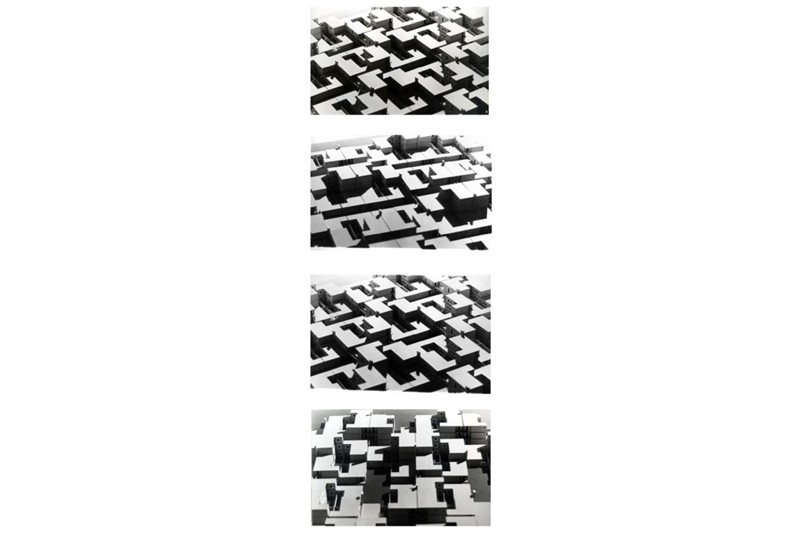
I smile at myself, of course. I reflected that ultimately – and you can confirm this for the work done together in Africa in other contexts – the line of research and design study that I have supported is always the same, as in Morocco (Fig. 6) as well as in Togo, in Sudan, Egypt, South Africa...: careful study and re-evaluation of traditional self-construction in order to be able to give life, with simple urban planning systems and refined and effective technical assistance, to cities suited to the actual needs of the people, who number in the millions people still well capable of making their home; cities, however, which are hygienically and infrastructurally equipped, albeit with the minimum of necessary interventions, but designed and executed professionally, modernly, by specialists. Certain! many talk about self-construction; but in reality we prefer to build, with public or private money, only buildings of traditional European or American modernity – very expensive – and the resources are certainly not enough for everyone. Most of the population of the cities (the urban majority to put it again with Abdumaliq Simone...) remains crowded in the oceans of shacks covered in corrugated iron without any infrastructure, any hygiene, any decency and none of the practical and cultural aspects of the housing tradition, which however still lives vigorously in the souls of the majority of new citizens, in their lifestyle habits.
AIDM: You must forgive me if I return to my arguments, but actually both Abdumaliq Simone and you, Professor Barbera, one from the point of view of the sociologist/urban geographer, the other of the architect, have consistently argued since the beginning of your career “in the field” this cultural and technical line. It’s certainly not something to scoff at. Instead, we should understand why the opposite tendency prevails. In his latest book Abdumaliq Simone argues that “practices for living with instability will be found in those places equipped with an infrastructure to move forward despite persistent marginalization. It is for these places that we must imagine the infrastructures to create livable spaces starting from less than ideal and less privileged circumstances.”
But before ending this conversation I would like to ask you something more. Nothing specific or technical; I would like to imagine better, if you like with greater possibility of involvement, the conditions of your work in those years in Togo. This is also a way to participate, isn’t it? The question that pushes me – don’t laugh – is this: how did you get from Italy to Togo in those years. When we worked together in Sudan, more than thirty years later, we went to Frankfurt and then reached Khartoum with a direct flight...
LVB: Ah well. Thirty years earlier, for those who wanted to go to Togo, the conditions were not very different. Maybe a little more uncomfortable, but not much different. To get to Lomè, you usually went to London and took a direct flight to Accra – the capital of Ghana – and then, once you landed, you reached Togo by driving all night. Or we passed through Paris after booking the rare flight to Lomè. In that case we stopped for a few days in the French capital, met Fabrizio Caròla – who lived in the French capital – we discussed his and our research, and then we left for Togo. Every time I visited Togo I crossed the whole country again and again, making increasingly more aware and targeted inspections of all the cities. Domenico Minchilli and Xico Meirelles, the residents, moved around depending on their needs and the stage of the study they had reached: I joined them where they were. We had a couple of cars in Togo, Russian Fiat 124 brand, built in Togliattigrad. They were indestructible cars and cost very little. Fiat made a series of them for Africa, “tropicalized” cars, they said, with a particular and very effective oil cooling system. They were really solid machines, with which you traveled along difficult tracks, trying to run in balance on the famous and very annoying corrugated pavement (pavé ondulé) that the passage of heavy trucks creates on the African dirt roads, making them similar to an infinite sequence of small parallel and hard waves, on which you can drive without subjecting the car’s shock absorbers to an endless series of stresses by simply reaching a speed that allows the car’s wheels to pass from one crest of the small waves to another without ever falling into the – equally infinite – valleys that divide them. Ours was always truly an interesting job, one of those jobs made up of multiple life experiences and opportunities for practical learning as well as professional experimentation...intellectual – can I say it? It was essentially – I repeat – a period... of peace. We knew we had the privilege of attempting to understand – by working for them – vast territories and singular places, regions that overlooked large continental sectors and provinces as pieces of marked individuality of the great cultural mosaic that is Africa. It was tiring, but it was also a pleasant way to work.
In Lomè there was a westernized multi-ethnic community still dominated by French customs. In the evening, baked foods were cooked outdoors in the gardens of old colonial homes transformed into resorts, not very luxurious – fortunately – but comfortable. We often bathed in the ocean, although the sea was not pleasant for us Mediterraneans. But we were also hosted in the traditional villages of the coast and inland, where the main dinner of the day was served under a canopy of branches in the centre. of the village with a series of simple convivial rites served, however, with Bordeaux wine. This was followed by pantomimes that recounted the vicissitudes of the village to the sound of the drum, a community pushed on a long odyssey towards the South, towards Lomè, periodically but inexorably expelled from the places where it tried to put down roots. The main dish, in those hospitable villages, was stewed mouse. A big field mouse. They called it, in English, Grass-cutter. Very good, red, tender meat. They hunted it with long single-shot rifles and sold it, hanging by its tail, along the streets. More than a few times we spent whole days watching a family build their first peri-urban accommodation – don’t laugh – helped by the most experienced people in the village. We took photos and notes. We spoke with the builders, the self-builders I mean, we tried to understand...
Even in the most remote savannah, the concrete block vibrated with the almost portable machines of Rosacometta, the famous Italian factory of machines for forming concrete products, began to spread. Years later, I also found Rosacometta machines in the Galapagos Islands... But Adobe, the mixture of earth, sand and straw, the same one used five thousand years ago in the Euphrates plain, resisted and still provided the majority of large blocks with which the walls of houses were now built even in the South rich in palm trees... it was a school, a real school for us architects... it certainly was for me.