Reviving the memory of historical facts for the new generations is
certainly one of the journal's missions which comes along with a second
task, just as important: turning historical experiences into triggers
for design.
We might well ask what sense it makes today to dwell on settlement
models alternative to the city. In fact, such question underpins the
present issue edited by Cristina Pallini, dense with outstanding
examples of urban and territorial schemes, building types,
architectural and figurative conceptions from a broad international
context. In reality, this issue stems from research undertaken (and
experience gained) during the EU-funded MODSCAPES project (Modernist
Reinventions of the Rural Landscape), addressing a special category of
rural areas, those subject to large-scale agricultural modernization
schemes implemented throughout the 20th century in various
socio-political contexts in Europe.
Concentrated as we are on cities and related urban regeneration
projects — also on account of the ongoing National Recovery and
Resilience Plan (PNRR) — we are running the risk to overlook what
happens extramoenia. Small-scale interventions have replaced the
broader picture as if urban regeneration may suffice to face the
overall challenge. Yet, a comprehensive idea of the city may still
prove fundamental to overcome the fragmentation of single
interventions, restoring the individual parts to the urban whole, in
its architectural composition.
Currently, the periphery is prioritized as an area of intervention,
particularly concerning the design of new schools (New Schools, Schools
4.0). As if trapped in the urban palimpsest, we are leaving aside the
countryside, the actual space in-between cities, where small hamlets
and villages, many of which abandoned, punctuate uncultivated areas;
this in-between space appears somehow uncharted: hic sunt leones they
used to say in Latin.
The policy on “Enhancement of Architecture and Rural
Landscape” aims at preserving rural and historical landscapes
through the protection of material and immaterial cultural assets, also
by promoting sustainable tourism-related activities based on local
traditions. This, however, does not serve much purpose. In fact, future
challenges — such as migratory movements, demographic shifts, and
climate change — concern both the urban and rural levels, as
clarified by EU documents addressing the liveability and attractiveness
of rural life as a mandatory field of action. Particularly so
vis-à-vis the recent news about natural disasters threatening
our territories, be it floods or inundations, landslides or landslips,
earthquakes, or fires.
This is really the time to explore (and some are doing it already)
difficult-to-reach Alpine and Apennine regions, now almost abandoned by
the younger generations. Problems such as these call us into question
— as architects, planners, scholars — urging us to move
beyond self-referential attitudes and gestures, gaining instead a
thorough understanding of the relationship between identity features,
future scenarios, and desirable transformations. Such a global approach
requires a full awareness, and a frame of knowledge ranging from
engineering to social studies.
History teaches us that, after the year 1000, city and country competed
for the supremacy of urbanism. In history, prosperity and crises on
either side cyclically followed each other, with consequent migratory
flows in both directions.
Although later than cities, whose evolution catalysed a massive
concentration of studies, the rural landscape also underwent profound
change, a transformation that deserves due consideration also by
architects.
We should move beyond landscape conservation or enhancement, as if
landscapes were to considered mere tourism destinations as proposed by
the authors of the PNRR. Just as we criticize the museumization of
cities, we should equally stigmatise the crystallisation of rural
landscapes, in full awareness that no evolution comes without
transformation (possibly in line with environmental compatibility
criteria).
Perhaps we cannot speak of a true 'agricultural revolution' (a concept
of Marxist origin), nevertheless we must recognise that a return to the
countryside could also benefit from technological developments applied
to agricultural production, so much so that we commonly speak of
Agriculture 4.0 or Precision Agriculture, regenerative agriculture,
etc.
The Covid-19 pandemic triggered a renewed interest in rural life,
closer to nature, along with a revival of settlements (hamlets,
villages) unlocking the possibility of further reflection about life
outside the city, as it has not happened for a long time.
Habitats and environments bearing witness to the life of past societies
may become part of future collective projections, challenging
architecture to meet functional, social and economic needs, as well as
empowering the cultural dimension, hence a coherent spatial syntax and
formal expression. In today's Europe, these same regions can offer us a
clear source of inspiration for long-term strategies aimed at
increasing the overall quality of the living environment.
Along this line of thoughts, the case studies included in this issue of
FAM offer a shared cultural heritage, often largely underestimated,
that today represents tangible evidence of recent European history
where the role of architectural design became decisive in the
definition of the “anthropic space”, in bringing into fucus
design problems often overlooked. Some examples represent crucial
settlement experiments that, ever since, have constituted a common
challenge for the ideas and tools of architects and engineers,
agronomists and social scientists, planners and landscape architects.
Here then, the example of an extraordinary season of modern
architecture in dealing with agricultural land and its functional,
architectural, and figurative needs appears as a valuable guide for the
revival of a fundamental dualism onto which the evolution of the world
has always been based.
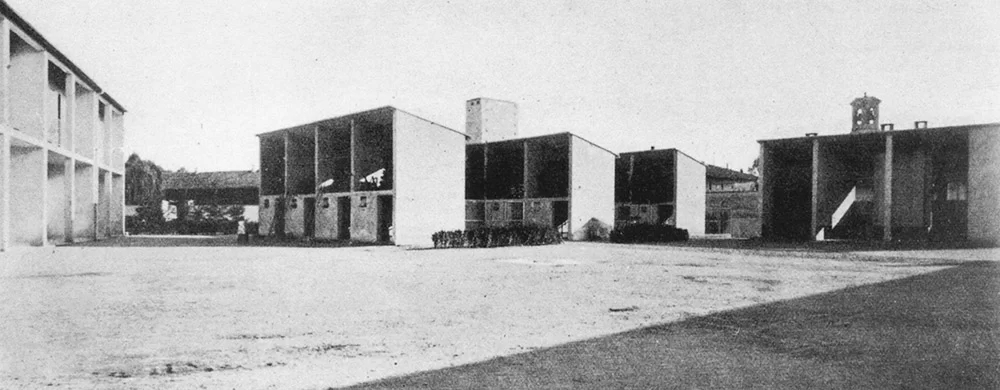
Mario Asnago and Claudio Vender, Complex of farmhouses in Torrevecchia Pia, 1937