Introduction
Geographical categories, defined as ‘Western’ and ‘non-Western’, have often been used as indicators of exclusion in architectural writing. Indeed, African architecture has centuries of tradition, although it did not gain prominence until recent decades. Slowly but surely, the Sub-Saharan architectural style proved its uniqueness in the face of Eurocentrism and architectural discrimination of some European schools of thought, especially before the Second World War.
There are many historical and cultural problems, such as the crisis of the ideology of progress after the Great Depression, the questioning of European culture during the Second World War, the doubts about the meaning of the Athens Charter of 1933, the creation of Team X and the new interest of the Modern Movement in nature and landscape, among many others. All of them represented a turning point in the usual procedure of South African modern architecture, typical of the International Style, leading its protagonists to revise that modernity and put it into crisis.
The New Modernity: Crisis of the Modern Movement in Sub-Saharan Africa
Modern architecture in Sub-Saharan Africa was born in colonial times and must be understood as a means to represent power, the continuation of colonial imperialism after independence or as the cultural supremacy of the other, represented by the permanence of the Western world in Africa. In many cases, the African city has been built without regard for historical pre-colonial urban identities and focused on modernity as a continuation of the colonial legacy. Despite the fact that the anti-imperialist narrative has extensively criticized this survival, the truth is that today the urban landscape of the African continent could not be understood without the contribution and imposition of Western architecture (Coquery and Vidrovitch 2005). In parallel, there is also a socio-economic reality in Sub-Saharan Africa that consists of the permanent existence of a constant migratory flow, especially from the rural to the urban context, due to the lack of necessities such as food and sanitation and the need to obtain decent housing (Kultermann 1969), a situation that is exponentially aggravated by the demographic increase. Ultimately, the growth of urban centers due to agglomeration generates global food, health and housing emergency.
The Modern Movement was clearly necessary to break away from the academic and archaic architecture of the 19th century. Its existence enabled the technological evolution and paradigm shift that the world needed to carry on the Industrial Revolution. Subsequently, the lack of regional architecture of each territory began to be perceived, considering that the International Style promulgated normative and abstract architecture that had to reach everywhere. This abstraction, initially necessary to break with any autarchic past, found its weak point a few years later due to the lack of respect for the own, indigenous, traditional and vernacular cultures of the various existing interstices.
In the face of this reality, concern for the revaluation of the indigenous languages of one’s own territories might seem secondary. Indeed, it is essential to be able to recognize an identity, as it is a heritage that pushes governments to value their resources by promoting low-cost types of construction that respect the pre-colonial past and the identity and memory of the people. Anyway, against the megalomaniac architectures built by western powers, whose only goal was the domination in Sub-Saharan territory and the need to prove western supremacy to the natives, there is an alternative path.
Pagano was already investigating indigenous folk architecture in the 1930s, during the International Style boom, or Le Corbusier himself when he realized, on board the Patris II during the IV CIAM in 1933, the wonderful value of vernacular architecture, or when he admired traditional African architecture (Le Roux 2004). Even Aalto put into practice this new positioning, which is nothing other than the reinterpretation in a modern key of the traditional languages of the different regions of the territories, while respecting, nonetheless, the emancipatory postulates that the Modern Movement allowed. Several European architects perceived the Modern Movement’s lack of humanity and considered indispensable its overcoming for the smooth progress of architecture’s future. Team X architects interpreted traditional African architecture and used its principles in their critique of contemporary architectural and urban design, identifying several alternative models that architects could choose for the building environment (Dainese 2015). Rudofsky’s magnum opus Architecture without Architects (1964) is also decisive, where the architect explicitly defends the values of African architecture when questioning the universal consideration of world civilization.
Critical Regionalism in Sub-Saharan Africa
Critical Regionalism is an approach to architecture that strives to counter the placelessness and lack of identity of the International Style, but also rejects the extravagant individualism and ornamentation of postmodernism. Consequently, African vernacular architecture is redefined to become modern, using a wide variety of materials in today’s use and with the aim of preserving historical identity. It must be understood as an attitude whose focus is on creating a bridge between tradition and modernity. However, this modernity cannot stop the permanence of local tradition as it would mean the disappearance of identities (Frampton 1983).
Sub-Saharan critical regionalist architecture is defined by its multicultural history, a term that runs through any historical and cultural narrative in this region. Here, architecture is a mix of vernacular building traditions and techniques, revised modernity and new technologies.
According to Manuel Herz, curator of the exhibition African Modernism – Architecture of Independence (2015), held at the Vitra Design Museum in Weil am Rhein, Germany, these constructions followed colonial models and, for the most part, failed to capture the desires or identities of the majority of Africans[1]. Constructive uprooting is one of the elements that ended with International Style. One of the pillars of Sub-Saharan Critical Regionalism is its ability to modernize local tradition using local materials that greatly reduce production costs, while at the same time freeing architecture from the inertia of colonialism on the continent.
Indeed, African architecture is a conglomerate of styles and forms, residing in the houses themselves and in the culture of their inhabitants. Construction techniques vary from area to area because what works in one place may not work in another. In Africa, for example, there are adobe houses covered with straw, a highly impermeable material that also allows air to pass through. There are also square or rectangular houses with sloping roofs in wet areas and with flat terraces in dry areas. Others overlook an internal patio. Some are built on rock. Sometimes they are circular, beehive or cone-shaped (W. Hull 1976). Vernacular architecture is very practical and adapts to each region, its climate and the needs of its people. In terms of materials, the most commonly used are, as already mentioned, clay – cheap, ecological and easy to obtain- and adobe – a mass of mud mixed with straw which, moulded into bricks and air-dried, is used in walls –, but there is also wood, rammed earth and even cocoa which, in areas where it is cultivated, is used to waterproof houses and repel insects (Fathy 1986).
In this type of architecture, nine broad categories of room structures can be identified: beehive-shaped, cone in a cylinder, cone at the poles, covered gable, pyramidal cone, rectangle with rounded roof and sloping at the ends, square, domed or flat brick roof, quadrangular around an open patio, cone on the ground (W. Hull 1976). This tradition is based on the sustainable relationship communities that have with their environment, where natural materials are compatible with the environment, facilitate indoor air circulation, are self-insulated and create a great symbiosis with nature. These materials have an impact on the aesthetics of space, as its natural colour scheme creates a decorative effect, ranging from lighter beige to red or even black.
The architects of Sub-Saharan Critical Regionalism
In the African context, after the Second World War, this vernacular architecture became the basis for the work of a new generation of professionals who, in the wake of the crisis of the Modern Movement, sought to define the identity of African architecture. It also demonstrates that through design, it is possible to change people’s lives for the better by incorporating forms into their local building projects, the result of which is economically and environmentally sustainable.
Through European cultural uprooting, these architects enhance their ability to modernize local tradition, compared to other professional colleagues who build with far more resources. It also served to break with the inertia of colonialism on the continent and encourage future generations to stop copying modern European architecture.
Young architects began to promote the study of traditional African architecture as an antidote to the ‘heroic’ attitude of modern architecture, seeking new ideas outside the traditional boundaries of the architectural discipline. In addition to the architecture of Henri Chomette (Touré 2002), probably the best-known architect of the New Modernity in Africa, there are lesser-known architects who, unlike their Western-influenced counterparts, do not adopt a Eurocentric perspective when building in Africa, but integrate local elements into their designs. The designs that are considered most representative of this critical positioning of architectural modernity in the Sub-Saharan context are exemplified below.
Demas Nwoko (1935), Nigeria
Nigerian-born artist, designer and architect Demas Nwoko received the Golden Lion for Lifetime Achievement at the 2023 Venice Architecture Biennale, entitled The Laboratory of the Future. Demas Nwoko is a Nigerian-born artist, designer and master builder at the forefront of the Nigerian modern art movement. Through his works, he strives to incorporate and articulate African themes and modern techniques in architecture and scenography. His versatile works span media and disciplines, including architecture, sculpture, design, literature, criticism, scenography and history.
Son of Obi (King) Nwoko II, Prince Demas Nwoko was born in 1935 in Idumuje Ugboko, Nigeria. There, Nwoko took inspiration from the city’s newly built residences and the palace building of Obi, her grandfather, who designed the palace. He studied at the Nigerian College of Arts, Sciences and Technology in Zaria between 1957 and 1961, where he became a founding member of the Zaria Art Society. The group, also known as “Zaria Rebels”, promoted the idea of natural synthesis, a concept developed by artist Uche Okeke. The concept was intended to bridge the gap between the Western training of artists by colonial educators and their African origin, centred on traditional themes and narratives. The Zaria rebels contributed to the postcolonial modernist avant-garde movement in Nigeria in the early 1960s (Prucnal and Ogunsote 2016).
Nwoko later established New Culture Studios in Ibadan, a training centre for the performing arts and design programme. The impact of his work lies in his desire to synthesize Western influences with authentic, traditional African practices. His architecture demonstrates these interests. Its buildings, while relatively few, demonstrate a resource-conscious and sustainable approach, incorporating culturally authentic forms of expression.
This deep desire to mix and synthesize, rather than sweep, has characterized Nwoko’s work for more than five decades. He was one of the first Nigerian creators of spaces and forms to criticize Nigeria’s dependence on the West for the importation of materials and goods, as well as ideas, and remained compromised in the use of local resources.
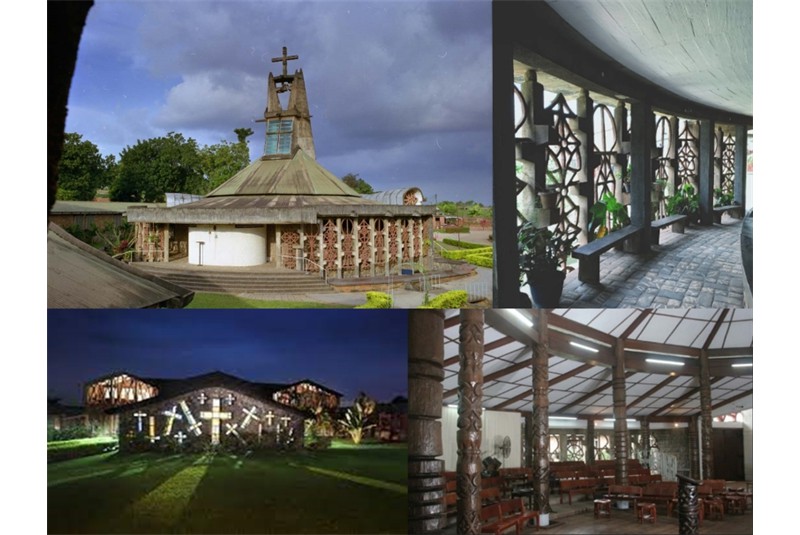
His works are a precursor of sustainable, resource-conscious and culturally authentic forms of expression that are crossing the African continent – and the world – and point to the future. The Dominican Institute was his first major architectural project. In the Dominican Chapel, a semicircle emphasizes the transition and movement in the complex and there is also a central axis with entrance doors and in the main sector two natural pools showing the central entrance of the building. The morphology of the building aims to be a modern interpretation of the basic constructions of African vernacular architecture. In this work the artist combines sculptural elements and modernity with a Nigerian vernacular architectural style. The structure incorporates features such as wooden columns carved with traditional designs and elaborate metal work on the balustrades and doors. The main facade alternates clay drawings that reinterpret the traditional aesthetics of the place (Dele 2007).
Anthony Almeida (1921-2019), Tanzania
Son of Indian immigrants from Goa, Anthony Almeida was born and raised in the city of Dar es Salaam (Tanzania). He subsequently went to India to study Architecture at the prestigious Sir J.J School of Architecture in Mumbai, where he met the work of important figures of the Modern Movement such as Le Corbusier, Wright and Aalto, all of whom would have a decisive influence on his architectural career. After completing his studies in 1948, Almeida returned to his hometown, where a few years later he opened his own architecture studio.
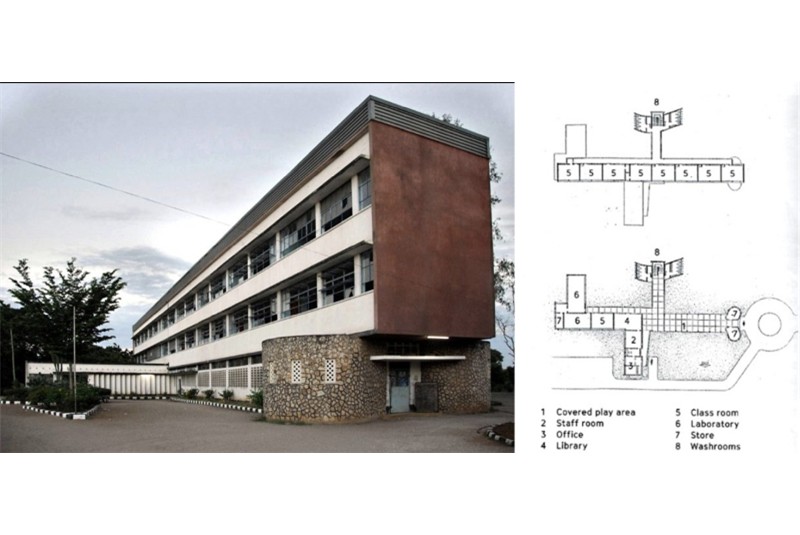
His first major commission did not come until 1955, when the Indian community of Dar es Salaam invited him to design a primary school for 500 students. At that time, Tanzania was still a very conservative colony. His design was considered by British officials to be too modern, although it was eventually approved and built. The project has transformed into a reference, where climate and rationality define the forms, with elevated classrooms supported by structural columns and a palette of discreet materials.
Its layout solution – with a service volume separate from the main building – led the British authorities compare the school to an airplane. It is a simple building, where it uses modern materials to offer a free plant, leaving the protagonism to the delicate finishes of the African tradition. It can be seen in the curved structure of the entrance, made of stones with lattice windows, and in the lattices of the ground floor facade, which allow fluid natural ventilation.
Lastly, the cladding of the side facades stands out, recalling the colours of the mud buildings typical of African popular architecture.
Beda Amuli, Tanzania
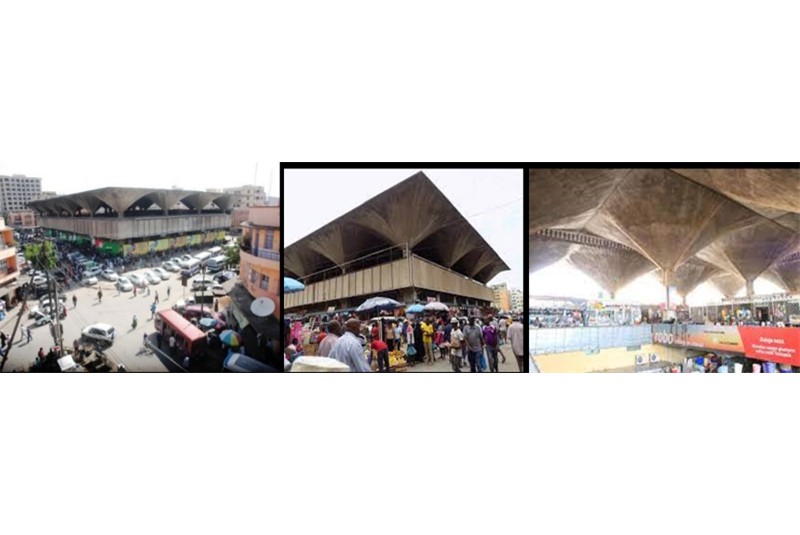
In the 1970s, Beda Amuli, became notable for being the first black African to open an architectural practice in an East African country. Amuli studied architecture at the Israel Institute of Technology, returning to Tanzania to open his own studio in 1970. Probably the most iconic of his projects is the Kariakoo Market, designed and built in 1973. Brutalist in style, the market was designed as a large clearing protected by “exposed concrete trees”. Taking inspiration from the nature and landscape of Tanzania, Amuli’s biggest challenge in this project was to translate the structure of a tree into concrete. With a total area of approximately 540 square meters, the Kariakoo Market is defined by a grid of 4 by 6 monumental concrete pillars, which expand in the shape of an inverted umbrella 15 by 15 meters wide, the “trees” from the African market.
Under the constructed topography of the roof, the market space develops on different levels: loading and unloading of goods, as well as product storage spaces take place in the basement, the coolest place; the commercial spaces, however, occupy the two upper floors which connect directly with the adjacent public space. Connecting all levels of the market, the central staircase also collaborates with the building’s natural ventilation system. This works primarily through a chimney effect, enhanced by the distance between the tops of the concrete “trees” designed by the architect. Furthermore, these magnificent and sculptural structures also serve to capture rainwater, which is filtered, stored and then reused in the market. The iconic building is an established urban landmark, a point of reference for residents and the vibrant city life of Dar es Salaam.
Pancho Guedes (1925-2015), Mozambique
Born in Lisbon in 1925, he moved with his family to the Portuguese territory of Mozambique at the age of 7. He studied in Sao Tome and Principe, Guinea, Lisbon, Lourenço Marques (now Maputo), Johannesburg and Porto. Guedes was part of Team 10. In addition to his major architectural projects, he was a sculptor and painter. After the Revolução dos Cravos in Lisbon, he left the colony practically independent. Mozambique’s independence was established in 1975 and was officially called the People’s Republic of Mozambique.
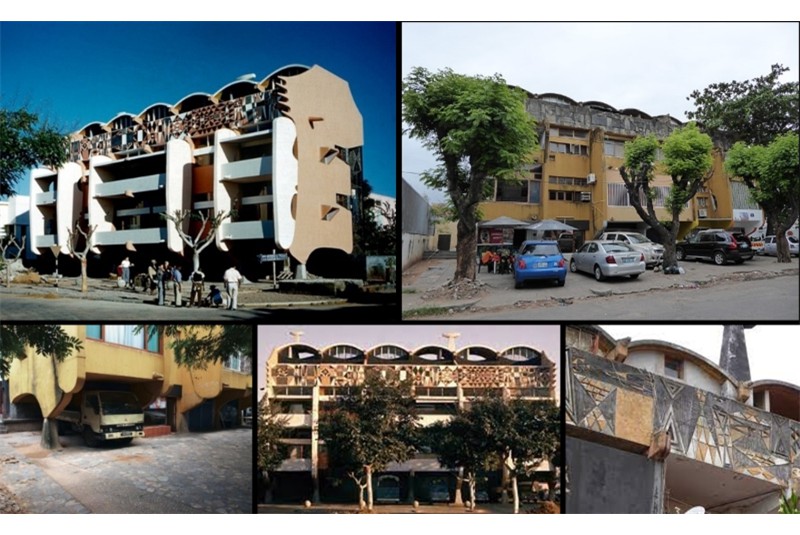
A Leão que Ri (1954-1958), his most famous building, located in Maputo, combines his desire to create with surrealism and expressionism an African modernity. It is a sculptural ambition with its ability to transform dreams and visions into space. It is a residential building, with a gallery at the back and with three apartments for plants, suspended above the ground and creating a sculptural modelling (AA.VV. 2011).
Located in a residential area on the corner of Kwame Nkrumah and Salvador Allende Avenue, the building consists of 6 apartments open to the city and with 6 parking slots. The seven pillars rest on seven sculpted bases approximately 1.20 m high and covered with mosaics of limestone pebbles.
The 6 apartments are located on the first and second floors, the main facade of which is oriented to the North-West, and the vertical accesses and the horizontal gallery are located on the South-East facade. Both vertical accesses are at the ends of each gallery. At the north-east end there is the service staircase, which goes up to the third floor protected by walls, where curved surfaces are sculpted. At the south-west end the main open staircase goes up to the second floor and connects the two wide access balconies. The third floor is delimited by two long bas-relief murals, which hide the terraces and the uncovered accesses to the domestic staff lodgings. Here we find toilets and showers, washing machines and clotheslines.
The roof is defined by 6 vaults that rest on the bas-relief murals. The mural is like that of the Palazzo Tonelli (1957-1968), and the sculptural design of the upper summit of the side facades reminds us the African combs and of the Palazzo Prometeo (1951-1953). The main facade consists of three sets of double balconies delimited by structural planes that organize the interior of the apartment. These sculptural walls touch the sculpted bases through an expressionist design of the pillars. The building owes its name to the lion that stands at the entrance on top of a cube which, as the author recalls, was sculpted by himself and Gonçalves, an African bricklayer from Inhambane. Nowadays, the ground floor is partially occupied with commercial premises and garages, and the balconies of the main façade are closed with railings.
Michael Tedros (1921-2012), Ethiopia
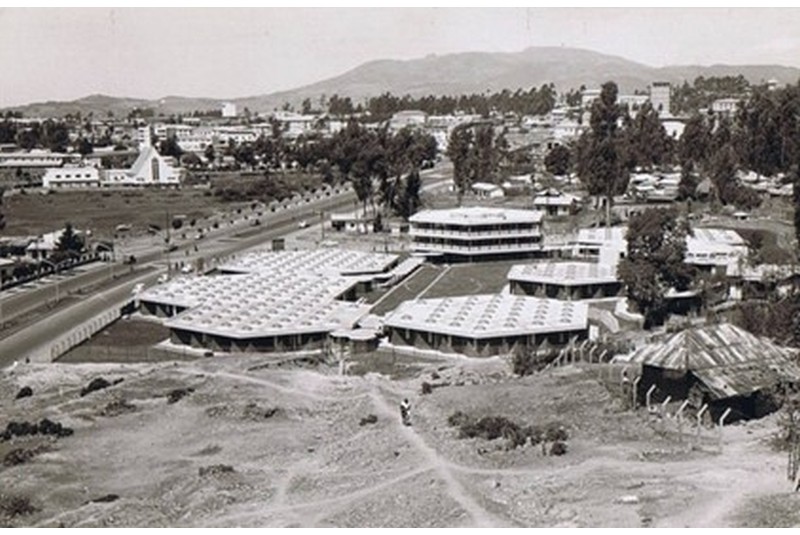
Filwoha Hotel and Spa are in the central part of Addis Abeba and serves the local public and tourists. The building was built on a natural hot spring, that Empress Taitu liked so much. That was the reason for Emperor Menelik II to move the capital, Addis Abeba, from the Entoto Mountains to the valley below (Levin 2016).
The project includes a hundred and thirty thermal baths, ten showers, two swimming pools and a hydrotherapy department. Each building is composed of hexagons grouped around a central public hall. All spaces are lit from above and ventilated via shutters. The main design considerations were traditional thermal baths shape, cell layout, climate, traditional shapes, prefabrication and provision of seating solutions. The aim of Tedros and Enav was to work as much as possible with natural resources. Natural light and a low-tech ventilation system that requires no electricity were an important part of the design. The construction system is based on load-bearing brick walls that support prefabricated concrete pyramid roofs. The prefabrication system saves construction time and reduces costs. The idea was to design a self-sufficient low-rise building with local materials that fit the economy of that time and that defines modernity in other way.
Conclusions
Critical Regionalism, theorized by Kennteh Frampton years after its appearance, forcefully entered Sub-Saharan Africa in the 1950s and became the most balanced attitude for designing new architectural spaces, both public and private, generating a harmonious balance between the progressive ideas of the Modern Movement and the characteristics of the vernacular tradition.
This new modus operandi will continue nowadays with new protagonists, always in search of sustainability. The help of ancestral techniques and materials, demonstrated for more than 50 years, are currently and continue to solve the problems of centuries ago. This design strategy is nothing other than the use of logic in building, beyond new construction techniques. The idea of mixing the ancient with the modern, in other words, those elements that worked long ago and continue to do so with those that have allowed technological progress, contributes to the optimization of resources in an environmental context of health, economic and society that requires the help of all other societies.
Notes
[1] The aim of the book, born from the homonymous exhibition hosted by the Vitra Design Museum in Weil am Rhein, Germany, wanted to express the idea of its curator Manuel Herz, architect and historian, to explore in paper format, the photographic catalogue of African banks or stadiums built starting from the 1950s in the main urban centres of Africa.
Bibliography
AA.VV. (2011) – Pancho Guedes: A Aventura da Arquitectura, o Desafio ao Formalismo. Exposição no Consulado Geral de Portugal em Maputo.
COQUERY-VIDROVITCH C. (2005) – The History of African Cities South of the Sahara. Markus Wiener Publishers, Princeton.
DAINESE E. (2015) – “Le Corbusier’s Proposal for the Capital of Ethiopia”. Torres, J. (ed.), LC2015: Le Corbusier 50 Years Later, UPV Press, Valencia.
DELE J. (2007) – “Nwoko, Demas N.”, Grove Art Online. University Press, Oxford, 8 june.
FATHY H. e SHEARER W. (a cura di) (1986) – Natural Energy and Vernacular Architecture: Principles and Examples, With Reference to Hot Arid Climates. University of Chicago Press.
FRAMPTON K. (1983) – “Towards a Critical Regionalism: Six Points for Architecture of Resistance”. FOSTER H. (a cura di) The Anti-Aesthetic. Essays on postmodern culture. Bay Press, Seattle.
KULTERMANN U. (1969) – New directions in African architecture. G. Braziller.
LE ROUX H. (2004) – “Building on the Boundary. Modern Architecture in the Tropics”. Social Identities. University of the Witwatersrand nº 10. Retrieved, 10 November 2016.
LEVIN A. (2016) – “Haile Selassie's Imperial Modernity: Expatriate Architects and the Shaping of Addis Ababa”. Journal of the Society of Architectural Historians, 75, nº 4.
PRUCNAL-OGUNSOTE, B. (6 november 2016) – “The International Style in Nigeria”. Journal of Environmental Technology. Retrieved.
RUDOFSKY B. (1964) – Architecture without Architects. University of New Mexico Pres, 1987.
TOURÉ D. (2002) – Creaciones arquitectónicas y artísticas en el África subsahariana (1948-1995): Bureaux d’Études Henri Chomette. Harmattan, col. “Artes de otros lugares”, Paris.
HULL R. (1976) – African Cities and Towns Before the European Conquest. W. W. Norton & Company, New York.